CRM Development Cost in India: Custom vs Subscription
What subscription CRMs charge in India, what drives a custom CRM quote, and a 5-year calculator for your own numbers.
Written by Prabhjot Kaur, Product Manager
Reviewed by Mukesh, PRS India software & mobile app development team
30 min read
Written from production. Our articles draw on products we run live and the client work behind them, and are revised as the systems they describe evolve.
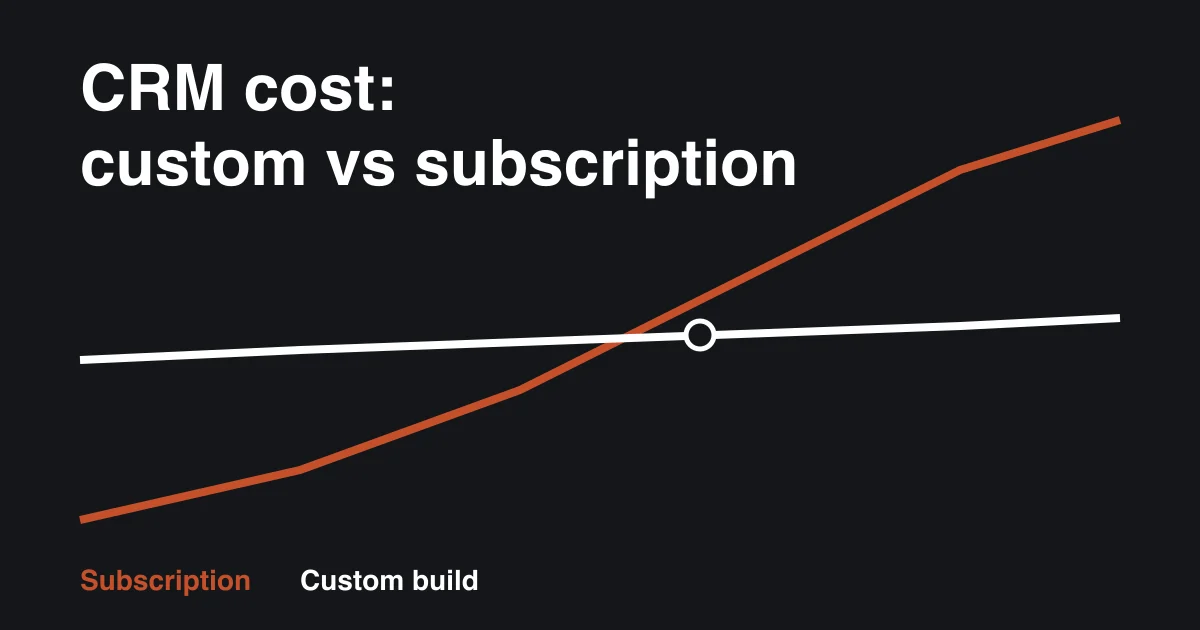
A subscription CRM looks low-priced on day one. You pay a small amount per user per month. The bill grows with every new user and every new year, and it never ends. A custom-built CRM works the other way: you pay one quote at the start, then hosting and support. This guide shows what CRM development cost depends on and what subscription CRMs charge in India. It also gives you a calculator. Use it to compare both over five years with your own numbers.
Short answer
- Subscription cost = users x months x plan price, for as long as you use it.
- Custom build cost = one quote, plus hosting and support each year. It tends to win when users or years grow.
- We do not print a build price here. Quotes differ by scope. Get 2 or 3 written quotes and type them into the calculator below.
How much does CRM development cost in India? There is no fixed price. Five things decide the cost. These are the modules, the user roles and the tools it must connect to, such as WhatsApp or Tally. Android and iPhone apps add to it, and so does moving old data. Use the 5-year calculator below to compare a build with a monthly plan. After one call about your needs, we send a written quote.
CRM price in India: what you pay for a subscription CRM
A subscription CRM, also called SaaS CRM, is software you rent. The vendor hosts it. You pay for each user, each month, and usually get a lower rate if you pay for the full year. This is the usual CRM software price in India that people search for.
The table lists the public price pages of five well-known CRMs. Prices change often, and the Indian page can differ from the global page. Open the source page before you decide. Zoho, Freshsales and Bitrix24 show rupee prices. HubSpot and Salesforce show US dollars on their public pages, so those two rows are in dollars.
| CRM | Plan | Price per user per month | Billing | Source and date seen |
|---|---|---|---|---|
| Zoho CRM | Professional (Standard is ₹800) | ₹1,400 (₹2,100 if paid monthly) | Annual billing. GST is added to the price. | Source: www.zoho.com/crm/zohocrm-pricing.html, checked 28 Nov 2026 |
| Freshsales (Freshworks) | Pro (Growth is ₹749) | ₹3,239 (₹3,889 if paid monthly) | Annual billing. The page does not say if GST is included. | Source: www.freshworks.com/crm/pricing/, checked 17 Nov 2026 |
| HubSpot | Sales Hub Starter. Free CRM is $0 for up to 2 users. | Shown in US dollars per seat per month. The amount changes with monthly or yearly billing, so check the page. | US dollars, no rupee price on the page. Tax is added to the price. | Source: www.hubspot.com/pricing/sales, checked 17 Nov 2026 |
| Bitrix24 | Standard, for 50 users in total (Basic is ₹1,910 for 5 users) | ₹4,790 a month for the whole plan (₹6,890 if paid monthly) | Annual billing. The page says GST may apply and does not say if it is included. | Source: www.bitrix24.in/prices/, checked 17 Nov 2026 |
| Salesforce | Starter Suite (Pro Suite is $100, billed annually) | $25 per user per month, in US dollars | Billed monthly or annually. The India page shows no rupee price and no tax note. | Source: www.salesforce.com/in/sales/pricing/, checked 17 Nov 2026 |
Two notes when you read these pages. First, check if the price is per user or per plan; Bitrix24, for example, sells plans with a user limit. Second, GST is charged on software subscriptions in India. Check the GST portal for the current rate, and see if the vendor page shows prices with or without GST.
What a subscription does not include
The plan price covers the plan's features for that user. Many things that a real sales team needs sit outside it. Check each one on the vendor's page, or ask the vendor in writing.
- Higher tiers for core features. Workflow rules, custom fields, roles and reports often start only on the second or third plan.
- Storage limits. Files, call recordings and attachments can have a cap per user or per account.
- WhatsApp and calling. Message fees from the WhatsApp provider and call charges from the telephony provider are paid extra.
- API limits. Connecting the CRM to your website, accounts or another system may have a daily call limit.
- Test environment. A sandbox to try changes before using them live is often on a higher plan.
- Onboarding and training. Some vendors charge a setup fee or sell paid implementation help.
- Growth. Every new salesperson adds a seat. Ten users today and forty in year four is a four times bigger bill.
None of this makes a subscription a bad choice. It means the plan price alone is not the cost. Put these extras in the "add-ons per month" box of the calculator.
CRM development cost: what drives a custom CRM quote
We do not publish a number for custom CRM development, and neither should you trust one without your scope. The same word "CRM" can mean a lead list for three people. It can also mean a full system with apps, partners and reports for three hundred. The table lists what moves a custom CRM cost and what to ask each developer.
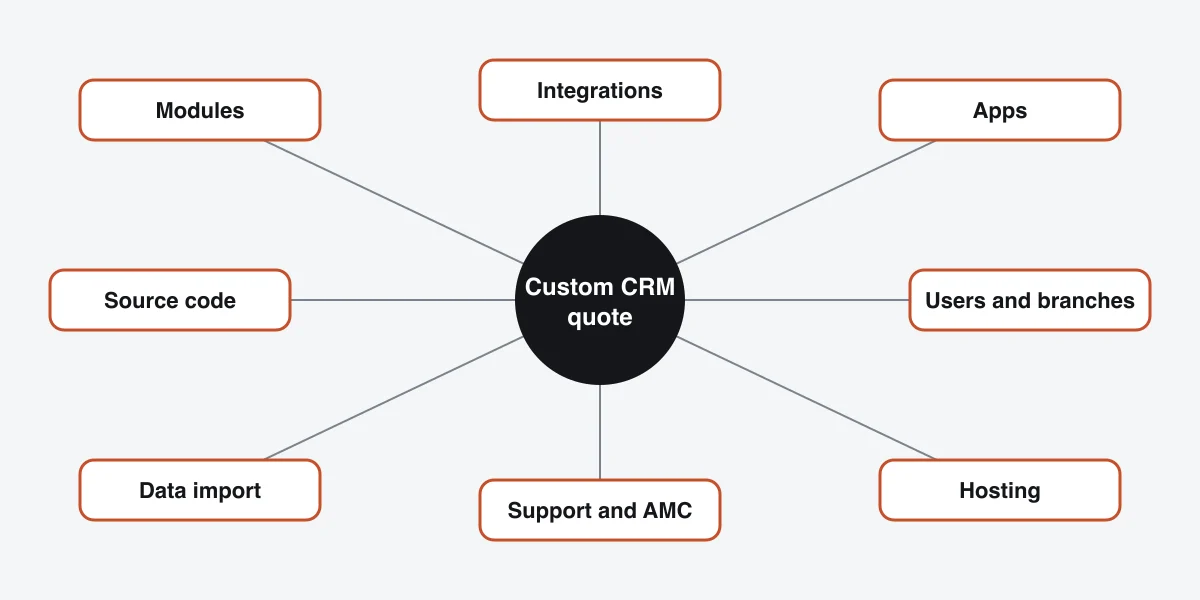
| Cost driver | Why it moves the quote | Ask the developer |
|---|---|---|
| Modules | Leads, pipeline, quotes, invoicing, tasks and reports are each work to build and test. | Which modules are in this quote, and which are not? |
| Roles and permissions | The more roles (sales, manager, partner, admin), the more rules to build and test. | How many roles are included, and can I add more later? |
| Integrations | WhatsApp, calling, IndiaMART, 99acres, email, Tally, Zoho Books and payment gateways each need their own work. | Which integrations are listed by name? Who pays the provider's fees? |
| Apps | A web-only CRM is one build. An Android and iPhone staff app is another, and a customer or partner app is a third. See what drives mobile app cost. | Are the Android and iPhone apps included? Are they one codebase? |
| Data import | Moving leads from Excel or an old CRM needs field mapping and clean-up. | How many records, and who cleans the data? |
| Users and branches | More branches mean more settings, roles and reports. User count affects hosting size more than build effort. | Is there a user limit in the licence? |
| Reports and dashboards | Each custom report is designed, built and checked against your data. | How many reports are ready-made, and what does a new one cost? |
| Hosting | Your own server, your own AWS account, or hosted by the developer. Each has a different yearly cost and a different owner. | Whose name are the server and domain in? |
| Security and compliance | Audit logs, access control and consent records take time. The Digital Personal Data Protection Act, 2023 covers customer data. | What is built in for audit and data export? |
| Support after go-live | Fixes, updates and help for your team. Offered as a free fix period and then a yearly plan (AMC). | What does the support period cover, and for how long? |
| Source code | Handing over the code is a decision in the contract, not a default. | Do I get the full source code in writing? |
Our own work follows this list. We set the CRM up on your own AWS account or server, or host it for you. We hand over the full source code. We take daily backups and offer an optional AMC. The CRM comes with 30 ready reports, and we add the ones your business needs. We read your scope and send a written quote. See our CRM development service.
Low quote vs complete quote
Two quotes can differ by a lot and still describe different products. Before you compare the totals, compare what each one counts. A low quote that leaves out the apps, the hosting or the source code will cost more later, as separate bills. Put every quote in the same shape: build, apps, integrations, hosting per year, support per year. That is exactly what the calculator asks for.
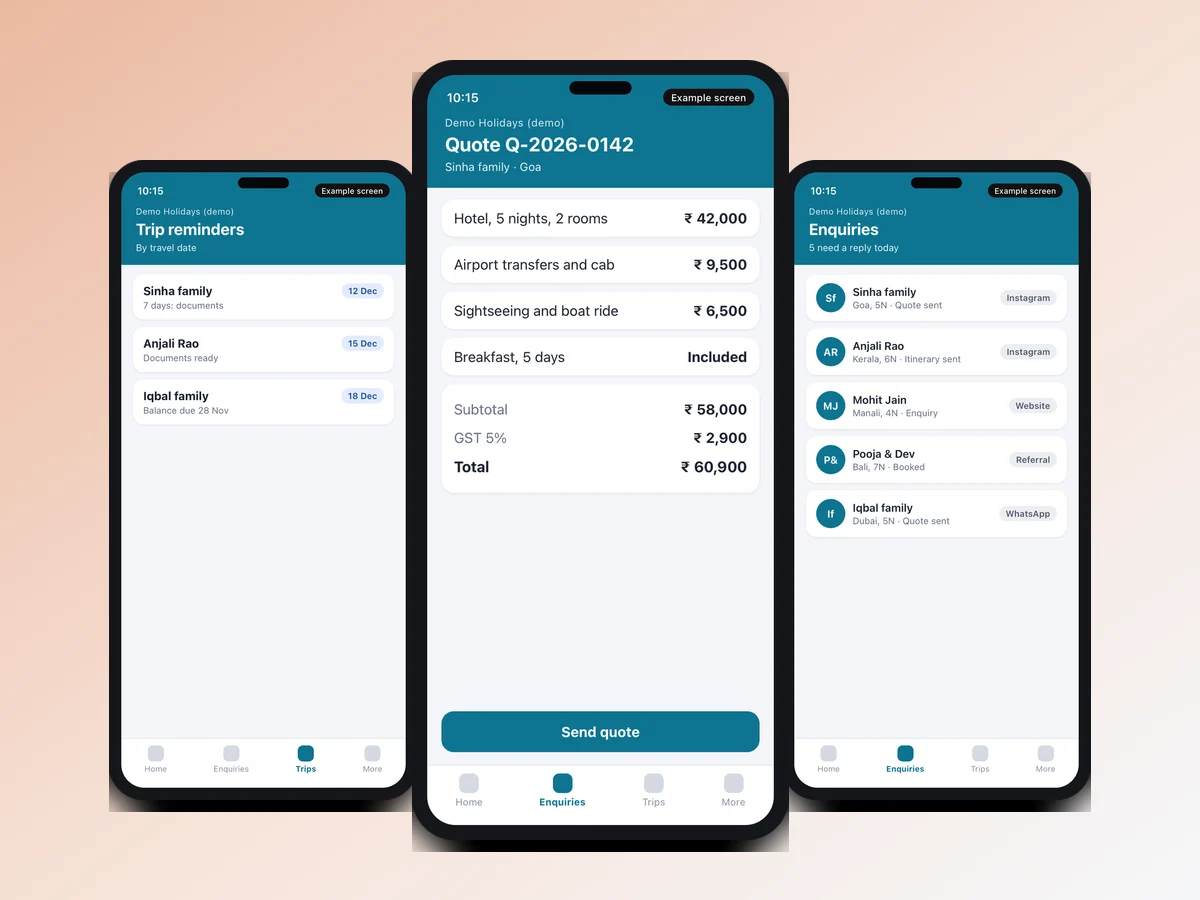
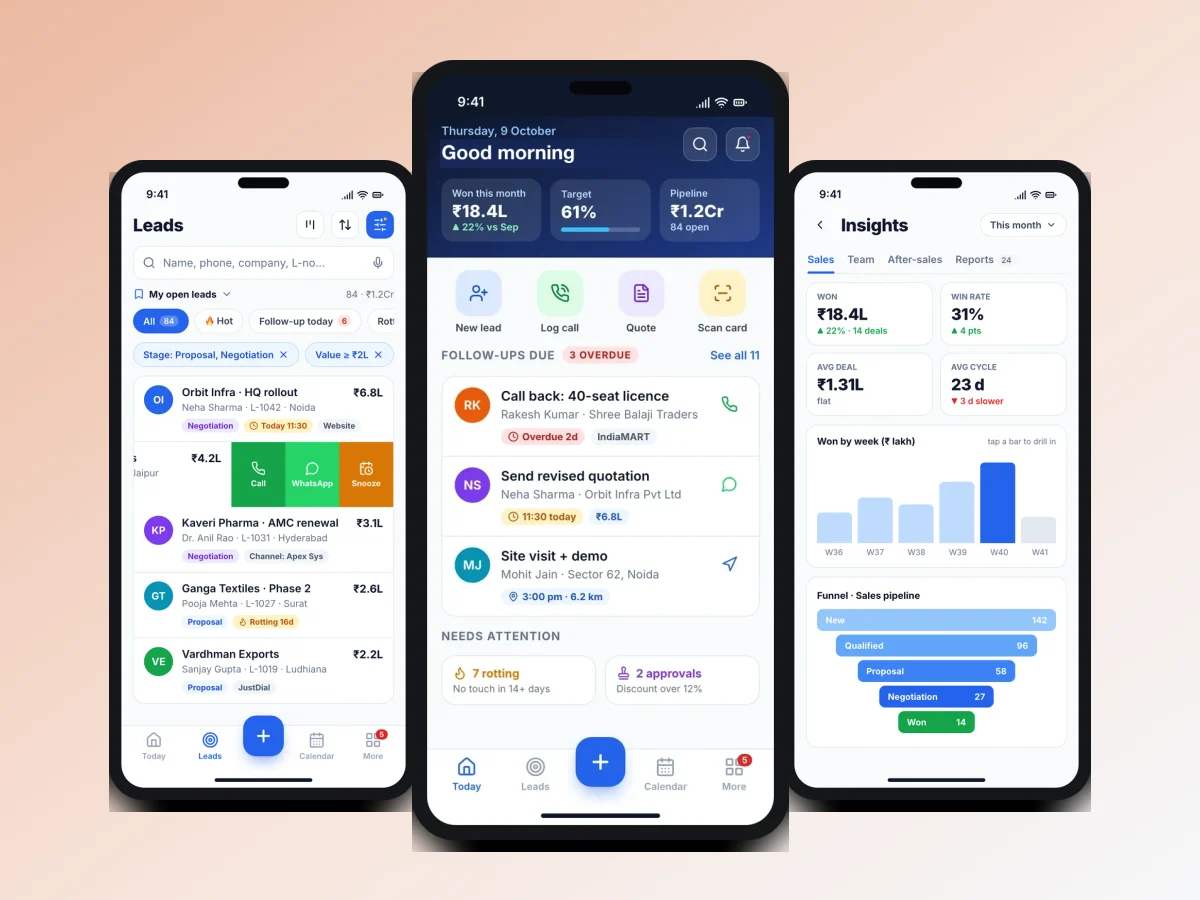
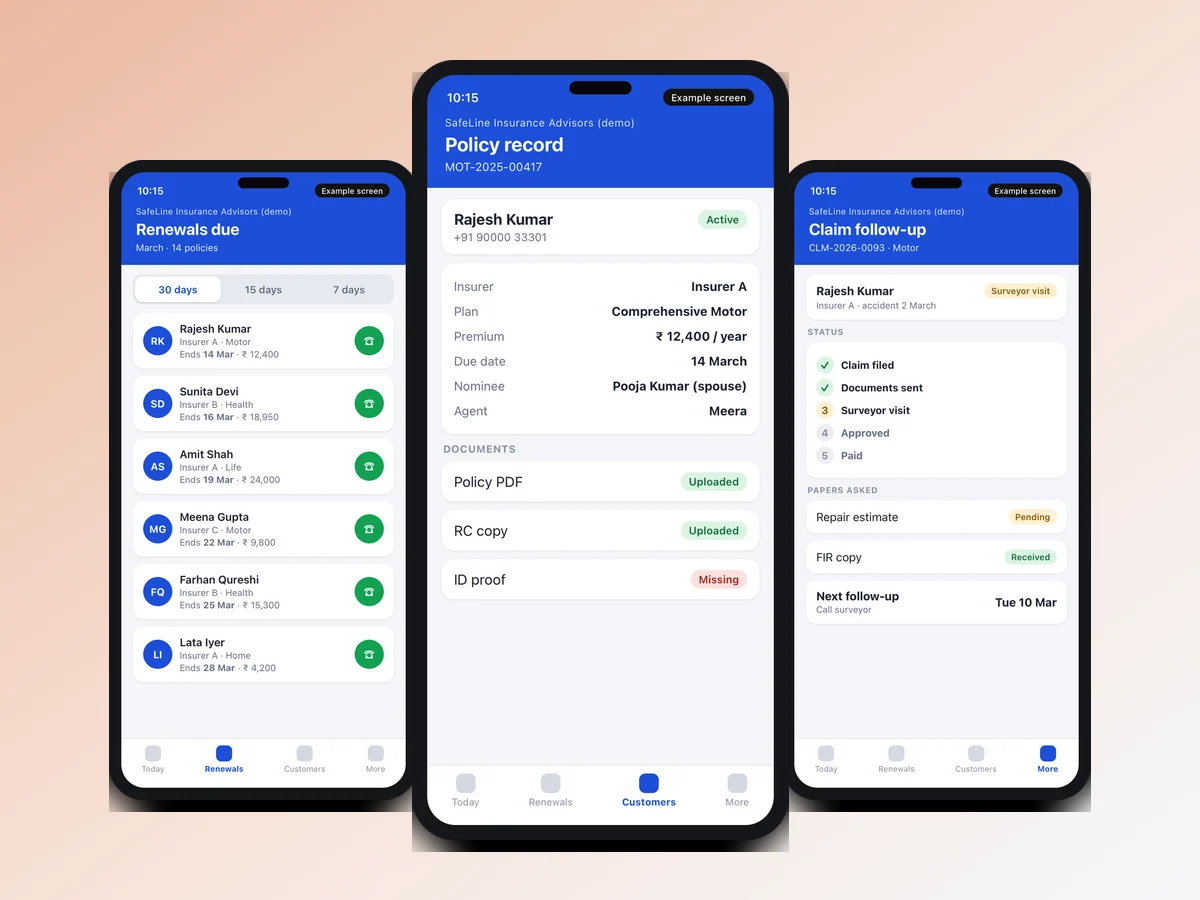
Each screen in a custom CRM is work that goes into the quote. These three are the base most teams start with: a lead list, a pipeline and follow-ups.
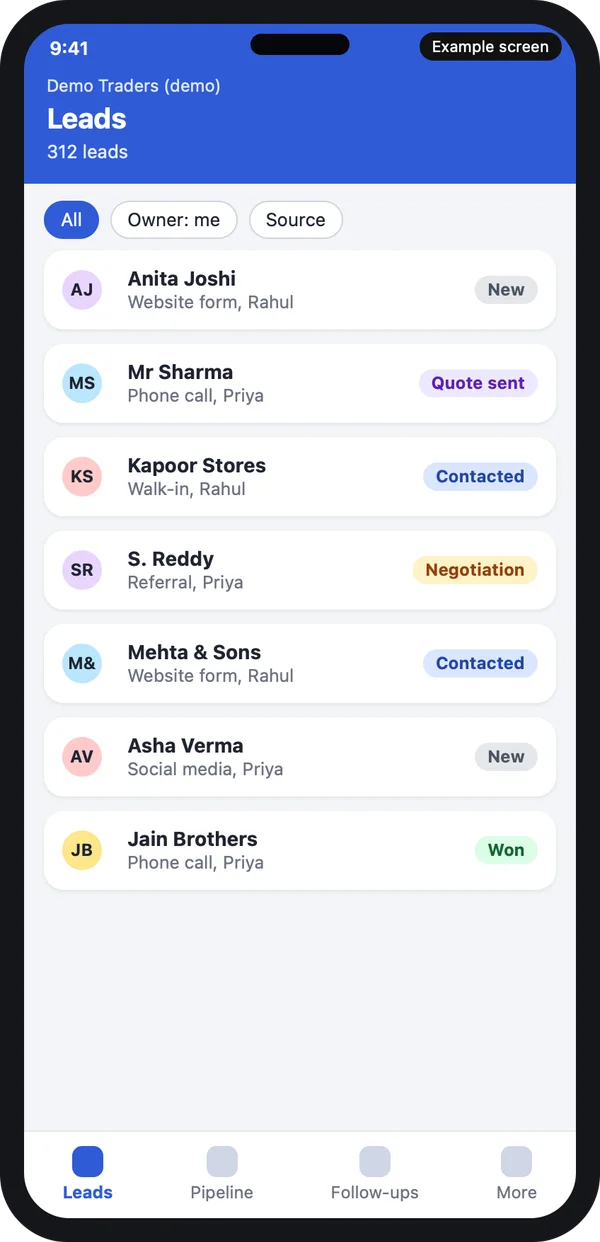
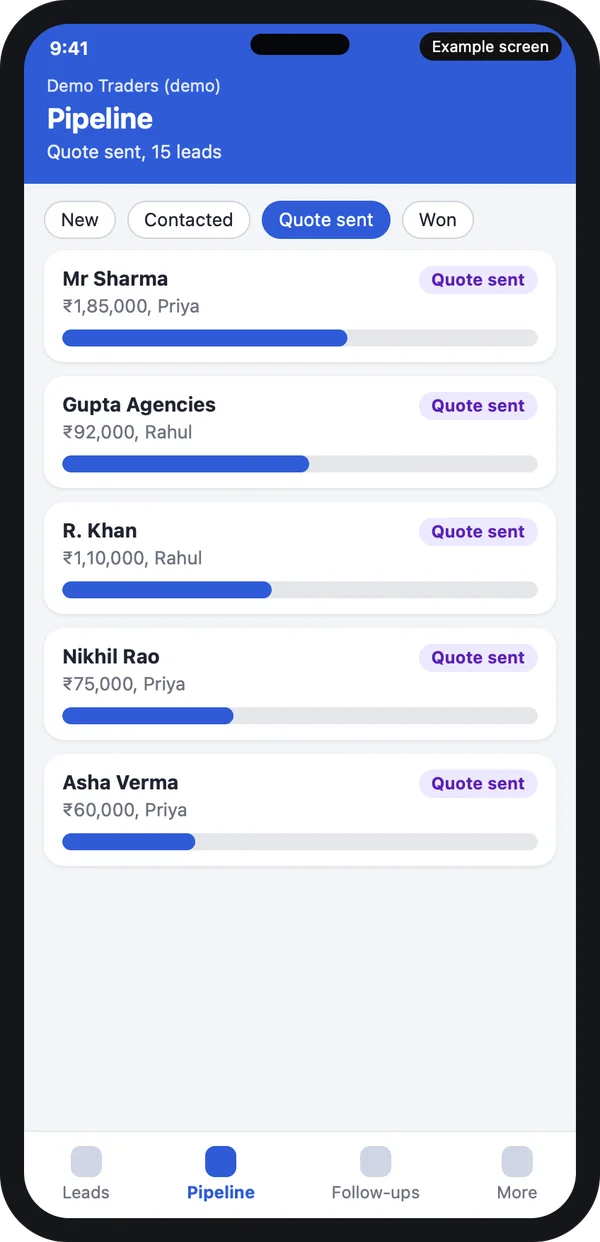
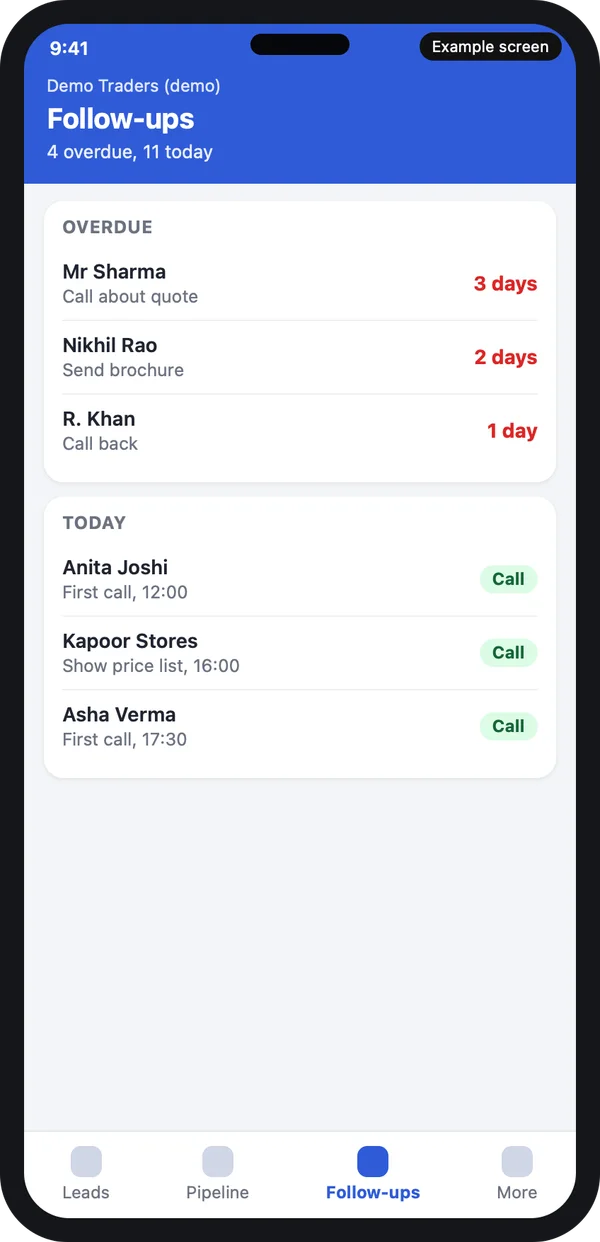
Example design with demo data.
CRM development cost by business size: what changes
A CRM for five people in one office is a small job. A CRM for ten branches and their partners is a much bigger one. The table shows what grows as the business grows. It shows work, not money.
| What changes | Small team (one office, a few users) | Growing team (two or three teams) | Multi-branch (many branches or partners) |
|---|---|---|---|
| Modules | Leads, follow-ups and one pipeline | Adds quotes, tasks and team targets | Adds branch pipelines, partner logins and approvals |
| Roles | Owner and sales staff | Sales, manager and admin | Branch head, region head, partner and auditor |
| Integrations | Website form and WhatsApp | Adds calling, email and accounts, such as Tally | Adds ERP, many lead portals and one login for all tools |
| Apps | Web, maybe one staff app | Android and iPhone staff app | Staff app plus a partner or customer app |
| Reports | A few ready-made reports | Reports by team and lead source | Reports by branch, region and partner, sent by email |
| Data import | One Excel sheet | An old CRM plus sheets from each team | Many sources, with the same lead in many branches |
| Hosting | One small server | A bigger server with daily backups | A separate test server and backups in a second place |
| Testing | The owner tests it | Each team tests its own part | A test plan for each branch and role |
A small team often does fine with a monthly plan. A placement agency with its own stages is a typical growing team; see recruitment CRM software development. Multi-branch firms also need a view of each branch. See CRM dashboard design and development for what those screens show.
Hidden costs after the quote
A build quote pays for the work to make the CRM. Some costs come later, and they come every month or year. Ask about each one before you sign. Then put them in the hosting and support boxes of the calculator.
| Cost item | What it pays for | Who you pay | How often |
|---|---|---|---|
| Hosting | The server that runs your CRM online | Cloud provider, or the developer if they host it | Monthly or yearly |
| Domain and SSL | Your CRM web address and the lock sign in the browser | Domain seller | Yearly |
| Data backup | Daily copies of your data, kept in a second place | Cloud provider | Monthly |
| SMS credits | OTP, reminder and alert texts | SMS provider | Per message |
| WhatsApp messages | Template messages to leads and customers | WhatsApp Business provider | Per message |
| Email sending | Quotes, reminders and bulk mail | Email service | Per mail or monthly |
| Calling | Click-to-call, call logs and recordings | Telephony provider | Per minute or monthly |
| Maps | Address search and field staff location | Maps provider | Per use |
| Google Play account | Publishing the Android app | US$25, one time. Source: Google Play Console Help, read 28 Nov 2026 | |
| Apple developer account | Publishing the iPhone app | Apple | 99 USD a year, in local currency where available. Source: Apple Developer enrollment page, read 28 Nov 2026 |
| Support or AMC | Fixes, updates and help after the no-charge fix period | Developer | Yearly |
| Changes | New fields, reports or screens after go-live | Developer | Each change |
| Training | Teaching new staff to use the CRM | Developer or your own team | Each new batch |
| Your own time | Testing and feedback by your team | Your team | During the build |
The two app store fees are the fees Google and Apple publish. They are not our prices. Fees for SMS, WhatsApp and calls go to the provider, not to the developer. A WhatsApp CRM sends messages at many steps of a sale. Get the provider's rate card in writing.
Custom CRM vs subscription: 5-year cost calculator
Fill in your numbers. We do not fill in the build quote for you. The left side is the subscription you are considering. The right side is a build quote you hold in writing. The result appears once you enter a build quote. Nothing you type is sent or saved; the maths runs in your browser.
If the calculator does not load in your browser, use the table below. It shows the same maths with letters in place of numbers. These are not prices.
| Year | Subscription, running total | Custom build, running total |
|---|---|---|
| 1 | (U1 x P x 12) + (A x 12) + O | Q + H + S |
| 2 | Year 1 total + (U2 x P x 12) + (A x 12) | Year 1 total + H + S |
| 3 | Year 2 total + (U3 x P x 12) + (A x 12) | Year 2 total + H + S |
| 4 | Year 3 total + (U4 x P x 12) + (A x 12) | Year 3 total + H + S |
| 5 | Year 4 total + (U5 x P x 12) + (A x 12) | Year 4 total + H + S |
U is users in that year. P is the price per user per month. A is add-ons per month. O is the one-time onboarding fee. Q is the build quote (with apps and integrations). H is hosting per year. S is support per year. If support is free in year 1, leave S out of year 1. The break-even year is the first year in which the build total is lower than the subscription total.
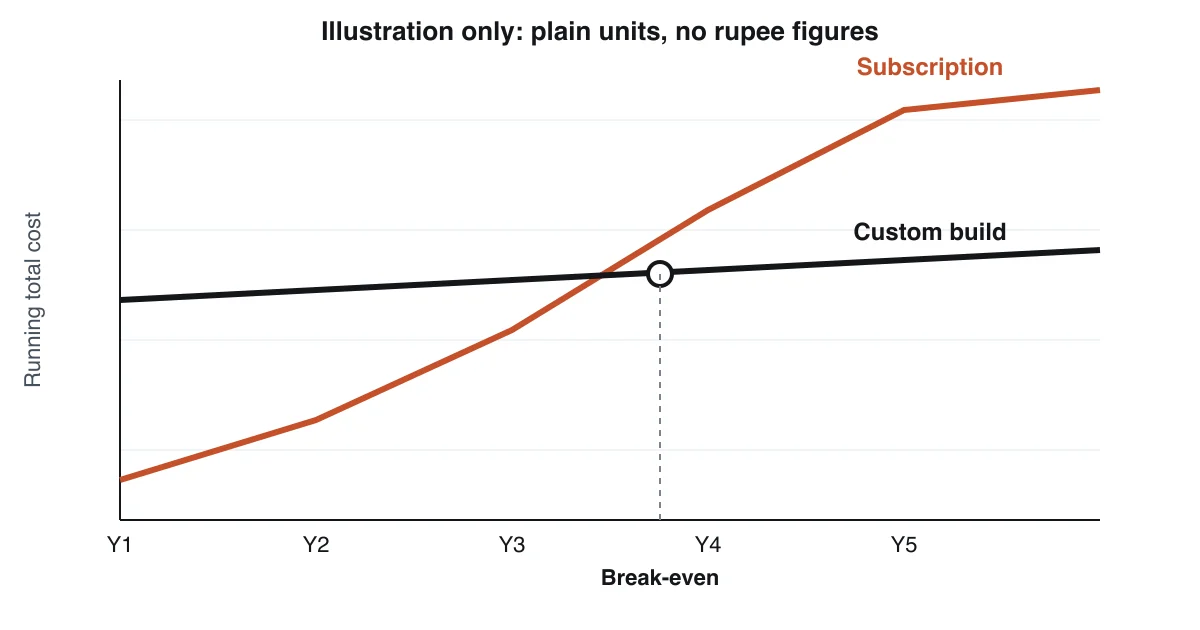
The same sum on paper or in a sheet
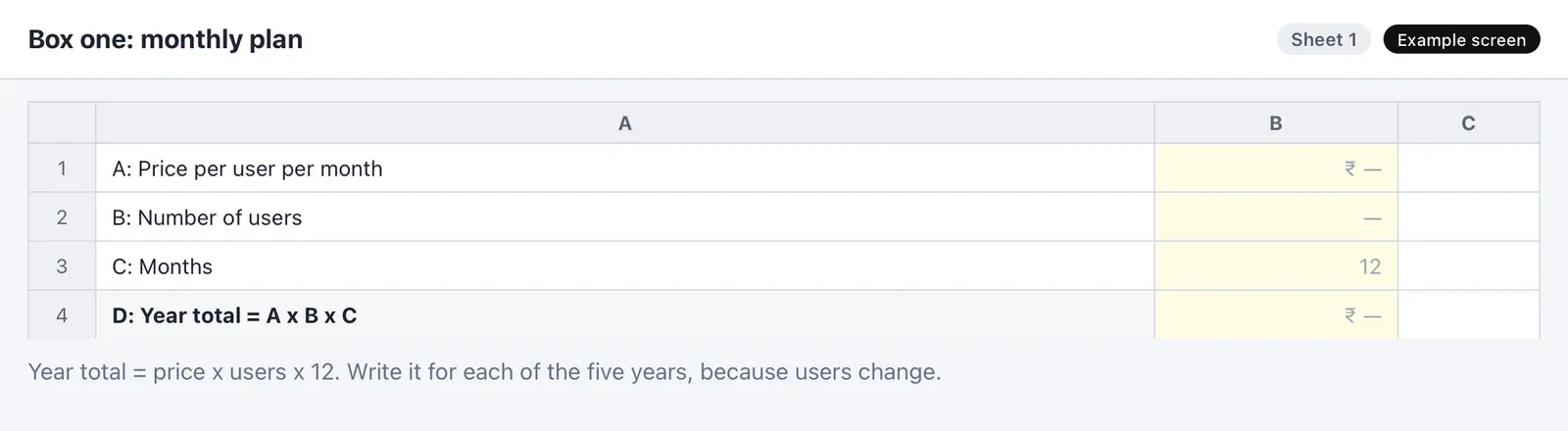
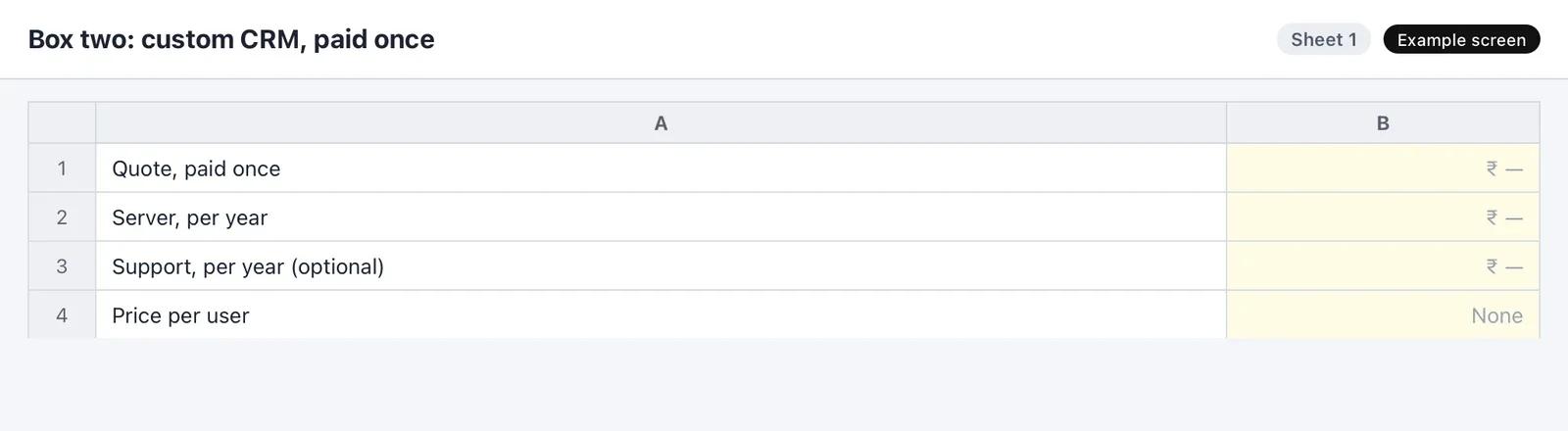
If you prefer a spreadsheet, set it up in three parts. Box one is the monthly plan. Box two is the custom quote. The last part adds up both, year by year.
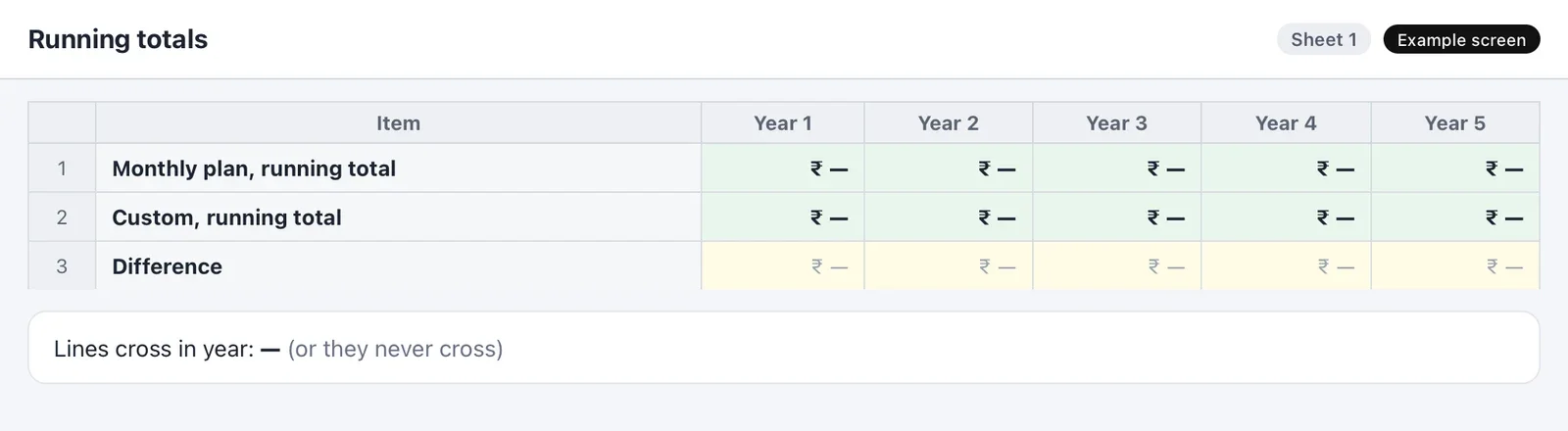
Worked example: a 25-user sales CRM, line by line
Here is a made-up example. It shows how a CRM quote is put together, one line at a time. It counts weeks of work, not money. Your own list will be different.
The business: a building-material trader with 20 sales staff, 4 managers and 1 admin. Leads come from the website, IndiaMART and phone calls. The sales staff visit shops and sites every day.
| Line item | What is in it | Count | Example weeks of work |
|---|---|---|---|
| Leads and follow-ups | Lead list, lead source, reminders, duplicate check | 25 users | 2 to 3 |
| Pipeline and quotes | Own stages, quote PDF, manager approval | 25 users | 2 to 3 |
| Roles | Sales, manager and admin; each sees only their own data | 3 roles | 1 |
| Staff app | Android and iPhone from one codebase, visit check-in with location | 20 field staff | 3 to 4 |
| Integrations | Website form, IndiaMART leads, WhatsApp messages | 3 | 2 to 3 |
| Reports | Leads by source, deals won by staff, overdue follow-ups | 8 reports | 1 to 2 |
| Data import | Leads from Excel, cleaned and mapped | 1 import | 1 |
| Testing and training | Team tests on real cases, then two training sessions | 25 users | 1 to 2 |
| Go-live | Live server, backups, Play Store and App Store publishing | 1 | 1 |
Some lines run at the same time. So the project takes fewer calendar weeks than the rows add up to. The staff app here works like a field sales CRM mobile app, with visits and check-ins. To turn this list into a quote, a developer prices each line. Ask every developer to quote in these same lines. Then the totals are fair to compare in the calculator above.
What the first version (MVP) of a CRM includes
MVP means the smallest version your team can use for real work. It is the first phase, not the last. Build it, use it for a few weeks, then add what the team asks for.
In the first version
- Lead list with source, owner and status
- Follow-up reminders for today and for overdue leads
- One pipeline with your own stages
- Notes and a call log on each lead
- Two or three roles, such as sales, manager and admin
- Import of your current leads from Excel
- A few reports: leads by source, deals by stage, work by staff
- Web access that also works on a phone screen
Usually left for phase 2:
- Android and iPhone apps
- WhatsApp, calling and email links
- Quotes, invoices and payment links
- A partner or customer portal
- Workflow rules and approvals
- AI features, such as lead scoring or call summaries
- Custom dashboards
Not sure what a CRM must hold? Start with what a CRM is and what it does. Then mark each feature as "day one" or "later".
CRM development timeline by phase
Time is the other half of cost. The table shows the usual phases of a first version. The weeks are effort ranges for a typical first version, not a promise. A large scope or slow feedback adds weeks.
| Phase | What happens | Typical weeks |
|---|---|---|
| Discovery | We study your sales steps, roles, reports and data. We write the scope. | 1 to 2 |
| Screen design | Clickable screens of each page. Your team says yes or asks for changes. | 1 to 2 |
| Build | Web admin, staff app if any, database and integrations. | 4 to 8 |
| Data import | Clean, map and load your old leads, then check the counts. | 1, often during the build |
| Testing | Your team tests real cases. We fix the bugs found. | 1 to 2 |
| Training and go-live | Train each role, move to the live server, publish the apps. | 1 |
| Fix period | Bugs found in daily use are fixed. | As agreed in the contract |
Discovery and screens matter most. A clear scope stops rework, and rework is what costs the most. Clickable screens are part of our UI and UX design work. You can also see how our projects run, step by step.
How to reduce CRM development cost
Most savings come from building less at first and deciding early. These steps keep a quote small without cutting what your team needs.
- Start with one team. Build for the sales team first. Add service, accounts or partners later.
- Build the first version only. Use the MVP list above. Leave the extras for phase 2.
- Start from a ready-made base. Leads, roles, login and reports already exist in a base CRM. You pay for your changes, not for every screen.
- Add integrations one at a time. Start with the one that brings the most leads. Add calling or accounts once the team uses the CRM daily.
- Write your needs on one page. List your stages, fields, roles and reports. Unclear needs cause rework.
- Clean your data first. Remove duplicates and fill blanks in your Excel sheet before the import.
- Use one codebase for both apps. One Flutter app runs on Android and iPhone. That is one build, not two.
- Start on a small server. Move to a bigger one when users grow. See cloud-based CRM development.
- Give feedback on time. Slow replies stretch the project, and the team still has to be paid.
When a subscription CRM is the right choice
Do not build a CRM when a subscription already fits. A subscription is the better choice when:
- You have fewer than about 5 to 10 users and do not expect many more.
- Your sales process is a standard one: lead, call, quote, close.
- You need to start this week, not in a few weeks.
- You only need email and a calendar connected, nothing else.
- You do not need a staff app with your own stages, or your own branded app.
In that case, run the calculator with a low build quote. If the subscription is lower for five years, the numbers say the same thing.
When a custom CRM costs less over 5 years
A custom CRM is likely to cost less over time when the subscription bill grows faster than your build cost. These are the usual signs:
- Many users. The subscription bill rises with every seat. A custom CRM does not charge per user.
- Your own process. Tenders, channel partners, site surveys, renewals or subsidy steps do not fit a standard pipeline.
- Your own customer app. You want your brand on the app that customers or partners use.
- Your data on your server. You want the database on your own AWS account or server, with daily backups.
- Locked integrations. The subscription keeps the integration you need on a higher plan.
- Reselling. You want to give the CRM to your own clients. See white label CRM for agencies and resellers.
We build such CRMs in Laravel for the web side and Flutter for the Android and iPhone apps. You can see the projects we have delivered.
There are also other ways to avoid per-user fees. An open-source CRM has no licence fee, but setup, hosting and upgrades are yours. A white-label CRM is a ready CRM that you run under your own brand. Low-code builders charge per user or per app. For each, put the extra cost in the calculator.
Customise Zoho, Salesforce or Odoo vs build your own CRM
There is a third path between renting and building. You take a CRM product and pay a developer to change it. Each path fits a different kind of business.
| Path | When it fits | What to watch |
|---|---|---|
| Use a subscription as it is | Standard sales steps, few users, and you need to start now | The bill grows with each user. Core features may sit on higher plans. |
| Customise Zoho or Salesforce | You like the product but need extra fields, rules or links to other tools | You still pay per user. Developer hours and add-on apps are added to the plan. Your plan may limit API calls. |
| Customise Odoo or another open-source CRM | You want to avoid per-user licence fees and can run the server | Check which edition you need, as some editions charge per user. Your changes may need rework at each new version. |
| Build your own | Your own process, many users, your brand on the apps, data on your server | More cost at the start. You need a developer for support. Get the source code in writing. |
Run each path through the calculator. For a customised subscription, keep the per-user price and put the developer's hours in the setup box. For a build, enter the quote you hold. Businesses with dates and visits outgrow a standard pipeline fast. Two examples are renewals in an insurance CRM and site visits in a real estate CRM.
Data migration from Excel or an old CRM
Your old leads are worth moving. But moving them is real work, and many quotes leave it out. Plan it in five steps.
- Export. Download leads, contacts, deals and notes as CSV files from the old CRM or sheet.
- Clean. Remove duplicates, fix phone number formats and fill in missing lead owners.
- Map. Match each old column to a field in the new CRM. Decide what to do with unused columns.
- Test import. Load a small sample first. Check names, stages and dates on screen.
- Full import and count check. Load everything. Compare the record count with the old system.
Phone numbers cause the most trouble. "+91", spaces and a 0 at the start make one person look like two. Ask who does the cleaning, you or the developer. Ask how many records the quote covers. Keep the old system open, read-only, for a few weeks in case something was missed.
India vs USA: why CRM development rates differ
The same CRM needs the same screens, tests and checks in both countries. For the same scope, the hours are similar. What differs is the rate charged for each hour. Two published figures show the gap.
These are third-party figures, not our prices. The US figure is the yearly pay of one employee, not an agency rate. An agency rate also covers office, tools, managers and profit.
- Pay and living costs. Salaries and living costs are lower in India, so hourly rates are lower.
- Time zone. An Indian team works while the USA sleeps. Agree on a few hours of overlap for calls.
- Billing. Indian buyers get a GST invoice in rupees from an Indian developer.
- What does not change. Scope, testing, source code and support still decide the total.
A low rate with a loose scope can still cost more in the end. Compare quotes line by line, as in the worked example above.
Data privacy: what the DPDP Act 2023 means for your CRM
A CRM holds names, phone numbers and notes about people. In India, the Digital Personal Data Protection Act, 2023 sets duties for anyone who handles such data. Build these duties into the CRM from day one. Adding them later costs more.
| What the Act asks | What the CRM should do |
|---|---|
| Give a notice when you ask for consent (Section 5) | Show what data you collect and why, on every lead form |
| Make withdrawing consent no harder than giving it (Section 6) | Store when and how each person agreed. Add a one-step opt-out. |
| Take reasonable security safeguards (Section 8) | Role-based access, a log of who viewed or exported data, and daily backups |
| Tell the Data Protection Board and each affected person about a data breach (Section 8) | Alerts and logs that show what was exposed and whose data it was |
| Erase data when consent is withdrawn or the purpose is over, unless a law needs it kept (Section 8) | A delete option, plus rules to remove old leads |
| Give a person a summary of their data on request (Section 11) | Export one person's record in a few clicks |
| Correct or erase data on request (Section 12) | Edit and delete, with a record of each change |
| Offer a way to raise a complaint (Section 13) | A contact for data complaints, tracked like a support ticket |
The penalty for failing to take reasonable security safeguards may extend to ₹250 crore. Source: DPDP Act, 2023, the Schedule. This is a plain summary, not legal advice. Check the Act and its rules with your lawyer.
CRM maintenance after go-live
A CRM is not finished on launch day. Phones update, browsers change and your team asks for new reports. Plan for this work from the start.
Ask what the no-charge fix period covers and for how long. After that, an AMC is a yearly plan for these jobs. Get response times in writing: how soon they reply, and how soon they fix. We can host your CRM on cloud servers we set up and manage. Then server updates and backups can be part of the AMC.
How to compare quotes: a 10-point checklist
Use this list on every written quote. If a point is missing, ask for it before you compare totals.
- Scope document. A written list of what is being built, with screens or a prototype.
- Modules. The exact modules and reports in the price.
- Apps. Web, Android and iPhone, and whether each one is included.
- Source code. Do you get the full source code, and when?
- Hosting and domain. Whose name are the server, the domain and the app store accounts in?
- Fix period. How long are bugs fixed at no charge after go-live?
- Change requests. The rate or process for work outside the scope.
- AMC terms. What the yearly plan covers, what it costs and how to stop it.
- Data export. Can you export all your data at any time?
- Payment milestones. What you pay at each stage, and what you see before each payment.
FAQ
What is the price of CRM software in India?
Subscription CRMs list a price per user per month, often lower when billed annually. The table above shows each vendor's public price with the date it was read. Add GST and any add-ons, then multiply by your users and months.
How much does it cost to develop a CRM?
It depends on modules, integrations, apps, users, hosting and support. We do not publish one number because quotes differ by scope. Use the cost-driver table, collect 2 or 3 written quotes and enter them in the calculator.
Can I build my own CRM?
Yes. You can build it with your own developers, hire a development company, or start from a ready-made base. Begin with a first version for one team. Add apps and integrations once the team uses it daily.
How much does it cost to implement a CRM?
Implementing means setup, data import, training and integrations, not only the software. For a subscription, add these to the plan price. For a custom CRM, ask for each one as a separate line in the written quote.
How long does CRM development take?
A first version for one team usually takes a few weeks to a few months. It depends on modules, apps, integrations and how fast your team gives feedback. The timeline table above shows each phase.
Is a custom CRM cheaper than Zoho CRM or Salesforce?
It depends on your users and years. A subscription grows with every user and month. A build is mostly one quote plus yearly hosting and support. The calculator shows the break-even year for your numbers.
How much is Zoho CRM per month?
Zoho's pricing page lists Zoho CRM Standard at ₹800 per user per month billed annually, or ₹1,300 billed monthly. Professional is ₹1,400 billed annually, or ₹2,100 billed monthly. Source: Zoho CRM pricing page, read 28 Nov 2026. Prices change, so check the page and its GST note.
What is included in a CRM subscription price?
The features of that plan, for each user. Storage, calling, WhatsApp, API use, a test environment and onboarding are often extra. Check the plan page.
Do I own the source code of a custom CRM?
Only if the contract says so. Ask for it in writing. We hand over the full source code of the CRM we build for you.
What recurring costs does a custom CRM have?
Hosting, provider fees for SMS, WhatsApp and maps, support or AMC, and yearly app store accounts. Put them in the hosting and support boxes of the calculator.
Can I start with a subscription and move to a custom CRM later?
Yes. Export your leads and customers as CSV files, then ask the developer to import them. Plan the field mapping early so that no data is lost.
Can I start with a small CRM and add features later?
Yes. That is the usual way. Build the first version for one team, then add apps, integrations and reports in phases. Ask the developer to plan the code so that new modules can be added.
What usually gets left out of a CRM quote?
Often left out are data cleaning and import, staff training and app store accounts. So are SMS and WhatsApp fees, hosting, backups and later support. Ask the developer to mark each one as included or not included.
Why is CRM development cheaper in India than in the USA?
The work is similar, but hourly rates differ, mainly because pay and living costs differ. A 2026 price guide by FullStack Labs puts India agency rates at roughly $25–$75 per hour. Source: FullStack Labs price guide. Scope still decides the total.
Related guides
Written by
Prabhjot Kaur · Product Manager
Product Manager at PRS India. Turns what a client needs into a screen-by-screen plan for the app, and checks every release against that plan before it goes out.