Real Estate CRM Software Development in India
We build your own real estate CRM: portal leads on WhatsApp, site visits, unit booking, channel partner commission and payment reminders. Web, Android and iPhone, your brand.

Written from production. Our articles draw on products we run live and the client work behind them, and are revised as the systems they describe evolve.
A real estate team does not lose money on the lead. It loses money after the lead. A portal enquiry that waited in an inbox for three hours. A buyer registered by two brokers. A flat promised to two people on the same afternoon. A demand letter that went out a month late. A real estate CRM keeps all of this in one place, from the first enquiry to the last instalment.
Ready-made CRMs are built for general sales. They stop at "deal won". In property, the sale is only the start of 4 to 18 months of payments. That is why many developers and brokerages now ask for their own real estate CRM software development. It follows their projects, units, payment plans and partners, under their own brand. It comes with a phone app for the site team. This guide shows what such a CRM must do, and how PRS India builds it. See also our page on real estate software development.
Key takeaways
- In property, a lead is not a contact. It is a buyer who moves to a site visit, a flat, a booking and then many payments.
- Most losses come from six places. These are late first calls, duplicate registrations, double-sold units, late demand letters, missing RERA details and lost partner credit.
- Your CRM needs seven parts: portal leads with WhatsApp, site visits, unit booking, RERA details, partner commission, demand letters and daily reports.
- A custom real estate CRM from PRS India: starting from ₹3,00,000. The final cost depends on projects, payment plans, partner levels and apps.
What is a real estate CRM, and what must it do that a normal CRM does not?
CRM means customer relationship management. In simple words, it is one list of all your buyers and leads, with the full history of each one. A real estate CRM software is the same idea, set up for how property is sold in India.
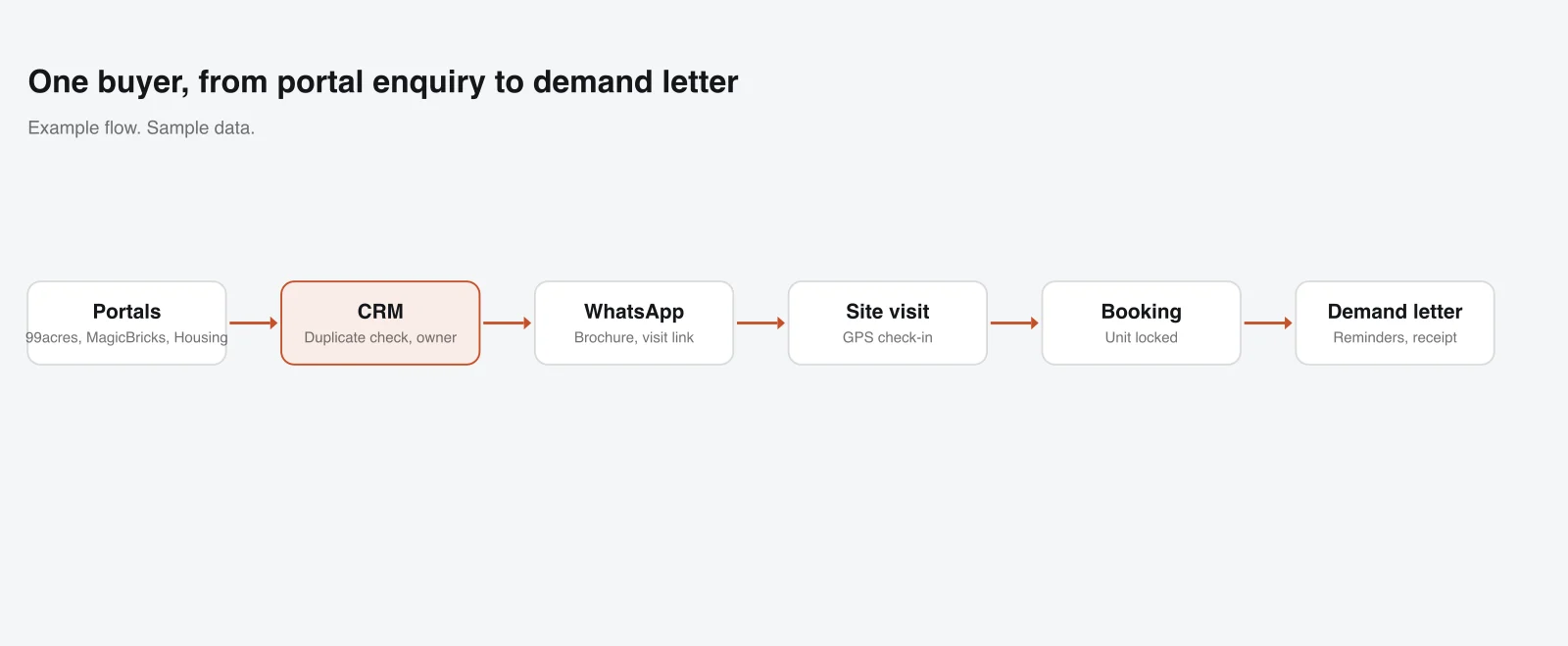
The role of a CRM in real estate is bigger than calling leads. One buyer moves through a chain: enquiry, call, site visit, a chosen flat, booking, agreement, registration and many payments. Each step has a person, a date and a document. A normal CRM tracks a name and a deal value. A real estate CRM tracks the flat, the payment plan and the broker who brought the buyer.
The problem
Where real estate teams lose leads and money
The same six leaks show up in most sales offices.
| Where it leaks | What happens | What your CRM does |
|---|---|---|
| Portal leads wait | Enquiries sit in email. The first call comes hours late. | Pulls the lead in, gives it to a person by rule, starts a timer |
| Two brokers, one buyer | Both claim the commission. | Keeps the first valid registration with a time stamp |
| One flat, two buyers | A spreadsheet lets two managers block the same unit. | Locks the unit while one booking is open |
| Late demand letters | Nobody notices that a milestone is done. | Makes the letter when the milestone is marked |
| Missing RERA number | An ad or listing goes out without it. | Blocks publishing until the number is saved |
| Cold follow-up | Visits are not reminded, feedback is not saved. | Sends reminders and records each visit |
Each row above is a section in this guide. We call it a requirement list: what your real estate CRM needs, and what we build into it.
Who uses a real estate CRM
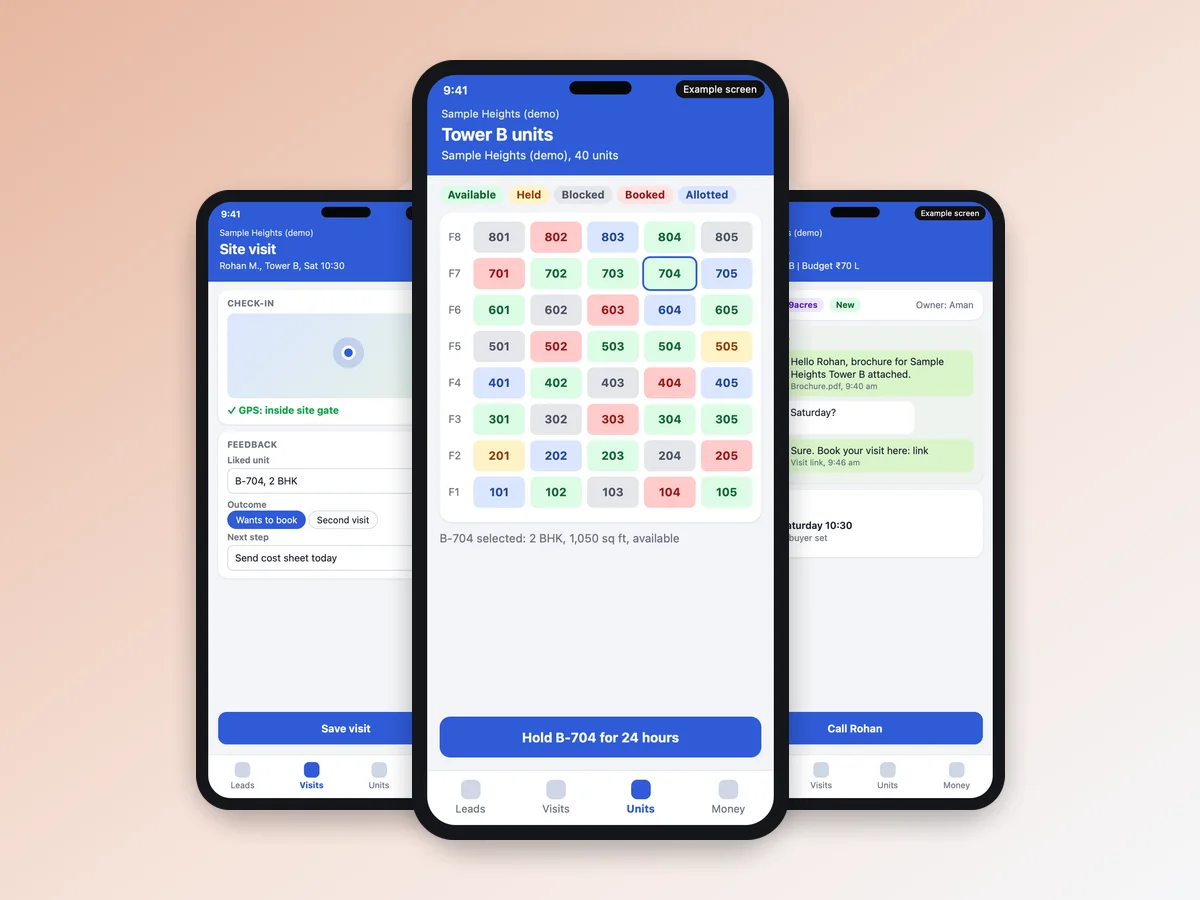
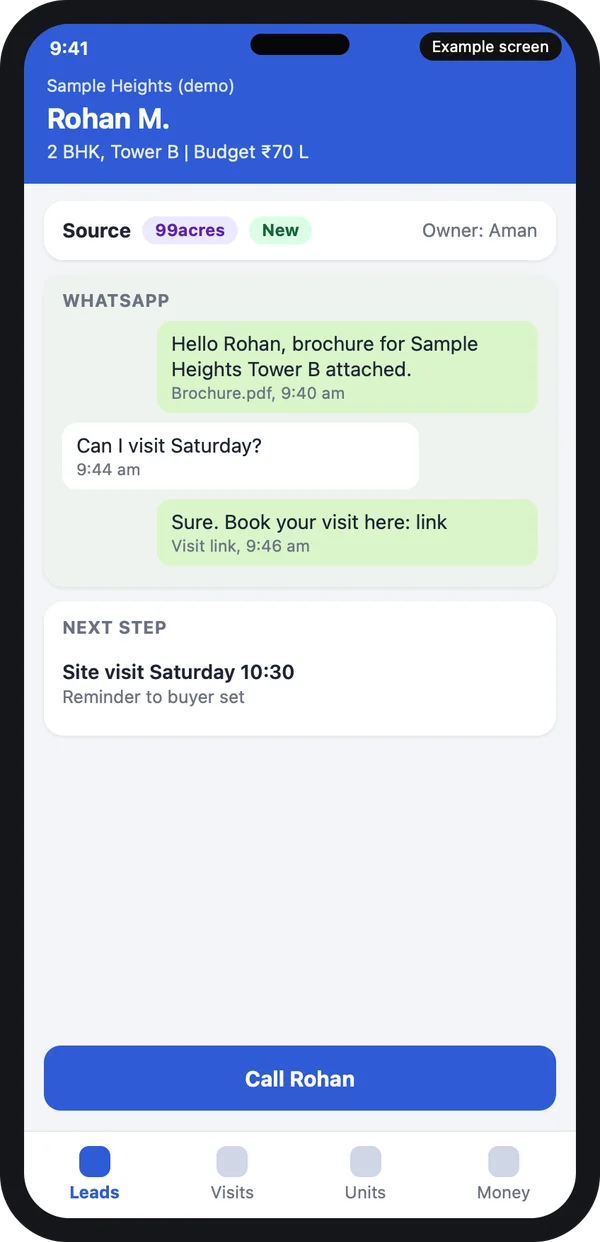
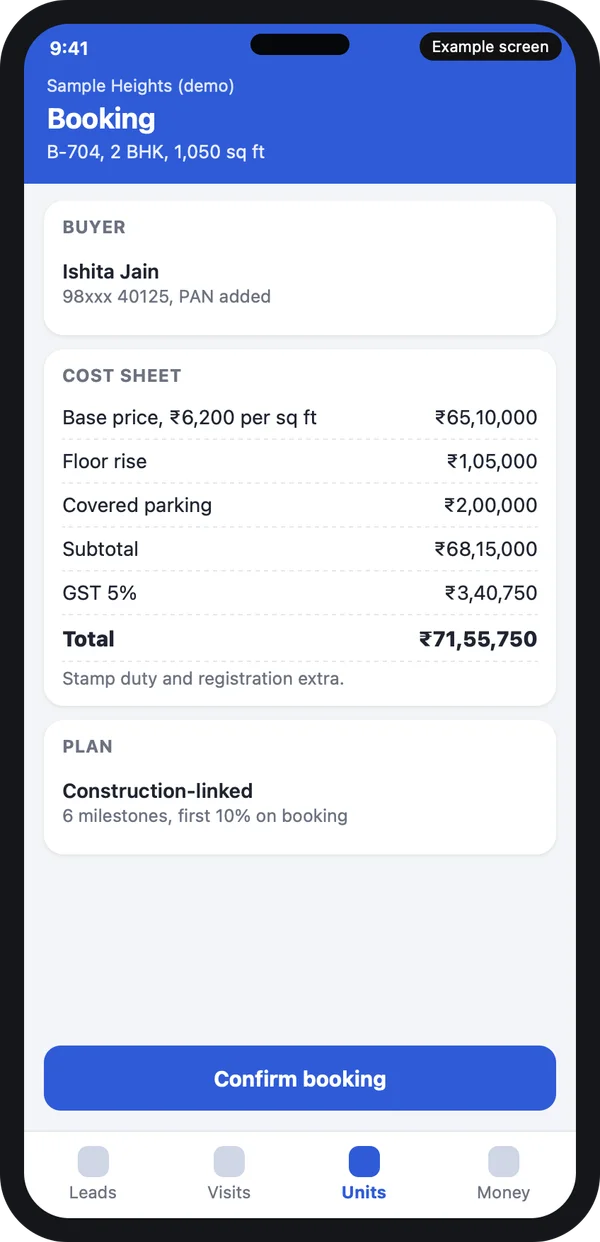
A real estate CRM is not only for the sales team. Five groups use it, each in their own way. The screens in this guide are example designs with demo data ("Sample Heights"). They are shown in the style of a field sales CRM mobile app. They are not a client's data.
Sales and telecallers
Call new leads, send WhatsApp, book visits, move the lead stage by stage.
Site team, brokers and dealers
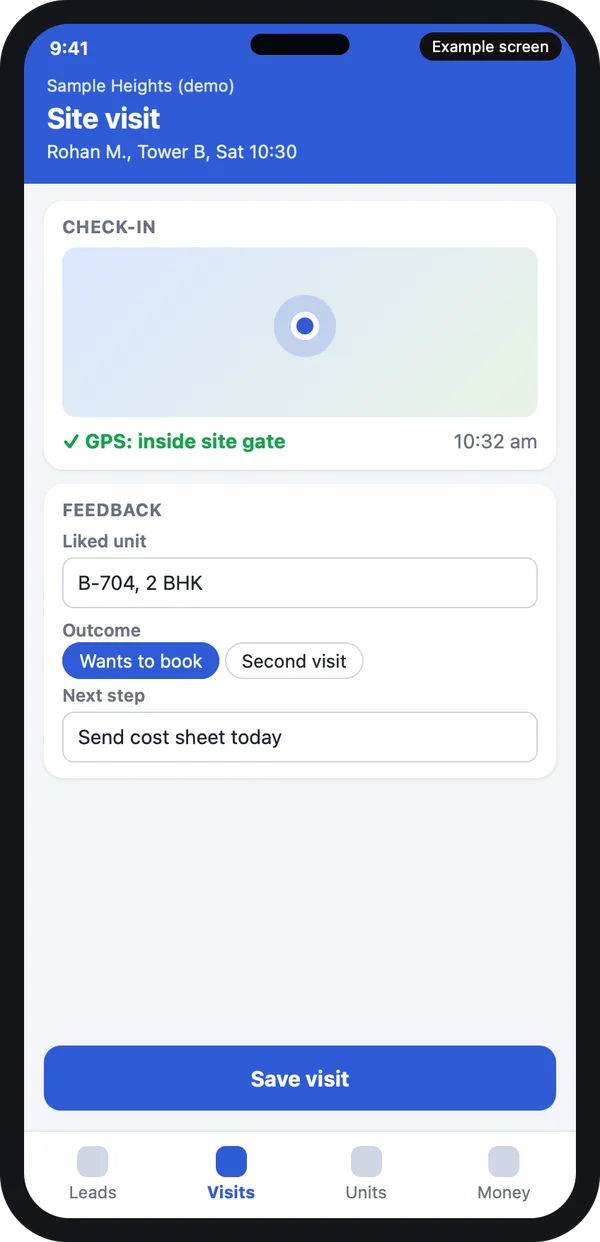
Check in at the site, show the flat, save feedback. Also fits a broker, a dealer or a realtor working alone.
Channel partners
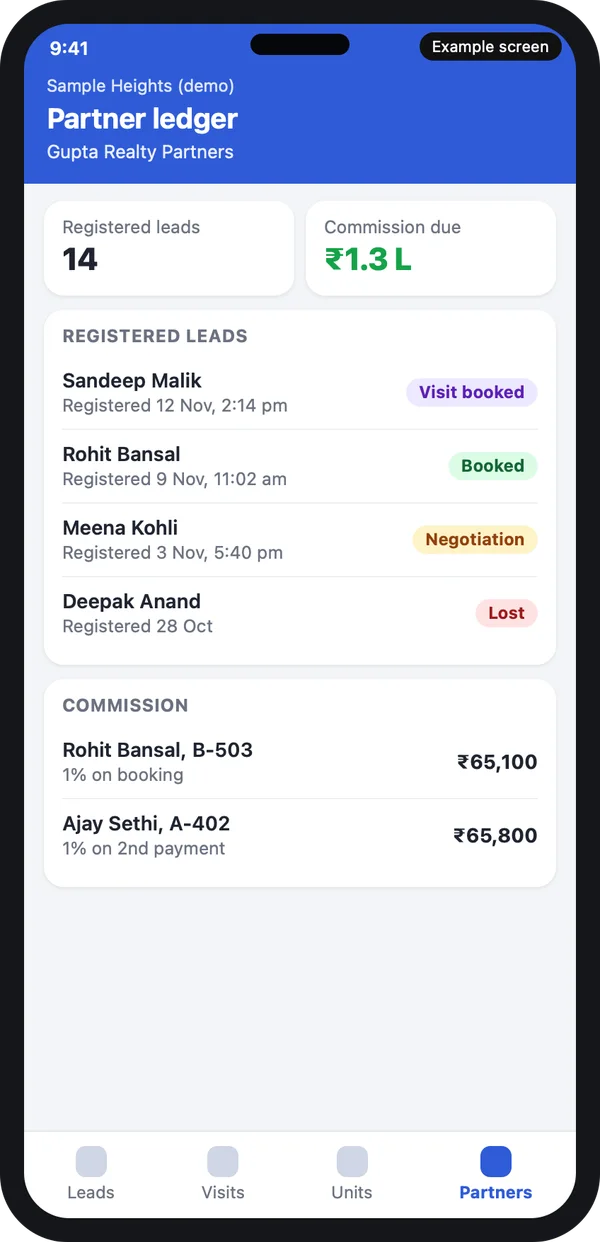
Register buyers, see their own leads and commission, without seeing other brokers' data.
Accounts and owner
Accounts record receipts and see the overdue list. The owner sees sales, stock and collections without calling anyone.
The buyer
The buyer gets WhatsApp messages with the brochure, the visit slot, the demand letter and the receipt. A real estate broker CRM or a CRM for real estate agents serves the same people, only with fewer roles.
Must-have features in real estate CRM software
Here are the seven parts a real estate CRM needs. For each one we say what the CRM must do, and what we build into your CRM.
1. Portal leads into the CRM and onto WhatsApp
Most buyers first appear on a property portal. Your CRM should take leads from 99acres, MagicBricks, Housing.com, Meta and Google forms, your website, walk-ins and missed calls. It should put all of them in one list.
- Lead comes in. From the portal, an ad form or the website.
- Duplicate check. The CRM matches the phone number. A repeat enquiry is added to the old lead, not made new.
- Given to a person. A rule picks the salesperson by project, city or turn. A timer starts for the first call.
- WhatsApp goes out. The buyer gets the project brochure and a link to book a site visit. The chat is saved on the lead.
Two honest notes. Portals send leads by email or by an API, depending on your plan, so we set up whichever your portal account allows. And WhatsApp messages from a business need the buyer's opt-in and approved templates. See the official WhatsApp opt-in guide and our guide to WhatsApp Business API integration.
2. Site visit scheduling and check-in
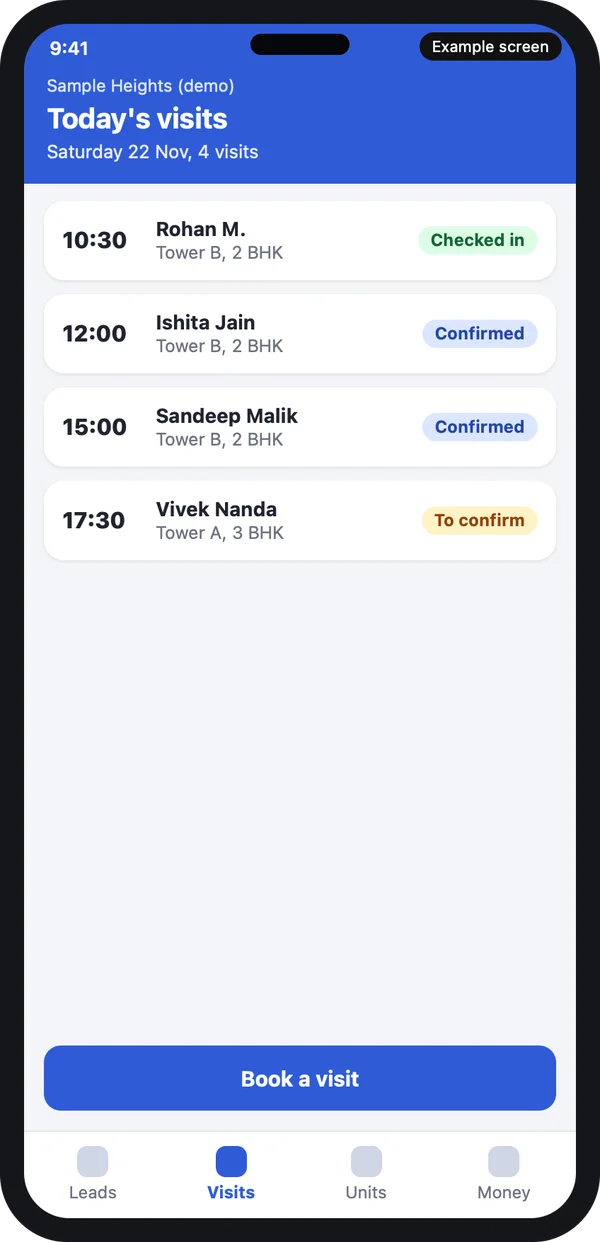
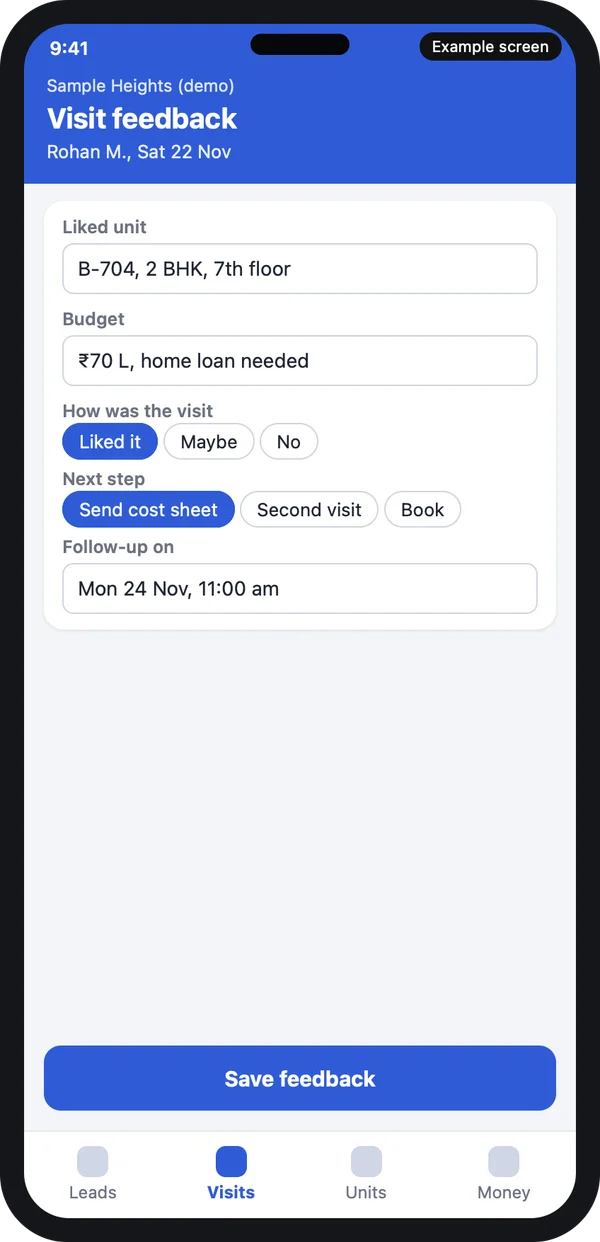
A site visit is the strongest sign of a serious buyer. The CRM books the visit from the lead and sends a reminder to the buyer and to the executive. At the site, the executive checks in with GPS, shows the sample flat and fills a short feedback form.
The next step is set before the executive leaves: second visit, price talk or booking. Over time you see visit-to-booking by project and by source.
3. Flat and unit inventory with booking
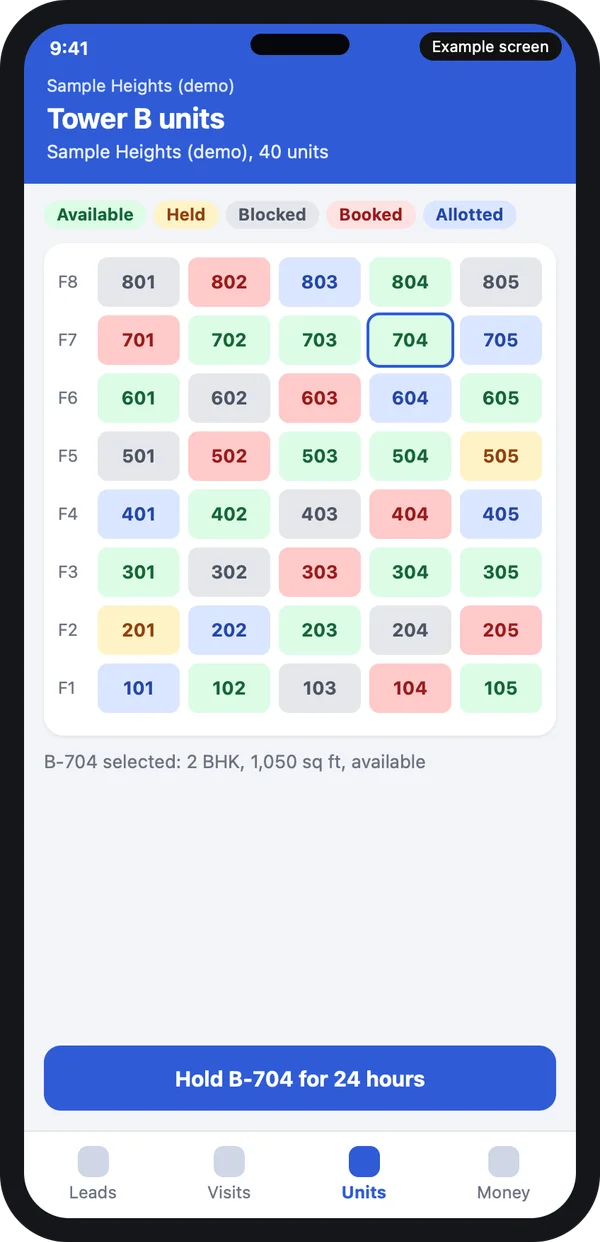
This is the part a normal CRM does not have. Your CRM needs the full stock: project, tower, floor, unit, area and price sheet. Each unit has a status, and the status changes only by rule.
| Status | What it means | Who can change it |
|---|---|---|
| Available | Open for any buyer | Sales manager |
| Held | Kept for one buyer for a set time. It ends on its own. | Sales executive |
| Blocked | Token paid, booking in progress | Sales manager |
| Booked | Booking amount received, cost sheet issued | Accounts |
| Allotted | Allotment letter issued | Sales head |
| Registered | Agreement registered | Legal or admin |
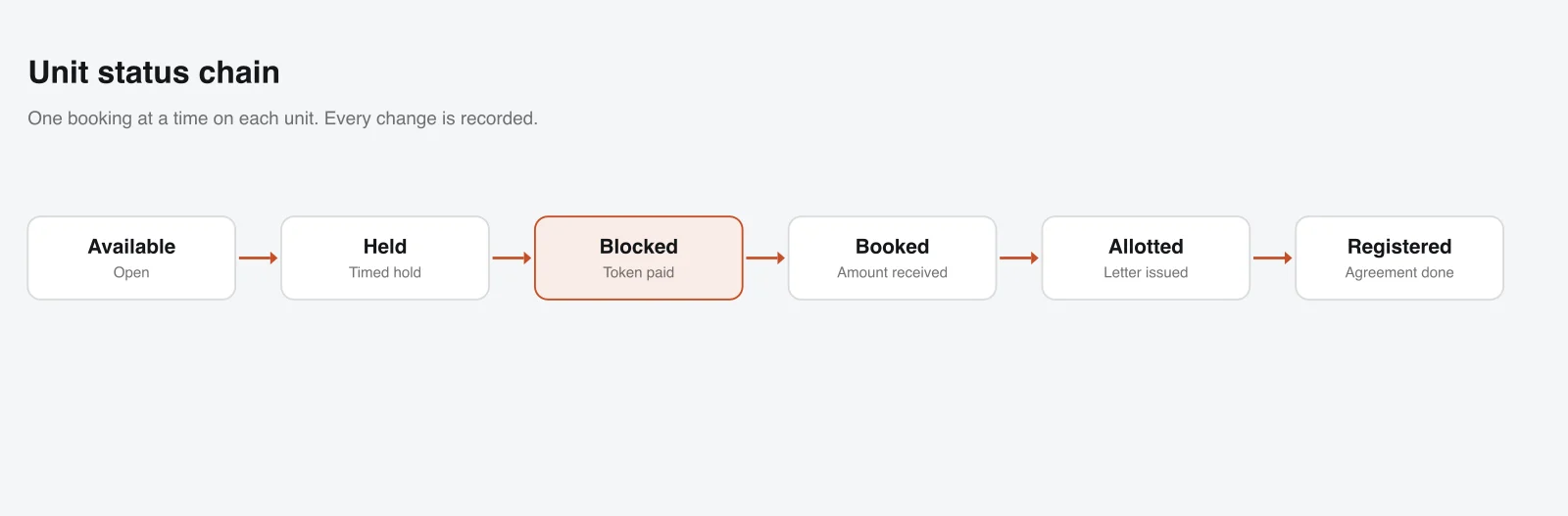
The key rule: while one booking is open on a unit, nobody else can book it. Two managers cannot block the same flat. The CRM then makes the booking form and a cost sheet PDF from the price sheet.
4. Project details, RERA and advertising
The RERA Act, 2016 asks developers to register projects and to keep buyers' money in a set way. Your CRM should hold the facts your team needs to follow it:
- The RERA registration number for each project, saved on the project record.
- A check that stops a listing or an ad from going out when the number is empty.
- Project documents and the construction progress details you report each quarter.
- A separate ledger line for the share of buyer payments that RERA asks promoters to keep in a separate project account. Your accounts team can then match it.
This is general information, not legal advice. RERA rules differ by state, and they change. Read the Act on the RERA page of the Ministry of Housing and Urban Affairs. Read your state RERA rules on your state RERA site. Check with your lawyer or chartered accountant. A good CRM keeps these rules as settings you can edit. Our construction software page covers the progress side.
5. Channel partner registration and commission
Many developers sell through brokers. The partner side of your CRM needs five things:
- The partner registers a buyer. The first valid registration wins inside a set window.
- The time comes from the server, so nobody can change it. The rule that applied that day is kept with the record.
- Commission is set by slab and by project, and paid at a chosen step: booking, agreement or registration.
- If a buyer cancels, the commission can be taken back by rule.
- The partner logs in and sees only their own leads and ledger. The buyer's details stay hidden until the lead is confirmed.
This is the part we built for a Delhi NCR developer, described below. Partner rules need depth, so we keep that detail for a separate guide on channel partner software.
6. Demand letters and payment reminders
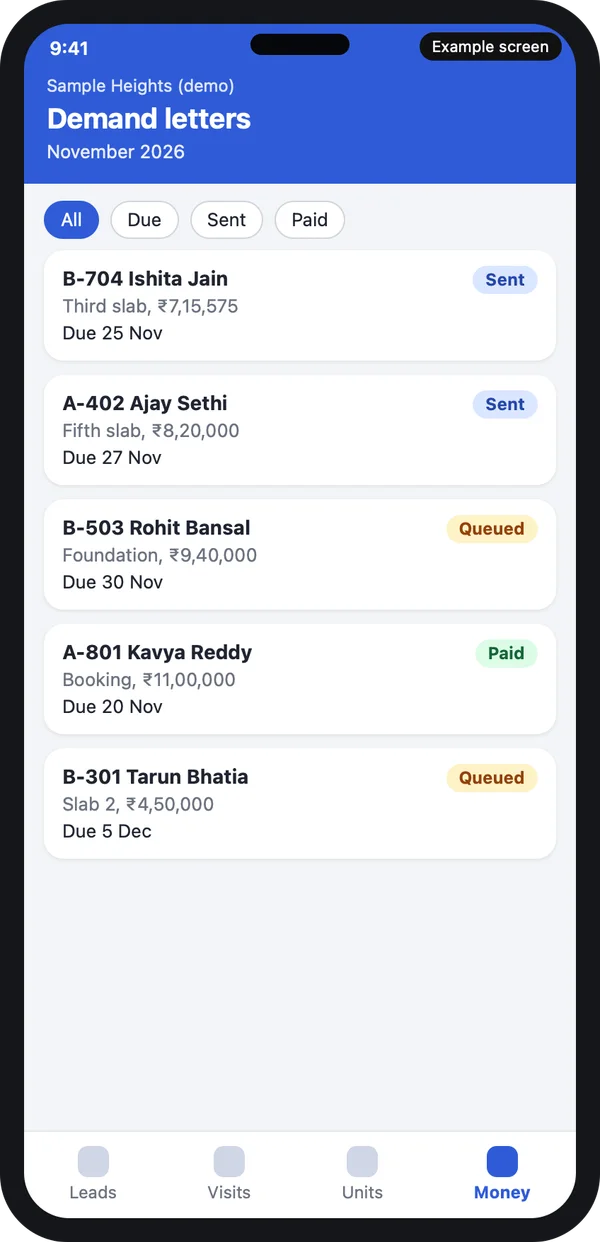
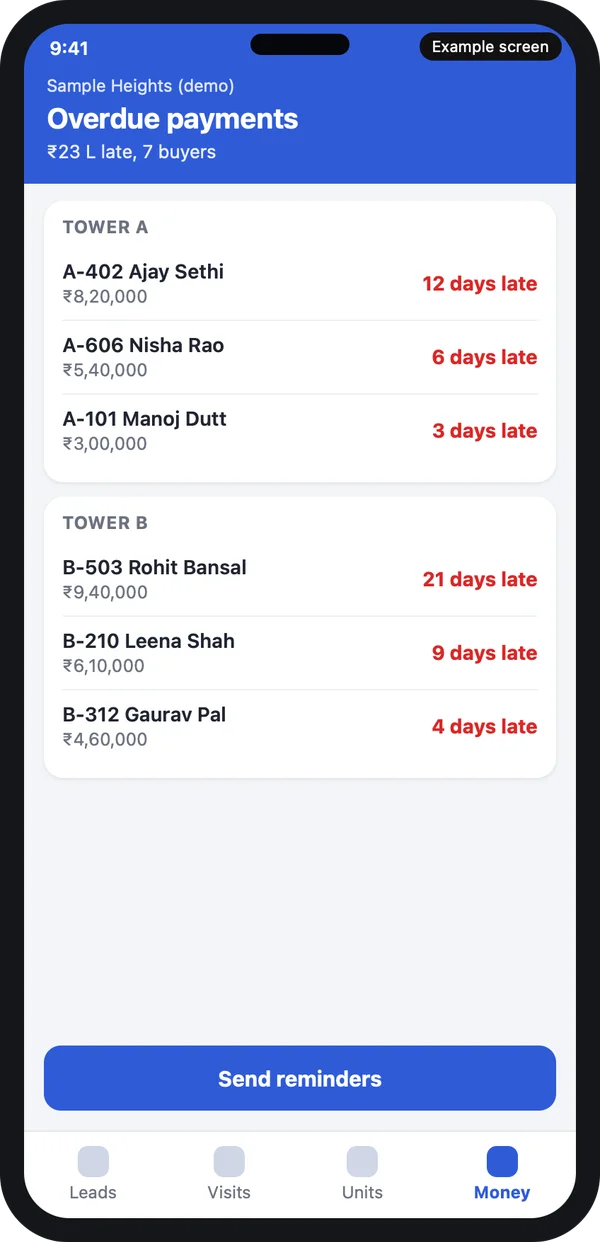
In property, money arrives in parts. Each unit has a payment plan, either linked to construction or to dates. Your CRM needs to turn that plan into action:
- Payment plan on the unit. Each instalment has a milestone and an amount.
- Milestone marked done. The site team or the project head marks it.
- Demand letter made. A PDF is built from your template with the buyer, unit and amount.
- Sent on WhatsApp and email. Reminders go before and after the due date.
- Receipt entered. Accounts record the payment. Unpaid items show on the overdue list.
Interest on late payment follows the rule in your agreement, so the CRM keeps it as a setting. Check the wording with your lawyer.
7. Reports the sales head and owner open every morning
Our ready-made CRM comes with 30 ready reports, and we add the real estate ones to your CRM. The set below is what a property team checks each day:
- Leads by source, and cost per lead.
- Time to first call, by person.
- Visit-to-booking by project, source and partner.
- Unit stock by tower and status.
- Collections due this week and this month.
- Partner commission due.
Real estate CRM vs Excel vs a ready-made CRM
Excel and free tools work for one agent with a few leads. If you search for a "real estate CRM template" or a "free CRM for real estate". You will find sheets that do exactly that. They stop when you add units, partners and payment plans.
| What you need | Excel and WhatsApp | Ready-made subscription CRM | Custom real estate CRM |
|---|---|---|---|
| Lock a unit while a booking is open | No | Usually no | Yes, built in |
| Partner credit with first-registration rule | Argument | Often paid custom work | Yes, built in |
| Demand letters from milestones | By hand | Often paid custom work | Yes, built in |
| RERA number and separate-account ledger | A column | Rarely | Yes, built in |
| Who owns the data and code | You | The vendor | You |
| Cost to change a rule | Manual edit in each sheet | Vendor ticket, paid | One change request |
How to choose the best CRM for real estate in India
People search for the "best CRM for real estate" or the "best real estate CRM software in India". No list can name one winner, because the right answer depends on your units, partners and payment plans. Ask every vendor, us included, these eight questions.
Eight questions to ask any real estate CRM vendor
- Can it lock a unit while one booking is open?
- Can it make a demand letter when a milestone is marked?
- Does it keep a partner ledger and the registration rule that applied?
- Can it pull leads from the portals you use, on your plan?
- Does WhatsApp run on the official business API, with opt-in?
- Who owns the data, and can you export all of it?
- What does a change cost after launch?
- Is there a mobile app for the site team?
Ask to see these working with your project's data before you sign.
Worked example: one buyer from a 99acres enquiry to the third demand letter
The names, project and dates below are sample data to show how the CRM works.
| Day | What happens | What the CRM does |
|---|---|---|
| Day 1, 10:02 | A buyer enquires about a 2 BHK in Sample Heights on 99acres. | Lead created. Phone matched, no duplicate. Given to a salesperson. |
| Day 1, 10:03 | The buyer gets a WhatsApp message. | Brochure and a visit-booking link sent. Chat saved on the lead. |
| Day 1, 10:20 | The salesperson calls and fixes a visit for Day 3. | First-call time recorded. Reminder set. |
| Day 3 | The buyer visits with the executive. | GPS check-in. Feedback saved: likes Tower B, floor 7. |
| Day 5 | The buyer chooses Unit B-702 and pays a token. | Unit held, then blocked. Nobody else can book it. Cost sheet PDF sent. |
| Day 12 | Booking amount received. | Status: booked. Partner commission step noted if a broker brought the buyer. |
| Month 3 | The foundation milestone is marked done. | Demand letter 1 made and sent on WhatsApp and email. |
| Month 3, due date minus 3 days | Payment not yet received. | Reminder sent. After the due date, the unit shows on the overdue list. |
| Month 7 | The slab milestone is marked done. | Demand letter 2 sent. Letter 3 follows the next milestone, the same way. |
What we built for a Delhi NCR developer
This is our own work, from the live case study of a real estate CRM and channel partner portal for Ashray Developers. Ashray builds homes in Delhi NCR and Jaipur: four projects, about 1,900 units, and a network of 300+ channel partners.
Source: PRS India case study, Ending brokerage disputes with a versioned lead-ownership engine. Results are as stated on that page.
The build had unit status with timed holds and demand letters linked to milestones. It also had a RERA number check on listings and a partner portal with masked buyer details. Your project will not be the same, so we plan your CRM around your own stages.
See our work in related fields: an affiliate and partner CRM and a remote property inspection app.
Our service
How we build your own real estate CRM
A CRM made around your projects, not the other way round.
- Map your stages. We list your projects, towers, payment plans and roles in one or two calls.
- Set up portals and WhatsApp. We connect the lead sources and the WhatsApp number that your accounts allow.
- Build the apps. A web admin for the office, an Android and iPhone app for the site team, and a partner portal.
- Pilot on one project. Your team uses it on real leads and one tower. We fix what they find.
- Train and move your data. We bring your Excel leads, units and receipts into the CRM.
- Support and grow. We add projects, rules and reports as you grow. Daily backups run, and an optional AMC covers support.
The CRM is yours. We set it up on your own AWS or server, or host it for you. You get the full source code, under your brand. It builds on our white-label CRM software and the Laravel web side, and accounts and collections link to ERP development.
Real estate CRM development cost: what decides it
A custom real estate CRM from PRS India: starting from ₹3,00,000. The final cost depends on seven things:
- How many projects and towers you sell.
- How many payment-plan types you run.
- How many partner levels and commission rules you need.
- Which portals you take leads from.
- How much WhatsApp use you plan.
- Which apps you need: web, staff app, partner portal.
- How much old data we move from Excel.
| Monthly CRM plan | Custom real estate CRM (built for you) | |
|---|---|---|
| Payment | Every month, for every user | One build cost, then optional support |
| Units, partners, demand letters | Usually extra work | Built in, the way you sell |
| Your brand on the apps | No | Yes |
| Data and source code | Stay with the vendor | Yours |
Share your projects and payment plans, and we send a written quote after one call.
Whoever builds your real estate CRM, make sure it can:
- Lock a unit while one booking is open
- Keep the version of each partner rule that applied
- Export all your data whenever you want
- Give you the source code
- Work on a phone at the site, with a weak signal
Buyer data needs care. Names, phone numbers and payment details are personal data. The Digital Personal Data Protection Act, 2023 applies. This is general information, so check with your lawyer. We build consent records and role-based access into your CRM.
FAQ
What is the best CRM for real estate in India?
It depends on your units, partners and payment plans. Ask the eight questions in this guide to any vendor. Ready-made CRMs often need paid custom work for partner levels and demand letters. We build your own CRM around your process.
Can a real estate CRM take leads from 99acres, MagicBricks and Housing.com?
Yes. We set it up for what your portal plan offers, which is email parsing or a lead API. The CRM removes duplicates, gives each lead to a salesperson and sends a WhatsApp message.
Can it send WhatsApp messages to portal leads?
Yes, through the WhatsApp Business API. The buyer must opt in, and the messages use approved templates. Chats are saved on the lead.
Does a real estate CRM help with RERA?
It stores the registration number, blocks ads without it, and tracks collections and progress details. It does not replace your lawyer or chartered accountant, and the rules differ by state.
How does a CRM handle channel partner commission?
It keeps the commission slab, the first-registration rule, the payout step, the cancel rule and a ledger for each partner.
Can a CRM send demand letters and payment reminders?
Yes. It makes the letter from the payment plan when a milestone is marked. It sends it on WhatsApp and email. It lists late payments for accounts.
Is there a free CRM for real estate agents?
Free tools and Excel work for one agent with few leads. They stop when you need unit booking, partners and demand letters. That is when a custom CRM pays off.
Will I own the CRM and its source code?
Yes. We build it under your brand on your own server or cloud, and hand over the full source code.
Can PRS India build a real estate CRM for my company?
Yes. We build custom CRM software around your projects, payment plans and partners. Contact us and we will show you screens for your process.
Related guides
Written by
Aditi
Building software at PRS India.