White Label CRM Development for Agencies and Resellers
We build your own white label CRM: agency panel, separate client workspaces, plans and a sales app in your brand, for web, Android and iPhone.

Written from production. Our articles draw on products we run live and the client work behind them, and are revised as the systems they describe evolve.
Many agencies already sell websites, ads and social media to small businesses. Their clients then ask the same question. "Where do I keep all these leads?" A white label CRM for agencies answers that question under the agency's own name. The client logs in to a CRM with the agency's logo, and the agency earns from it every month.
Most resellers rent such a CRM from a vendor. The vendor keeps the code, the data and the rules. Some agencies now prefer to get their own CRM software built and resell it as their own product. This guide explains how a white label CRM reseller setup works and what it must do. It also shows how PRS India builds it for you.
Key takeaways
- A reseller CRM has two levels: your agency panel above, and one separate workspace for each client under it.
- Each client's data must stay fully apart from every other client's data.
- Ready-made pipeline templates for each industry reduce the time to set up a new client from days to hours.
- Renting a white label licence is quick to start. Owning the platform gives you the code, the pricing control and the client data.
- A mobile app for your clients' sales staff is often what makes them renew.
What is a white label CRM?
"White label" means the product carries your name, not the maker's name. Your clients see your logo, your colours and your web address. They never see who wrote the code.
For an agency, the CRM becomes a second product next to its services. You already bring leads to your clients through ads and websites. With a CRM, you also show them what happened to each lead after it came in. That makes your ad work easier to prove, and harder to cancel.
How a reseller CRM is set up
A reseller CRM is one platform with many separate accounts inside it. Think of it as one building with many locked flats. This model is called multi-tenant software. It is the core of any SaaS product we build for resellers.
| Level | Who uses it | What they do there |
|---|---|---|
| Platform owner | Your agency's admin | Create client accounts, set plans and limits, see usage and renewals |
| Client workspace | The client's owner or manager | Add staff, set stages, see reports for their own business only |
| Client staff | Sales and support people | Work on leads, calls, follow-ups and tickets, mostly on the phone |
| Agency support | Your support team | Answer client questions and fix settings with the client's permission |
The problem
Where agencies get stuck reselling a rented CRM
Agencies that rent a white label licence often hit the same walls after the first few clients.
- The vendor sets your margin. The licence cost rises, and you cannot pass it on to clients who signed a fixed rate.
- The brand slips. A help link, an email footer or the app store name still shows the vendor.
- Feature requests go nowhere. A client in real estate needs a site visit field. The vendor's roadmap does not include it.
- Data is not yours. If you leave the vendor, moving every client's history out is slow and partial.
- No phone app in your name. Clients' staff download the vendor's app, so the client learns who the real maker is.
- Setup is manual each time. Every new client means building stages, fields and reports from zero.
What your clients see
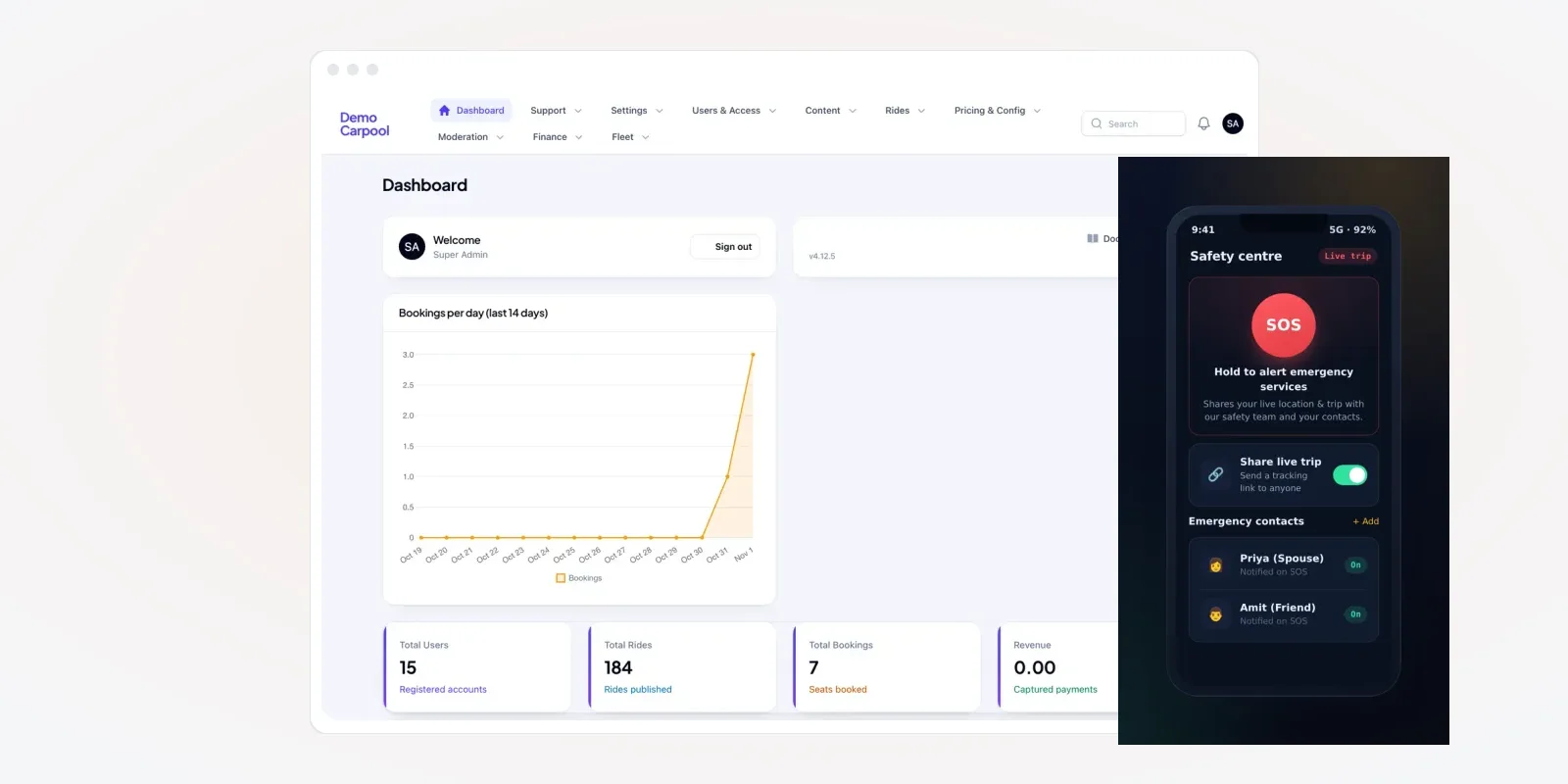
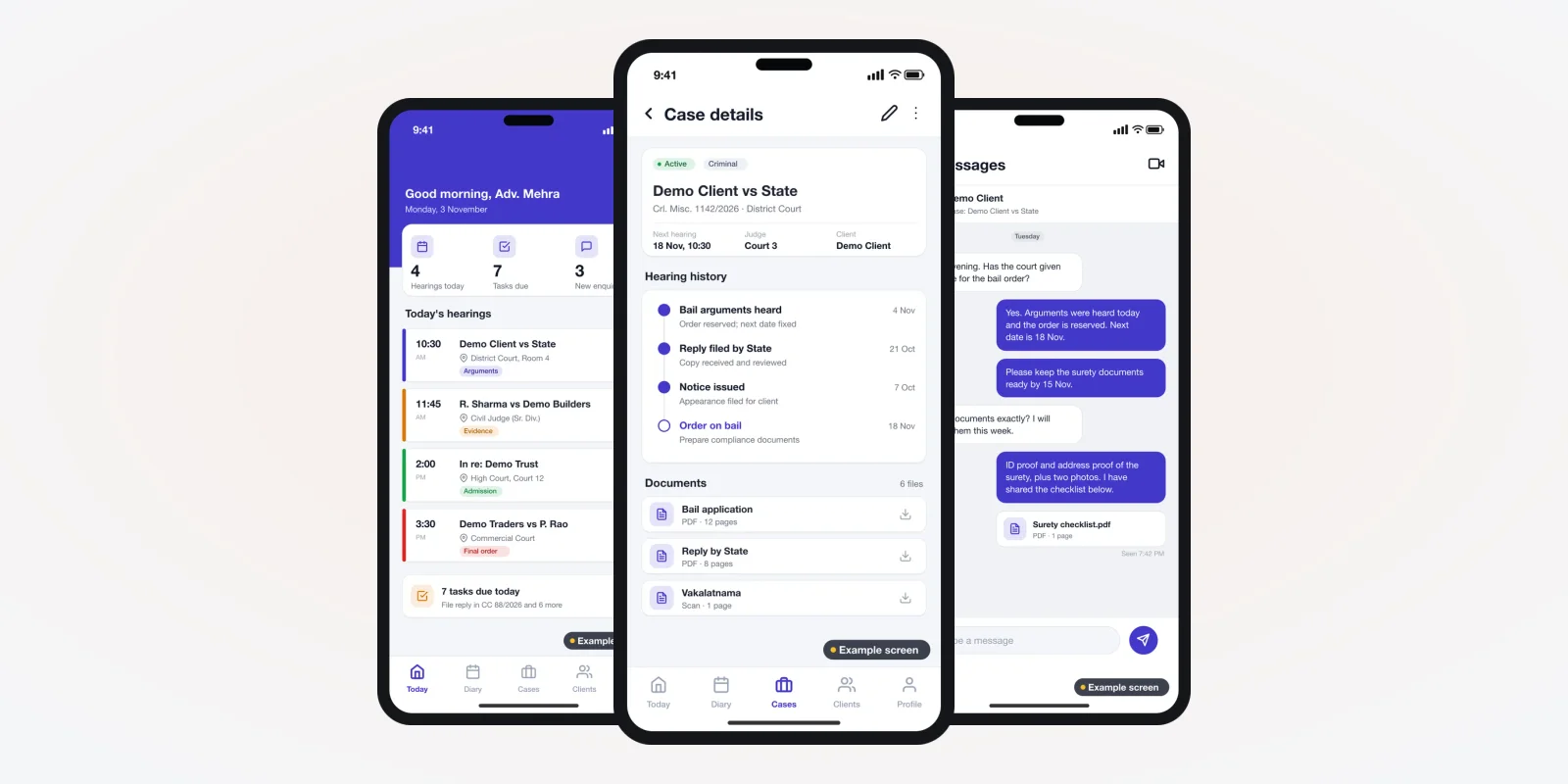
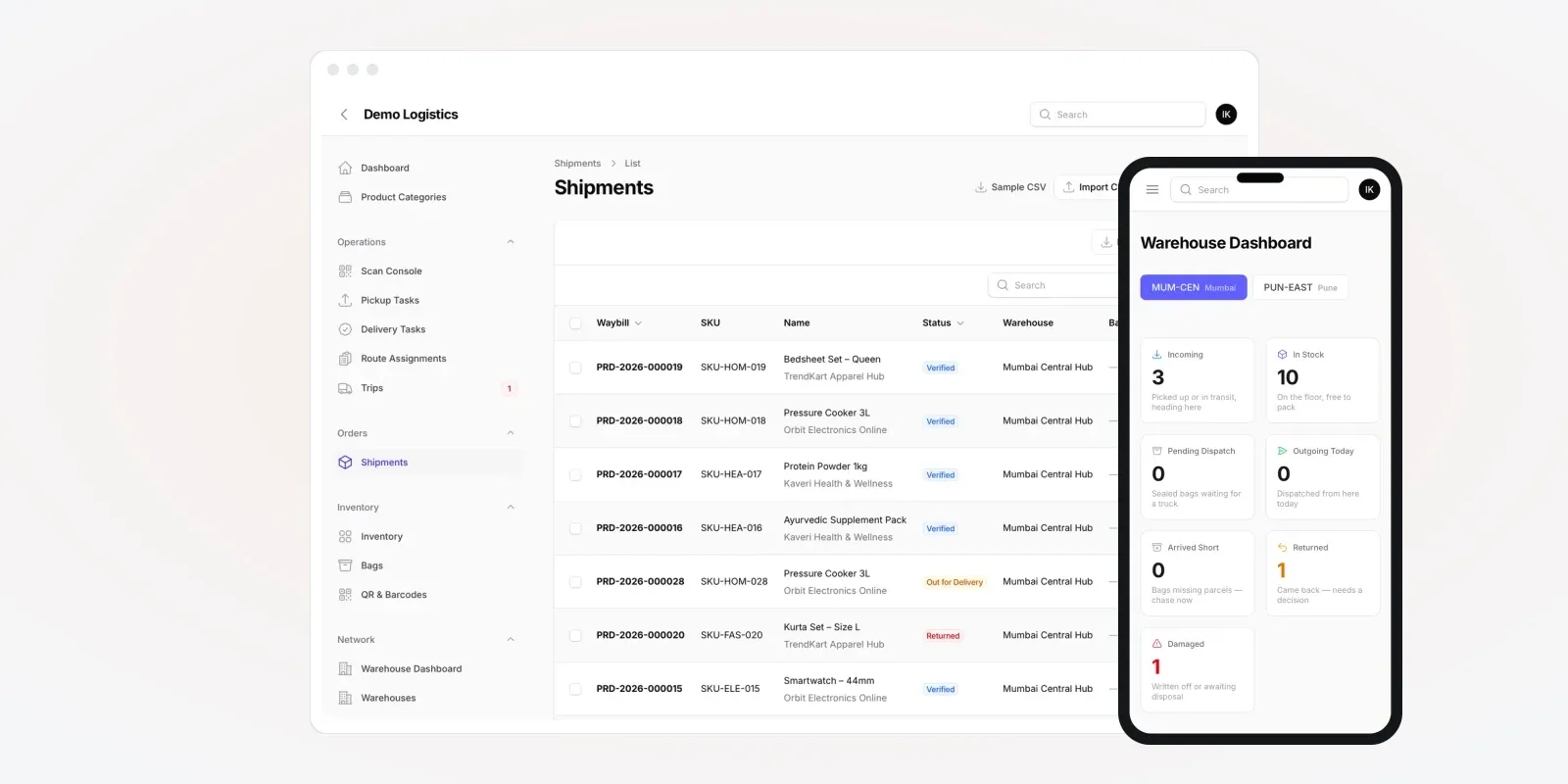
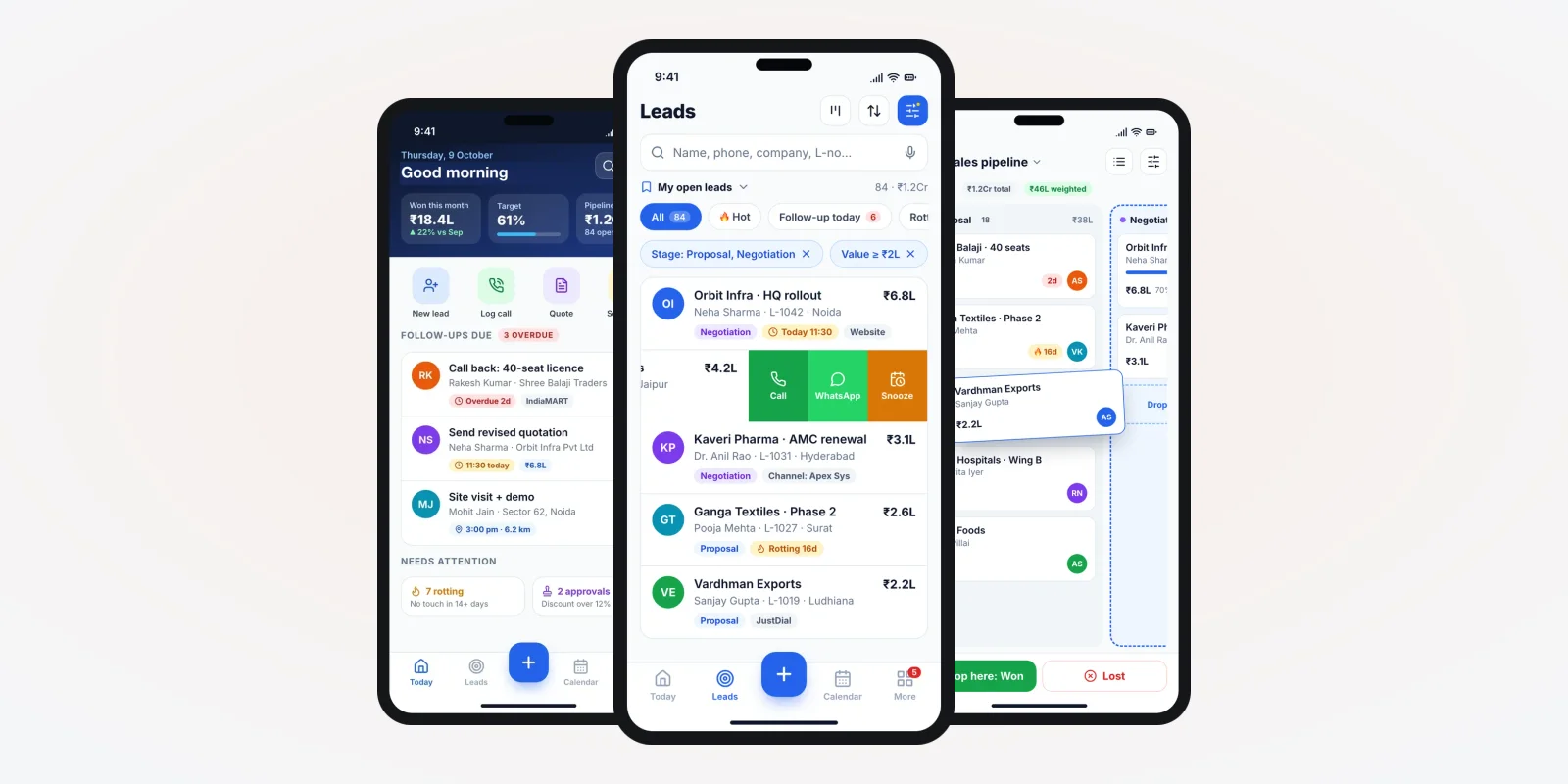
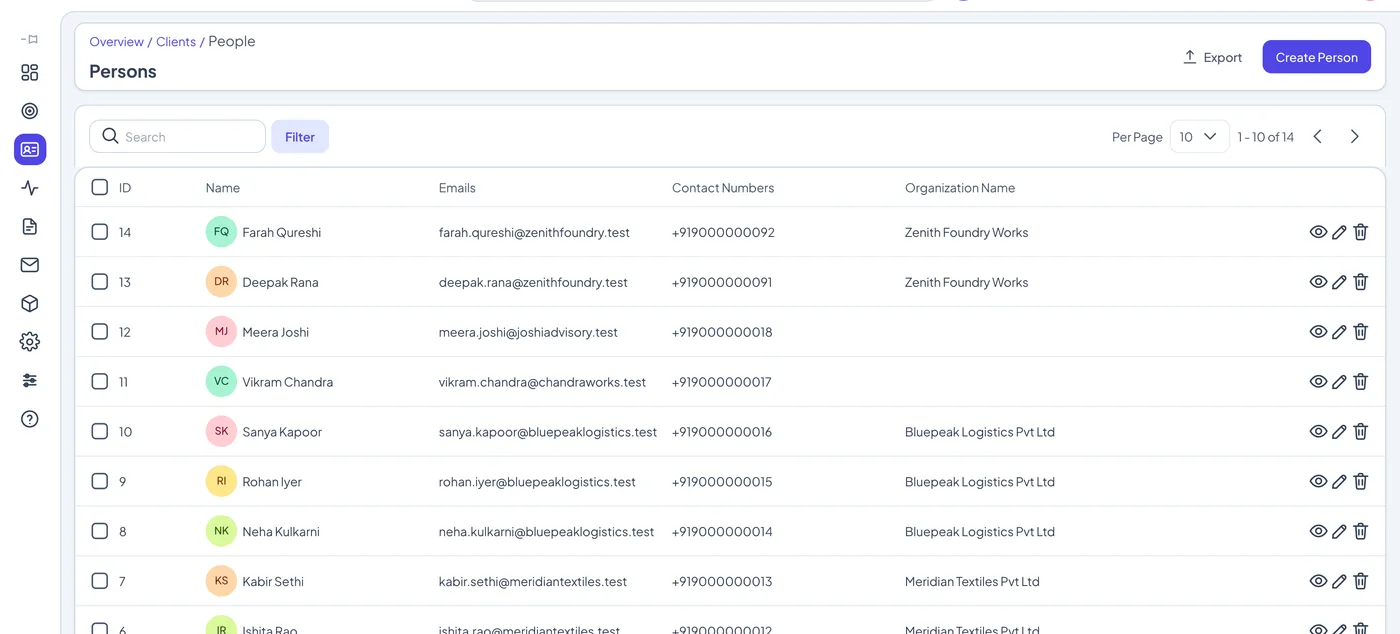
Your clients judge the CRM by the screens their staff open every day. The screens below are from a CRM we built, shown with demo data. In a reseller setup, each client sees screens like these with your own logo.
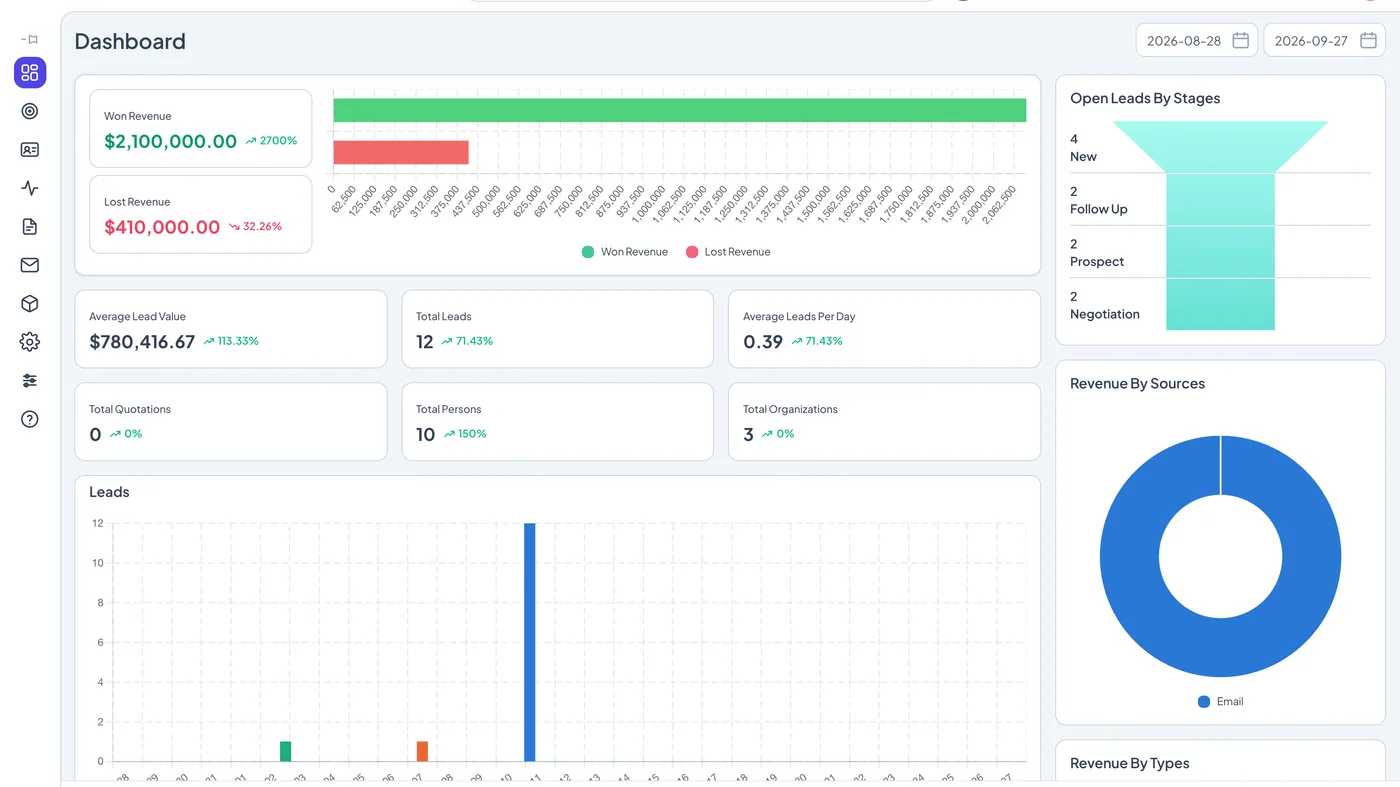
The owner of each client business sees only their own numbers. Your agency panel sees the totals across all clients, such as active users and logins this week. That tells you which client may cancel soon, before they tell you.
Features a white label CRM platform needs
1. Full brand control per client
Your logo and colours appear on the login page, the menus, the emails and the reports. Each client can run on your web address or on a sub-address such as crm.yourclient.com.
2. Ready pipeline templates
Save a set of stages, fields and reports for each industry you serve. A coaching centre gets "Enquiry, Demo class, Fee paid". A builder gets "Site visit, Booking, Agreement". You apply the template when you open a new client.
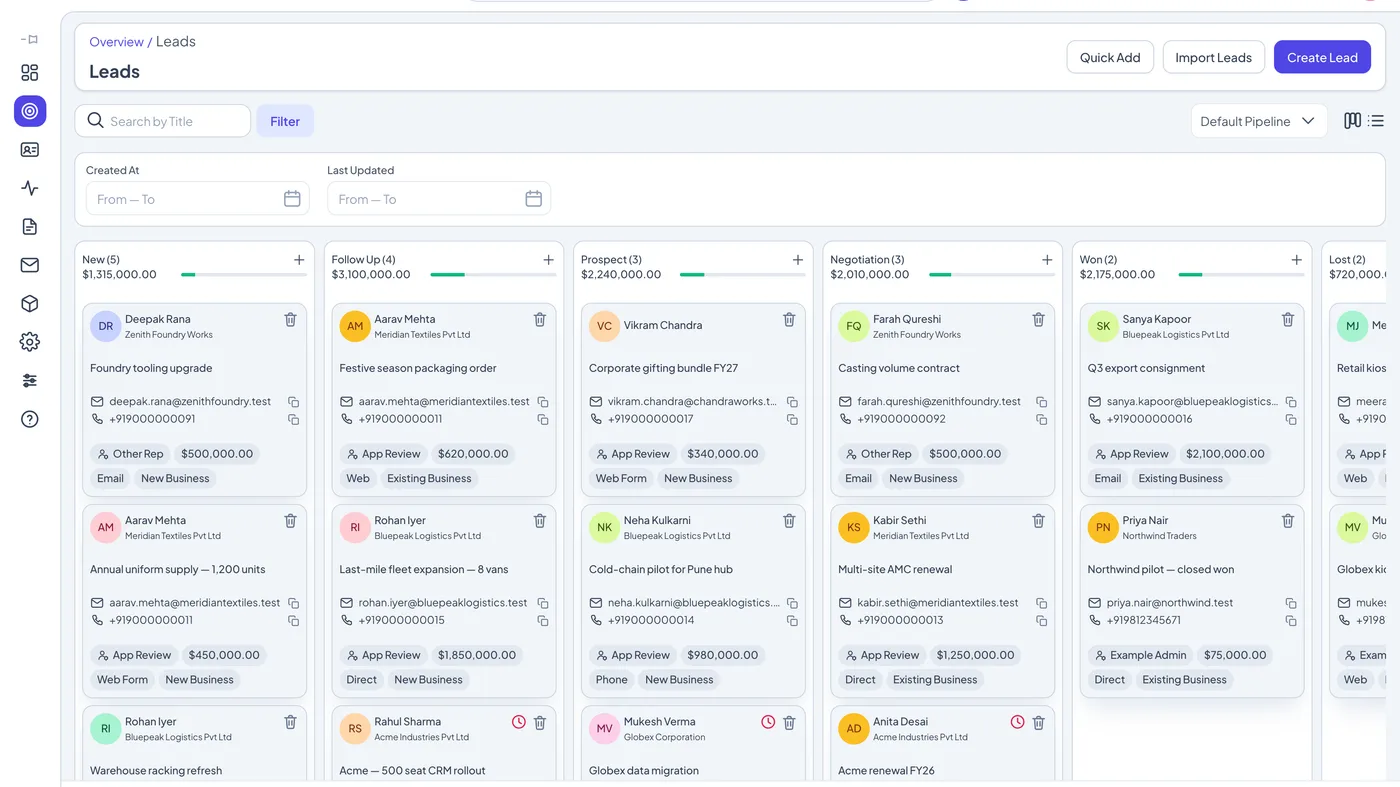
3. Lead import from your own campaigns
The leads your agency brings from ads and landing pages should land in the client's CRM by themselves. Each lead keeps its source, so the client sees which campaign sent it.
4. Contacts with clean data
Clients bring old Excel sheets. The import tool should match columns, skip duplicates and show what failed. A clean start stops early complaints.
5. A sales app in your name
Field and phone sales staff work from their phones. The app should open on today's follow-ups. Staff call or send a WhatsApp message in one tap. They move a deal to the next stage with a drag. We build it as one app with your brand, where each user signs in to their own company's workspace. Android and iPhone apps under your name also keep the store listing in your brand.
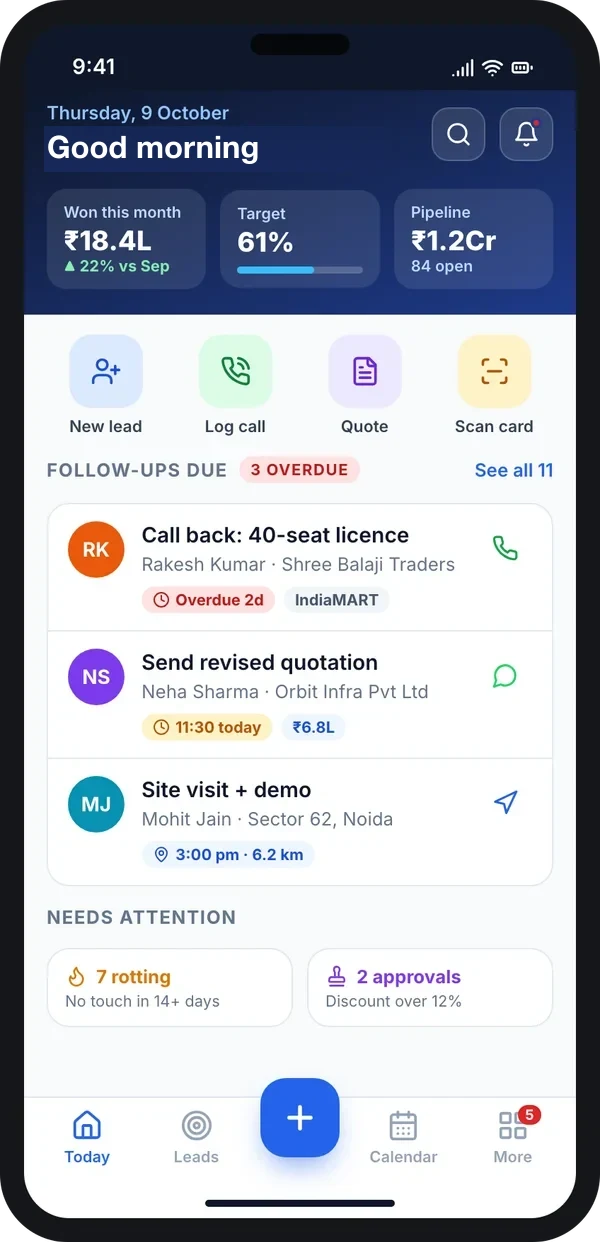
Today screen
Target, follow-ups due and deals that need attention.
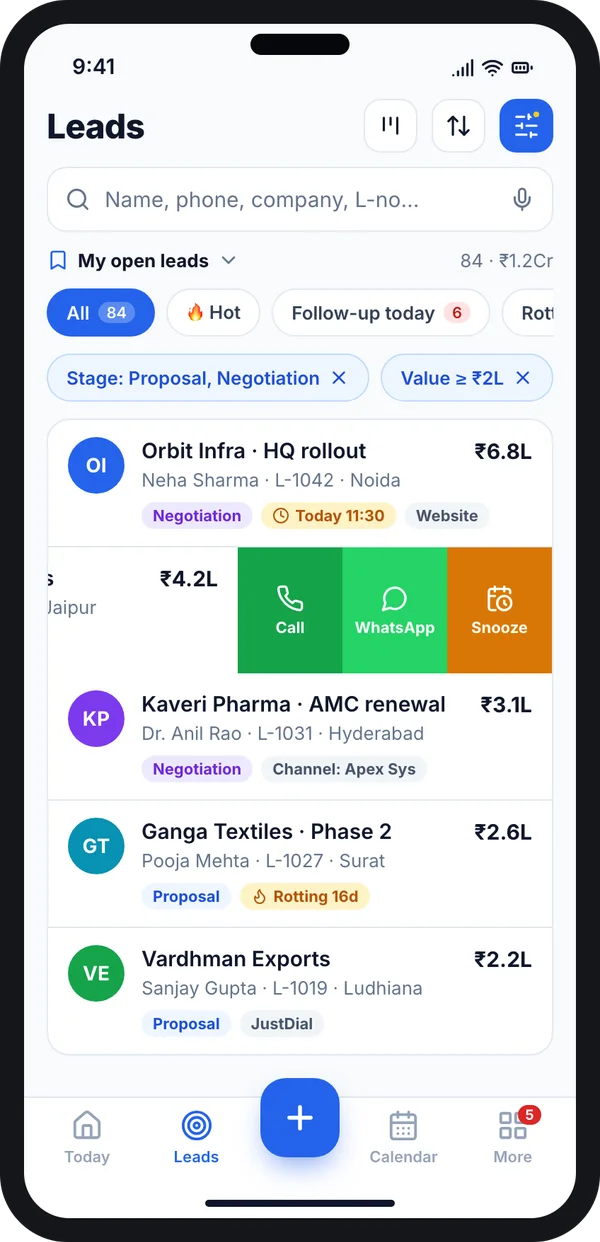
Lead list
Swipe a lead to call, message or snooze it.
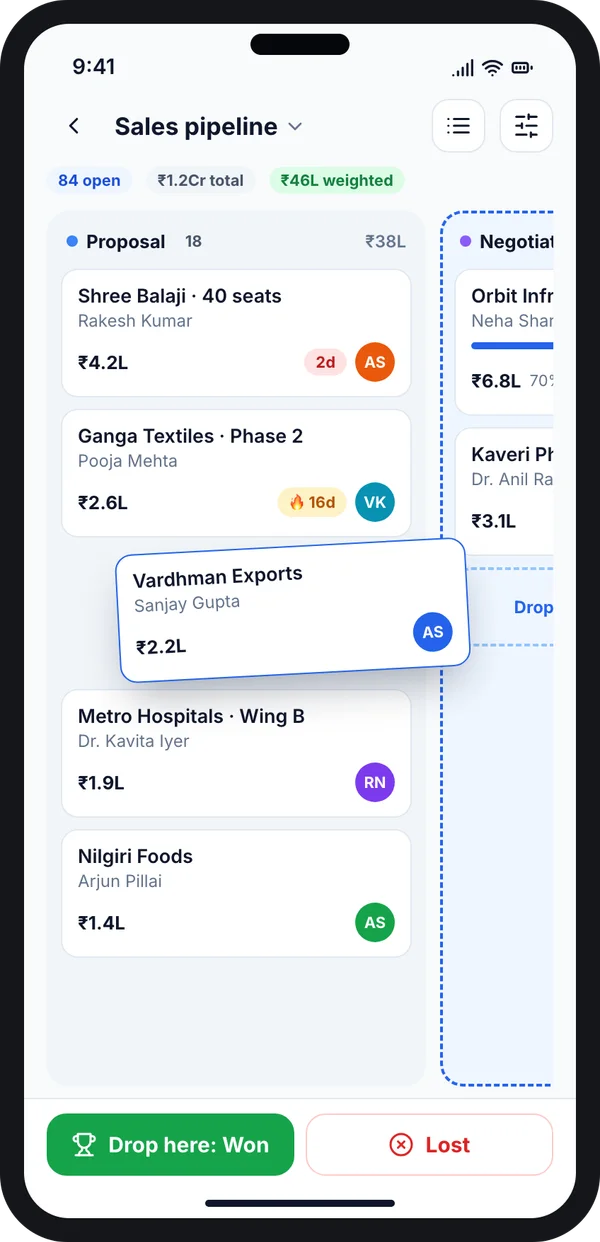
Pipeline on the phone
Drag a deal to the next stage.
6. Support desk for your clients
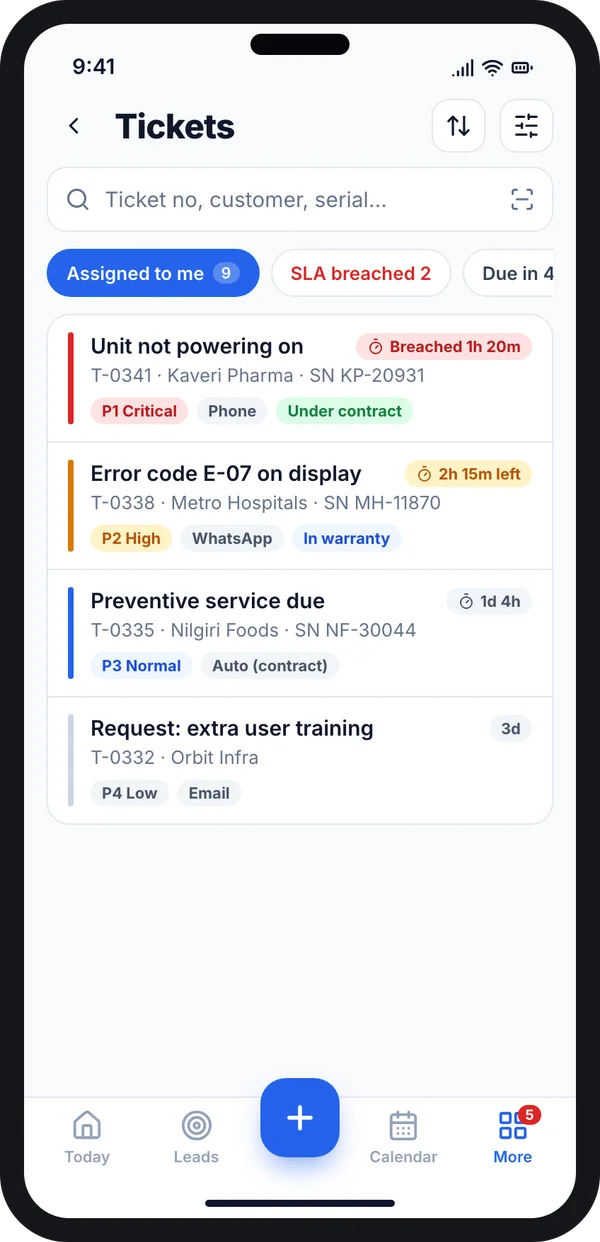
Your clients will raise questions. A built-in ticket list lets your team answer them with due times. The same module can also be sold to clients for their own customer support.
7. Plans, limits and billing
You decide the plans: number of users, storage, modules and add-ons. The platform should raise the monthly invoice for each client. It should warn or stop when a plan limit is crossed. Invoices to Indian clients need GST details, as set out on the GST portal.
8. Messages that follow the rules
Your CRM may send SMS for clients. Then each sender ID and message template must be registered on a DLT platform. This is part of TRAI's commercial messaging rules. Source: Telecom Regulatory Authority of India. Your platform should store each client's own registered templates, not share one set across clients.
Client data is your duty too. As the platform owner, you hold personal data for many businesses. The Digital Personal Data Protection Act, 2023 sets duties on how that data is collected and kept. CERT-In directions also ask service providers to report certain cyber incidents within 6 hours. Source: CERT-In directions of 28 April 2022. Check your own duties with a lawyer.
Rent a licence or own the platform
| Point | Rented white label licence | Your own CRM platform |
|---|---|---|
| Time to first client | Days | Weeks, after the build |
| Your margin | Set by the vendor's price list | Set by you |
| Brand everywhere, including the app stores | Partly | Yes |
| Industry fields and features | Only what the vendor ships | Added when your clients need them |
| Client data and source code | Held by the vendor | Held by you |
| Who fixes a problem | The vendor, in their queue | Your team or your developer |
A rented licence is fine to test demand with a few clients. Once you have steady clients in one or two industries, owning the platform usually makes more sense.
Worked example: an agency with real estate clients
Here is how one agency might use its own CRM. The agency, clients and numbers are examples.
- Week 1, the offer. The agency runs property ads for local builders. It adds "CRM with site visit tracking" to its monthly package.
- Week 1, the new client. A builder signs up. The agency admin creates a workspace and applies the real estate template.
- Week 1, the import. The builder's old Excel list of buyers goes in. Duplicates are skipped and listed.
- Week 2, the team. Five sales staff install the app in the agency's brand and log in to the builder's workspace.
- Every day. Ad leads land in the CRM with the campaign name. Staff call, book site visits and log the result.
- Month end. The builder sees leads by campaign and site visits by staff. The agency sees that this client logged in every day.
- Renewal. The invoice goes out from the platform. The builder renews both ads and CRM together.
Agencies with property clients often start with this one template, then add more industries one by one.
Our service
How we build your own white label CRM
A platform you sell as yours, built around the clients you already have.
- Understand your clients. We list your industries, plans and support steps with you in one or two calls.
- Design the screens. You click through the screens in your brand before any code is written.
- Build the platform. The agency panel and client workspaces on the web. We often use Laravel, or the stack your team knows.
- Build the app. One Flutter codebase for Android and iPhone, published under your developer account.
- Test with two clients. Two friendly clients use it for real. We fix what their staff find.
- Launch and grow. Hosting on your own cloud account, then new templates and modules as you sign new industries.
White label CRM development cost: what decides it
We do not publish a fixed price, because each reseller needs a different scope. Five things decide the cost. These include the client modules, the depth of the agency panel and billing, and the number of apps. Next are the external services you connect, such as SMS, WhatsApp, email, payments, and ad lead forms. Last is whether you need AI features such as lead scoring.
| Monthly white label licence | Custom platform built for you | |
|---|---|---|
| First payment | Low | Build cost, paid by milestone |
| Cost as clients grow | Rises with every client or user | Mostly hosting and optional support |
| Changes for one industry | Usually not possible | Built when you need them |
| Brand in the app stores | Often the vendor's | Yours |
| Data and source code | Vendor's | Yours |
Tell us your client count, industries and plans. We send a written quote after one call. You can also see software products we have built to judge the kind of work we do.
Whoever builds your white label CRM, make sure it can:
- Keep each client's data fully apart, with no shared lists
- Show your brand on web, email, reports and the app store listing
- Copy an industry template into a new client in minutes
- Set plan limits on users, storage and modules per client
- Raise monthly invoices with GST details for each client
- Store each client's own SMS and WhatsApp templates
- Let your support team enter a client account only with permission, and log it
- Export one client's full data if that client leaves
FAQ
What is a white label CRM for agencies?
It is a CRM that an agency sells to its clients under its own brand. Clients see the agency's logo and web address. The agency sets the plans, the price and the support.
How does a white label CRM reseller earn money?
The reseller charges each client a monthly or yearly fee for the CRM. Many agencies bundle it with ads, websites or support, so the client renews the whole package together.
How long does it take to build a white label CRM platform?
It depends on the modules, the agency panel and the number of apps. After one call, we share a plan with dates for each part, starting with clickable screens.
Will I own the platform and its source code?
Yes. We build it under your brand and hand over the source code. The platform runs on your own cloud account, so all client data stays with you.
Can each client have a separate login and data?
Yes. Each client gets its own workspace with its own users, stages and reports. One client can never see another client's leads.
Can the mobile app carry my agency's brand?
Yes. We publish the Android and iPhone apps under your developer accounts, with your name and icon. Each user signs in to their own company's workspace.
Is client data safe in a white label CRM?
It should be. The platform must keep client data apart, control staff access and keep logs. The Digital Personal Data Protection Act, 2023 also applies, so check your duties with a lawyer.
Can I start with one industry and add more later?
Yes. Most agencies start with one template, such as real estate or education. New templates and fields are added later without rebuilding the platform.
Can PRS India build a white label CRM for my agency?
Yes. We build the agency panel, client workspaces and the sales app for Android and iPhone under your brand. Book a consultation and we will show you screens for your own client base.
Related guides
Written by
Aditi
Building software at PRS India.