Insurance CRM Software Development Company in India
We build your own insurance CRM: policies, renewals, many insurers, agents, commissions, claims and KYC. Web, Android and iPhone, under your brand.

Written by Prabhjot Kaur, Product Manager
Reviewed by the PRS India software & mobile app development team
14 min read
Written from production. Our articles draw on products we run live and the client work behind them, and are revised as the systems they describe evolve.
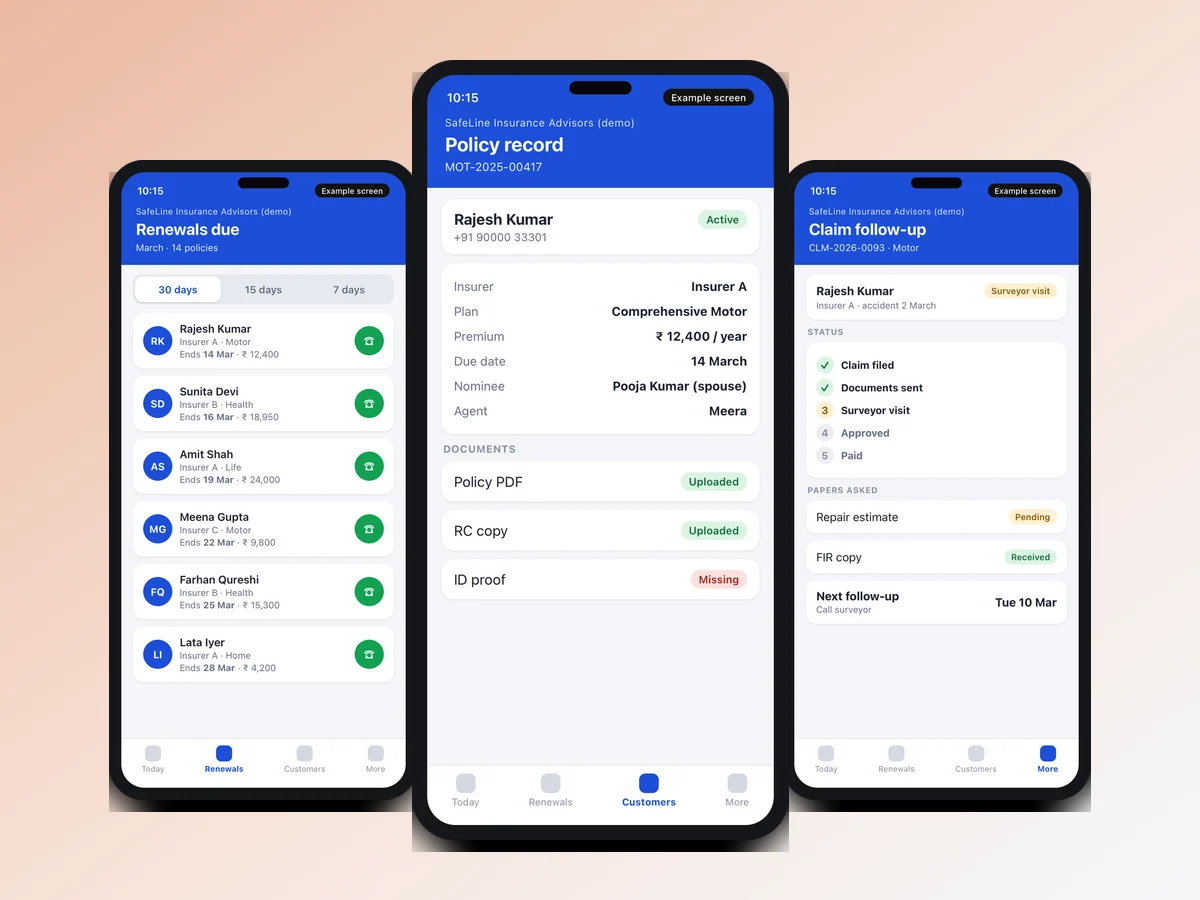
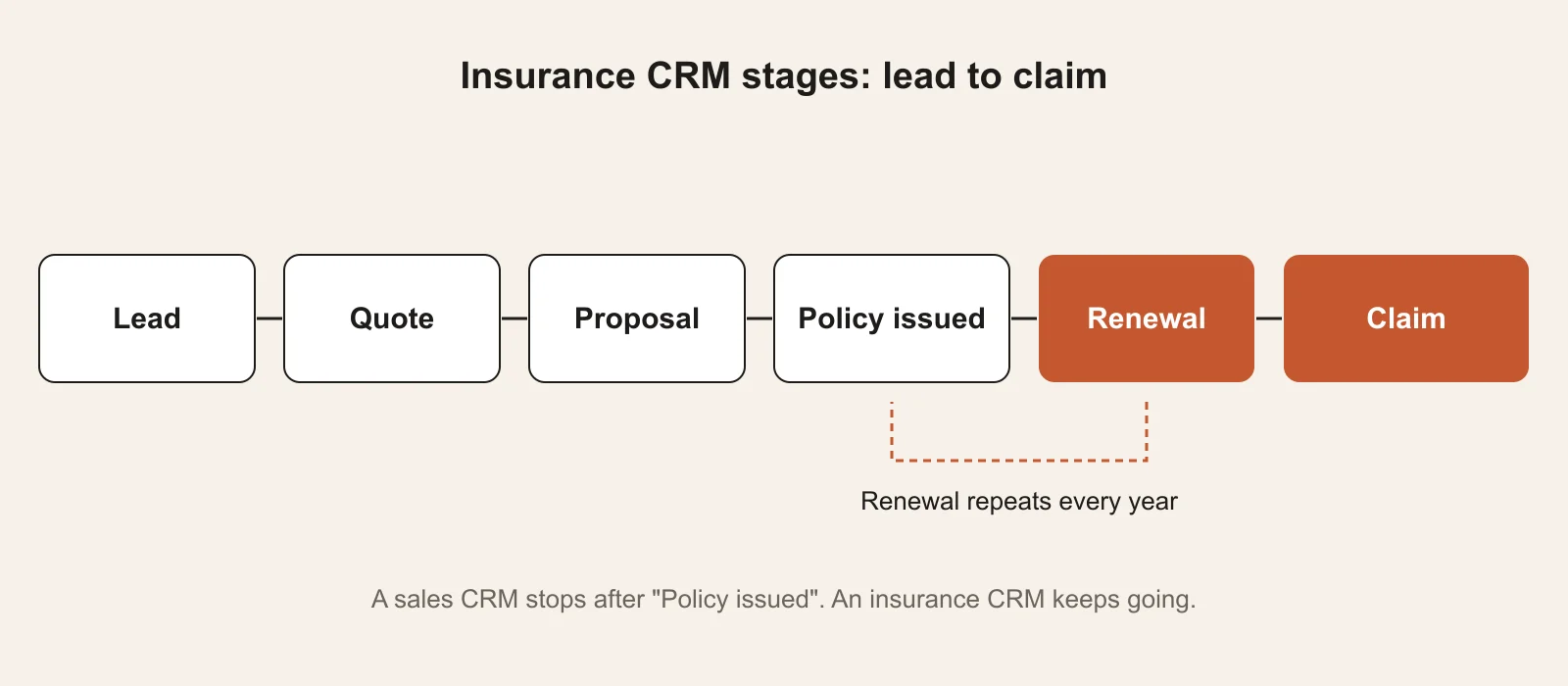
An insurance policy is sold once. It is then serviced for years and renewed every year. A sales CRM stops at "deal won", so the renewal date sits in Excel, and one missed call means a lapsed policy. A CRM for insurance keeps the policy, the insurer, the due date and the claim on one customer page.
That is why many agencies, brokers and POSP teams now build their own insurance CRM software. It follows their insurers and their agent tree, under their own brand. It comes with a phone app for agents. This guide shows what such a CRM keeps, and how PRS India builds yours.
Key takeaways
- In insurance the policy is the main record, not the lead. The renewal date drives most of the daily work.
- One customer often holds policies from several insurers. Your CRM should show all of them on one page.
- The agent tree decides who sees which customer and who earns which commission.
- Claims need a follow-up owner and a reminder, or they sit with the insurer.
- A custom-built insurance CRM is yours: your brand, your data and the source code.
What a CRM does in insurance, and where a sales CRM stops
CRM means customer relationship management. In insurance, the role of a CRM is to keep one page per customer. That page lists every policy, every insurer, the family members covered, the nominee, the papers and every call.
A sales CRM follows a lead until the deal is won. In insurance, that is where the real work starts. The policy is issued, the premium falls due every year, and a claim may come at any time. An insurance CRM tracks that whole chain. We build it from our ready-made CRM base, so leads, follow-ups and reports already exist.
The problem
The problems an insurance business has
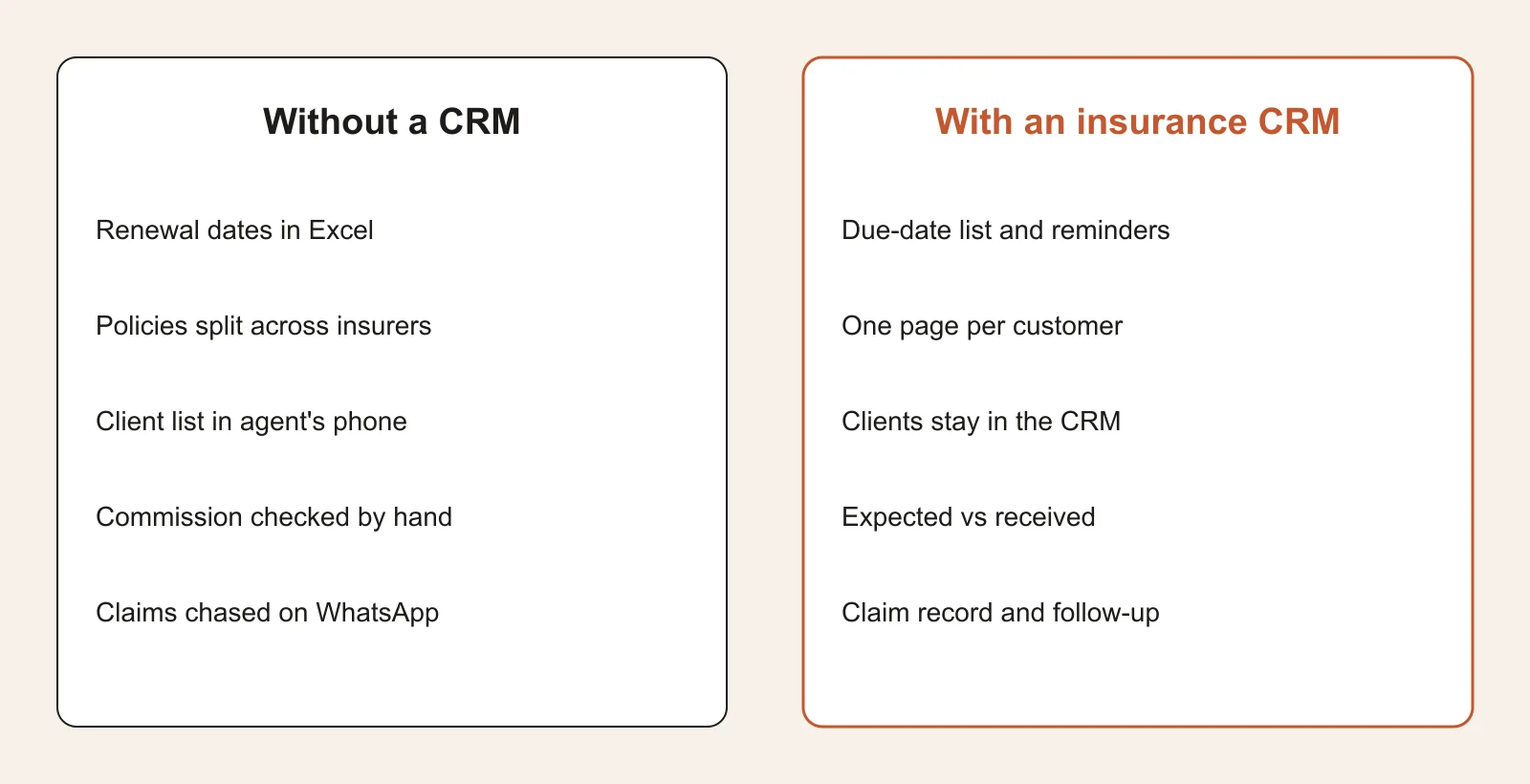
Most agencies lose business in the same six places. Each one maps to a module below.
- Renewals in Excel. Due dates sit in a sheet. Nobody calls in time, and the customer buys from someone else.
- One customer, five insurers. The customer holds policies from five companies. You see only the one you sold.
- The agent leaves, the list leaves. Client names and phone numbers stay in the agent's own phone.
- Commission statements that do not match. Each insurer sends its own format. Checking what you should receive takes days.
- Claims chased on personal WhatsApp. The follow-up history is in one person's chat.
- KYC papers in phone galleries. ID proofs and proposal forms are scattered, and hard to find when the insurer asks.
Who uses it: agent, manager and customer
An insurance CRM has three groups of users. Each one needs a different screen. We design these as example screens first, filled with demo data, so you can change them before we write code. Our field sales CRM app already serves teams that visit customers, and we extend that idea to insurance agents.
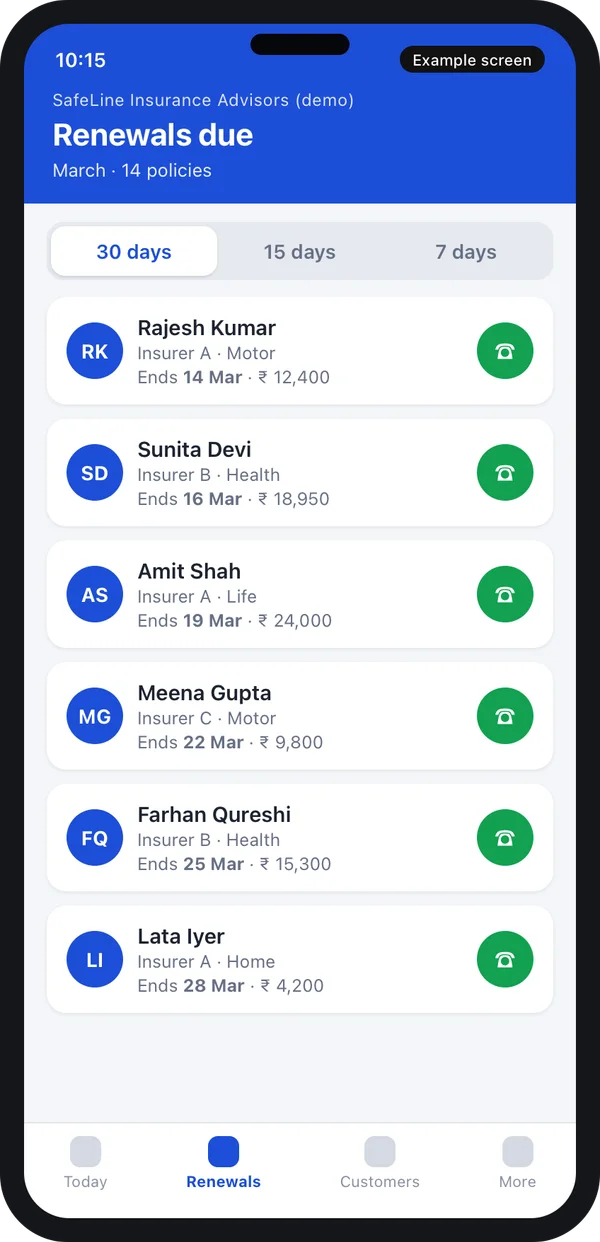
Agent or POSP
Sees today's renewals, adds a lead, uploads KYC papers from the phone.
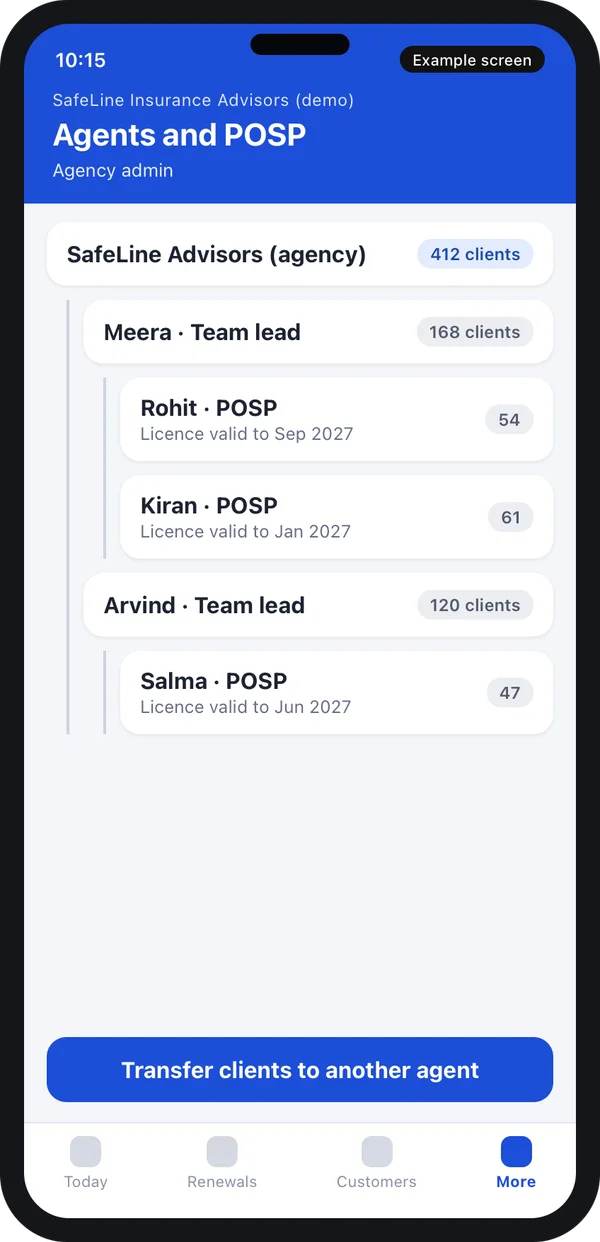
Branch manager or agency head
Sees team renewals due, commission and open claims on the web admin.
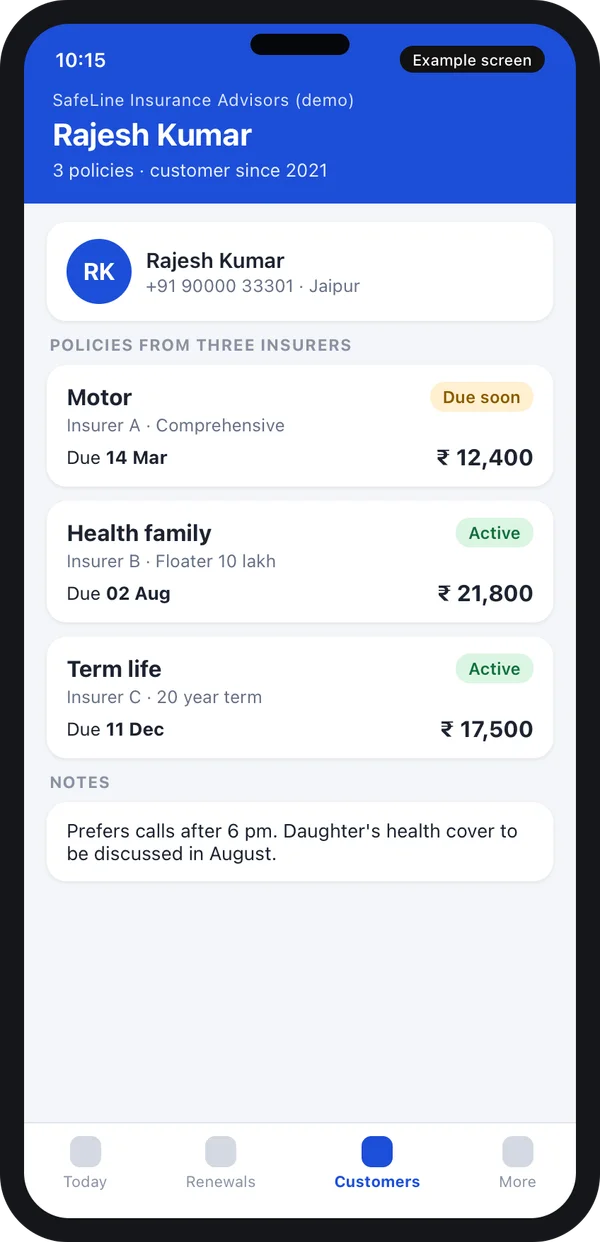
Customer
Opens a page with their own policies, due dates and claim status.
This suits a CRM for insurance agents working alone, a team of life insurance agents, and a broker with many sub-agents. We build the Android and iPhone app in Flutter, so one code base serves both phones. The customer page is built on the same data.
What the CRM keeps: the policy record
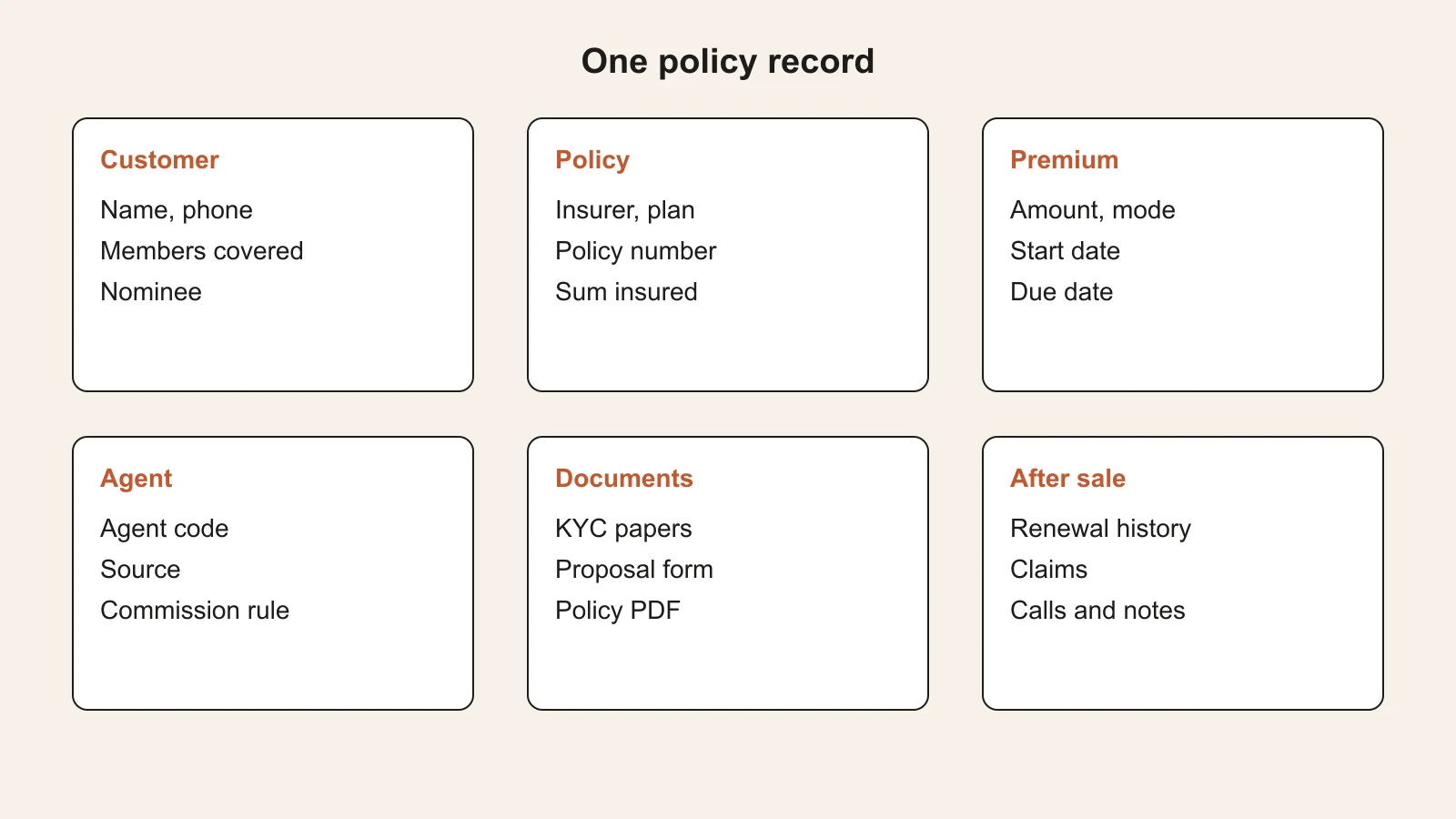
A normal CRM stores a name, a phone number and a deal value. An insurance CRM stores the policy. Life, health, motor and general policies each carry their own fields, and you choose them in settings.
A life insurance CRM needs the sum assured, the term and the premium due dates. A health insurance CRM needs the members covered under a family floater and the waiting-period notes. In this post, health insurance CRM means the agent side: selling and servicing health policies, not a hospital's patient system.
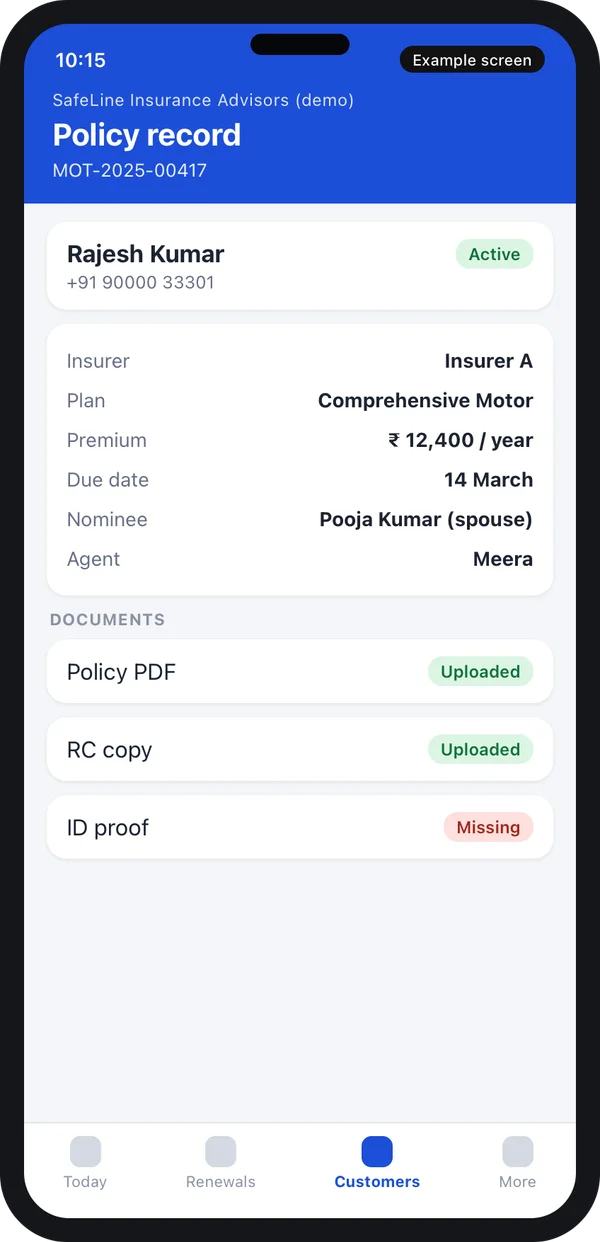
Every record also holds the insurer, plan, policy number, premium, payment mode, start date, due date, nominee, agent code, source and documents.
Insurance CRM features to build
These are the modules we build into your insurance CRM. We set them up around your insurers, products and team.
1. Renewal reminders that run by themselves
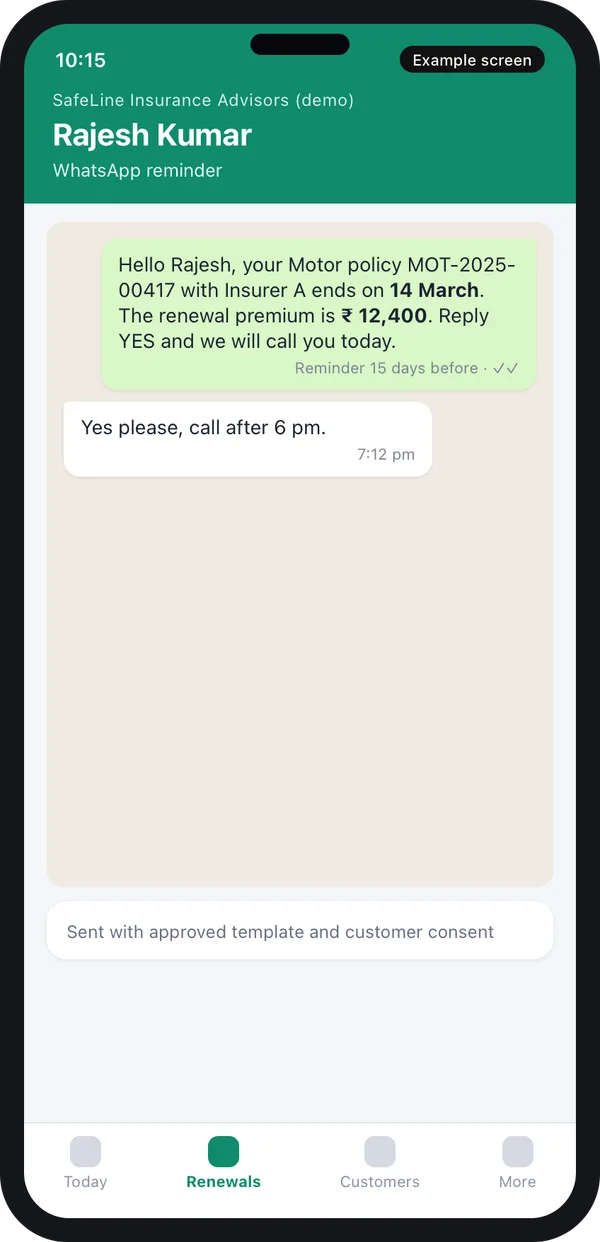
The CRM lists every policy by due date: 30 days, 15 days, 7 days, 1 day and overdue. Each due policy becomes a call task for the agent. It can also send a reminder with the policy name and premium by WhatsApp, SMS or email. When the customer renews, the agent marks it done and enters the new policy number.
This is the part of CRM for insurance sales that protects the most income. For WhatsApp, read how WhatsApp Business API integration works.
2. Many insurers, one customer page
You add an insurer list with each insurer's products, commission rules and portal link. A customer with policies from three insurers sees them all on one page. If the customer moves to another insurer at renewal, that is a move in the pipeline, not a new customer.
3. Agent, sub-agent and POSP hierarchy
The CRM holds a tree: agency, team lead, then POSP or agent. Each person sees their own customers, their team or the whole branch, as you set. If an agent leaves, you move the clients to another agent and the full history stays. This fits a CRM for insurance brokers and for agencies with sub-agents across India.
The role rules come from our ready CRM base. The tree and the client transfer are built for you. We built a similar partner tree for a partner portal in another industry, and a partner and referral CRM.
4. Commission tracking
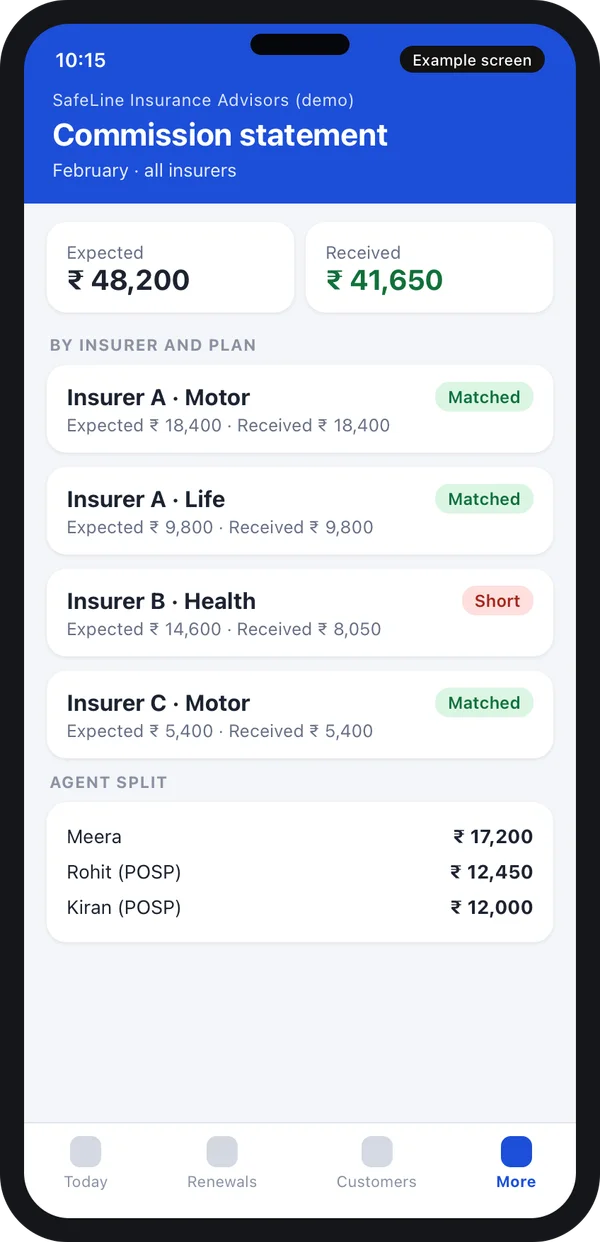
You enter the commission rates for each insurer, plan and policy year, such as first year and renewal years. The CRM then shows the expected commission, the amount received and the difference. It also splits the share between agent and sub-agent and prints a statement for each agent. The software does not invent any rate. You enter them. This is a record of commission, not a payout system. For ledgers and payment flows, see our fintech software work.
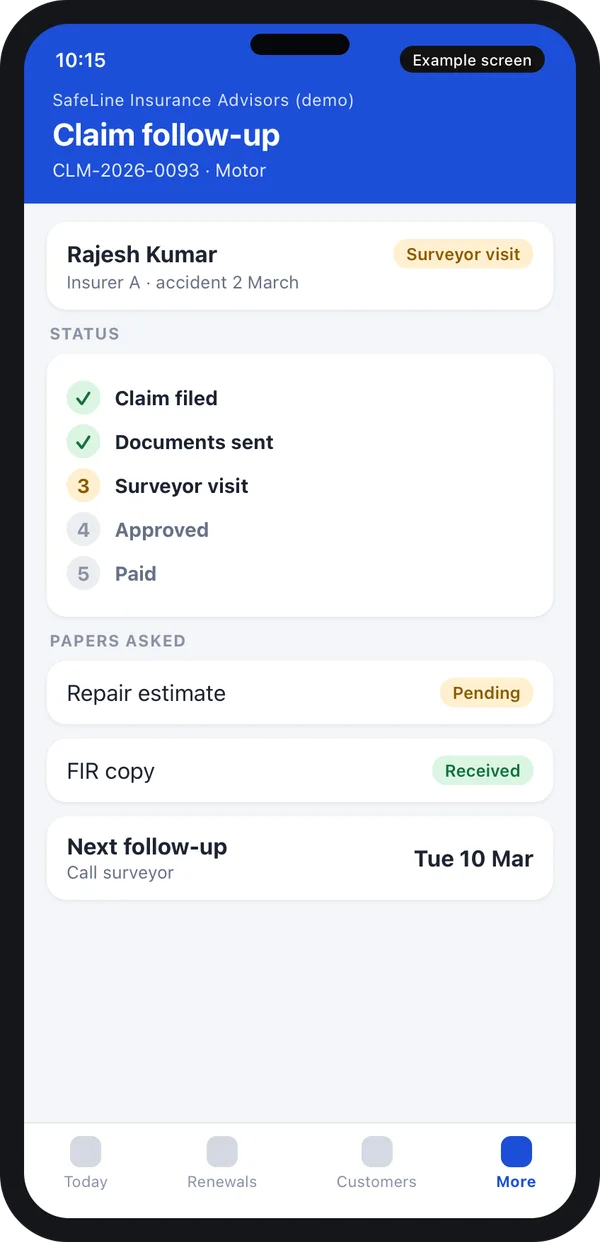
5. Claims follow-up
A claim record sits under the policy. It holds the claim date, type and insurer claim number. It also holds the papers asked for, the status steps, the next follow-up date and who is chasing it. If a claim has no update for a number of days you set, the CRM reminds the owner.
We build tracking and reminders. The insurer decides the claim, not the CRM.
6. KYC and policy documents
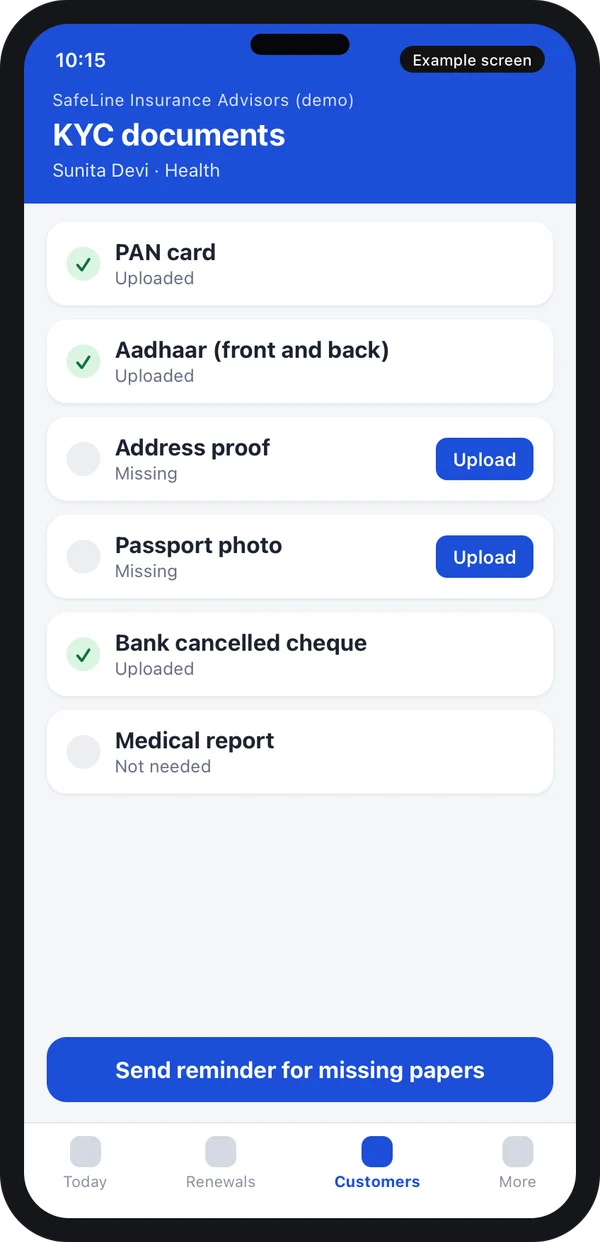
The agent uploads ID proof, address proof, photos, the proposal form and the policy PDF from the phone. A checklist for each product shows what is missing. You decide which role can open which file, and the history shows who changed a record.
7. Leads, quotes and the new-business pipeline
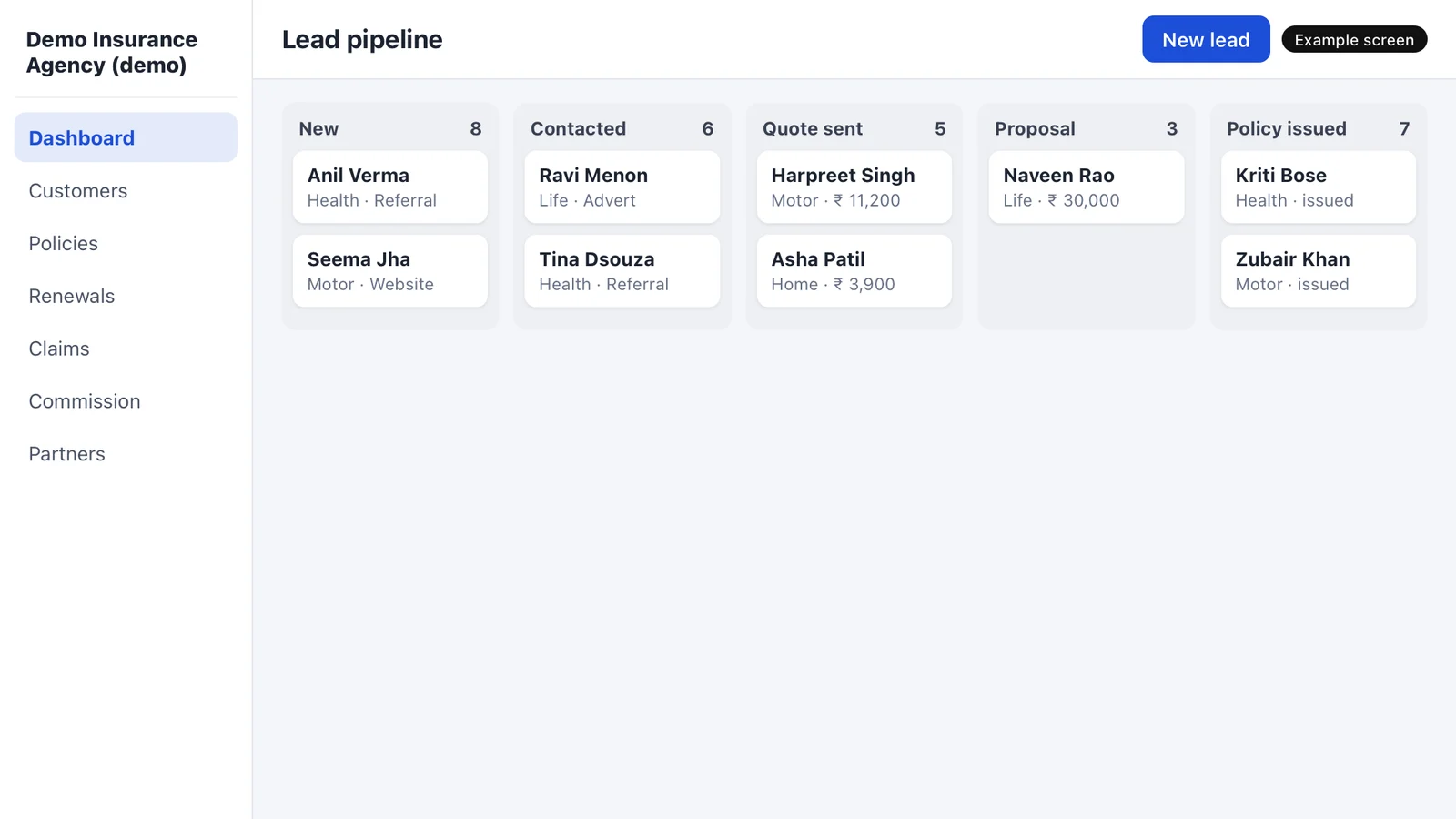
New leads arrive from your website form, calls, referrals and portals. Each lead gets an owner and a follow-up date, and moves through stages for each product line. We can add a sheet that compares quotes from several insurers for one customer. The pipeline board comes from the ready CRM base.
8. Reports the head of agency opens every day
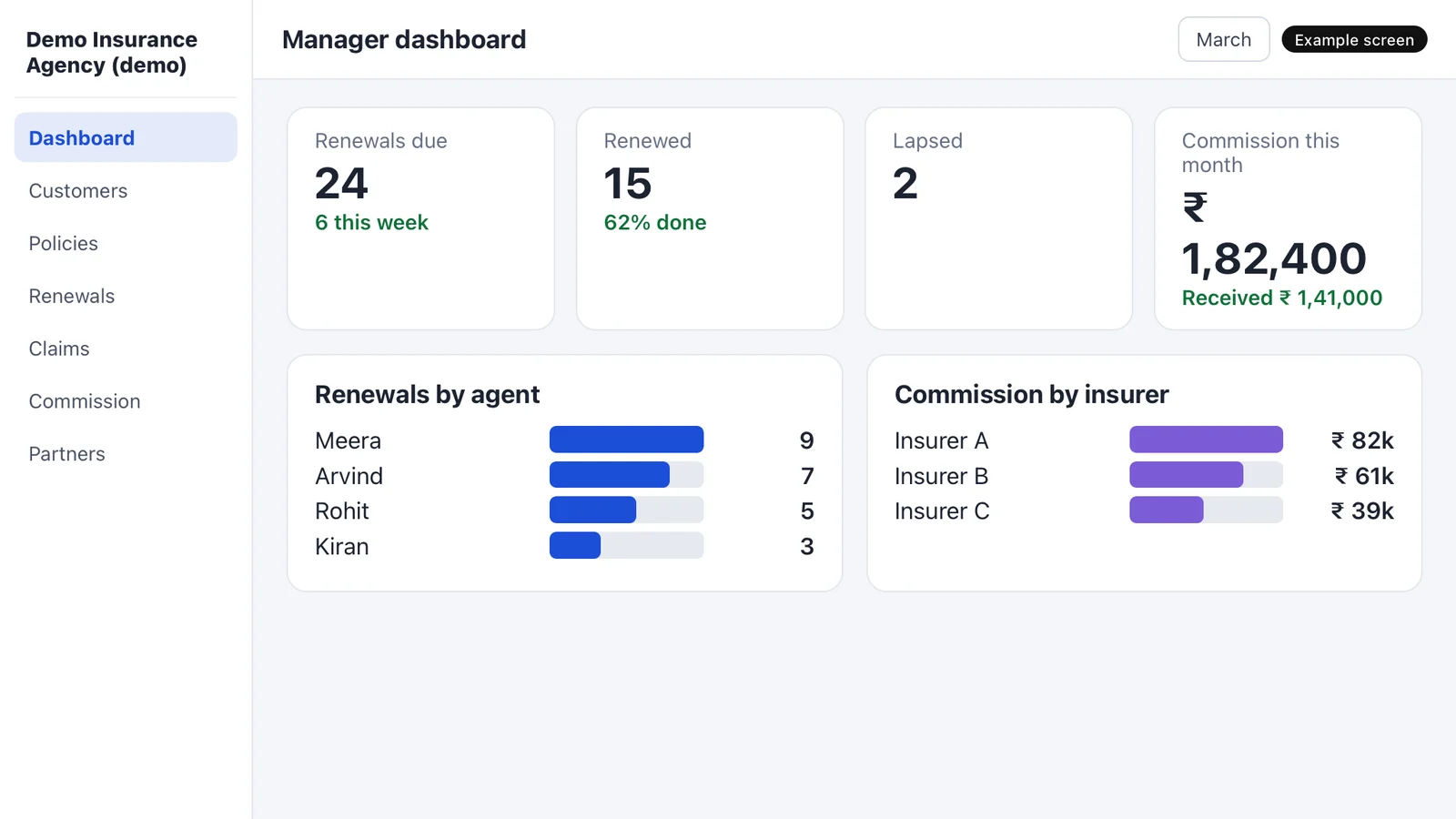
Renewals due against renewals done, lapsed policies, and premium by insurer. Commission by agent, claims open for more than a set number of days and leads by source. These sit alongside the 30 ready reports in the base CRM.
Insurance rules the CRM is built around
Check the current rules with your compliance adviser. IRDAI publishes the regulations for insurers and intermediaries. Ask your adviser which ones apply to Points of Sales Persons (POSP). We build a field for each POSP's code and training proof, and a "service due" reminder. You enter the values.
Customer data falls under India's Digital Personal Data Protection Act, 2023. We build consent notes and role-based access. We build the fields and reminders; we do not give legal advice.
Custom insurance CRM vs a ready-made or free CRM
People search for a free CRM or the best insurance CRM. We do not rank products. A better way is to ask five questions of any CRM: Does it keep policies by insurer? Does it keep the renewal date? Does it hold an agent tree? Does it track commission by insurer and year? Does it track claims? Then compare.
| What you need | Free or generic CRM | Insurer or aggregator portal | Your own CRM built by us |
|---|---|---|---|
| Policy and renewal record | Usually not | Only that insurer's policies | Yes, all insurers |
| Many insurers on one customer page | No | No | Yes |
| Agent and POSP tree | Basic roles | Limited | Built to your tree |
| Commission by insurer and year | No | Own statement only | Yes |
| Claim tracking | No | Own claims only | Yes |
| WhatsApp renewal reminders | Rarely | No | Yes |
| Your brand on the apps | No | No | Yes |
| Source code and data location | Vendor's | Insurer's | Yours |
| Cost pattern | Free to start, per user later | Free to agents | One build, then optional support |
A worked example: one health policy, from enquiry to renewal
Here is how one customer moves through an insurance CRM. The names are examples. Insurers are shown as A, B and C.
- Enquiry. Neha asks about a family health plan. The agent adds the lead and uploads her KYC papers from the phone.
- Quote. The agent compares plans from Insurer A, B and C on one sheet and shares it with her.
- Policy issued. She picks Insurer B. The agent creates the policy record with the premium, members covered and due date.
- Reminders. The CRM sends a WhatsApp reminder at 30, 15 and 7 days before the due date. It adds a call task for the agent.
- Renewal. Neha pays. The agent marks the policy renewed, enters the new policy number and adds the commission entry.
- Claim. Mid-year, a hospital claim is logged against the policy with the papers asked for.
- Follow-up. The CRM reminds the agent every few days until the insurer settles the claim.
Our service
How we build your own insurance CRM
A CRM made around your insurers and your team. We build in India for Indian agencies, brokers and POSP teams, with Hindi and English screens.
- Understand your process. We map your model: agency, broker or POSP, your products, your insurers and your reports.
- Design the screens. You click through example screens first and change them before any code is written.
- Build the apps. We start from our ready CRM and add the insurance modules. A web admin for the office and a phone app for agents, with a Laravel back end.
- Test with your agents. Your team tries it on real policy samples. We fix what they find.
- Launch under your brand. Your name and logo on the apps. We set it up on your own AWS or server, or we host it for you.
- Support and grow. Daily backups come with the setup, and an optional AMC covers support. We add insurers and products as you grow.
We also built a medical exam scheduling system for an insurance business.
Insurance CRM development cost: what decides it
Every insurance business is different, so we do not publish a fixed price. The cost of an insurance CRM depends on these things:
- How many insurers and products you handle.
- Which lines you sell: life, health, motor or general, each with its own fields.
- How deep your agent tree is.
- How complex your commission rules are.
- Which channels you use: WhatsApp, SMS and email.
- How much old Excel data we must import.
- Whether you want a customer page or app.
- How many reports and languages you need.
- Where it is hosted: your server or ours.
| Monthly CRM plan | Custom insurance CRM (built for you) | |
|---|---|---|
| Start | Quick, low first payment | Takes a few weeks to build |
| Cost over years | Pay every month, for every user | One build cost, then optional support |
| Renewals, insurers and commission | Usually not, or with heavy changes | Built in, the way you work |
| Your brand on the apps | No | Yes |
| Data and source code | Stay with the vendor | Yours |
Share your insurers, products and team size, and we will send a written quote after one call. Contact us to start with one call.
Your brand, your data, your source code
When we finish, the insurance CRM belongs to you. Your name and logo are on the web admin and the apps. We hand over the full source code. Your data sits on your own server or cloud, or on a server we host for you. You can export it at any time.
Access is role-based, so an agent sees only the customers you allow. A history of changes shows who edited a record, and daily backups protect the data. These are the insurance CRM solutions most agencies ask for first. If you run several agencies that need separate logins, read about white-label CRM for agencies and resellers or our SaaS development service.
Whoever builds your insurance CRM, make sure it can:
- Keep a policy record with insurer, premium and due date
- Show renewals by 30, 15, 7 and 1 day, and overdue
- Show all policies of one customer from many insurers
- Hold an agent and POSP tree with client transfer
- Track commission by insurer, plan and policy year
- Track claims with a next follow-up date
- Store KYC papers with role-based access
- Let you export your data whenever you want
FAQ
What is CRM in insurance?
A CRM in insurance keeps every customer, policy, renewal date, paper and claim in one place, so agents follow up on time. We build it to your insurers and your team.
How is an insurance CRM different from a normal sales CRM?
A normal CRM ends at "deal won". An insurance CRM keeps the policy, the yearly renewal, the insurer, the commission and the claims after the sale.
Can it handle many insurers?
Yes. We add an insurer list with products and commission rules. One customer page shows all of their policies.
Can we send WhatsApp renewal reminders?
Yes, through the WhatsApp Business API or a ready WhatsApp message, as you choose. You write the message wording. Customers should have agreed to receive messages.
Does it work for POSP and sub-agents?
Yes. We build a tree of agency, team lead and POSP or agent. Each person sees only what you allow. Check the IRDAI regulations for POSPs with your adviser.
Is a free insurance CRM enough?
A free CRM is fine to start with leads. It rarely has insurer-wise policies, commission splits or claim follow-up. An own build is for when those matter to you.
How long does it take, and who owns it?
The time depends on your insurers, products and data import. We give a plan with dates after one call. You own the brand, the data and the source code.
Is customer data safe?
We build role-based access, a history of changes and daily backups, on your own server or cloud. We build to the data-protection steps you choose with your adviser.
Related guides
- WhatsApp CRM Software Development Company in India
- Real Estate CRM Software Development in India
- Hospital CRM Development Company in India: Build Your Own
- What Is CRM? Meaning, Full Form and Examples in India
- Cloud Based CRM Platforms: Build Your Own or Rent a Seat
- Recruitment CRM Software Development for Agencies
Written by
Prabhjot Kaur · Product Manager
Product Manager at PRS India. Turns what a client needs into a screen-by-screen plan for the app, and checks every release against that plan before it goes out.