How Do Taxi Apps Make Money: Revenue Model Guide
See every way a taxi app earns, from ride commission to driver plans and ads, and how PRS India builds your own app with the income lines you choose.

Written from production. Our articles draw on products we run live and the client work behind them, and are revised as the systems they describe evolve.
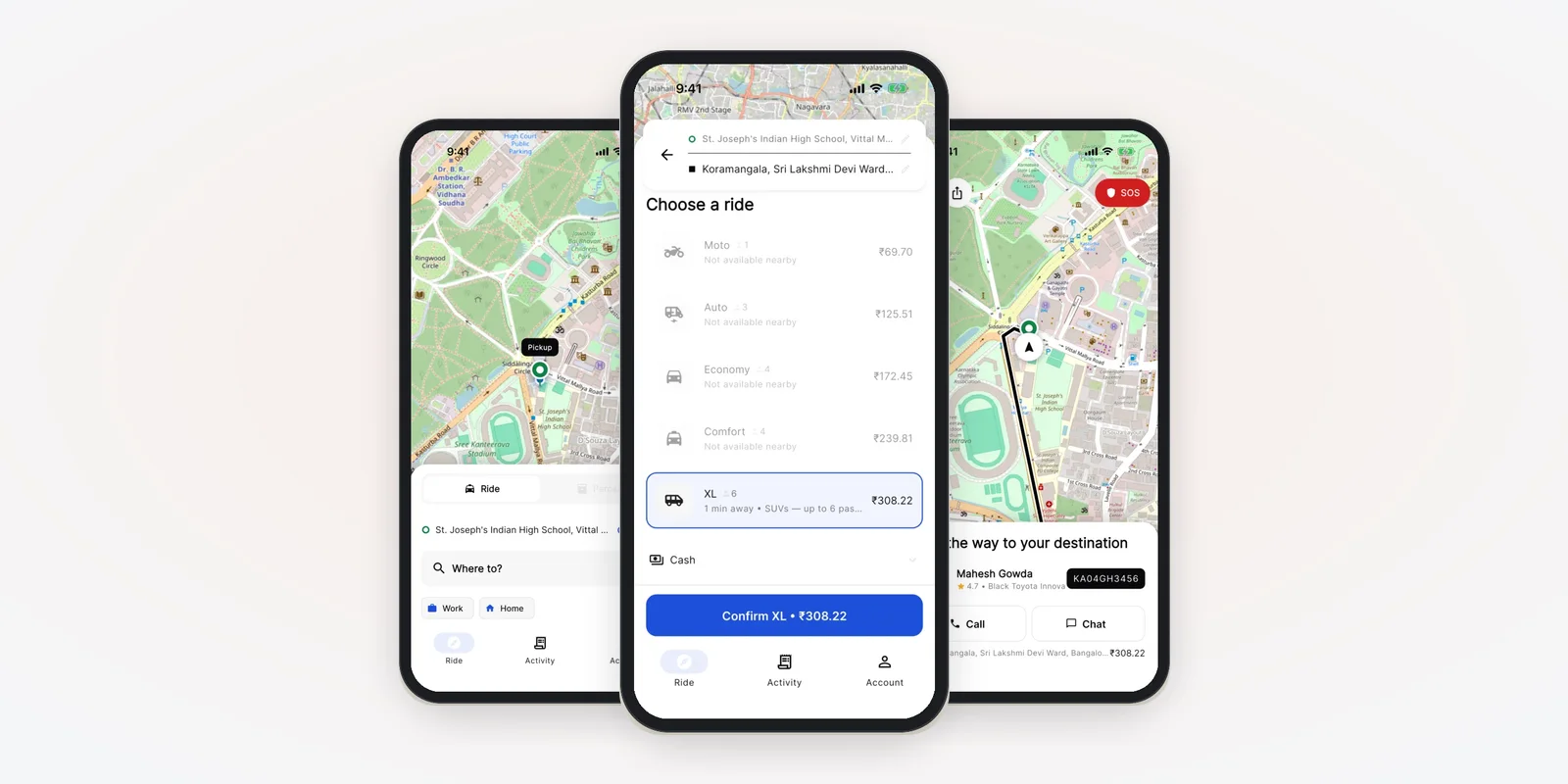
Every taxi app owner asks the same question before the first line of code: how do taxi apps make money? Many think the answer is one line, a cut of every ride. In real life a taxi app earns from several places. Some of them have nothing to do with the fare.
This guide lists every way a ride app can earn, and what each one needs inside the app. If you plan to build your own taxi app, you choose the mix. The mix is a business choice, and the software must be built to match it. PRS India builds that software for you, under your brand.
Key takeaways
- A taxi app can earn from ride commission, driver plans, advertising, peak-time charges, and extra services such as parcels and rentals.
- Each income line needs its own screens, rules and reports. A line you do not build into the app cannot be switched on later by a setting.
- Most new owners start with one or two lines and add more after the first city is running.
- The owner needs one revenue screen that shows every line side by side, so a weak line is seen early.
- When we build it for you, the money rules, the data and the source code are yours.
The short answer: where the money comes from
A ride app is a marketplace. Riders are on one side and drivers are on the other. The app owner sits in the middle and earns by running that meeting place. There are five common ways to earn from it.
- Ride commission. The app keeps a share of each completed trip and pays the rest to the driver.
- Driver plans. The driver pays a fixed fee for a day, a week or a month, and keeps the whole fare.
- Advertising. Local shops pay to show a banner or a sponsored place inside the app.
- Peak-time charges. The fare rises in busy hours, and the app owner decides how the extra is shared.
- Extra services. Parcel drops, rentals, outstation trips and corporate accounts bring their own income.
Big ride apps use more than one of these at the same time. A small operator can do the same, one line at a time.
Ride commission: a share of each trip
This is the oldest model. The rider pays the fare. The app keeps a share and sends the rest to the driver. The share can be the same for all trips, or it can change by city, by vehicle type or by time of day.
The model is plain to explain to investors, because income grows with every ride. The weak point is the driver. A driver who feels the share is too high will switch to another app, or take trips outside the app. If you pick commission, the app needs clear receipts that show the driver exactly what was kept.
What the app must show
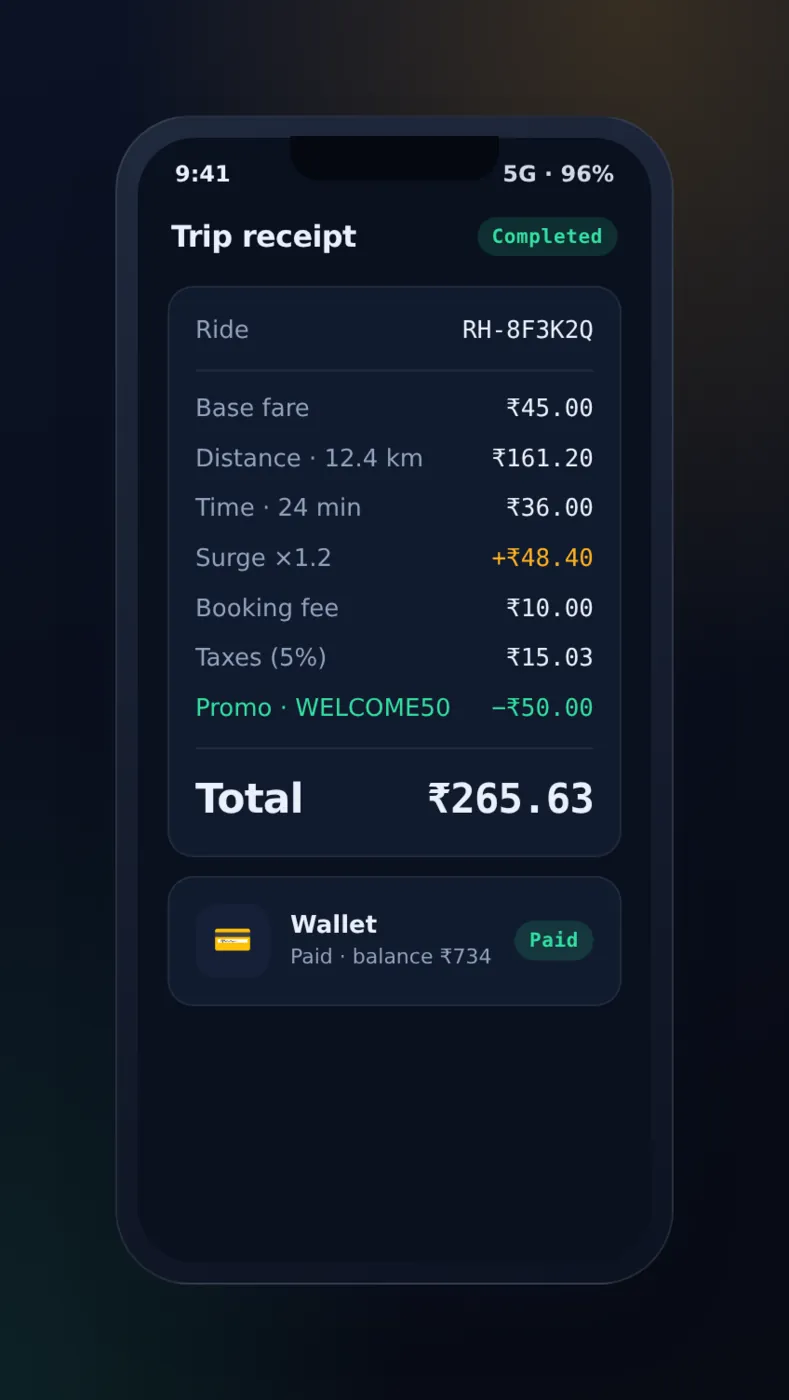
The rider sees the fare before booking. After the trip, both sides see a receipt. The driver's receipt lists the fare, the share kept by the app and the amount paid out.
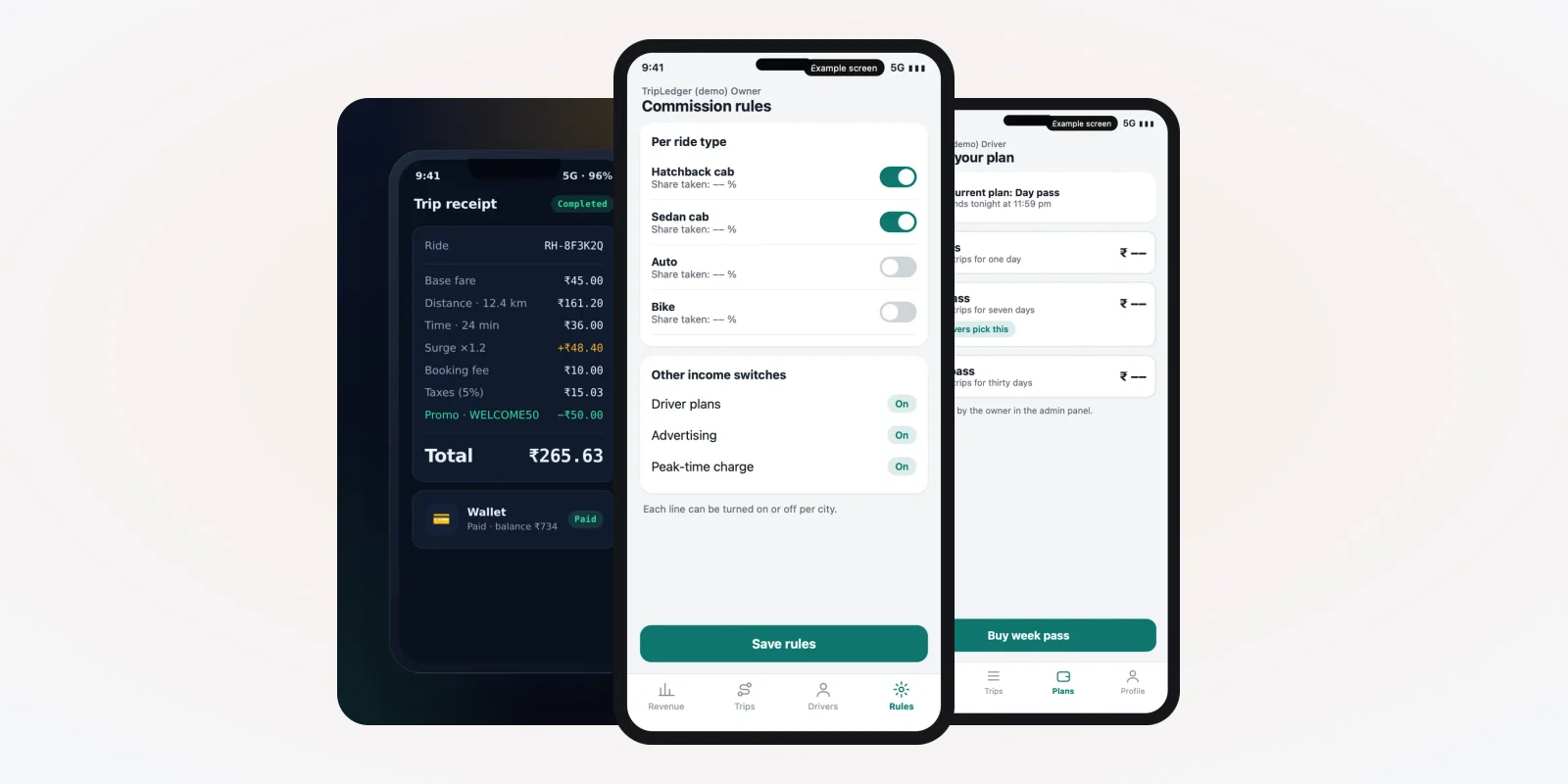
The fare screen below is from a taxi app we built, with demo data. It breaks the fare into its parts, which is the base for any commission rule.
Commission rules the admin panel needs
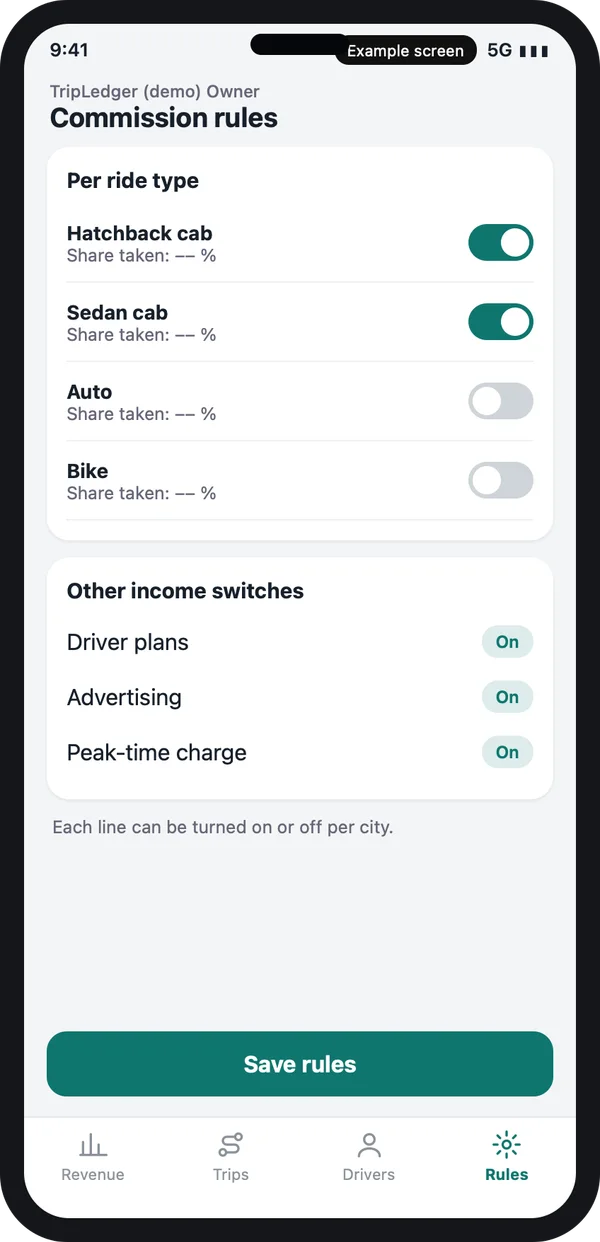
A fixed share is not enough for real use. The owner needs to set the share per vehicle type and per city, and to switch it off for one group, such as a new driver in the first week. The design below shows such a rules screen.
Driver plans: fixed fee instead of a share
In this model the driver pays a fee to use the app, and the app takes nothing from the fare. The fee may be for a day, a week or a month. The driver can do many rides or few; the fee does not change.
It suits busy cities, where a driver does many trips. It also feels fair to drivers, because the cost is known in advance. The app owner gets steady income, even on slow days. The app then needs a plan page, payment in the app, a pass that ends on time and a reminder before it ends. Some plans run on the open mobility network backed by ONDC, where the app takes no share of the fare. We cover that model in a separate guide.
The plan page in the driver app
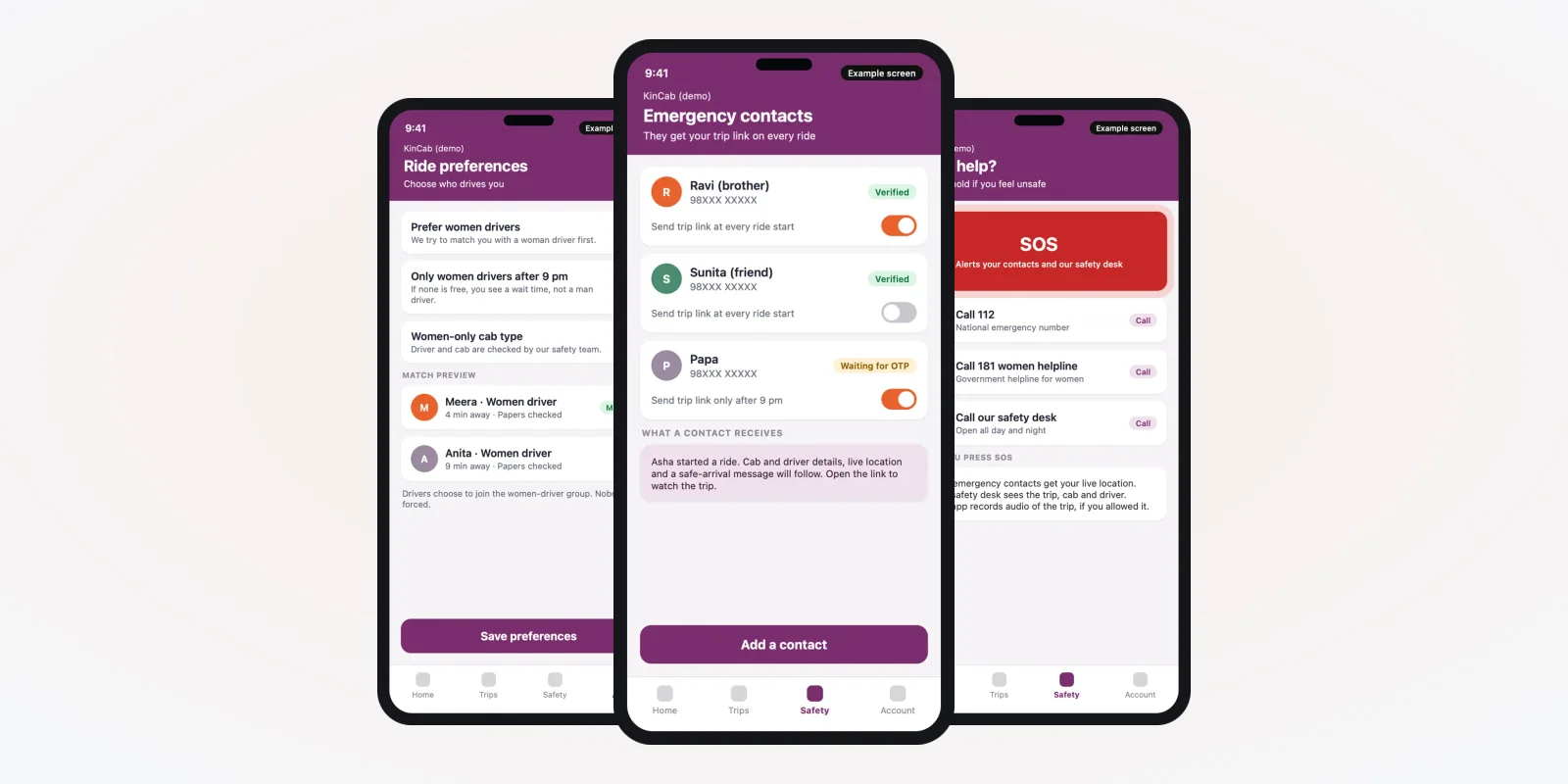
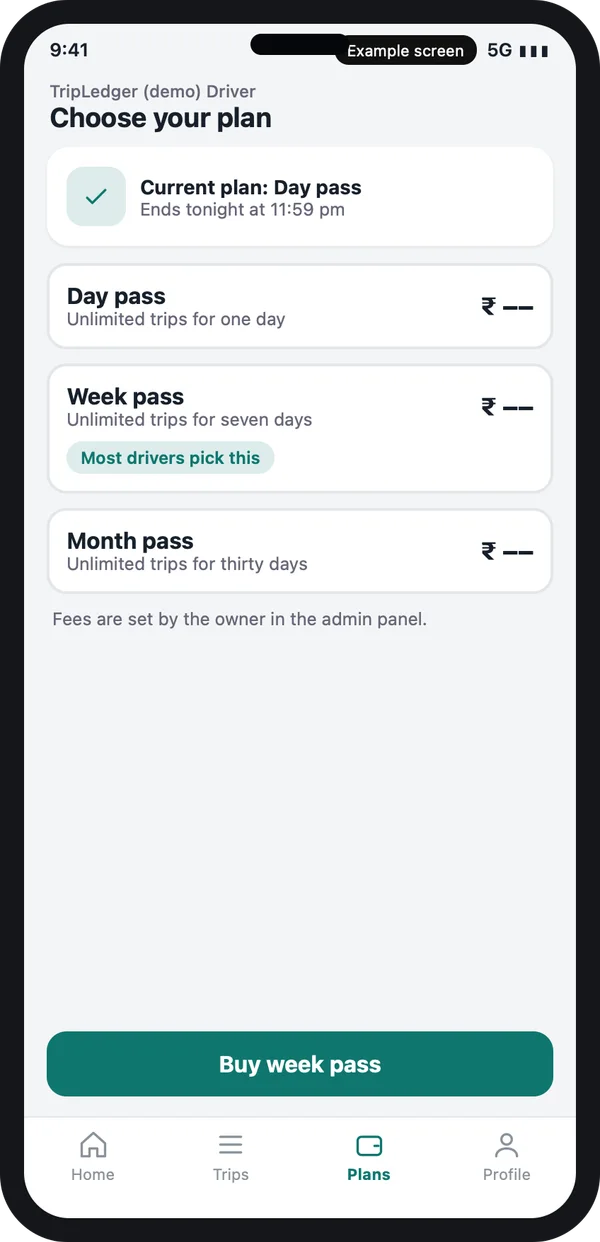
The driver sees the current plan, when it ends, and the other plans. One tap buys a new pass. The driver can go online only while a pass is active, and the app blocks new requests when it ends.
Advertising: local brands pay for a place in the app
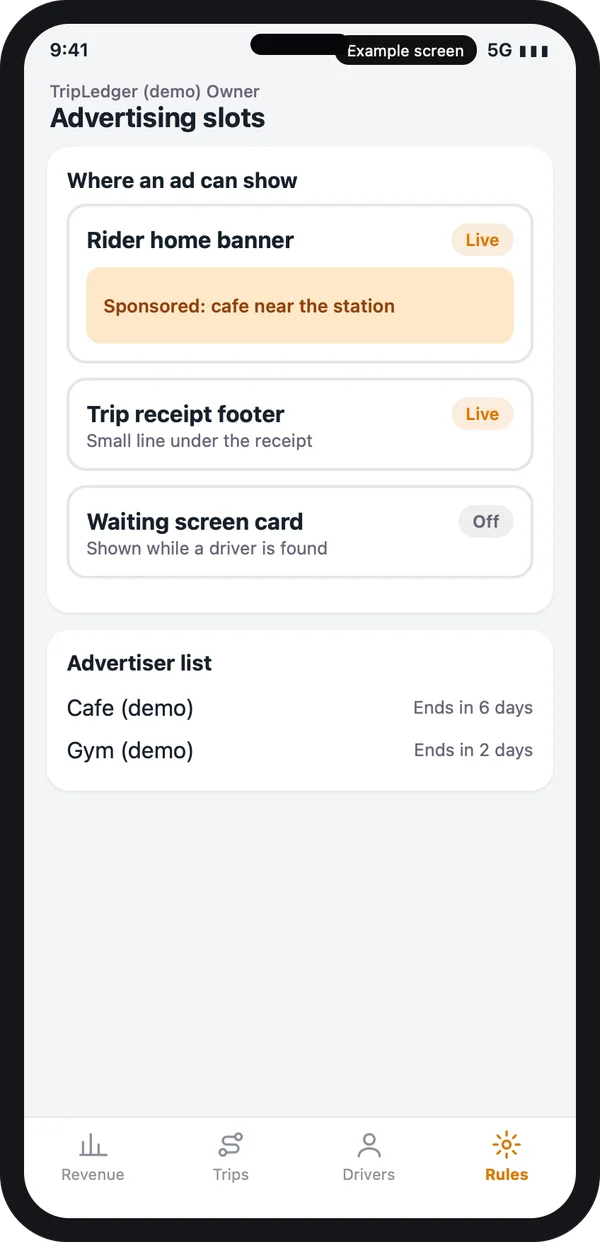
A ride app is opened many times a day. That makes a banner on the home screen worth something to a nearby shop, a cafe or a gym. Some owners also sell a line at the bottom of the trip receipt, or a card on the screen where the rider waits for a driver.
Ads are a small line at first. They grow only when the app has many daily users. The software side is light: ad slots, a start and end date for each ad, and a switch to turn a slot off. Rider data should not be handed to advertisers. The Digital Personal Data Protection Act, 2023 sets rules for personal data, so plan for consent. Read the official page at MeitY data protection framework.
Peak-time charges: when demand is high
When many riders ask for rides in the same place, the fare can go up for a short time. This brings more drivers to that place and trims the number of requests. The extra amount can be kept by the app, shared with the driver, or both.
This line needs care. The central government issued Motor Vehicle Aggregator Guidelines in 2025 that deal with items such as how far a fare can rise and what share goes to the driver. Check the latest text on the Ministry of Road Transport and Highways site, and then ask the transport department of your state what applies to you. Your app should let you set a limit per zone and per hour, and show the rider the change before booking.
Rules the owner sets
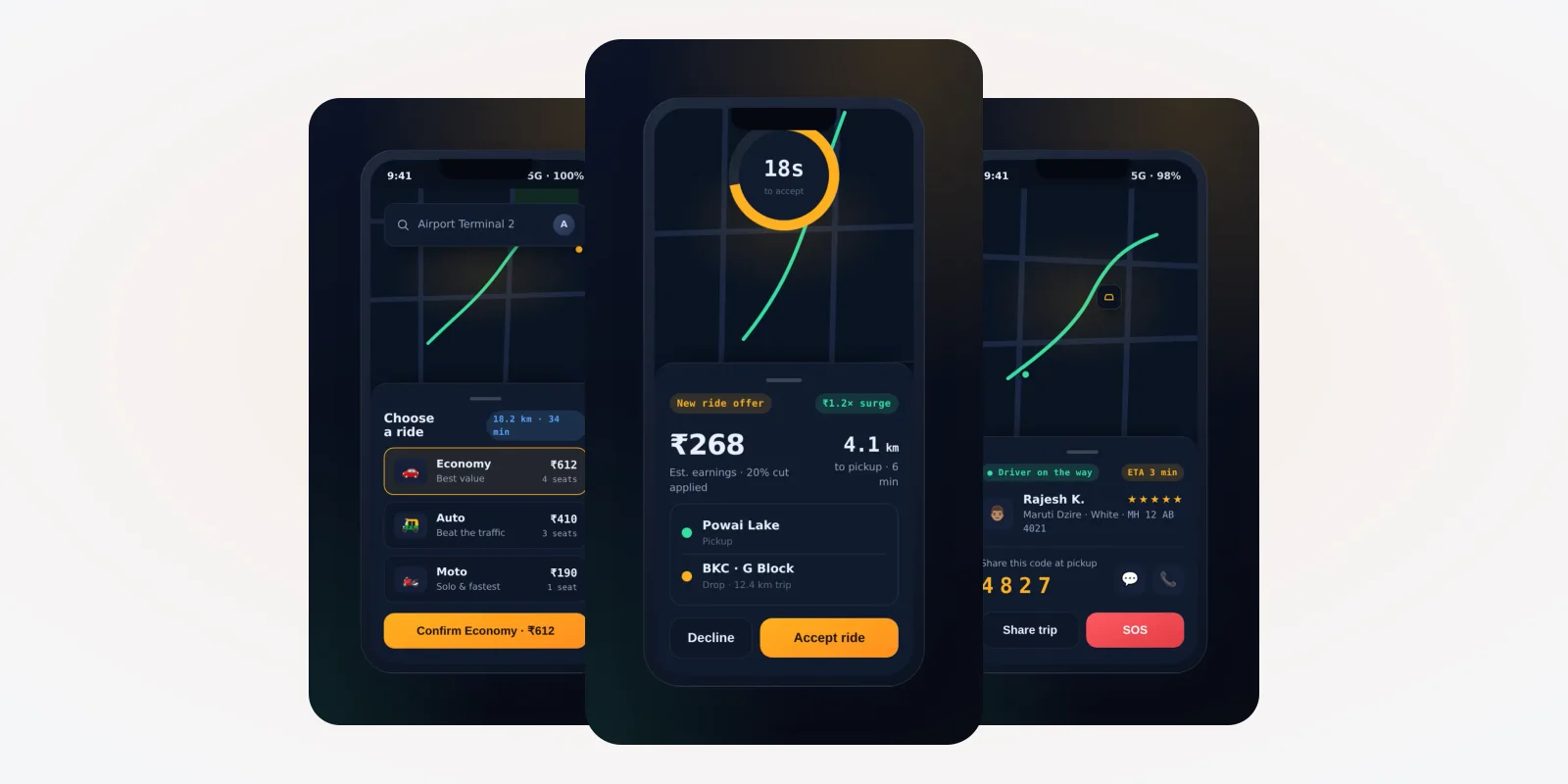
The owner draws a zone on the map, picks the days and hours, and sets how far the fare may rise. The rider sees the change on the booking screen, before confirming.
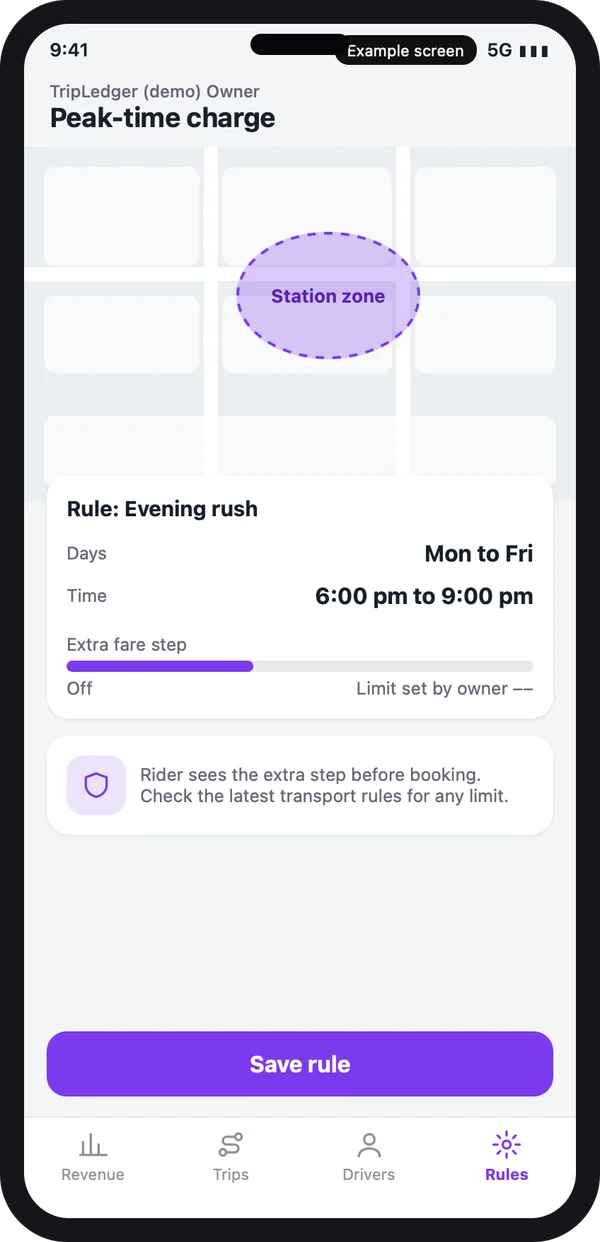
An AI model can later predict busy zones from past trips and suggest the zones for you. That is an add-on, not a day-one need. See our AI and machine learning development service.
Extra services on the same app
Once riders and drivers use the app, you can sell more on the same base.
- Parcel drops: a driver with spare time carries a small package. The fare is set by distance.
- Rentals and outstation: a rider books a car for hours or for a city-to-city trip.
- Corporate accounts: a company books rides for staff and pays one bill each month.
- Airport and station pickups: fixed pickup points with their own fare card.
The core build is the same; each service needs its own fare rules and booking screen. For the rental angle, see our guide on how to create an app like Ola, and compare the choices in Ola alternatives in India.
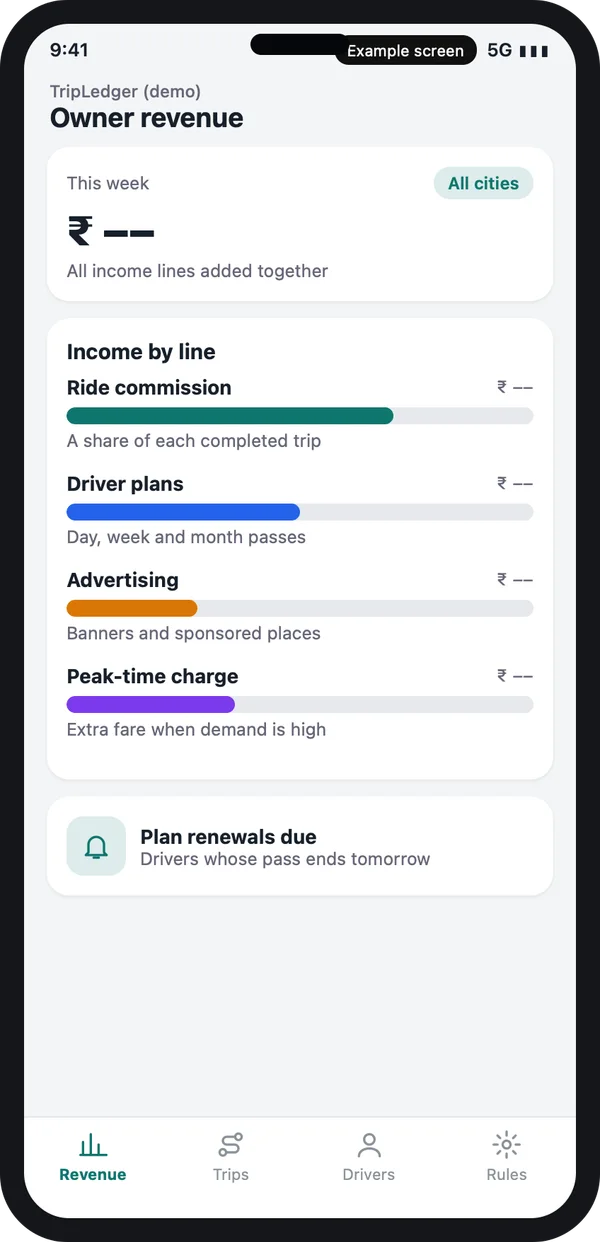
What the owner sees: one revenue screen
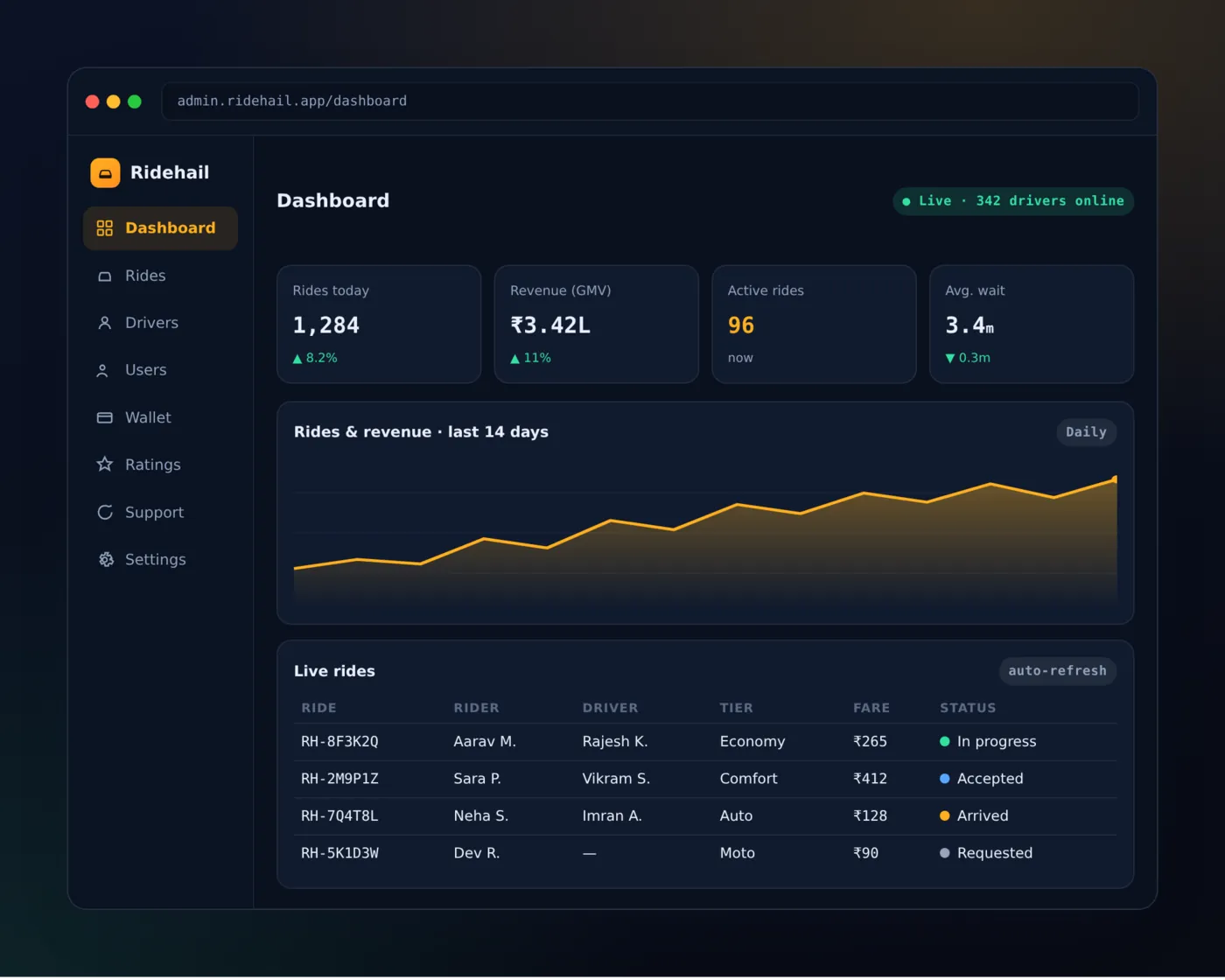
If you run several income lines, you need to see them together. The owner dashboard shows each line as its own bar, the total, and the payments due. It lets you see at once that, say, driver plans are doing well while ads are not.
How the money moves through the app
The rider can pay in cash, by UPI or card, or from a wallet. Money paid online must pass through a licensed payment gateway. The Reserve Bank of India regulates payment aggregators; read its rules at the RBI website and ask your gateway what it needs from you.
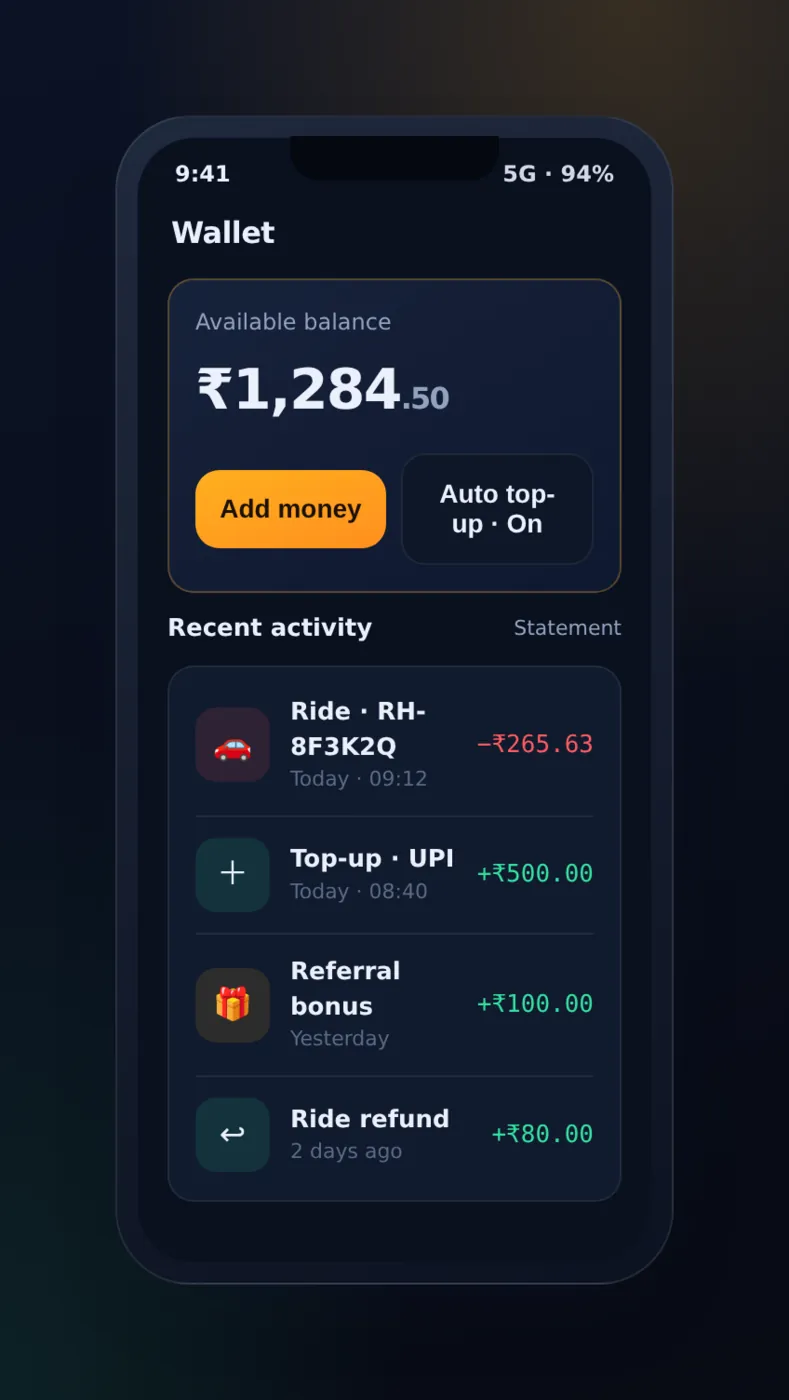
Wallet and cash trips
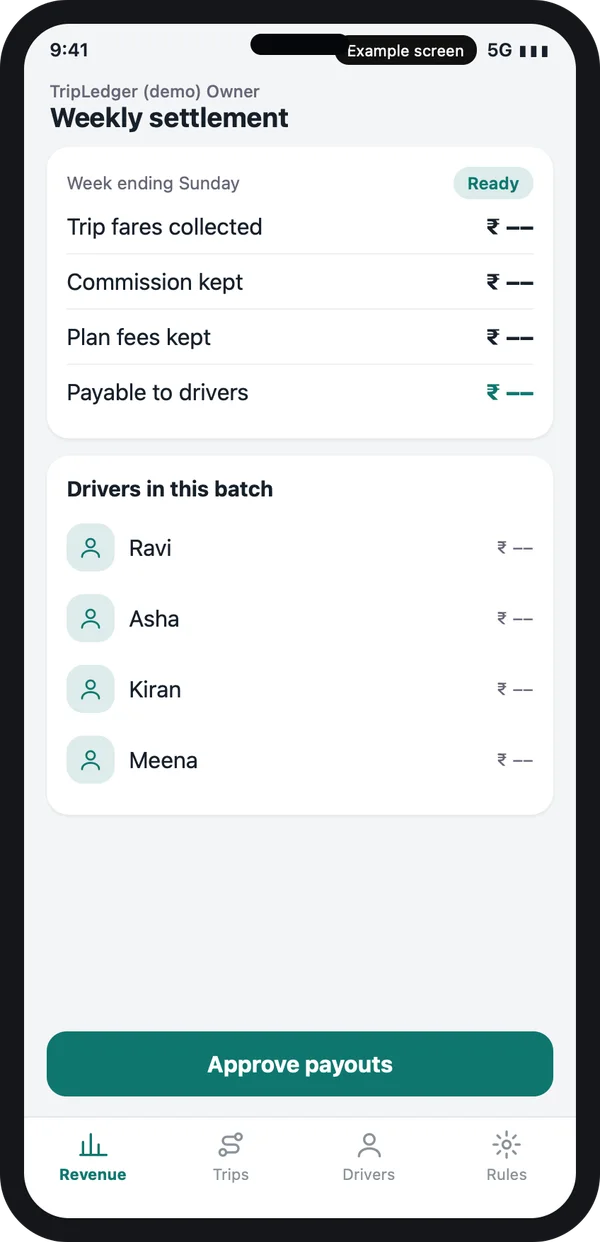
A wallet lets the rider top up once and pay fast. For cash trips, the app must record the cash the driver collected, so the owner can settle the share due at the end of the week.
The weekly settlement is the screen your accountant will ask for. It lists fares collected, shares kept, plan fees kept and what is payable to each driver. Build it first, not last.
Which income line fits which business
| Income line | Suits | Main risk | What the app needs |
|---|---|---|---|
| Ride commission | New apps with few drivers | Drivers leave if the share feels high | Share rules, driver receipts |
| Driver plans | Busy cities with full-time drivers | Drivers quit on slow days | Pass purchase, expiry, reminders |
| Advertising | Apps with many daily users | Few buyers at the start | Ad slots, dates, reports |
| Peak-time charge | Cities with clear rush hours | Rider anger, rule limits | Zones, hours, limits, notice |
| Extra services | Apps with a steady driver pool | More fare rules to manage | Booking screens per service |
Worked example: a city cab operator picks a mix
An operator runs a cab business in a mid-size city with a bus stand, a railway station and a hospital district. He wants his own app.
- Month one. He launches with ride commission only, because it needs the fewest rules.
- After the first drivers settle in. He adds a week pass for full-time drivers, who ask for a fixed cost.
- Station rush. He adds a peak-time rule for the railway station zone, with a limit he sets.
- Local shops ask. Nearby shops ask for a banner. He adds one ad slot on the home screen.
- Review each week. He reads the revenue screen and the settlement list, and changes one rule at a time.
Our service
How we build your own taxi app with the income lines you choose
- We learn how you earn. We ask which lines you want now and which later, and how you pay drivers.
- We design the screens. You click through rider, driver and admin screens before we write code.
- We build. Rider and driver apps on Flutter, an admin panel on the web, and a server behind them.
- We test with your team. Your staff and a few drivers run real trips and settlements.
- We launch under your brand. Your name on the stores, your payment account, your servers.
- We support you after launch. You can add a new income line later as a planned change.
See our build process and the case studies for how we work. The server side can use Laravel and run on your own cloud with our cloud and DevOps team. We treat the money rules as the core of the product, not an add-on.
Taxi app revenue features: what decides the budget
The cost of a taxi app does not depend on the number of income lines alone. These are the factors that move the budget.
- How many income lines you want on day one.
- Whether payments are cash only, or also UPI, cards and a wallet.
- How many cities and vehicle types need their own rules.
- Whether you need weekly settlements and payout files for your bank.
- Ad tools, reports and any link to an accounting tool.
| Custom build | Monthly plan from a vendor | |
|---|---|---|
| Income rules | Built to your mix | Fixed list from the vendor |
| Source code | Yours | Not shared |
| Rider and driver data | On your servers | On the vendor's servers |
| Changing a rule later | Planned change with us | Depends on the vendor |
| Cost pattern | One build, then support | Fee every month |
Read the full cost view in our guides to script versus custom build and white-label taxi booking apps. If you plan an Uber-style build, read how to build an Uber-like app.
Whoever builds it, make sure it can
- Set the share per city and per vehicle type, and turn it off for a group.
- Sell day, week and month passes, and block new requests when a pass ends.
- Show the fare breakdown to the rider and the payout to the driver.
- Record cash collected by drivers and settle it each week.
- Show every income line on one owner screen.
- Give you the source code, not only the apps.
Our checklist of must-have taxi booking app features covers the rest of the app.
FAQ
How do taxi apps make money in India?
Most earn from a share of each ride, fixed fees paid by drivers, advertising and extra services such as parcels. Many use more than one at the same time. The mix is a business choice that you make before the build.
Which income line should a new taxi app start with?
Most new apps start with ride commission or a fixed driver plan, because both need few rules. Add advertising and peak-time charges later, when the app has steady daily users.
Can I change the income model after launch?
Yes, if the app was built with rules you can change. Share, plan fees and peak-time limits should be settings in the admin panel. A brand new income line is a planned change that we build and test.
Do I need a payment gateway?
Yes, for card, UPI and wallet payments. Cash trips need no gateway, but the app must still record the cash. We connect the gateway you choose and check its rules with you.
Are peak-time charges allowed?
The 2025 aggregator guidelines from the central government deal with this. States can set their own rules. Check the latest rules with the transport department before you switch it on.
How long does it take to build a taxi app with these lines?
It depends on how many lines and cities you need. We give a plan with dates after one call and a look at your list.
Who owns the app and the data?
You do. The brand, the rider and driver data and the source code are handed to you.
Which platforms do you build for?
Android and iPhone apps for riders and drivers, and a web admin panel for your office.
Can PRS India build a taxi app with my own revenue rules?
Yes. We build the rider app, the driver app and the admin panel with the income lines you pick. Book a consultation and we will show you screens for your city.
Related guides
Written by
Aditi
Building software at PRS India.