Business of Software
White-Label Taxi Booking Mobile App: The Complete Guide
What a white-label taxi app really includes, what you can rebrand, who it's for, and the one distinction that decides whether you own your business or rent it.

Written from production. Our articles draw on products we run live and the client work behind them, and are revised as the systems they describe evolve.
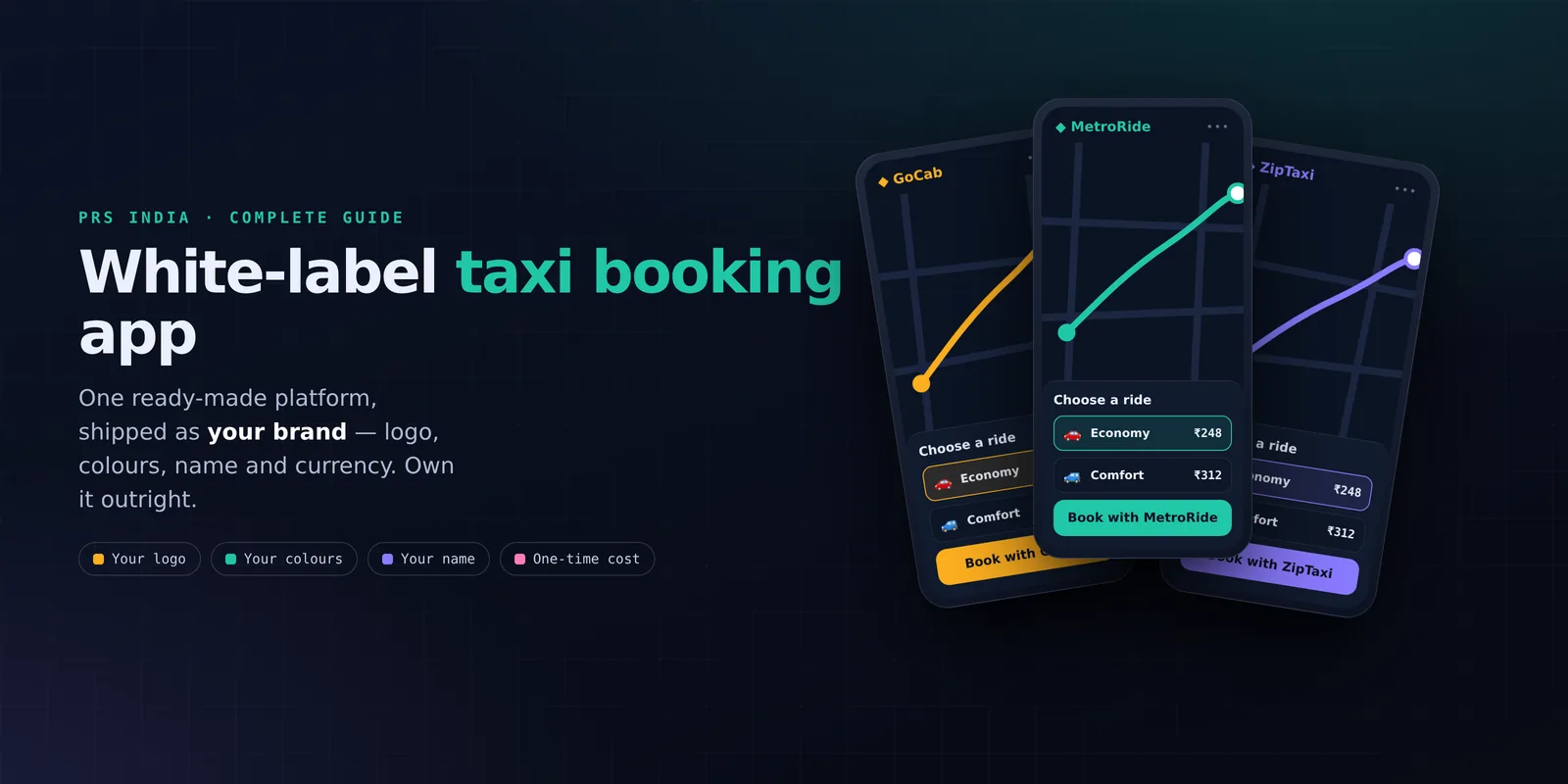
A white-label taxi booking app is a complete, ready-made ride-hailing platform that you rebrand and launch as your own — your logo, your colours, your app name, your fares — without building any of it from scratch.
Instead of a 10–14 month engineering project, you start from a product that already works and make it yours. It sounds simple, and the pitch is everywhere.
But "white-label" is used to describe two very different things, and the difference decides whether you end up owning a taxi business or merely renting one.
This guide covers what a white-label taxi app includes, what you can rebrand, who it's for, how fast you can launch and what it costs. It also covers the one question that separates a real asset from a subscription.
What is a white-label taxi booking app?
"White-label" comes from manufacturing: one company makes a product with no branding, and others put their own label on it and sell it.
Applied to software, a white-label taxi app is a fully built ride-hailing platform — the rider app, the driver app, the admin panel and the backend — delivered so you can drop in your brand and go to market.
The hard engineering (real-time dispatch, maps, fare calculation, payments, safety) is already done and tested. Your job is branding, configuration and launch, not development.
If you want the full breakdown of the moving parts underneath, we cover them in how to create an app like Ola. This guide is about the layer on top: making that platform yours.
What's included, and what you can white-label
A genuine white-label platform hands you the whole product and lets you brand every part your customers and drivers ever see.
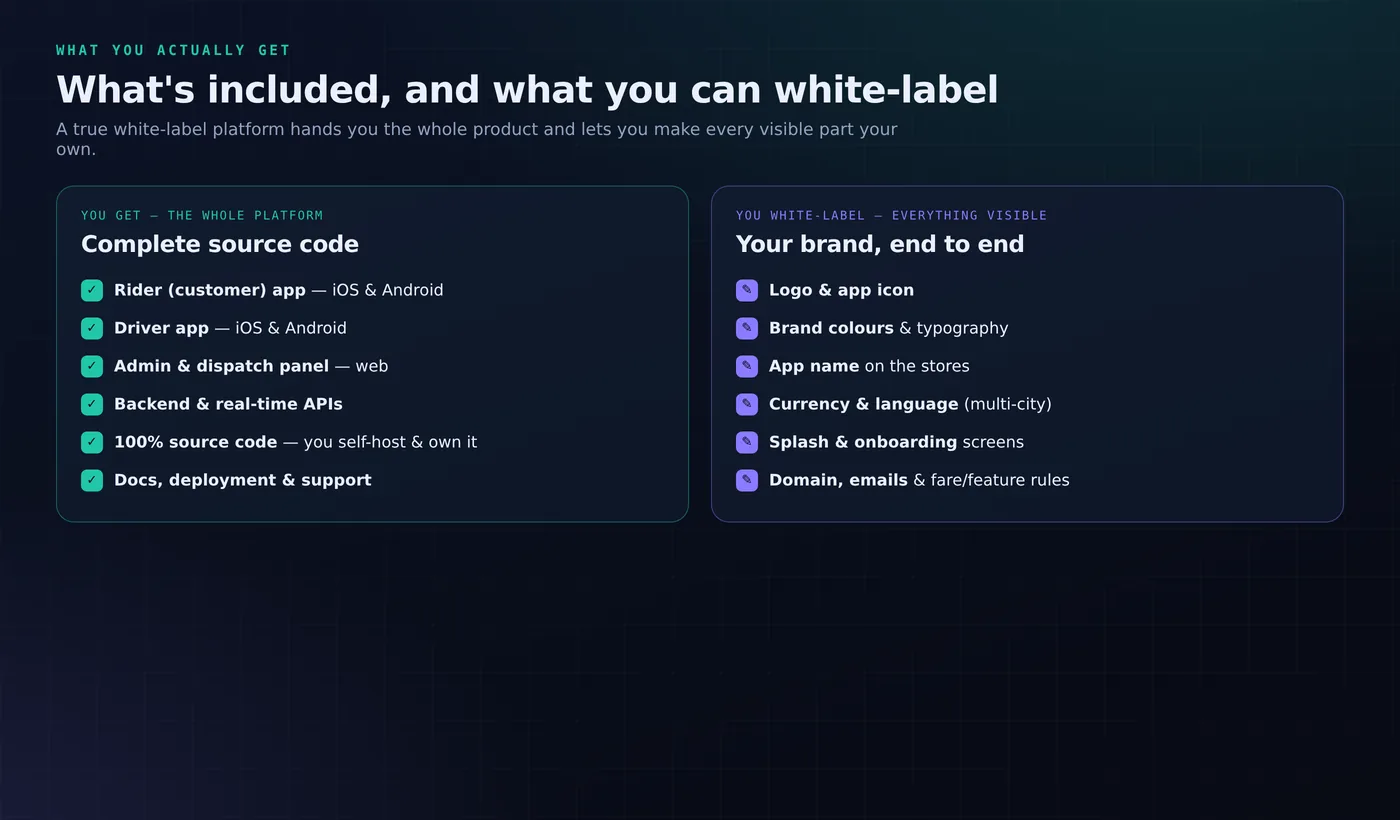 The whole platform is included; everything visible is yours to brand.
What you get is the complete stack:
- Customer and driver apps — for iOS and Android.
- Web admin and dispatch panel.
- Backend and real-time APIs.
- Full source code — with documentation and support, in the best case.
What you white-label is everything visible:
- Logo and app icon.
- Brand colours and typography.
- App name on the stores.
- Currency and language.
- Splash and onboarding screens.
- Domain and email templates.
- Fare and feature rules — your own.
One codebase, your brand
The whole point of white-label is that a single, proven codebase can ship as any number of distinct brands. The same booking flow, the same dispatch engine, the same admin — wearing a completely different identity each time.
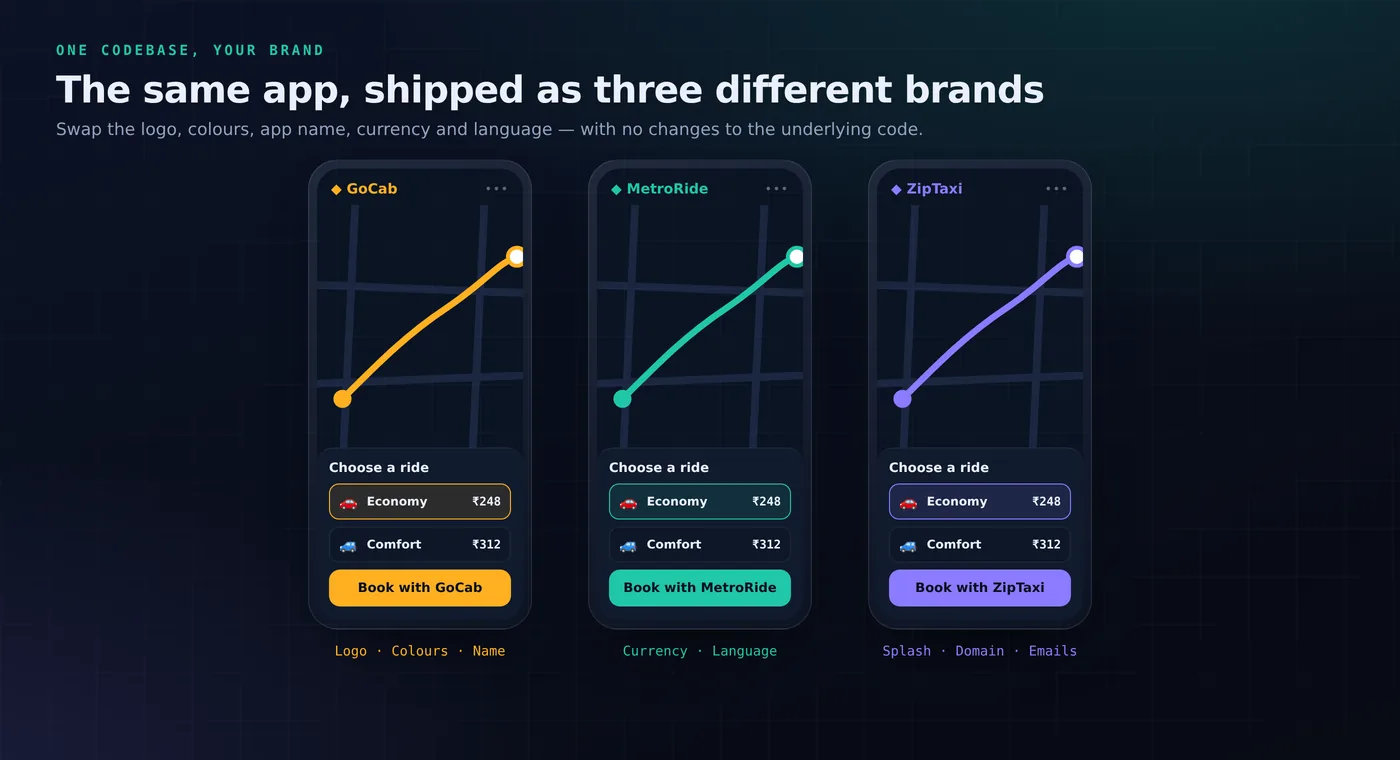 The same app, shipped as three brands — swap logo, colours, name, currency and language.
Because branding is configuration rather than code, you can launch in one city under one identity, then spin up a second market — or an entirely separate brand — from the same foundation.
The apps you're putting your name on
Three apps carry your brand to two different audiences. The rider app is what your customers download and judge you by; the driver app serves your supply side; the admin panel is how you run it all.
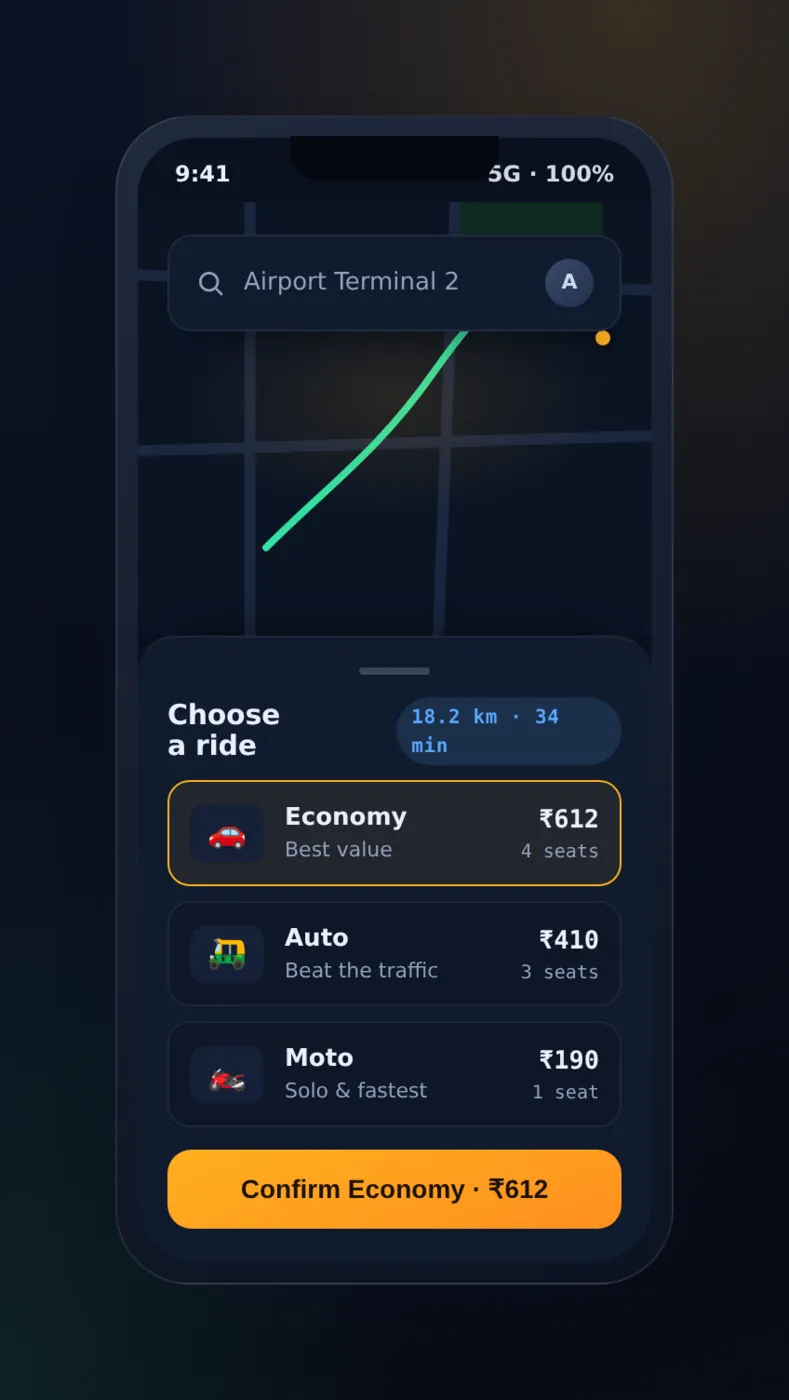 The rider app — your brand, your fares, your city.
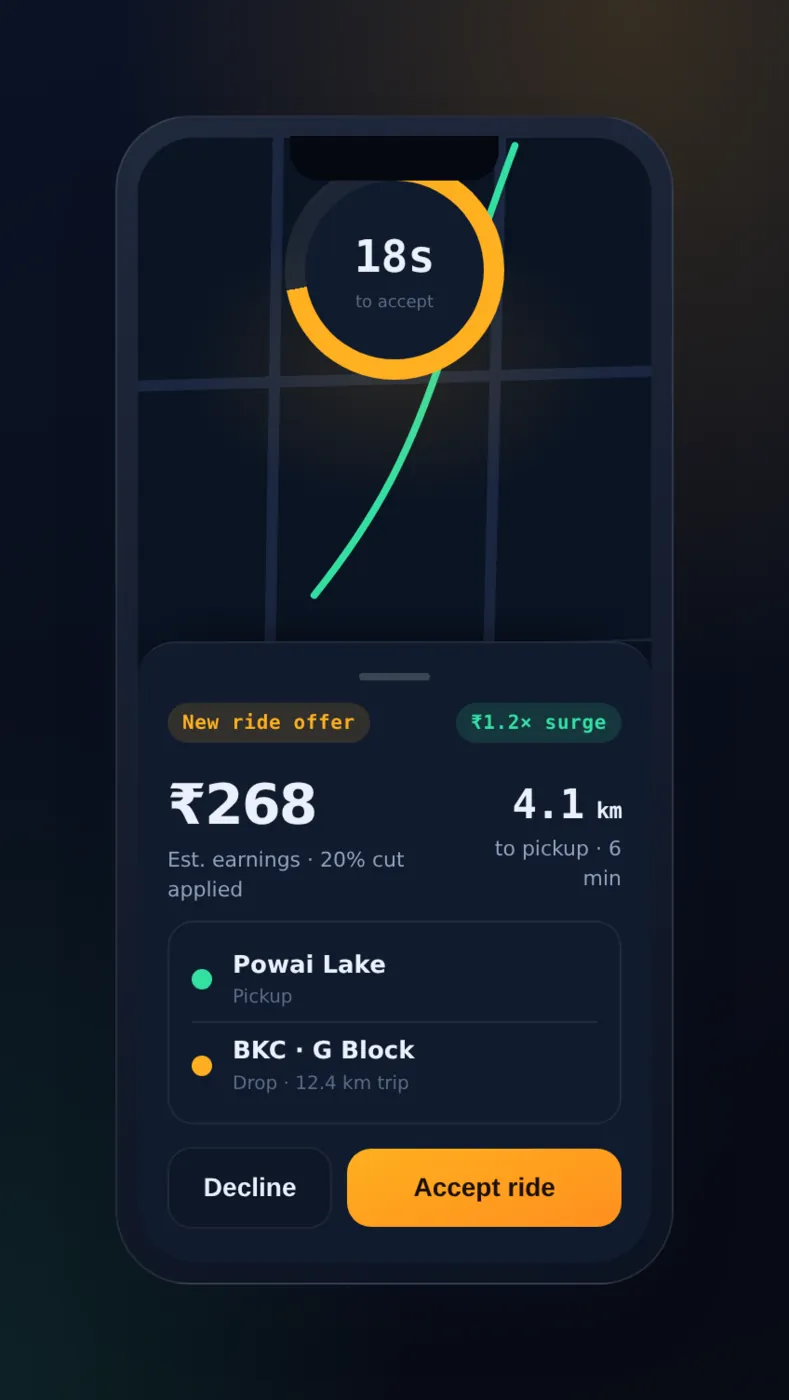 The driver app — offers, navigation and earnings.
Behind them, the admin and dispatch panel is where you onboard drivers, set pricing and surge, run promos, handle payouts and watch the whole operation live.
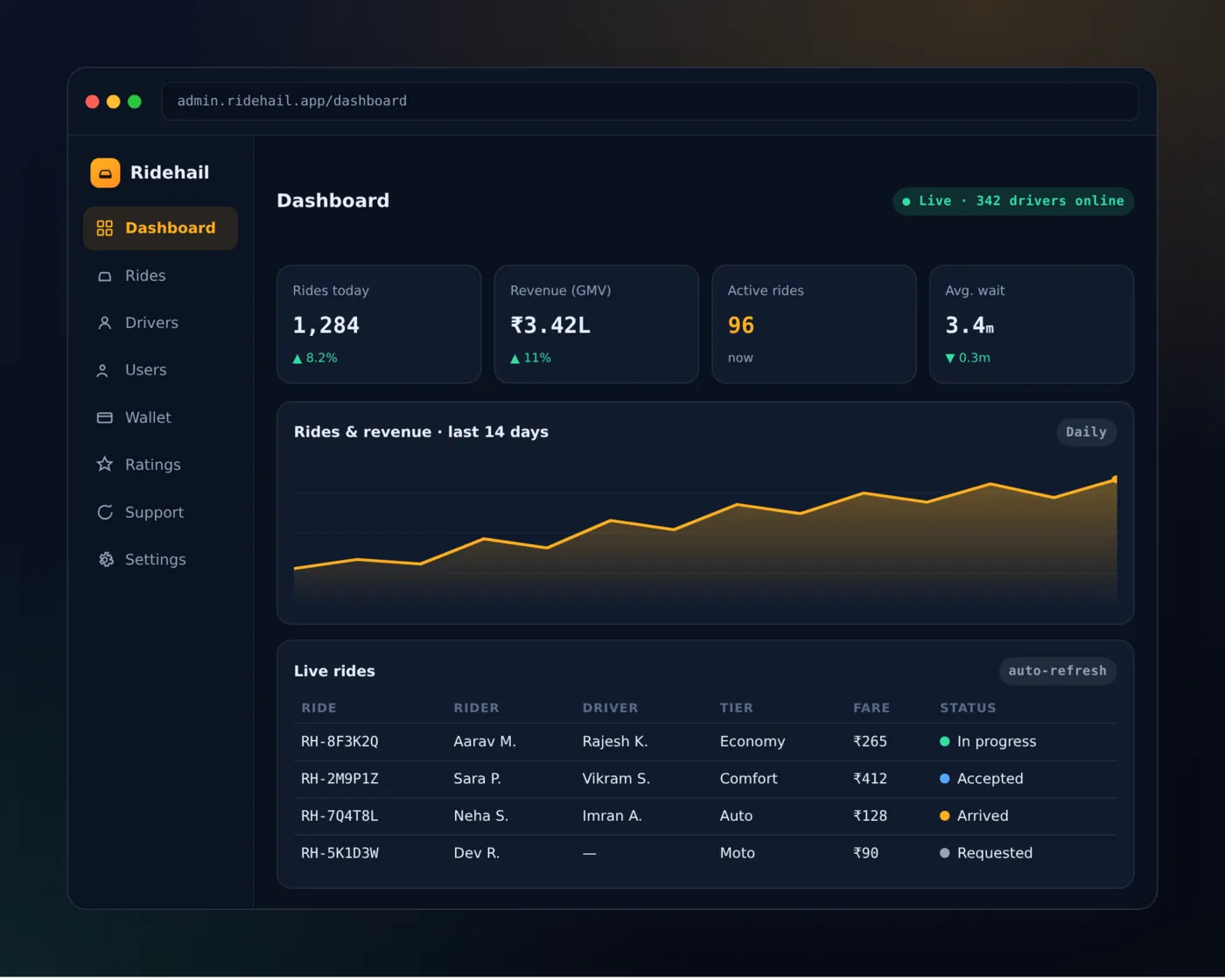 The admin panel — your operations cockpit, under your brand.
For a full feature-by-feature tour of these three apps, see the Ridehail taxi platform.
Who a white-label taxi app is for
The same rebrandable platform fits a surprising range of businesses — anyone who needs to move people or parcels on demand under their own name.
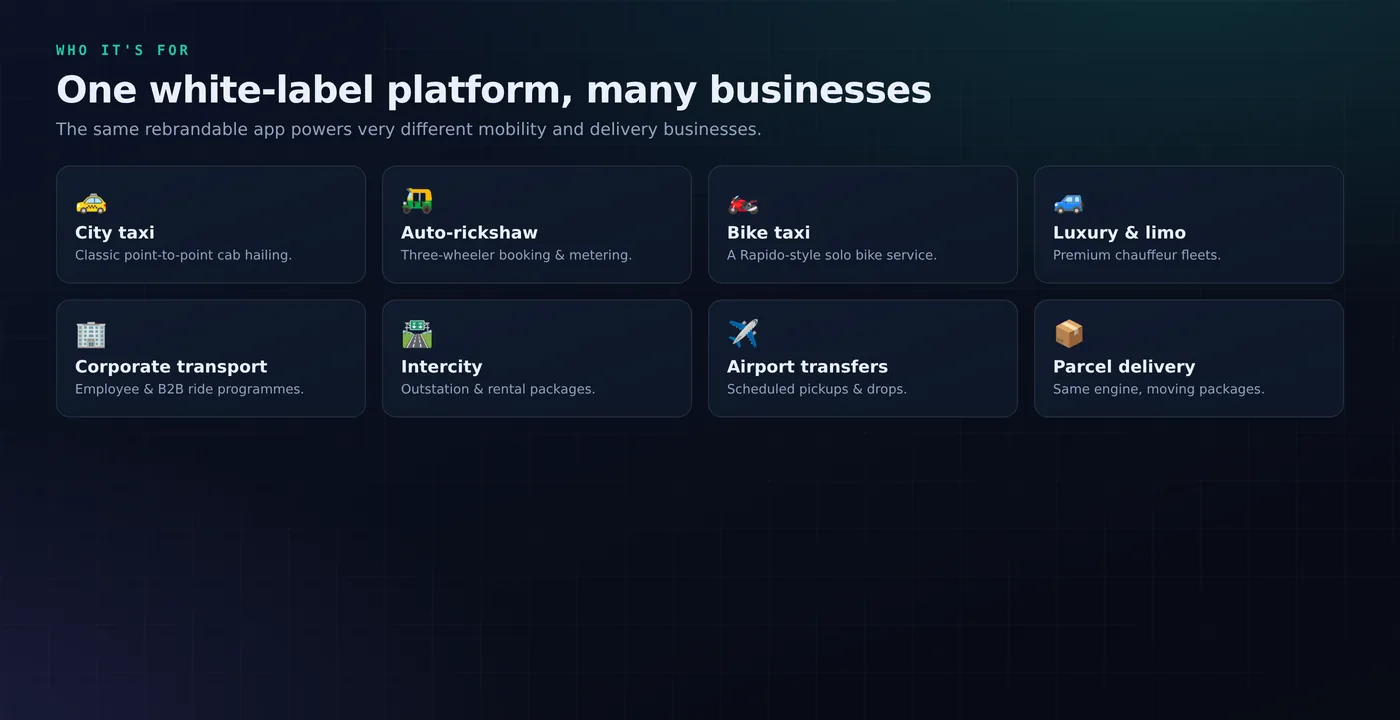 One platform, many businesses — from city taxis to bike taxis to parcel delivery.
Typical buyers include:
- Entrepreneurs — launching a local Ola or Rapido alternative.
- Existing fleet and taxi-union operators — going digital.
- Corporates — building employee transport.
- Agencies — shipping ride-hailing apps for their own clients.
The distinction that matters: white-label SaaS vs white-label source code
Here is the fine print most guides skip. "White-label" only describes the branding — it says nothing about ownership. Two offers can both be "white-label" and be worlds apart:
White-label SaaS — you rebrand the apps, but the platform stays on the vendor's servers and you pay forever (monthly, per-vehicle, per-trip or a revenue share). You never receive the code, customisation is capped by their roadmap, and if you leave, you leave with nothing.
White-label source code — you rebrand and receive the complete source, self-hosted on your own infrastructure, for a one-time cost. You can change anything, there are no per-ride fees, and the platform is an asset you own.
| Aspect | White-label SaaS (rented) | White-label source code (owned) |
|---|---|---|
| Cost model | Recurring — monthly / per-vehicle / per-trip / revenue share | One-time cost |
| Source code | No — vendor keeps it | Yes — 100%, delivered to you |
| Hosting | Vendor's servers | Your own infrastructure |
| Customisation | Limited to their roadmap | Unlimited |
| Data ownership | On the vendor's platform | Fully yours |
| If you leave | You lose the platform | You keep everything |
Neither is wrong — but they're different decisions. If you want the fastest possible start and are happy renting, white-label SaaS is fine. If you're building a business you intend to own, grow and control, insist on the source code.
From rebrand to launch: the timeline
Because the product already exists, launching a white-label taxi app is a matter of weeks, not months. A typical single-city launch looks like this:
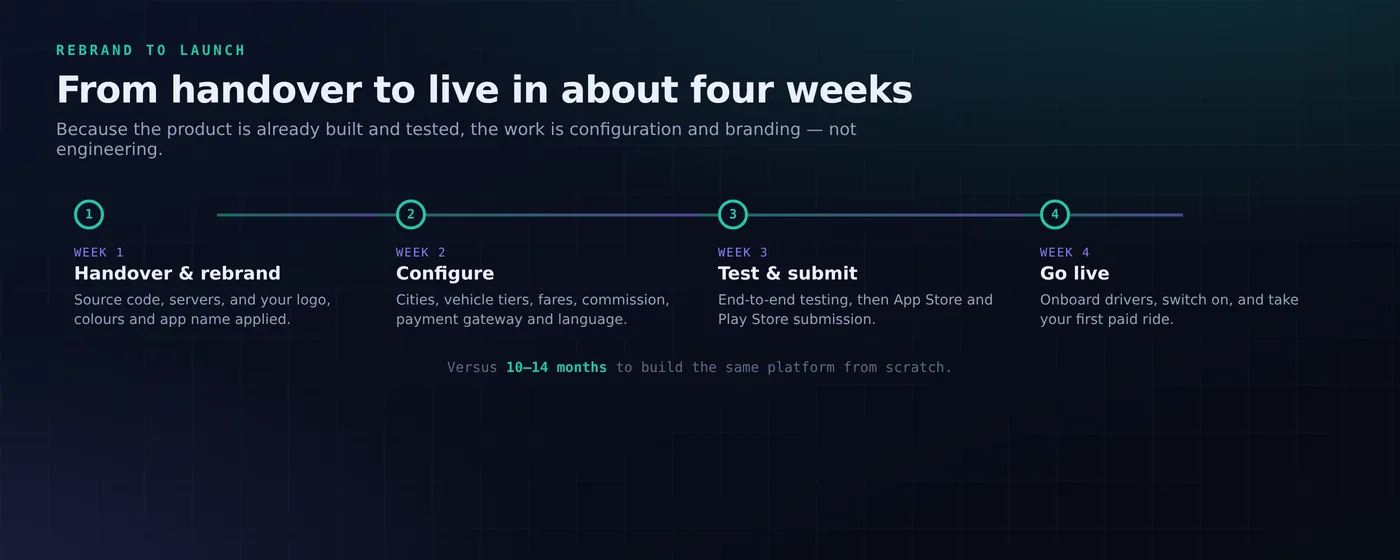 A realistic four-week path from handover to your first paid ride.
One variable is app-store review, not the build — the platform is ready on day one.
The other variable is what only you can supply. That means a payment gateway account and its KYC (the apps ship collecting cash). It also means store developer accounts in your own company name, and a first batch of verified drivers. None of it is engineering, but all of it can hold up launch.
How much does a white-label taxi app cost?
There are two cost shapes, and they behave very differently over time. A white-label SaaS is cheaper to start but never stops charging — and the bill usually grows with your fleet or trip volume, so success makes it more expensive.
A white-label source-code platform is a single upfront cost with no per-ride or per-vehicle fees, so your platform cost stays flat while your business scales.
Over any multi-year horizon, ownership usually wins on total cost — and you hold an asset at the end instead of a cancelled subscription.
Two things no sticker price covers, on either model: the running costs of operating (maps and routing, OTP delivery, push, servers, store developer accounts), and the engineering time to keep two mobile apps installable as iOS and Android change. Owning the asset means owning its maintenance too.
Where white-label goes wrong
One limit applies to either flavour: rebranding is not differentiation. The software is the same software, so coverage, price and service still have to come out of how you operate. The other three depend on which flavour you bought, and all are cheaper to learn now than in month four:
"Unlimited customisation" is about permission, not effort. With the source in hand, nothing is off limits. But you are working inside someone else's design. Changes that fit it are quick. Changes that fight it can cost about as much as writing them yourself.
Editing the code is what ends clean upgrades. Once you have forked it meaningfully, every vendor fix arrives as a merge for you to resolve, so keep your changes narrow and separated rather than scattered.
On SaaS, the ceiling is wherever the settings screen stops. Ask whether the one change you already know you need is a setting, a roadmap item, or a no.
How to choose a white-label taxi app provider
Run every "white-label" offer through this checklist before you sign:
Do you get the source code? If not, you're renting, not owning.
Are all three apps plus the backend included? Rider, driver, admin and APIs — not just a booking app.
Is it truly one-time, or are there per-ride, per-vehicle or revenue-share fees hiding in the contract?
How deep is the customisation? Colours and logo are the minimum; can you change flows, features and business rules?
Which payment gateways and maps are supported, and can you swap them for local providers?
What's the launch support and documentation — and who owns the servers and the data?
Our own Ridehail platform is built to pass every one of these: all three apps and the backend, delivered as 100% source code for a one-time cost, self-hosted and fully rebrandable — no recurring or per-ride fees.
Frequently asked questions
What is a white-label taxi booking app?
A ready-made ride-hailing platform — rider app, driver app, admin panel and backend — that you rebrand with your own logo, colours, name and fares and launch as your own, instead of building from scratch.
Is a white-label taxi app the same as an Uber clone?
They overlap. "Uber clone" describes the feature set; "white-label" describes that it's built to be rebranded as yours. The best solutions are both — a full-featured, Uber-like platform delivered white-label.
Do I get the source code with a white-label taxi app?
Only if it's a white-label source-code solution. Many "white-label" offers are SaaS: you rebrand the apps but never receive the code and pay a recurring fee. If ownership matters, confirm you get the complete source.
How long does it take to launch a white-label taxi app?
Typically about four weeks for a single city — roughly a week each for handover and rebranding, configuration, testing and app-store submission, then go-live. The platform itself is ready on day one.
Can I customise a white-label taxi app beyond the logo and colours?
With a source-code solution, yes — you can change flows, add features and rewrite business rules. With SaaS white-label, customisation is usually limited to branding and the options the vendor exposes.
How much does a white-label taxi app cost?
SaaS white-label starts low but recurs (monthly, per-vehicle, per-trip or revenue share). A source-code platform is a one-time cost with no per-ride fees, which is usually cheaper over any multi-year period and leaves you owning the asset.
Launch your white-label taxi app with PRS India
We deliver a complete, rebrandable ride-hailing platform as full source code — ready to launch as your brand, owned outright, with no recurring fees. See the Ridehail platform, read how to build an app like Ola, or talk to our team about launching your brand.
Written by
Aditi
Building software at PRS India.