Business of Software
Uber Clone App Script vs Custom Development: Which Saves You More Money?
A cost, timeline and ownership comparison of a clone script, a custom build, and a one-time white-label platform for launching a ride-hailing business.

Written from production. Our articles draw on products we run live and the client work behind them, and are revised as the systems they describe evolve.
Every entrepreneur who decides to launch a ride-hailing business in 2026 hits the same choice in the first week of research. The pitches come in two types:
- $99–$499 “Uber clone script” ads — promising a live taxi app by the weekend.
- Six-figure agency proposals — quoting more than a year of building before a single ride happens.
Both can be true, and both leave things out.
The real cost of launching an app like Uber or Ola is not one number. It’s a mix of upfront spend, time-to-market, ongoing fees, and who owns the source code once the app is live. Almost nobody counts that until year two.
Both extremes have a catch that only shows up later:
- The cheap script can look like the obvious choice next to a $100,000 custom quote — until you add up two years of per-ride commission.
- The custom build can look like the “serious” choice — until you count the months of cash spent before your first paying ride.
This guide walks through the real cost math of all three paths — a generic clone script, a fully custom build, and a white-label source-code platform. It covers realistic ranges, the hidden costs, and a decision guide to help you find the path that fits your budget, timeline and growth plan.
What “Uber Clone App Script” Actually Means
“Uber clone script” is not one product — it is a label put on three very different things:
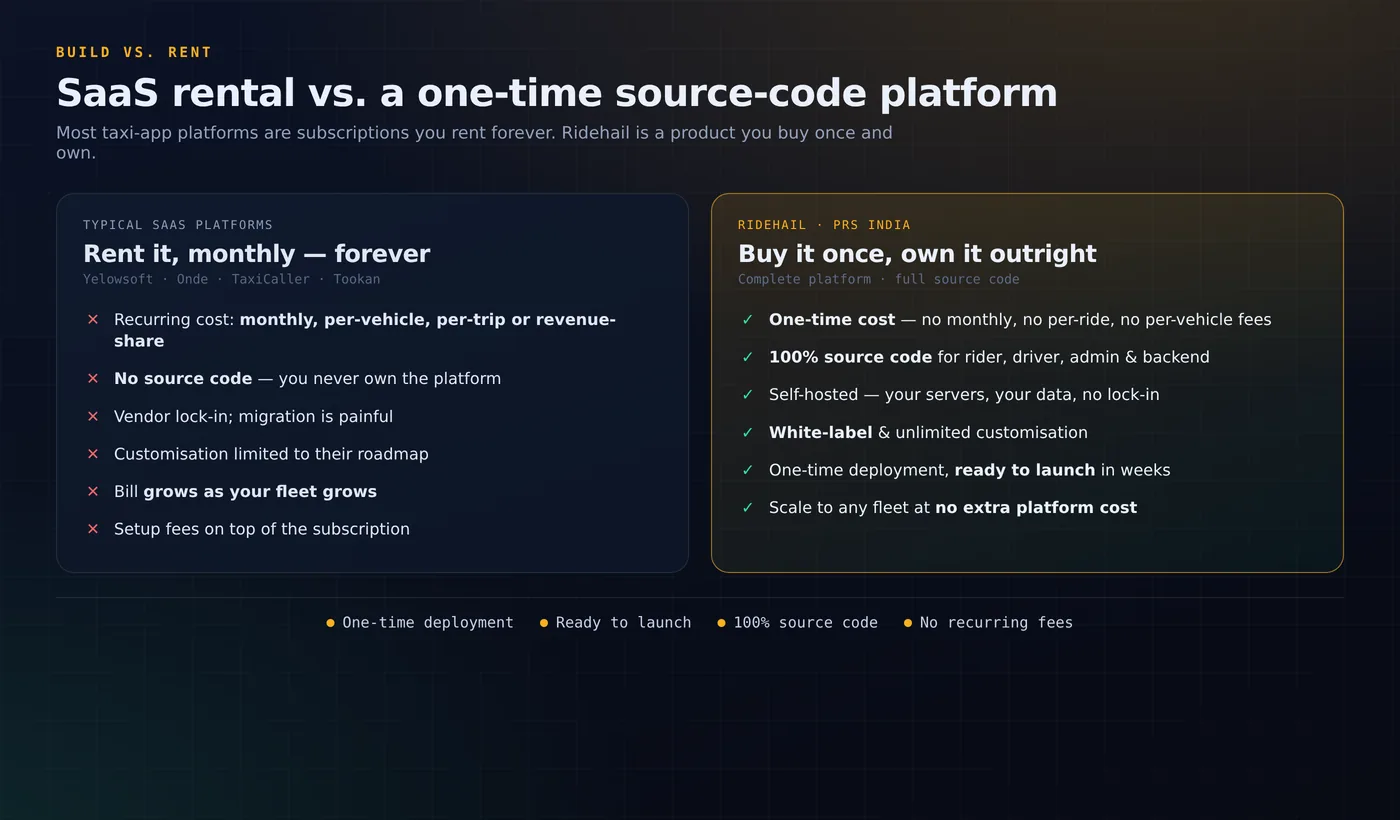
- SaaS rental — you pay little or nothing upfront, the vendor hosts everything, and they take a per-ride commission (often 15–30%) for as long as you use it. You never get the source code, so if you stop paying, your app stops working.
- Cheap one-time script — sold on marketplaces for a few hundred dollars. You do get files, but often on an outdated framework, with no live dispatch engine, no documentation, and a seller who disappears after the sale.
- Genuine white-label platform — much rarer, and the category worth paying attention to: ready-to-use source code, actively maintained, that you buy once and own outright.
Know which of the three you are being sold before you pay.
Three questions separate them, and you can ask all three before you pay. Do you get the source code, or only access to a hosted app? Is there a commission or per-ride fee anywhere in the terms? Can you run it on servers you control? A seller who will not answer in writing has given you the answer.
What Custom Development Actually Costs
Building an Uber-like platform from scratch means building four linked products at once: a customer app, a driver app, an admin/dispatch panel, and a live backend that ties them together with GPS tracking, fare calculation and payments.
That’s not a weekend job for one developer — it is a team effort, usually:
- 2–3 mobile developers (customer app + driver app, often iOS and Android separately unless the team uses a cross-platform framework)
- 1–2 backend engineers for the real-time dispatch engine, fare logic, payments and APIs
- 1 project manager to coordinate the four moving pieces
- 1 QA engineer for a system where a dispatch bug means a driver never shows up
- 1 UI/UX designer for three distinct interfaces (rider, driver, admin)
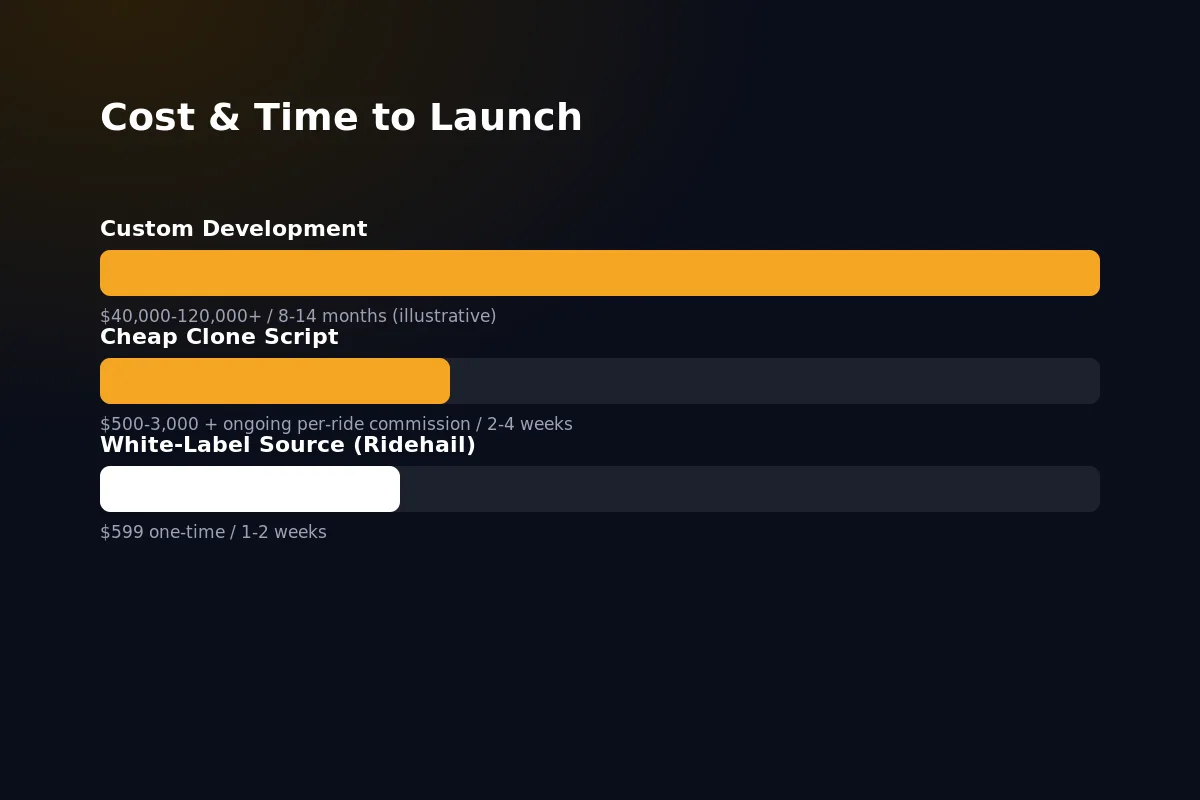
A team of this shape typically takes 8–14 months to reach a truly usable, live dispatch platform — not a static prototype. The cost depends a lot on region and team, and runs roughly $40,000–$120,000+ for an offshore or mixed team, and considerably higher for an agency in the US or Western Europe.
These figures are rough ranges to plan around, not a quote — your actual number depends on team location, scope, and how many features you cut from the first release.
It also helps to know which of those four products the budget disappears into. The rider and driver apps are conventional maps-and-forms work; the dispatch engine is not. Every ride is a record that has to survive a driver losing signal mid-trip, two drivers accepting the same request, a cancellation that arrives after an acceptance, and a fare that must match what the payment gateway actually captured. That is where the senior backend and QA time goes, and it is the part a demo quietly leaves out.
For a closer look at what that build actually involves feature by feature, see our taxi mobile app development breakdown.
Upfront Cost, Time and Ownership Compared
Side by side, the three paths have clear trade-offs — cheap and fast comes with strings attached, thorough and owned costs more time, and there is a middle path that gets the ownership without the build time. Rough ranges below, not fixed quotes:
| Path | Upfront Cost | Time to Launch | Source Code Ownership | Customization Depth | Ongoing Fees | Best For |
|---|---|---|---|---|---|---|
| Cheap clone script | $0–$999 | 1–4 weeks | None (SaaS) or unsupported files | Cosmetic only | 15–30% per-ride commission, or $50–$300/mo | Testing demand before committing real capital |
| Full custom development | $40,000–$120,000+ | 8–14+ months | Full, once fully paid | Unlimited — built to spec | $3,000–$15,000/mo in-house or retainer team | Well-funded teams with unique dispatch logic no platform supports |
| Ridehail white-label source | One-time license fee | 2–6 weeks typical | 100% — yours from day one | Full — complete source access | None mandatory | Most founders launching a real, ownable business fast |
What the table cannot show is what happens after launch — and that is where most of the real cost, in either direction, actually lives.
The Hidden Costs Nobody Budgets For
With a Cheap Clone Script
The sticker price is the least important number. Three costs matter far more once you are actually running the business:
- Commission compounding — a 20% cut on a modest 300 rides a day at a $4 average fare is roughly $240 a day given to the platform, over $85,000 a year, and it keeps growing for as long as you operate.
- Permanent vendor lock-in — because you never get real source code, you cannot move to your own servers, cannot sell the platform as a business asset, and cannot change anything beyond a logo and a colour scheme.
- Support that quietly disappears — most of these sellers earn very little themselves, so there are no updates when Android or iOS changes its rules, no fixes when a payment gateway drops an old API, and no one to call when the app gets rejected from an app store.
Those three are worse together than apart. A commission grows exactly as fast as your success. Lock-in means leaving is cheapest when you have the least reason to leave. So founders put it off. By then, moving means shifting a live fleet, active riders and two years of trip history to a platform you have not tested.
With Custom Development
Custom builds fail their budgets for more human reasons than a bad quote. Four costs often catch first-time founders off guard:
- Scope creep — a “simple MVP” quote rarely survives live dispatch, surge pricing, safety features and payment matching. Each one adds weeks.
- Opportunity cost — the 8–14 months you spend not earning revenue, while drivers, marketing spend and rent all wait, rarely makes it into a spreadsheet.
- Maintenance and bug-fixing budget — a common rule is about 15–20% of the original build cost, every year, after launch. Most first-time founders forget this cost completely.
- Key-person risk — a custom platform is usually the work of a small team. If the one senior developer who understands the dispatch engine leaves, you inherit code with no notes and a hiring problem at the worst possible time.
Total Cost of Ownership Over 2 Years
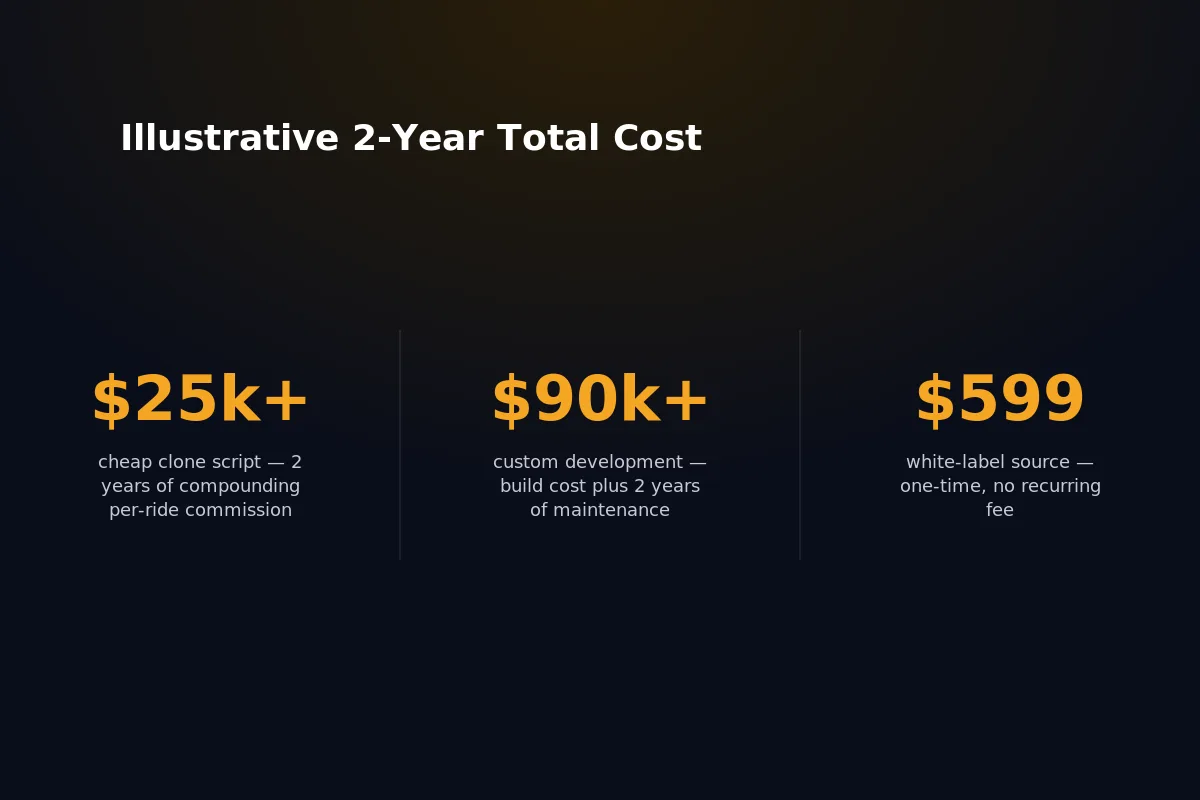
This is a sample estimate for a mid-size city launch over two years. It is not a quote, and not specific to any one vendor. Treat the numbers as a guide, since actual costs change with ride volume, region and how much customization you need.
A clone-script-with-commission path starts cheap — often free or under $1,000 upfront. But a 20% commission on a growing number of rides adds up fast:
- At a few hundred rides a day, two years of commission alone can land well into six figures, on top of whatever the “rental” itself costs monthly.
- You end year two with no asset: stop paying, and the app stops working.
A full custom build typically lands in the $40,000–$120,000+ range for the build itself, plus 8–14 months before any income, plus a realistic $15,000–$40,000 a year in post-launch maintenance:
- Add it up, and a two-year TCO commonly runs $150,000–$300,000+ before the business turns any profit.
- The upside: you end up with a fully custom, fully owned codebase built exactly to your specification.
A one-time white-label source-code purchase — the license plus optional customization (commonly $2,000–$15,000 depending on scope) and standard server costs (roughly $100–$500 a month) — typically keeps a two-year TCO under $20,000–$30,000:
- No commission is owed to anyone.
- At the end of two years, you hold the same asset you held on day one: source code you fully own.
Where PRS India’s Ridehail Fits
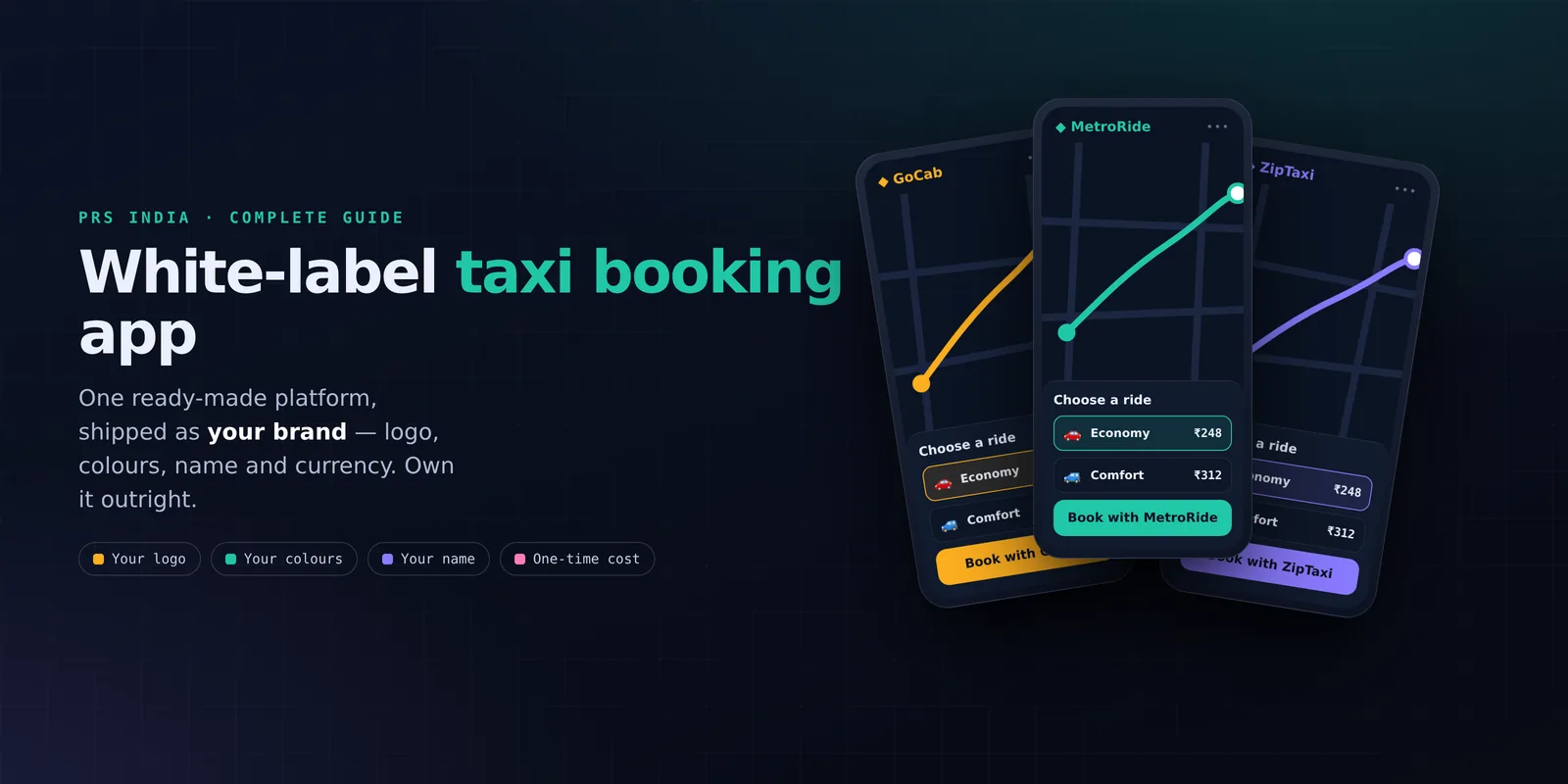
Ridehail is PRS India’s answer to the gap between “cheap and unowned” and “thorough and expensive.” It is a complete ride-hailing platform — customer app, driver app, admin panel and live backend — sold as a one-time source-code license, not a subscription and not a commission arrangement.
You receive 100% of the code — the same platform already detailed in our white-label taxi booking app overview and broken down feature-by-feature in 20 must-have features of a taxi booking app. It includes:
- Live GPS tracking
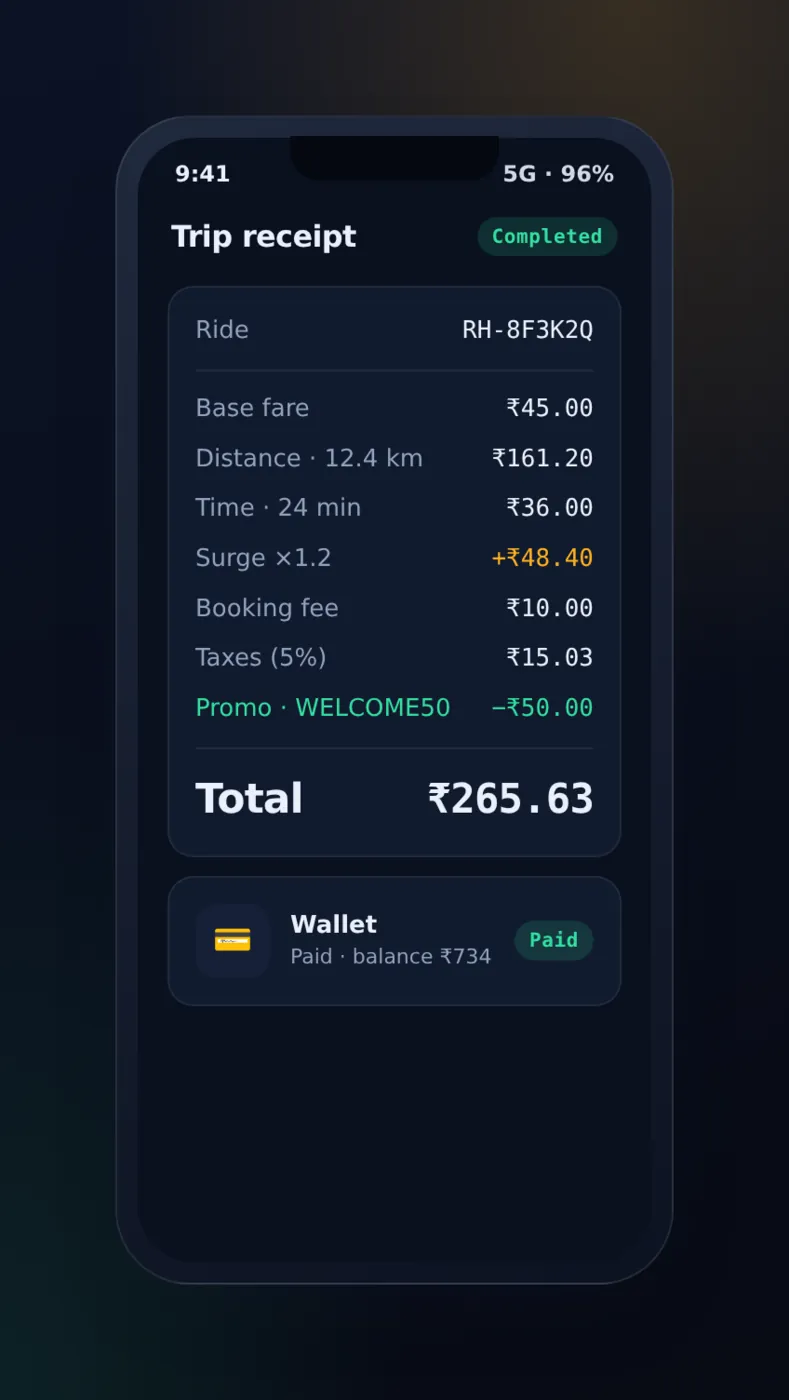
- An itemised fare engine
- Cash fare collection, with the payment layer built so a wallet or a card gateway can be added for your market
- Driver onboarding
- A real-time dispatch map
All of it is rebrandable to your logo, colours, currency and language.
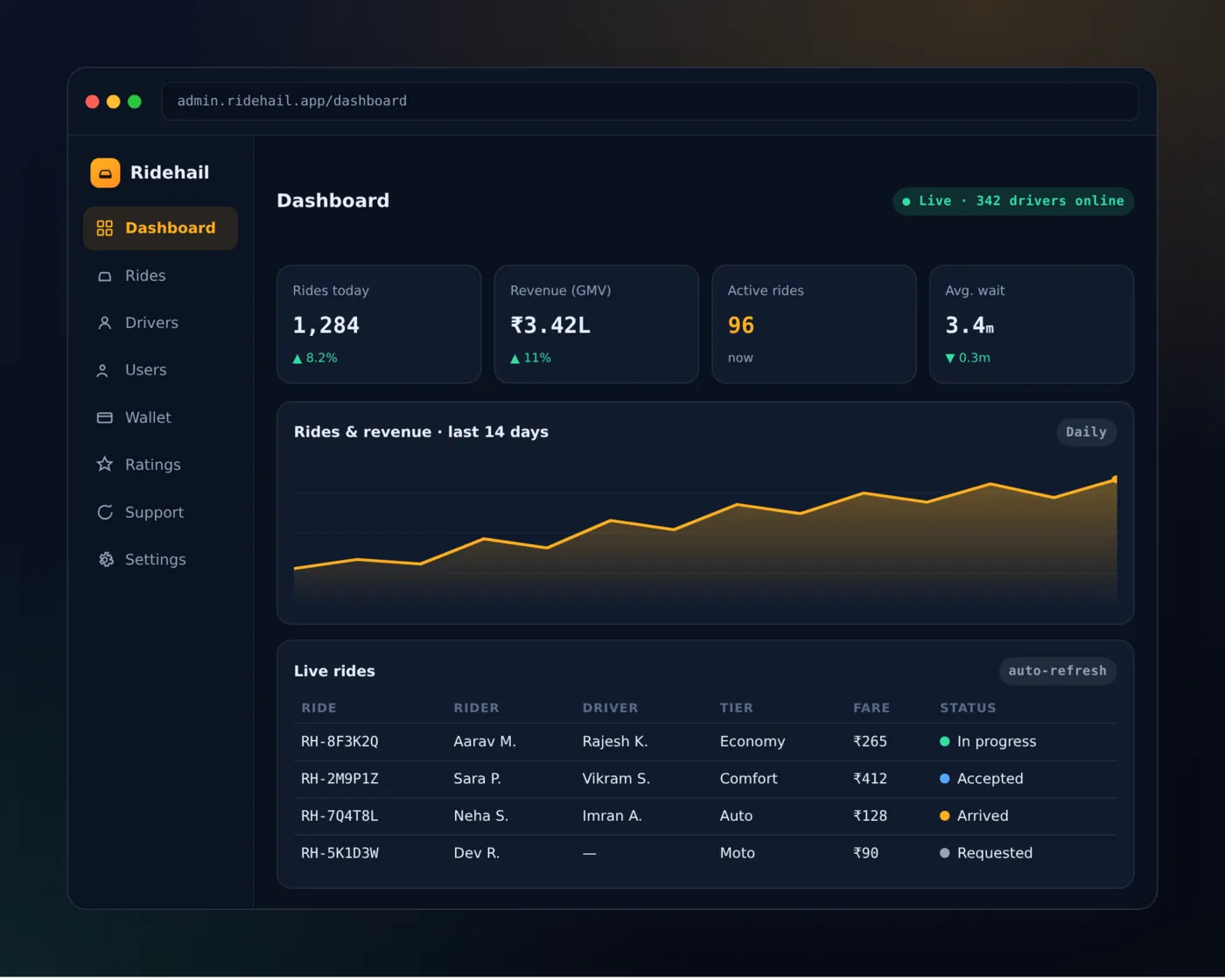
There is no monthly platform fee and no per-ride cut going to anyone, ever — the money from every ride is yours from day one.
The license ships with documentation and support to get a working platform live. For teams that want more customization, a specific payment gateway added, or hands-on help at launch, PRS also offers custom integration and launch help on top of the base platform.
If you are weighing this against a clone script or a custom quote, talk to our team about what your city, fleet size and feature list would cost to launch.
Decision Framework: Which Path Should You Choose?
- Choose a cheap clone script if you are only testing demand before putting in real money, plan to run a short pilot, and are comfortable that the app could disappear the day you stop paying.
- Choose full custom development if your dispatch logic, market regulations or business model are genuinely unique, no existing platform can support them, and you have $150,000+ and 12+ months of cash to spend on proving it.
- Choose a white-label source-code platform if you want to launch a real, ownable ride-hailing business in weeks rather than months, keep every rupee or dollar a ride earns, and still want the freedom to customize and scale as the business grows — this is the fit for most founders reading this.
Frequently Asked Questions
Is a clone script legal and safe to use commercially?
Building a ride-hailing app inspired by the booking flow riders already know is legal — booking flows, vehicle tiers and live tracking are common UX patterns, not proprietary intellectual property.
The risk is not legal, it is commercial: cheap scripts often run on outdated frameworks, lack real security review, and come with no support, which can expose your business and customer data to real operational risk. Vet the code quality and support terms, not just the price.
How much does custom Uber-like app development really cost?
For a genuinely real-time platform — not a static prototype — indicative costs run roughly $40,000–$120,000 or more, depending on team location, scope and how many features ship in version one, with agency teams in higher-cost regions often well above that range.
Timeline typically runs 8–14 months. These are planning ranges, not quotes; get a scoped proposal for your exact feature list before budgeting.
What is the difference between a SaaS taxi rental and owning white-label source code?
A SaaS rental hosts your app on the vendor’s infrastructure and takes an ongoing cut — usually a per-ride commission — for as long as you use it; stop paying, and your app stops working, because you never held the code.
Owning white-label source code means the platform is yours outright after a one-time purchase: you can self-host it, modify it, and there is no commission owed to the vendor on any ride, ever.
How fast can you actually launch with a white-label platform?
With a mature white-label codebase like Ridehail, most launches take roughly 2–6 weeks — covering rebranding (logo, colours, app name, currency), setting your fare rules, wiring up whatever payment method your market expects beyond cash, and app store submission.
That compares with 1–4 weeks for a bare clone script (with none of the ownership) and 8–14+ months for a fully custom build.
Written by
Aditi
Building software at PRS India.