Business of Software
Payroll Compliance in India 2026: PF, ESIC, TDS and PT
A practical guide to PF, ESIC, TDS and Professional Tax compliance in India, including employer responsibilities, payroll calculations, deadlines and common mistakes.

Written from production. Our articles draw on products we run live and the client work behind them, and are revised as the systems they describe evolve.
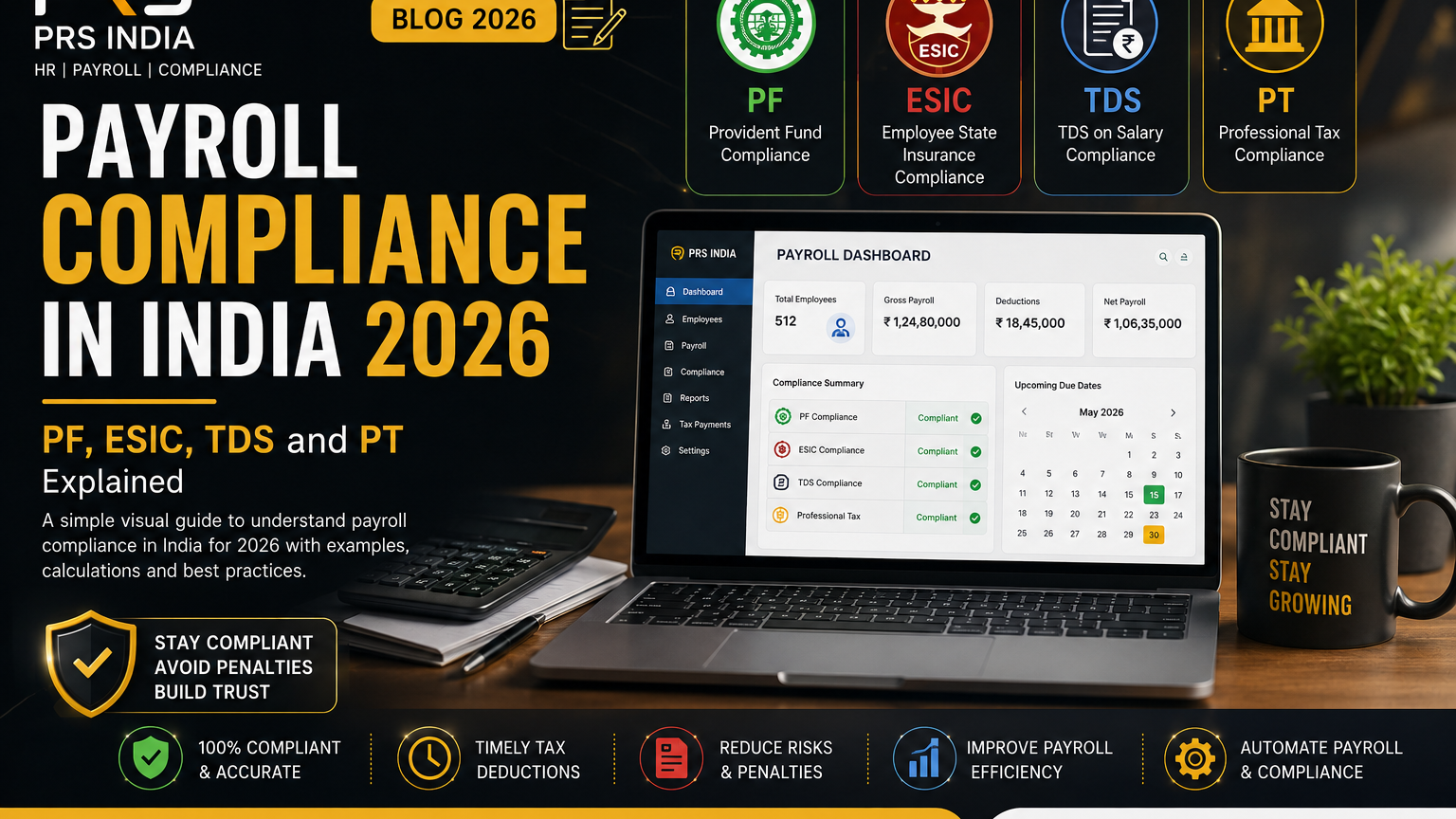
A simple visual guide to payroll compliance in India, with practical examples of Provident Fund (PF), ESIC, TDS on salary and Professional Tax (PT), along with payroll calculation charts and compliance steps.
What Is Payroll Compliance?
Payroll compliance means following the legal rules that apply while calculating and paying employee salaries. It includes deductions from employees, employer contributions, statutory deposits, returns and employee records.
How Monthly Payroll Works
1. Provident Fund (PF) Compliance
Provident Fund is an important social-security component for eligible establishments and employees. PF generally involves contributions from both the employer and employee, subject to applicable rules.
The ₹15,000 in the example below is not an arbitrary salary. It is the legal monthly wage limit for PF. It has not changed since 2014. So the required contribution is capped at 12% of ₹15,000: ₹1,800 a month from each side. A higher salary does not raise that required amount, because the 12% is applied to the limit, not to the full gross salary.
PF Example: ₹15,000 Applicable PF Wage
IllustrationPF Contribution Visual
In this simplified illustration, the employee and employer each contribute 12% of the applicable PF wage, but the two 12% shares do not go to the same place. The employee's 12% goes entirely to EPF. The employer's 12% is split: 8.33% goes to the Employees' Pension Scheme (EPS), which is restricted to the wage ceiling and capped at ₹1,250 a month, and only the remaining 3.67% goes to EPF.
That split matters as soon as someone reads a payslip or a PF passbook. Treating the whole employer 12% as provident fund makes the PF balance look too high and hides the pension contribution, and the combined 24% is not what accumulates in the PF account. The employer also bears EDLI and administrative charges on top of the 12%, which are not deducted from the employee, so employer cost is higher than 12% of PF wages; confirm the current rate for those charges before budgeting them.
2. ESIC Compliance
ESIC provides social-security benefits to eligible employees. Both employer and employee contributions apply to covered employees, subject to the applicable rules.
Coverage decides whether the rates below apply at all. The 0.75% employee and 3.25% employer contributions — 4% in total — apply where an employee's gross wages are ₹21,000 a month or below, and ₹25,000 or below for an employee with a disability. The ₹20,000 example that follows sits inside that limit. Applying the same rates to a salary above the threshold is a common ESI mistake in payroll.
ESIC Example: ₹20,000 ESI Wages
IllustrationESIC Contribution Graph
The visual above uses the usual rates as an educational example. Eligibility and applicable wage rules should be checked before payroll processing.
3. TDS on Salary
Tax Deducted at Source (TDS) on salary is calculated by the employer based on the employee's estimated taxable income and applicable income tax provisions.
Visual TDS Calculation Process
TDS Example
Simple IllustrationSuppose an employee's estimated annual tax liability is ₹60,000.
TDS Visual Breakdown
4. Professional Tax (PT)
Professional Tax is a state-level tax applicable in certain states and jurisdictions. Its slabs, thresholds, maximum amounts and compliance requirements can differ.
Why PT Needs State-Wise Configuration
Delhi
Delhi does not levy professional tax at all. There is no PT deduction to make, no employer PT registration to hold and no PT return to file for an employee who works in Delhi. PT status follows the employee's physical work location rather than the state the company is registered in, so a Delhi-registered company with staff working in a state that does levy PT still has to deduct and file there.
Maharashtra
Professional Tax rules and slabs are governed by the applicable state legislation. Two employees on identical salaries can therefore carry different PT deductions purely because they work in different states, which is why the slab has to be read from that state's own schedule rather than from a single company-wide formula.
Karnataka
Payroll teams should configure applicable state-specific rules rather than using one national PT formula.
Other States
Applicability and compliance should be verified separately for each state or jurisdiction.
PF vs ESIC vs TDS vs Professional Tax
| Compliance | Main Purpose | Employee Deduction | Employer Contribution | Key Point |
|---|---|---|---|---|
| PF | Retirement & social security | Applicable | Applicable | Subject to PF rules |
| ESIC | Social insurance | Applicable where eligible | Applicable where eligible | Eligibility based |
| TDS | Income tax | Applicable based on tax liability | Deduction responsibility | Tax-regime dependent |
| PT | State professional tax | Applicable where required | Usually collection/remittance responsibility | State specific |
Monthly Payroll Compliance Workflow
A structured monthly payroll cycle can reduce mistakes and make statutory compliance easier to manage.
The order matters because each step uses the result of the one before it. If attendance changes after salaries are approved, the statutory calculations must be redone. Deposits and filings come last, so any time lost earlier in the month is taken from the time left for them.
Common Payroll Compliance Mistakes
01. Incorrect PF Wage
Using the wrong salary parts can give a wrong PF calculation and payroll mismatches.
02. Missing ESIC Eligibility
Employee eligibility should be reviewed rather than applying ESIC blindly to every employee.
03. Wrong TDS
Changes in salary, tax declarations and applicable tax provisions can affect TDS.
04. Wrong PT Slab
Professional Tax is state-specific, so payroll should maintain appropriate state-wise configurations.
05. Missed Deadlines
Statutory deposits and returns should be tracked with a compliance calendar, and every due date on it should be confirmed against the relevant authority rather than carried forward from an earlier month or a previous year. A missed deposit is usually a calendar failure rather than a calculation failure.
06. Too Much Excel Dependency
Manual calculations become harder to control as employee count, locations and salary structures increase.
How Payroll Software Helps With Compliance
Modern HRMS and payroll systems can connect employee data, attendance, leave and payroll into a single workflow.
Software does the sums, not the thinking. Someone still has to decide which salary parts count as wages, which employees are covered, and which state each employee works in. Those settings need a fresh look whenever the rules or the workforce change. A wrong setting does not announce itself. It repeats quietly every month until a return, a reconciliation or an employee query brings it to the surface.
Features Businesses Should Look For
Employee Management
Central employee records, salary structures and statutory details.
Attendance Integration
Attendance, shifts, overtime and leave can feed directly into payroll.
PF & ESIC
Automatic legal contribution calculations based on the rules you set.
TDS
Salary tax calculations and employee tax information management.
Professional Tax
State-wise configuration for applicable Professional Tax requirements.
Payslips & Reports
Digital payslips, payroll reports and management dashboards.
Why Small Businesses Should Consider Payroll Automation
A business may start with 10 employees and manage salary calculations through Excel. As the workforce grows to 50, 100 or more employees, manual payroll can become much harder.
For businesses that need a customized HRMS, Payroll Software, Attendance Management System or Employee Management Application, PRS India can build software around the way a company works.
Related services: ERP development, SaaS development and mobile app development.
Payroll Compliance Checklist for 2026
Keep salary, joining, exit and statutory information updated.
Complete attendance before processing monthly payroll.
Apply the correct eligibility and contribution rules.
Consider applicable tax provisions and employee declarations.
Check state-specific rules and slabs.
Track applicable due dates through a compliance calendar.
Written by
Aditi
Building software at PRS India.