Engineering
How to Build an Uber-Like App in 2026: Phases, Features and Cost
Build a powerful Uber-like mobile app with customer and driver apps, real-time GPS tracking, smart driver matching, secure payments, and a scalable admin panel.

Written from production. Our articles draw on products we run live and the client work behind them, and are revised as the systems they describe evolve.

Uber, Ola, Lyft and Grab did not launch as finished platforms. Each started as a scoped build with a backend, two mobile apps, and an admin panel—shipped in phases, not all at once.
This guide is a project plan, not a feature list. It walks through the actual phases a founder or technical lead runs to ship an Uber-like app: architecture, builds, testing, launch, and what comes after.
What Is an Uber-Like Mobile App?
An Uber-like app is an on-demand platform that connects customers with drivers or service providers.
The basic concept is simple:
Customer requests a service → System finds a suitable driver → Driver accepts → Service is completed → Customer pays and gives feedback.Although Uber is best known for ride booking, the same technology model can be used for:
Taxi booking
Bike taxi
Car rental
Courier booking
Delivery services
Logistics
Moving services
Home services
And other on-demand businesses
How Does an Uber-Like App Actually Work?
A customer selects a pickup location and destination, chooses a vehicle and sees an estimated fare. Once the customer confirms the ride, the backend checks nearby available drivers and sends the request to a suitable driver.
After the driver accepts the booking, the customer can see the driver's location and estimated arrival time. From there:
The driver reaches the pickup point
The driver starts the ride
The trip is completed and the final fare is calculated
The customer pays and can rate the driver
01 Request — Pickup & destination
02 Match — Find driver
03 Track — Live GPS
04 Complete — Finish ride
05 Pay — Payment & rating
Booking state machine
Requested
Assigned
Arriving
In Progress
Completed
Payment
Payment Failed — retry or mark dues
No Driver — timeout, retry search
Driver Cancels — reassign silently
Rider Cancels — fee may apply
The failure branches are the states that decide whether people trust your platform.
Most teams build the happy path and discover the failure states in production. Model the failure states before you write the booking service.
You Need More Than One Application
An Uber-like platform normally has three major components: the customer application, driver application and admin panel.
Customer App
Registration and login
Pickup and destination
Vehicle selection
Fare estimate
Ride booking
Live driver tracking
Payments and invoices
Ratings and reviews
Driver App
Driver registration
Document upload
Vehicle details
Online/offline status
Booking requests
Navigation
Earnings and history
Notifications
Admin Panel
Dashboard and reports
Customer management
Driver management
Booking management
Pricing configuration
Payment monitoring
Complaints and ratings
Coupons and analytics
System architecture
Customer App — Book, track, pay, rate (iOS · Android)
Driver App — Accept, navigate, earn (iOS · Android)
Admin Panel — Pricing, disputes, reports (Web)
REST + WebSocket
Backend API — Auth · Bookings · Matching · Pricing · Notifications · Wallet
Database — Users, trips, ledger
Geo Index — Live driver positions
Payments — UPI, cards, wallet
Maps & Push — Routing, ETA, alerts
Three applications, one backend. Every booking rule, price and payment decision lives on the server — not inside the apps.
Phase 1: Discovery and Scoping
Before any code gets written, scope the project. This phase sets the budget, the timeline, and the feature boundary for everything that follows.
- Define your market and vehicle types: sedans, autos, bikes, vans, or a mixed fleet—each vehicle type changes fare logic and driver onboarding.
- Decide your MVP feature set vs. later phases: lock what ships on day one (booking, tracking, payments) and defer extras (scheduled rides, corporate accounts, loyalty) to a v2 backlog.
- Choose build-vs-buy: a custom build from scratch vs. starting from white-label source code like Ridehail changes your timeline by months, not weeks.
- Lock down payment gateway and compliance requirements per region: Razorpay, Stripe or a local gateway, plus driver background-check and licensing rules for each city you plan to launch in.
- Map your competitive landscape: compare your positioning against Uber, Ola, Lyft or Grab in your target city, and decide where you differentiate on price, vehicle mix or service area.
- Set a realistic budget and runway: cover phases one through eight, not just development—driver incentives and marketing spend during launch add up fast.
Every decision in this phase becomes a constraint on phase two. A vague scope here is a common cause of budget overruns later in the build.
Phase 2: Backend and Real-Time Architecture
This is the hardest engineering phase and the one most teams underestimate. Everything else—both apps and the admin panel—is a client of what you build here.
- Dispatch and matching engine: the logic that finds the nearest available driver, ranks candidates, and handles timeouts when a driver doesn't respond.
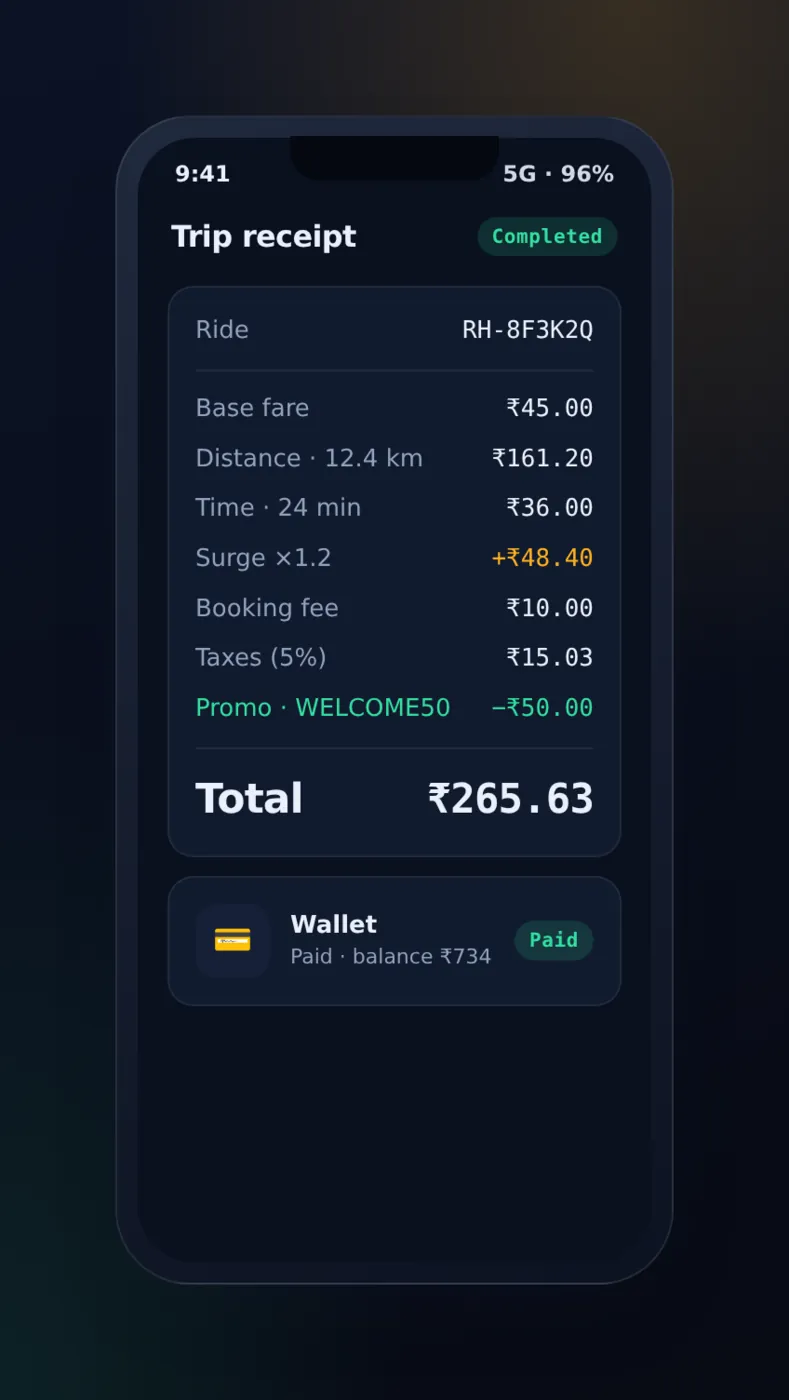
- Fare calculation engine: base fare, per-km and per-minute rates, surge multipliers, and vehicle-type pricing, computed consistently before and after the ride.
- Real-time location updates via WebSockets: driver GPS pings streamed to riders and the admin map with sub-second latency, not polling.
- Database schema for rides, drivers, riders and payments: normalized tables with clear state machines for ride status (requested, matched, in-progress, completed, cancelled).
- API design: REST or GraphQL endpoints versioned from day one, shared cleanly across the customer app, driver app and admin panel.
- Admin and reporting APIs: endpoints that feed the analytics and dispute-resolution views your ops team will use in phase five.
Get this phase wrong and every screen built on top of it inherits the bug. Most teams spend more calendar time here than on both mobile apps combined.
The part that bites is concurrency, not features. Two drivers accept the same request. A driver goes offline just as they accept. A rider cancels while the match is being saved. Each case must end in exactly one outcome. So ride status changes belong in one place, under a lock, not in whichever endpoint fires first. Offer timeouts belong on the server for the same reason: a countdown that only exists on the driver's phone stops running the moment that phone loses signal.
Phase 3: Building the Customer App
With the backend live, the customer-facing app is where riders experience the product. Every screen here calls the APIs built in phase two.
- Booking flow: pickup/drop pin selection, vehicle-type picker, fare estimate, and one-tap confirmation.
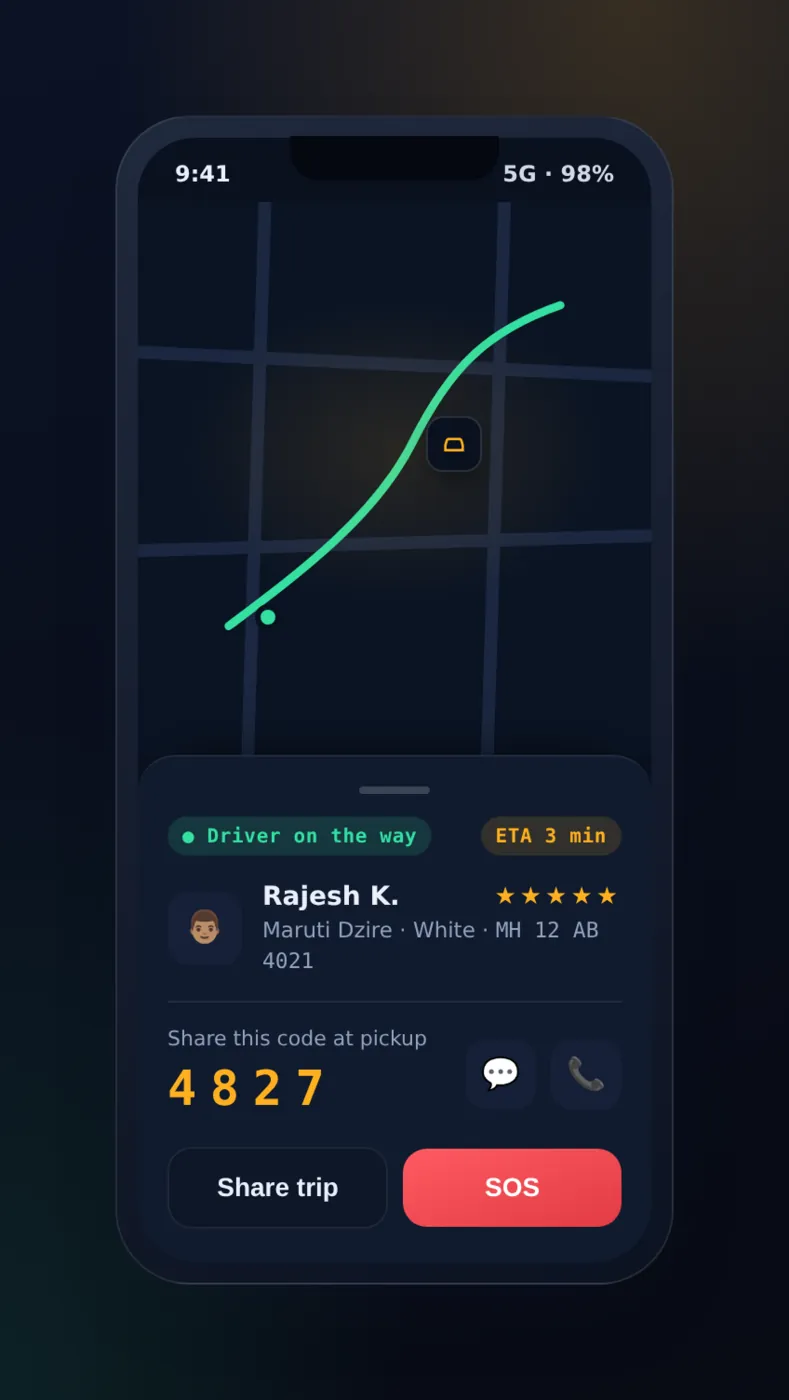
- Live tracking: the driver's location on a map from pickup through drop-off, with ETA updates.
- Payment integration: card, UPI and wallet options via a gateway like Razorpay, plus cash-ride support.
- Ratings: post-ride driver rating and feedback that feeds back into the matching engine.
- Safety features: SOS button, trip sharing with contacts, and driver-verification badges visible before pickup.
- Multi-stop and scheduled rides: letting a rider add a stop or book a ride in advance—common phase-two-later additions once the core flow is stable.
- Ride history and receipts: a searchable trip log with downloadable receipts, useful for business travelers expensing rides.
This is the app your riders judge you by, but it is the thinnest layer in the whole project. Almost everything it does is a call to a phase-two API.
For the full list of screens riders expect, see our breakdown of 20 must-have features for a taxi booking app.
Phase 4: Building the Driver App
The driver app is a different product with different priorities: speed of response, low data usage, and clarity under time pressure.
- Onboarding and KYC: document upload (license, ID, vehicle papers), verification status, and background-check integration.
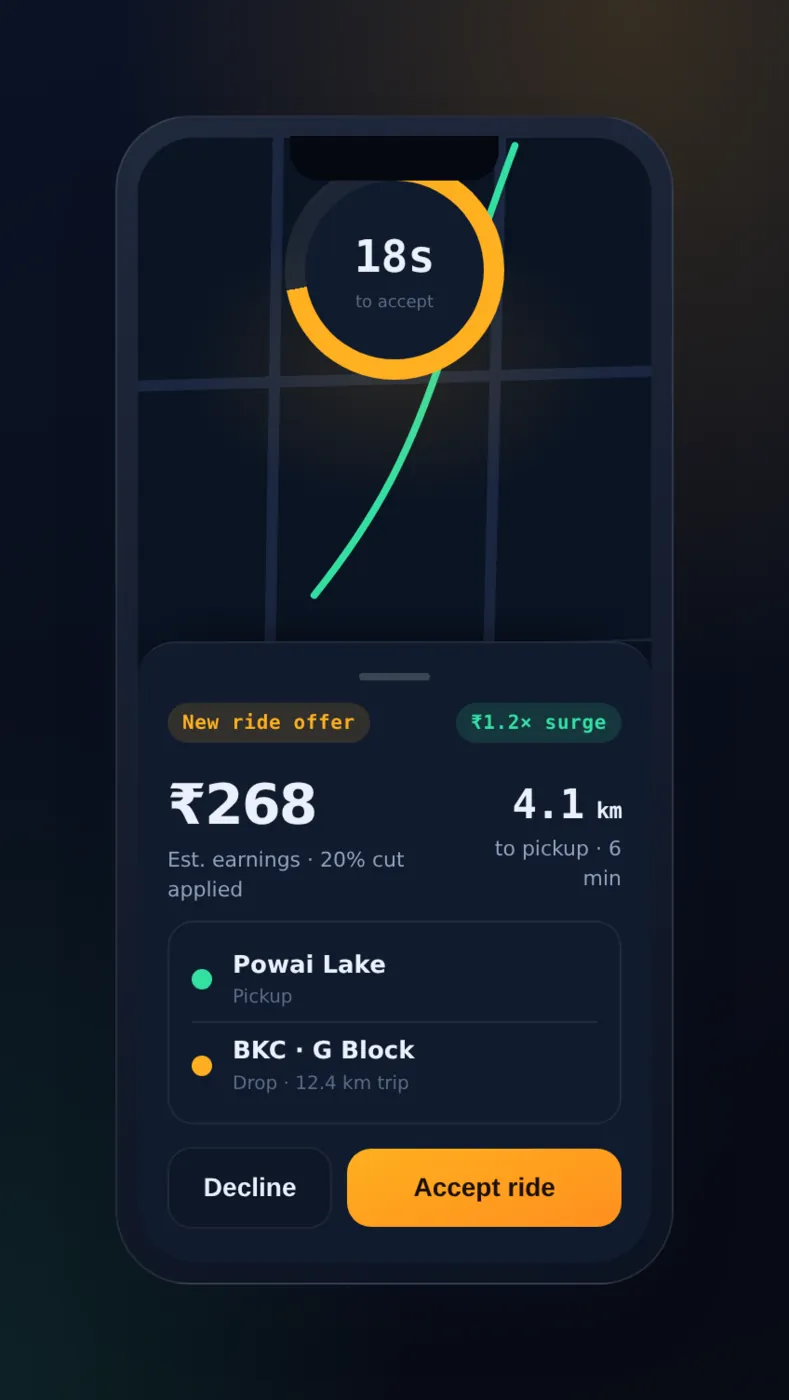
- Dispatch and accept/decline flow: incoming ride offers with a countdown timer, fare preview, and pickup distance.
- Navigation integration: turn-by-turn directions to pickup and drop, via Google Maps or a similar SDK.
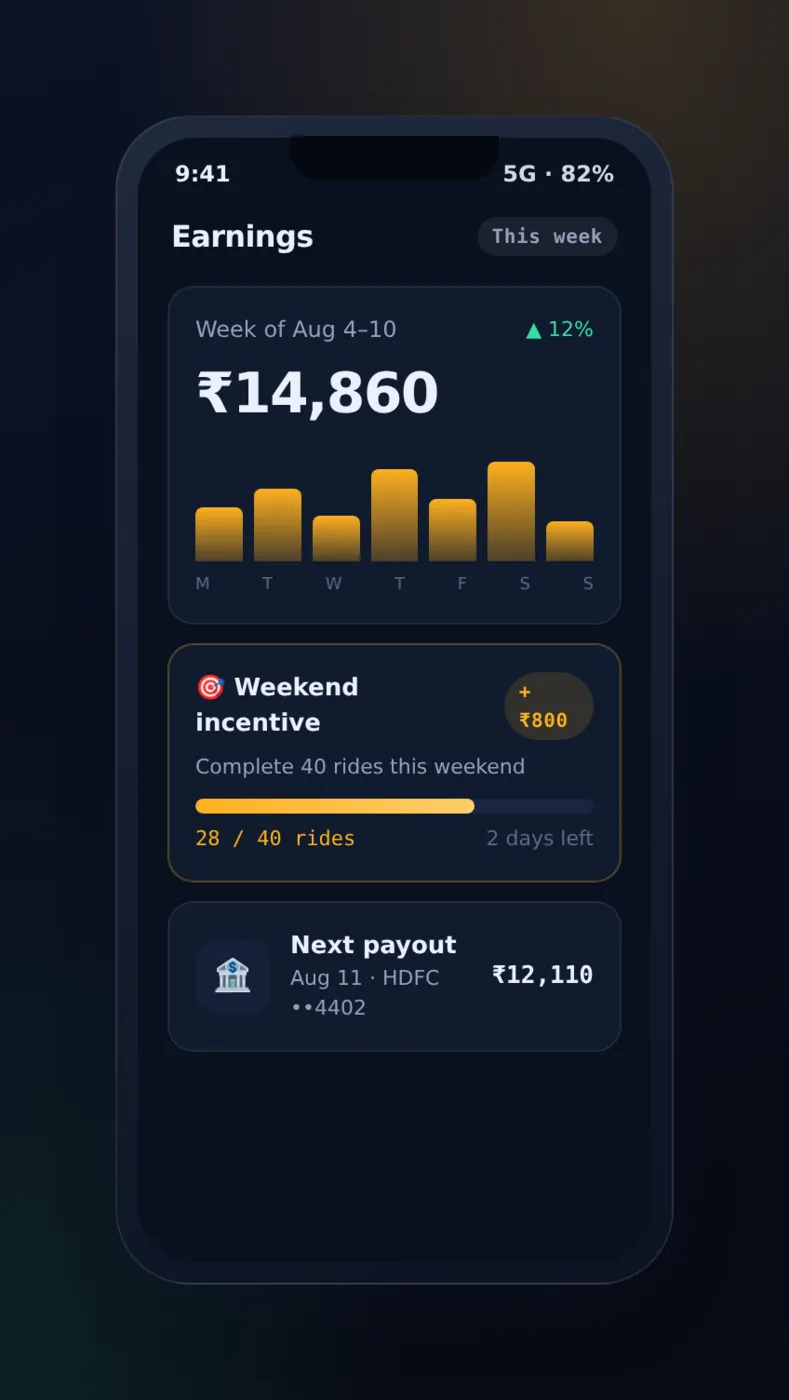
- Earnings dashboard: per-ride breakdown, daily and weekly totals, and payout history.
- Offline and low-connectivity handling: queuing ride-status updates when a driver briefly loses signal, common in dense urban zones.
- Multi-language support: localized UI and voice-friendly navigation cues for drivers who may not read the app's default language comfortably.
A driver who misses an offer because a screen loaded slowly is a driver who logs off. This app has to be faster and lighter than the customer app, not equal to it.
Phase 5: Building the Admin Panel
The admin panel is where your ops team runs the business day to day. It is also the phase founders most often forget to scope until it is too late.
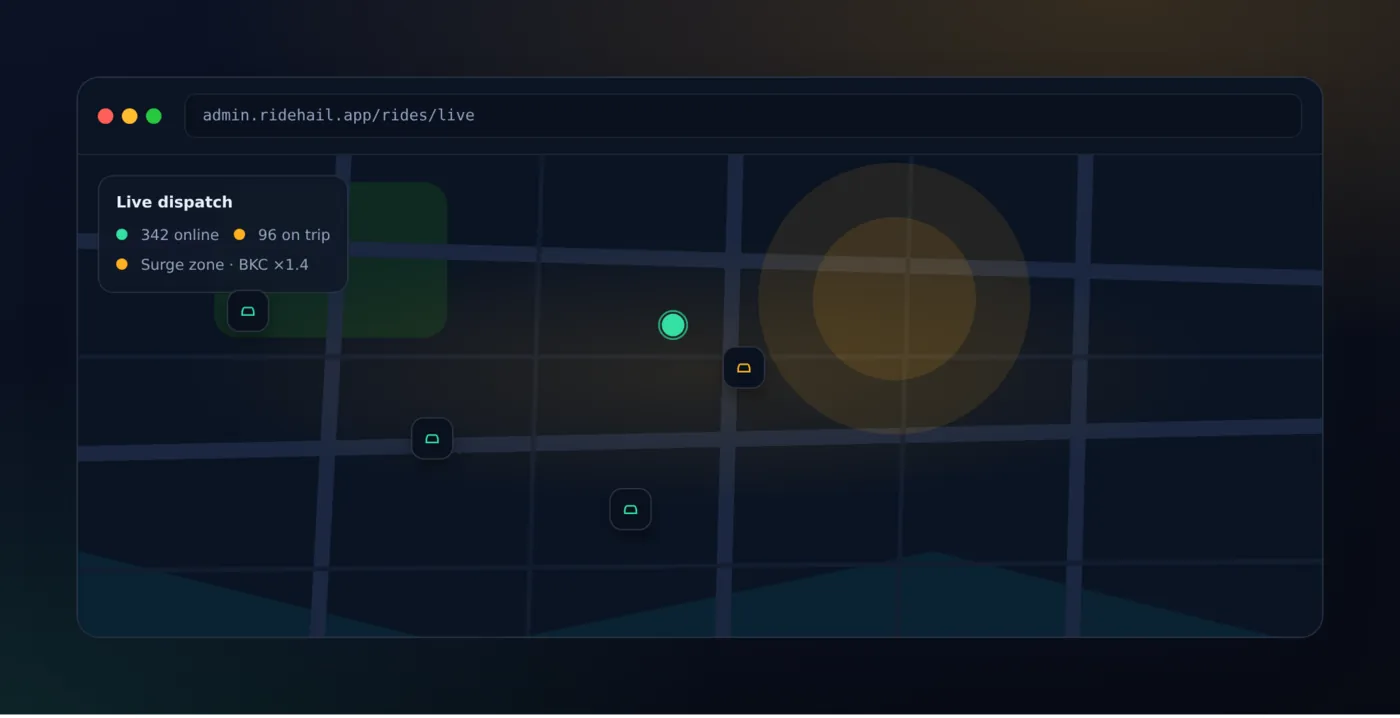
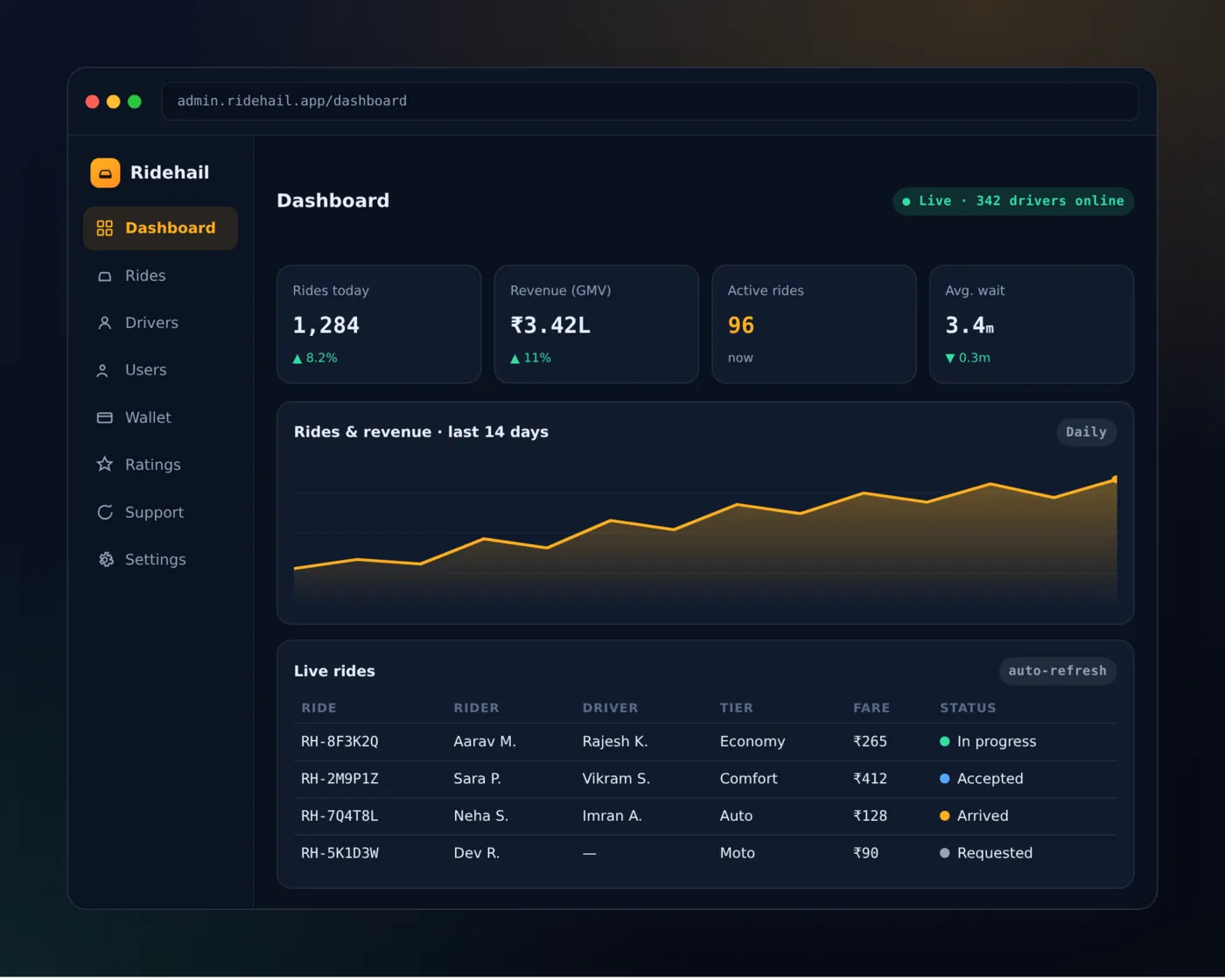
- Live dispatch map: every active driver and ride, plotted in real time, with drill-down into any single trip.
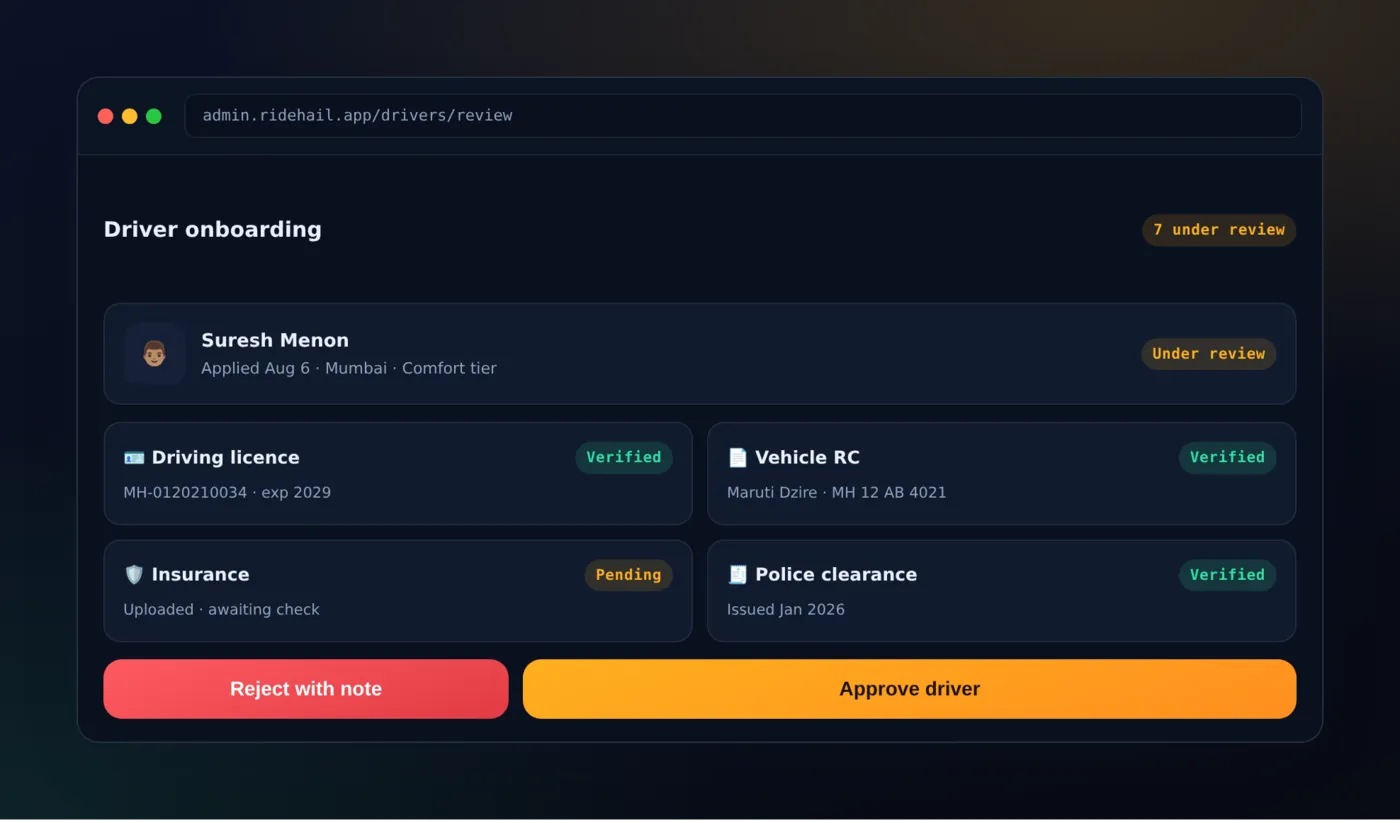
- Driver approval: a review queue for KYC documents, with approve/reject actions and status history.
- Pricing and surge controls: editable base fares, per-km rates and surge zones without a code deploy.
- Analytics: rides completed, revenue, driver utilization and cancellation rate, by city and by day.
- Dispute resolution: a ticketing view for fare disputes, lost items and driver complaints tied to specific rides.
- Role-based access: separate permissions for ops staff, finance and city managers, so no single login touches everything.
- Notifications and alerts: automated flags for stuck rides, payment failures or a driver going offline mid-trip, sent straight to the ops team.
A weak admin panel doesn't fail loudly like a crashed app does. It fails quietly, as slow driver approvals and pricing decisions made on gut feel instead of data.
Phase 6: Testing, QA and Compliance
This phase is where most self-built projects run over schedule. Real-time systems and real money both demand more testing than a typical app.
- Load-testing the dispatch engine: simulate concurrent ride requests during peak hours to catch matching delays before riders do.
- Payment reconciliation testing: verify every successful, failed and refunded transaction matches between the app, the gateway, and your ledger.
- Driver background-check compliance: confirm your KYC and verification flow meets local transport-authority rules before onboarding real drivers.
- App-store review prep: location-permission disclosures, payment-handling documentation and content-policy checks for both Apple and Google.
- Security testing: penetration testing on payment flows and on rider and driver personal data, especially stored location history.
- Device and OS coverage testing: both apps across a realistic spread of Android and iOS versions and screen sizes, not just the latest flagship phone.
Budget real calendar time here. A skipped week of QA on a payments-and-location app tends to resurface later as a much more expensive support fire.
The reconciliation cases that actually hurt are the asymmetric ones: a cash ride where no money passes through the gateway but commission is still owed, a payment the gateway accepted whose webhook never arrived, and a refund issued after the payout for that trip has already gone out. Test those three deliberately — none of them turns up in a happy-path run.
Phase 7: Deployment and Launch
Launch is a rollout, not a single event. Treat it as its own phase with its own checklist.
- Infrastructure setup: production servers, database backups, monitoring and alerting configured before the first real ride.
- Phased city rollout: launch in one city or zone first, watch dispatch performance, then expand.
- Driver recruitment and onboarding: a supply pipeline running before demand—riders with no available drivers churn fast.
- Marketing launch: referral codes, first-ride discounts, and local driver-community outreach to seed both sides of the marketplace.
- Support and escalation setup: a live-ops channel for driver and rider issues during the first weeks, before self-serve support scales.
- Launch-week monitoring: a war room watching dispatch success rate, payment failures and crash reports hour by hour for the first few days.
Launch week always surfaces something the discovery phase didn't anticipate. Plan for that reality instead of treating launch day as a finish line.
Phase 8: Post-Launch Iteration
Shipping is the start of the real work. The apps that outlast their first year are the ones that keep iterating on real ride data.
- Monitoring dispatch performance: match times, cancellation rates and driver idle time, tracked daily.
- Incentive campaigns: driver bonuses and rider promotions timed to fix specific supply or demand gaps.
- Expanding vehicle tiers: adding premium, XL or bike categories once core demand is proven.
- Multi-city scaling: replicating the phase-seven rollout playbook in each new market, city by city.
- Feature requests from real usage: prioritizing what actual riders and drivers ask for over what looked good in the original spec.
Treat this phase as ongoing, not optional. The gap between a one-city taxi app and a multi-city one is largely built in phase eight.
Realistic Timeline and Cost by Phase
Phases two through six are the expensive part. They involve real-time systems, three separate applications, and compliance work that cannot be rushed.
Building all eight phases from scratch with an in-house or agency team typically runs six to nine months before a real driver takes a real ride.
Starting from a proven white-label codebase compresses that into the weeks shown below, because most of phases two through six already exist and are already tested.
| Approach | Timeline | Illustrative Cost | Ownership |
|---|---|---|---|
| All 8 phases from scratch | 6–9 months | $40,000–$150,000+ | Full, but built from zero |
| Start from Ridehail white-label source | 3–6 weeks to launch | ~$599 one-time license | Full source-code ownership, no royalty |
The numbers above are illustrative, not a fixed quote. Three variables swing the from-scratch range the most:
- City count at launch: one city vs. three multiplies driver-recruitment and support workload from day one.
- Vehicle-type complexity: a single sedan tier is simpler to price and dispatch than a mixed fleet of bikes, autos and cars.
- Custom features beyond the core flow: loyalty programs, corporate accounts or in-app chat add scope on top of the eight phases above.
Both rows end with full ownership of working software. The difference is which phases you pay to redo versus which ones you inherit already built.
Real-Time GPS Tracking
If there is one feature that makes an Uber-like application different from a normal booking app, it is real-time location tracking.
GPS and mapping services can provide:
Current location
Pickup location
Destination
Driver location
Distance
Route
Estimated arrival time
The backend also needs to handle frequent location updates efficiently so that the experience remains smooth without unnecessarily consuming device battery or server resources.
Location update pipeline
Device GPS — Driver app
Batch & Filter — Drop idle pings
Ingest Gateway — Validate, throttle
Geo Index — Nearby lookup
Customer App — live map (Car moves, ETA recalculates)
every 3–5s when moving
saves battery
sub-second reads
The hard part isn't reading GPS — it's absorbing thousands of updates a second without draining phone batteries or melting the server.
How Does Driver Matching Work?
When a customer requests a ride, the system needs to find an available driver. The nearest driver isn't always the right driver.
The matching system may consider:
Distance from the pickup point
Driver availability
Vehicle category
Service area
Current driver status
Existing bookings
Other business rules
Driver matching
Pickup — 3 km · 2 km · 1 km
D1 · 0.4 km — wrong category
D2 · 1.1 km — matched
D3 · 1.3 km — on another trip
D4 · 2.6 km — outside service area
Match score inputs
Distance to pickup
Vehicle category match
Driver availability
Service area & shift
Acceptance history
D1 is closest and still loses. Category, availability and service area filter the pool before distance ever gets to break the tie.
How Should the Fare Be Calculated?
A basic fare structure can include:
Base Fare + Distance Charge + Time Charge + Additional ChargesReal businesses often need different pricing for:
Cities
Vehicle categories
Peak hours
Night rides
Airport pickups
Minimum fares
Waiting time
Toll charges
Platform fees
Taxes
These rules should ideally be manageable through the admin panel so the business team can update pricing without changing the application code.
Editable pricing has a catch worth planning for: a fare quoted under one rate card and settled under another cannot be explained afterwards. Store the rates used with the trip itself, so an invoice from last month still adds up after the business team changes the per-km rate. Keep the estimate alongside the final fare too — the gap between those two is what customers write in about.
Fare breakdown
Base — flat pickup fee
Distance — per km, by category
Time — per min in traffic
Surge — demand multiplier
Taxes — GST, tolls
Then the total splits again
Platform commission — your revenue
Driver payout — settled to wallet
Gateway fees — deducted per txn
Every item above should be editable from the admin panel — per city, per vehicle category, per time of day.
A fare is never one number. It's a stack the customer sees, and a second split the customer never sees.
Online Payments and Cash
Depending on the business model, customers can be offered:
UPI
Credit cards
Debit cards
Net banking
Digital wallets
Cash
The payment gateway should communicate with the backend so booking and payment status remain synchronized. The system should also handle failed payments, cancellations and refunds.
Cash is the awkward one. The gateway never sees the money, so the commission on that ride becomes a balance the driver owes, to be netted off a later payout. A failed online payment ends up in the same place: the ride is over and the car has gone, so the amount has to survive as a due on the account rather than as a retry nobody will ever open.
Cancellations and No-Shows
Cancellations are not one case, and they are where a booking platform quietly earns or loses trust. A rider who cancels before a driver is assigned costs nobody anything; the same tap after a driver has spent ten minutes reaching the pickup does not.
Decide where that line sits, what the driver is owed on either side of it, and how long a driver waits before a no-show can be declared — then show the rider the rule before they confirm, not after they are charged.
Push Notifications
Notifications keep customers and drivers informed throughout the booking process.
Booking Confirmed → Driver Assigned → Driver Is Arriving → Ride Started → Ride Completed → Payment SuccessfulIn-App Chat and Calling
Drivers and customers sometimes need to communicate about pickup points. In-app communication or masked calling can make this easier while giving the business more control over customer-driver interactions.
Ratings and Reviews
After a ride is completed, customers can rate their experience using a five-star system and optionally leave written feedback.
The admin team can monitor low ratings and complaints and take action when required. Driver ratings can also become part of the platform's quality-management process.
What Technology Should You Use?
There isn't one technology stack that is perfect for every project. The right choice depends on business requirements, expected users, budget, development team and future plans.
Mobile Application
Flutter
React Native
Native Android
Native iOS
Backend & Database
Node.js
Laravel / PHP
Python / Java / .NET
PostgreSQL / MySQL / MongoDB
For maps and location services, a mapping platform such as Google Maps Platform can be integrated. The important thing is to choose an architecture that fits the actual product requirements rather than selecting technology simply because it is popular.
Stack layers
CLIENT — Flutter or React Native · native Android / iOS · React admin web
API — REST for requests · WebSocket for live position and trip state
SERVICES — Matching · pricing · trips · wallet · notifications · fraud checks
DATA — Relational store for trips and ledger · in-memory geo index · object storage for documents
RUNTIME — Containers · queue for async jobs · logging, metrics, alerting
Third-party
Maps & routing
Payment gateway
SMS & OTP
Push notifications
KYC verification
Masked calling
Each one is a cost — per trip, per month
Language choice matters less than the layering. The third-party list is where most of the recurring operating cost actually sits.
Start With an MVP
If you're starting a new business, you don't necessarily need every possible feature on day one.
A practical MVP can include:
Customer and driver registration
Location selection
Ride booking
Driver matching
Fare calculation
Live tracking
Payment
Notifications
Booking history
Admin dashboard
Once the platform starts getting real users, you can add:
Wallets
Coupons
Referral systems
Driver incentives
Subscription plans
Corporate accounts
Multiple cities
Multiple languages
Advanced analytics
Dynamic pricing
Security Matters From Day One
An on-demand application handles:
Customer information
Driver documents
Phone numbers
Location data
Payment transactions
Business information
The application should be designed with:
HTTPS
Secure authentication
API protection
Role-based access
Input validation
Database security
Backups
Server monitoring
Secure payment integration
Two of the data types listed above are worth a decision rather than a checkbox: driver documents and location data. Both outlive the trip that produced them, so settle early who in the admin panel can open a driver's licence scan, and how long a completed ride's GPS track is kept once it has been paid for and rated.
Skip Straight to Phase 7 With Ridehail
Ridehail is PRS India's white-label taxi platform: a customer app, a driver app, an admin panel, and the backend behind all three, built and running today.
It is not a blank template you customize from zero. Phases two through six of this exact plan are already done.
- Backend: a NestJS and Prisma backend on MySQL, with the dispatch engine, fare engine and real-time location layer already built and tested.
- Customer and driver apps: built in Flutter, covering booking, live tracking, ratings, KYC, dispatch and earnings—the core of phases three and four above.
- Admin panel: a Next.js dashboard with the live dispatch map, driver approval queue, pricing controls and analytics from phase five.
- Payments: cash rides running through the ledger and commission split, plus a Razorpay integration in the backend that ships without keys, so you connect your own merchant account or swap in the gateway your market uses.
- Source code: full source-code access for all four pieces, so your team can customize freely instead of working around a black box.
Starting from Ridehail means phase one—scoping your market, your branding, your city launch plan—is your actual starting line, not month four of a nine-month build.
Phase seven, deployment, is weeks away instead of months. Because it is a one-time ~$599 source-code license with no per-ride commission, every rupee your platform earns stays yours.
Talk to the team about your specific city and fleet plan through our contact page—most conversations end with a working demo, not just a proposal.
Frequently Asked Questions
Which phase takes the longest?
Phase two, backend and real-time architecture, is almost always the longest when building from scratch.
Dispatch logic, fare calculation and live location tracking touch every other phase, so mistakes here get expensive to fix later. Budget extra review time for this phase specifically.
Can phases run in parallel?
Some can. Once core APIs are stable, the customer app, driver app and admin panel—phases three, four and five—can be built by parallel teams.
Phases one and two, and phases six through eight, are largely sequential. You cannot test what has not been built yet.
What's the minimum viable version of this build?
An MVP needs working versions of phases one through four, plus a thin slice of phase five: booking, matching, tracking, payment, and just enough admin visibility to approve drivers and watch rides.
Surge pricing, dispute tooling and multi-city scaling can wait for phase eight. A tight MVP proves demand before you invest in the full scope.
What an MVP cannot defer is the failure paths. A ride nobody accepts, a driver who cancels at the pickup, a payment that fails once the trip is over — on a spec these look like v2 work, and to the first hundred riders they look like a broken product. Ship fewer flows, but ship the unhappy path of each one.
How much of this is already done if you start from white-label source?
Starting from Ridehail, phases two through six are already built and tested, with one carve-out inside phase three: fares are taken in cash as shipped, so connecting a payment gateway is work for your own market.
You are effectively starting the project at phase one, with a working phase-seven launch checklist just weeks away.
Written by
Aditi
Building software at PRS India.