Engineering
How to Create an App Like Ola? Steps to Build a Taxi App Like Uber or Rapido
The anatomy of a ride-hailing marketplace, the seven build steps, and the three ways to launch — from scratch, SaaS rental, or a one-time full-source platform you own.

Written from production. Our articles draw on products we run live and the client work behind them, and are revised as the systems they describe evolve.
Ola, Uber and Rapido look like a single app, but each is really a two-sided marketplace: a rider app that requests trips, a driver app that fulfils them, and a real-time engine in the middle that matches the two, prices the trip and moves the money.
If you want to create an app like Ola — or a bike-taxi app like Rapido — this guide walks through exactly what you have to build, the order to build it in, and the three realistic ways to get there in 2026.
The short version: building a ride-hailing platform from zero is a 10–14 month engineering programme. Renting a SaaS platform gets you live fast but you never own it.
The middle path — starting from a complete, one-time, full-source platform — is how that year of engineering turns into a launch measured in weeks. We'll cover all three honestly, including the four SaaS platforms you'll shortlist.
What an app "like Ola" actually is
Before estimating cost or timeline, get the anatomy right. A production ride-hailing service is four products that share one database and one set of business rules:
The rider (customer) app — book a ride, see an upfront fare, track the driver live, pay, rate.
The driver app — go online, receive nearby ride offers, navigate, and track earnings and payouts.
The admin panel — the operations cockpit: live dispatch map, driver onboarding, pricing, promos, wallet and support.
The backend & real-time engine — matching/dispatch, fare calculation, geolocation, payments, notifications and safety, over both REST and WebSockets.
Miss any one of these and you don't have a marketplace — you have a demo. Everything below is about building all four without the timeline blowing out.
The 7 steps to build a taxi app like Ola or Rapido
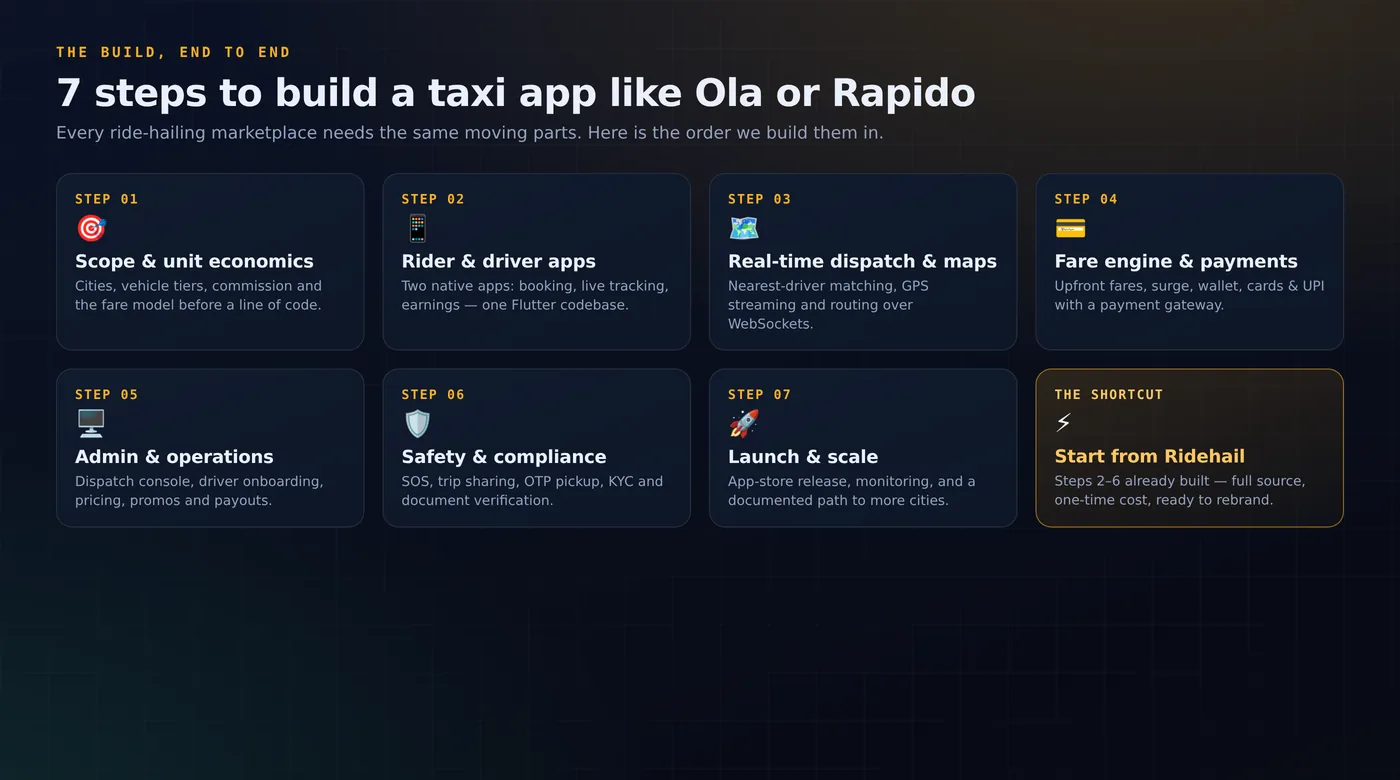 The build, end to end — the order the moving parts come together.
1. Scope the product and the unit economics
Decide your cities, your vehicle tiers (economy, auto, bike, XL), your commission, and the fare formula — base fare, per-kilometre and per-minute rates, minimum fare, waiting charges and surge.
This isn't paperwork; the pricing and commission model is your business, and it drives half the code you write later.
2. Build the rider and driver apps
Two apps, each shipping on both iOS and Android. Building them from one Flutter codebase (rather than two separate native teams) is one of the biggest levers on timeline and cost.
The rider app is a booking + live-map + payments app; the driver app is an availability + offers + earnings app.
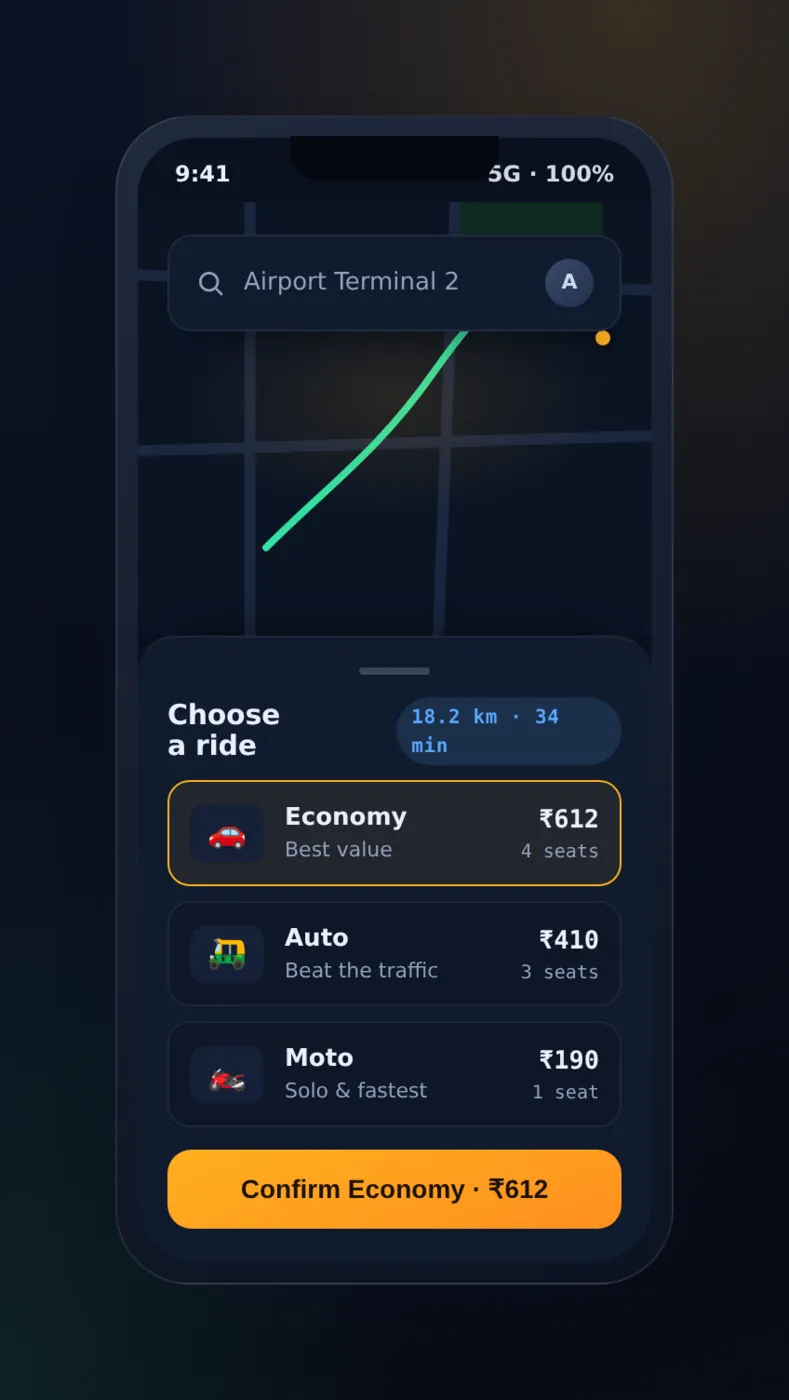 Rider app — book a ride, upfront fare per tier.
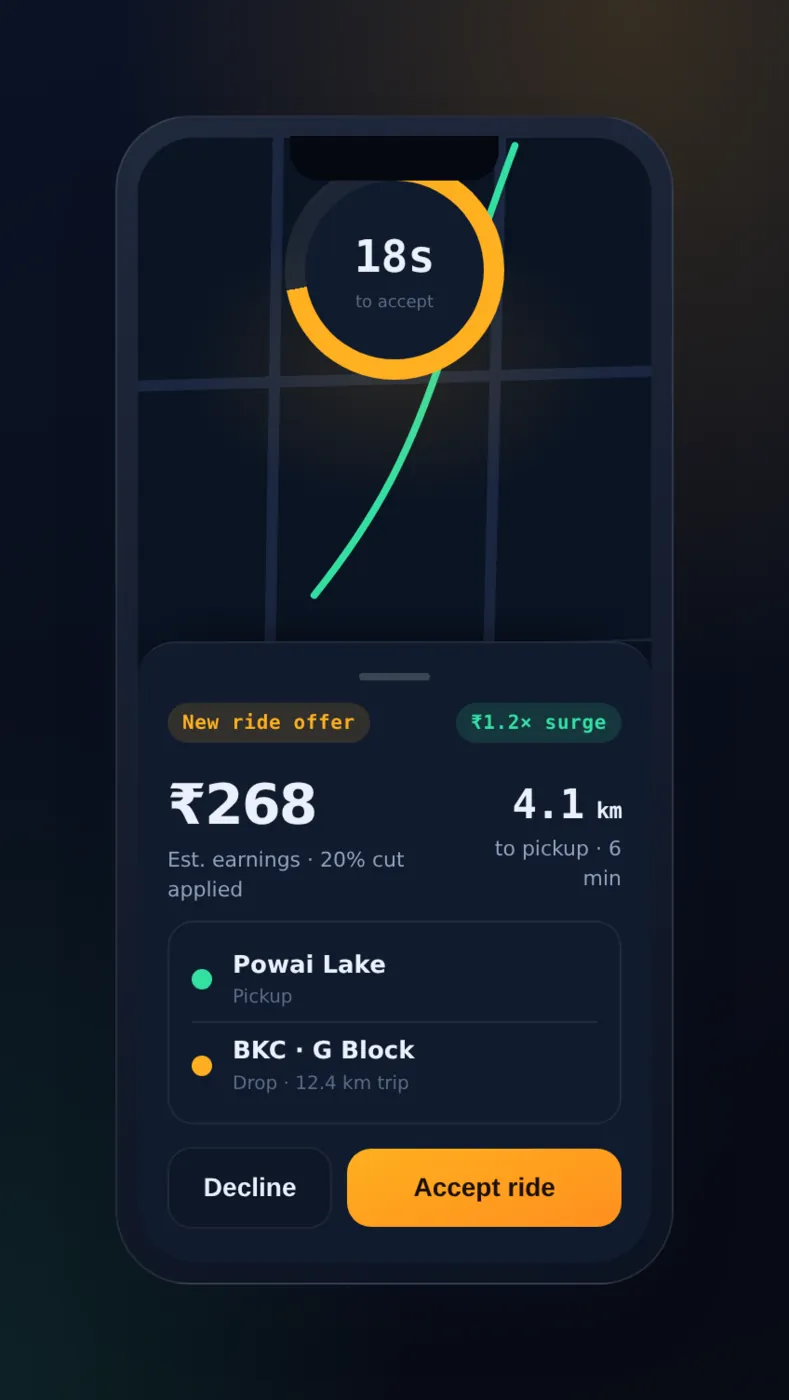 Driver app — a ride offer with earnings and a countdown.
3. Wire up real-time dispatch and maps
This is the hard part and the reason "an Uber clone" is more than a UI. You need the following, all pushed live over WebSockets:
Continuous driver-location streaming
A nearest-eligible-driver search — a geospatial query.
Round-based offers — that widen the radius until someone accepts.
A race-safe accept — so two cars are never sent to one pickup.
Maps and routing can run on OpenStreetMap + OSRM to avoid per-request map billing.
That trade runs both ways. You stop paying per request. But you now run a routing server, keep its map data current, and live with the address coverage the open data has in your cities. Test geocoding on your own pickup points before you commit. Routing that works on main roads can still miss the lane address a rider actually types.
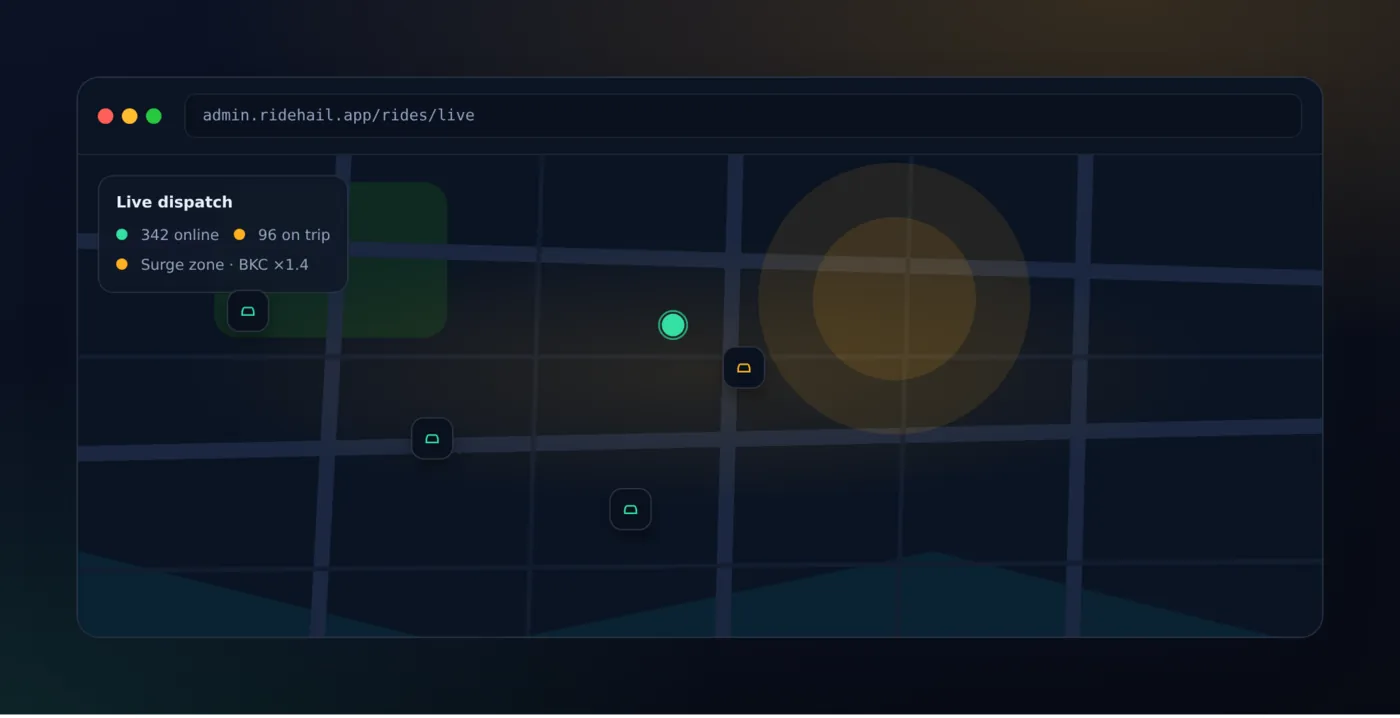 Real-time dispatch — every driver, ride and surge zone on one map.
4. Build the fare engine and payments
A deterministic fare engine quotes the price up front from a real route estimate and freezes each component so a mid-ride surge can't silently reprice the trip.
The harder half is deciding what happens when the trip stops matching the quote — a rider who changes the destination, twenty minutes of waiting at the pickup, a toll the estimate never saw, a route the driver had to abandon. Write those rules before you write the engine. Each one is a support ticket and a refund argument later, and bolting them onto a frozen quote afterwards is worse than designing for them now.
Then wire payments the way your market pays, through a gateway such as Razorpay (swappable for Stripe or a local provider):
Payment methods — cash, cards, UPI and an in-app wallet.
Money movement — an auditable ledger with automatic commission splits and payouts.
5. Build the admin panel and operations
None of the above is operable without a control room — with every privileged action audit-logged:
Live dashboard
Ride management
Driver onboarding and document verification
Pricing and surge-zone editing
Promos
Wallet adjustments and support
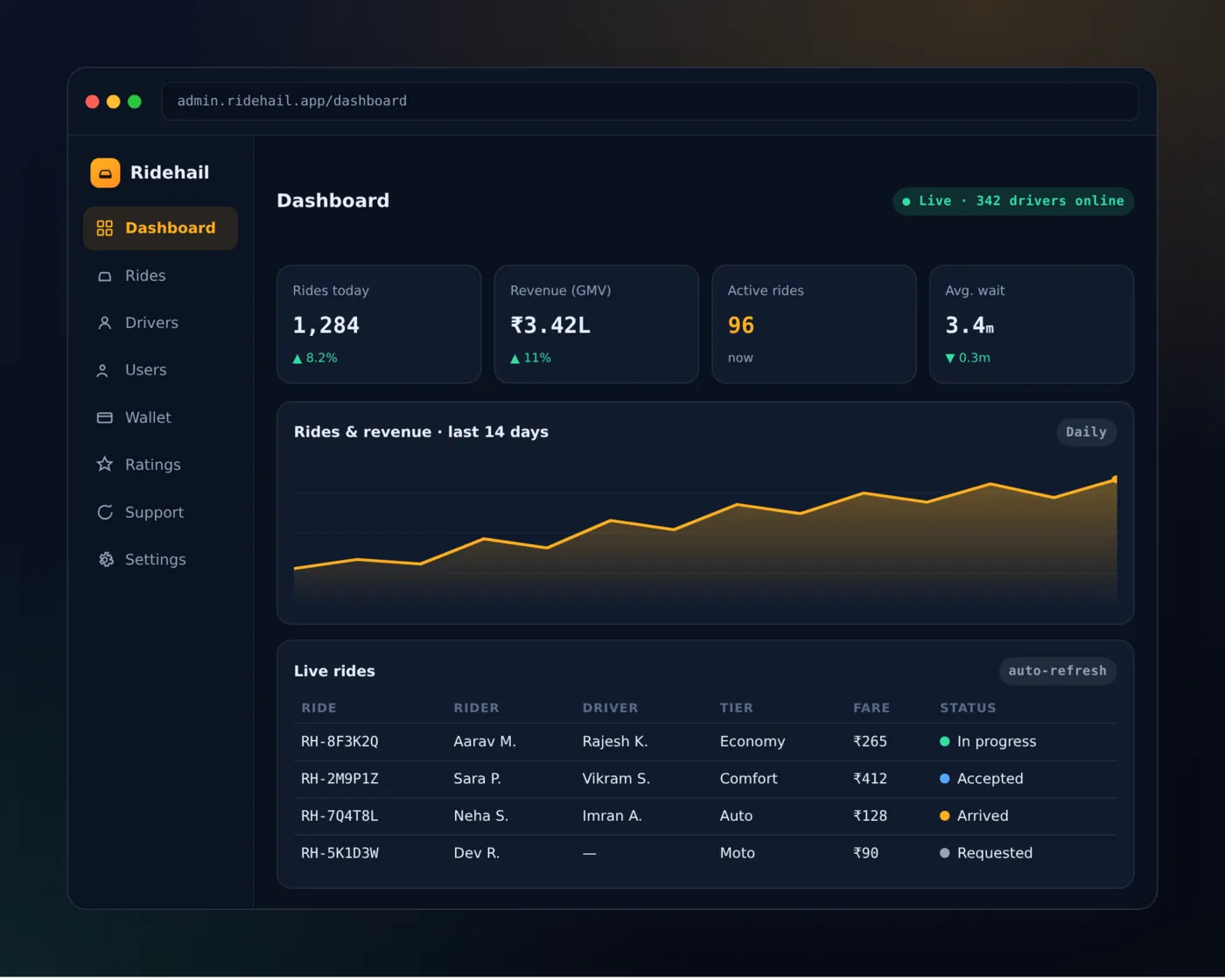 Admin panel — KPIs, revenue trends and live rides at a glance.
6. Add safety and compliance
Rider trust is a feature — every driver needs KYC before taking a ride:
SOS button
Shareable live-trip links
Pickup OTP — so riders board the right car.
Driver KYC — licence, registration, insurance and ID verification.
In India this is also where you handle city-level permits and GST-correct invoicing.
7. Launch and scale
App-store release, monitoring, and a documented path from one city to many. The dispatch and geo layers are where scale bites first, so plan the move to PostGIS / Redis GEO before you need it.
Be honest about which problem comes first, though. A first city rarely struggles with load. It struggles with density: too few drivers online in the area the requests come from. Riders just see "no cars available", however well the dispatch code performs. Plan the launch around that, and keep the admin panel's supply view in front of whoever is running the city.
Build from scratch, rent SaaS, or buy the source?
There are three realistic ways to get an app like Ola live. They trade cost, speed and ownership against each other.
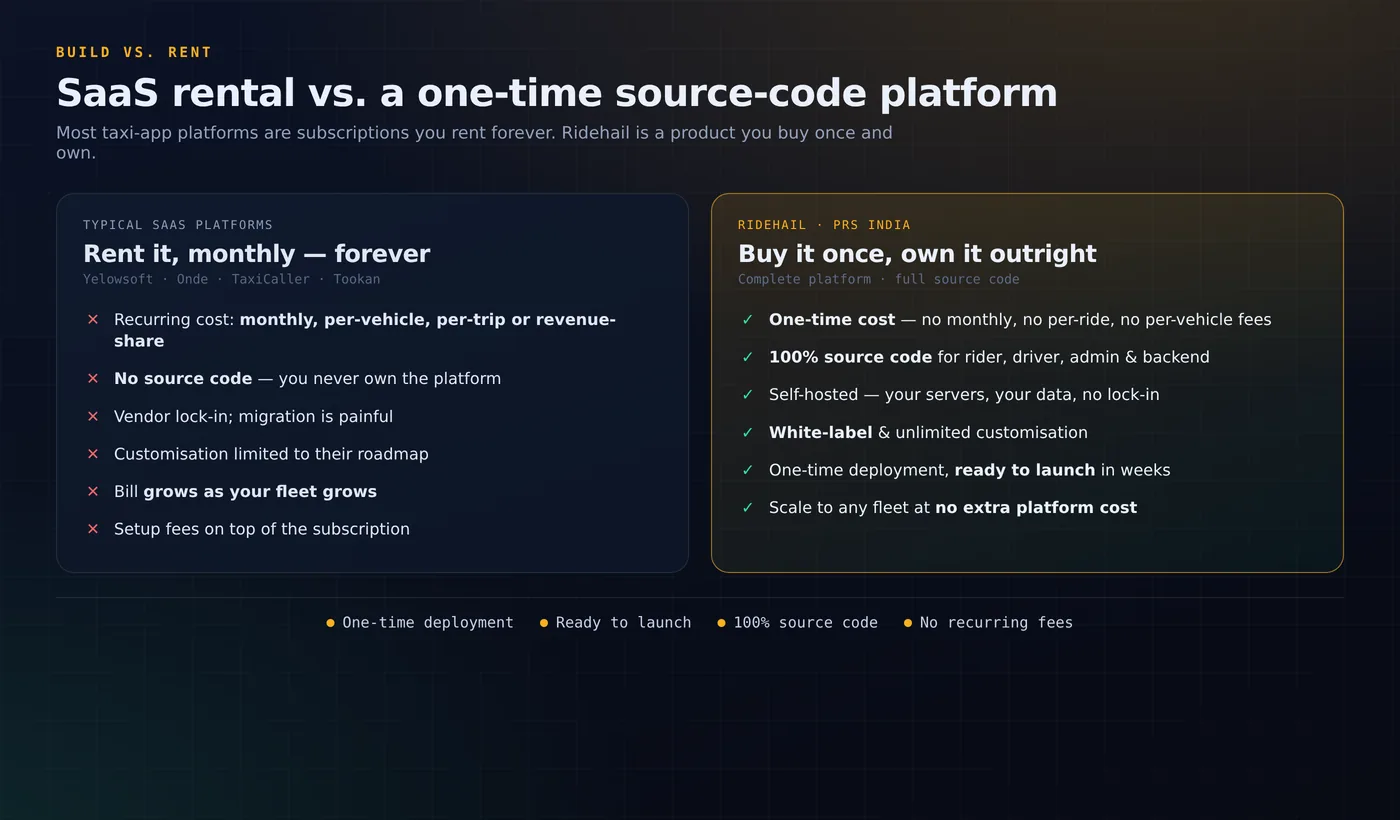 The core trade-off: rent a platform forever, or own one outright.
Option A — Build everything from scratch
Maximum control, maximum cost. Expect 10–14 months and a multi-person team across Flutter, backend, DevOps and design before your first paid ride.
It only makes sense if your model is genuinely unlike every existing platform.
Option B — Rent a SaaS platform
Fastest to a logo on screen, but you are renting, not owning — and the meter never stops. The four you'll most likely shortlist, and how they charge (as of 2026):
Yelowsoft — white-label taxi SaaS; subscription from about $149/month plus a setup fee, with monthly trip limits and per-trip overage.
Onde (formerly TaxiStartup) — white-label apps on a one-time fee plus a monthly revenue-share subscription.
TaxiCaller — cloud dispatch billed per vehicle per month (around $20/vehicle), Enterprise on quote.
Tookan / Yelo (JungleWorks) — task-based monthly or annual subscription.
All four are established products. The catch is the same for every one of them:
No source code — you never receive it.
Recurring bill — and it usually grows with your fleet or trips.
Bounded customisation — limited to their roadmap.
Hard to leave — moving off later means rebuilding.
Option C — Buy a one-time, full-source platform
The middle path: start from a complete, production-grade platform delivered as full source code for a one-time price, then rebrand and launch it.
You get SaaS-like speed with from-scratch ownership — no monthly fee, no per-ride cut, and no lock-in. This is exactly what our own Ridehail platform delivers.
Taxi app platforms compared (2026)
| Option | Pricing model | Source code | Recurring fees | Customisation | You own it? |
|---|---|---|---|---|---|
| Build from scratch | Development cost (large) | Yes (you write it) | None (but you carry all maintenance) | Total | Yes — after 10–14 months |
| Yelowsoft | Subscription (~$149/mo + setup) | No | Monthly + per-trip overage | Config / white-label | No — rented |
| Onde | One-time fee + monthly revenue share | No | Ongoing revenue share | White-label | No — rented |
| TaxiCaller | Per vehicle / month (~$20) | No | Per vehicle, monthly | Config | No — rented |
| Tookan / Yelo | Task-based subscription | No | Per task, monthly/annual | Config | No — rented |
| Ridehail (PRS India) | One-time cost | Yes — 100% | None | Unlimited (full source) | Yes — outright |
Pricing models are as published by each vendor in 2026 and are indicative; confirm current pricing on each vendor's site before deciding.
Why a one-time, full-source platform wins
For most founders launching an Ola or Rapido alternative, renting forever is the expensive option in disguise — a subscription that scales up exactly as your business does, on a platform you can never truly change or own.
A one-time, full-source platform flips that:
One-time cost — no monthly fee, no per-ride commission, no per-vehicle charge.
Complete source code — the rider app, driver app, admin panel and backend are all yours.
Ready to launch — a one-time deployment, rebranded and live in weeks, not a year.
White-label & unlimited customisation — your colours, logo, currency, language and features.
Own your data and infrastructure — self-hosted, no vendor lock-in.
Our Ridehail platform is exactly this: an open, full-source taxi and ride-booking solution — customer and driver apps, admin panel and real-time backend — delivered for a one-time price and built to rebrand.
It already has steps 2 through 6 above built and tested, with one carve-out inside step 4: fares are taken in cash as shipped, so connecting a payment gateway and settling drivers automatically is work for your own market. That is why it collapses a year of engineering into a launch you can schedule.
Frequently asked questions
How much does it cost to build an app like Ola?
From scratch, a production ride-hailing platform is a 10–14 month build with a full team, which is why the all-in cost runs into tens of lakhs (or high five figures in USD).
Renting a SaaS platform trades that for a recurring monthly, per-vehicle or per-trip fee. A one-time, full-source platform like Ridehail sits in between: a single upfront cost, no recurring fees, and you own the code.
How long does it take to build a taxi app like Ola or Rapido?
Ten to fourteen months from scratch. With a ready-made, full-source platform you rebrand and configure rather than build, so a single-city launch is typically a matter of weeks.
What features are essential for a ride-hailing app?
At minimum, a ride-hailing app needs:
Map-based booking — with upfront fares.
Live GPS tracking
Real-time driver–rider matching — dispatch.
Multiple payment methods — with a wallet.
Ratings
An admin/dispatch panel
Safety tools — SOS, trip sharing, pickup OTP, driver KYC.
Should I use a SaaS platform or buy the source code?
Choose SaaS if you want the fastest possible start and are comfortable renting forever with capped customisation.
Choose a one-time source-code platform if you want to own the product, avoid per-ride and per-vehicle fees, and customise without waiting on a vendor's roadmap.
Can one app do both taxi rides and bike taxis like Rapido?
Yes. Bike-taxi, auto, economy and XL are just vehicle tiers with their own pricing and capacity on the same dispatch engine — no separate app required. The same engine can also run parcel delivery.
Do I get the source code with Ridehail?
Yes — Ridehail is delivered as 100% source code for the rider app, driver app, admin panel and backend, for a one-time price, with no recurring or per-ride fees. You self-host it and own it outright.
Build your Ola or Rapido alternative with PRS India
Whether you want the platform handed over ready to launch, or customised and deployed for you, that's the work we do. See the full Ridehail taxi platform, or talk to our engineers about your city, your tiers and your timeline.
Written by
Aditi
Building software at PRS India.