How to Start Taxi Business: Build Your Own Taxi App
Start a taxi business step by step: pick a model and area, sort the papers, then launch your own rider and driver app under your name.

Written by Babita Kumari, Business Developer
Reviewed by the PRS India software & mobile app development team
12 min read
Written from production. Our articles draw on products we run live and the client work behind them, and are revised as the systems they describe evolve.
Many people want to start a taxi business. Some own a few cars. Some run a travel desk. Some drive themselves and want to grow. The first question is always the same: where do I start? Cars and drivers come first. Papers come next. Then you need a way for customers to book you.
Today, that way is an app. You do not have to join a big ride app and share each fare with it. You can build your own taxi app under your own name. This guide walks through how to start a taxi business step by step, and shows where your own app fits in.
Key takeaways
- Pick your model first: your own cars, attached cars from owners, or both.
- Sort the papers early: business registration, GST, vehicle permits and any state aggregator licence.
- Start in one area with one or two ride types, then grow.
- Your own app keeps the customer list, the trip data and the fares in your hands.
- Plan the driver side as carefully as the rider side. Drivers leave apps that pay late or confuse them.
Step one: choose your taxi business model
Before you buy a car or build an app, decide how your business will make money. There are three common models in India.
| Model | How it works | What you manage |
|---|---|---|
| Own fleet | You buy or lease the cars and hire drivers on salary or per trip. | Cars, service, fuel, driver pay and bookings |
| Attached cars | Car owners join you. You send them rides and keep a share of each fare. | Bookings, driver checks and weekly payouts |
| Mixed | A few own cars for steady work, plus attached cars for busy days. | Both of the above |
The attached-car model is a small two-sided marketplace. Riders are on one side and car owners on the other. Your app sits in the middle and decides who gets which ride.
Step two: pick your area and ride types
Do not try to cover a whole state on day one. Pick the area where you already know the roads and the demand. A railway station, an airport, a hospital belt or a group of colleges are good places to begin.
Then pick the ride types you will offer. Keep it short at the start. You can add more later.
- City rides by car or auto
- Airport and station drops at a fixed fare
- Hourly rental for shopping or meetings
- Outstation trips for families
- Small parcel drops, if your drivers agree
If you plan parcels as a large part of your work, read about logistics platform development too. Parcels need different steps from passenger rides.
Step three: sort the papers
A taxi business deals with the law in more places than most small businesses. Here is a general list. Rules differ by state, so check each one with a lawyer and your local RTO.
- Register the business. A proprietorship, partnership or company. Small firms can also register as an MSME on the Udyam registration portal.
- Get GST registration if it applies to you. Registration and returns are done on the GST portal. Ask your accountant which GST rate fits your rides.
- Register cars for commercial use. Taxis need commercial registration, a permit and insurance. Vehicle records are kept on the Vahan portal of the transport ministry.
- Check driver licences. Each driver needs a valid licence for the vehicle type. Your RTO can tell you about badge rules in your state.
- Check the aggregator licence rule. If you run an app that connects riders and drivers, state aggregator rules may apply. The Ministry of Road Transport and Highways issues guidelines for this, and states issue the licence.
The problem
Why new taxi businesses struggle without an app
Most new taxi owners start on phone calls. It works for a while. Then these problems start.
- Missed calls are missed rides. When the owner is driving, nobody picks up the phone.
- No proof of the fare. The rider and driver argue about the amount at the end.
- No idea where cars are. The owner calls each driver to find who is near the pickup.
- Payout fights. Attached car owners and the office keep different counts of the week's trips.
- No customer list. Repeat riders are saved in one phone, and lost when that phone is lost.
- Big apps take the customer. Riders who book you through a big app belong to that app, not to you.
Step four: build your own taxi app
Your app is the shop front of your taxi business. It needs three parts. Each screen here comes from a taxi app we built, shown with demo data.
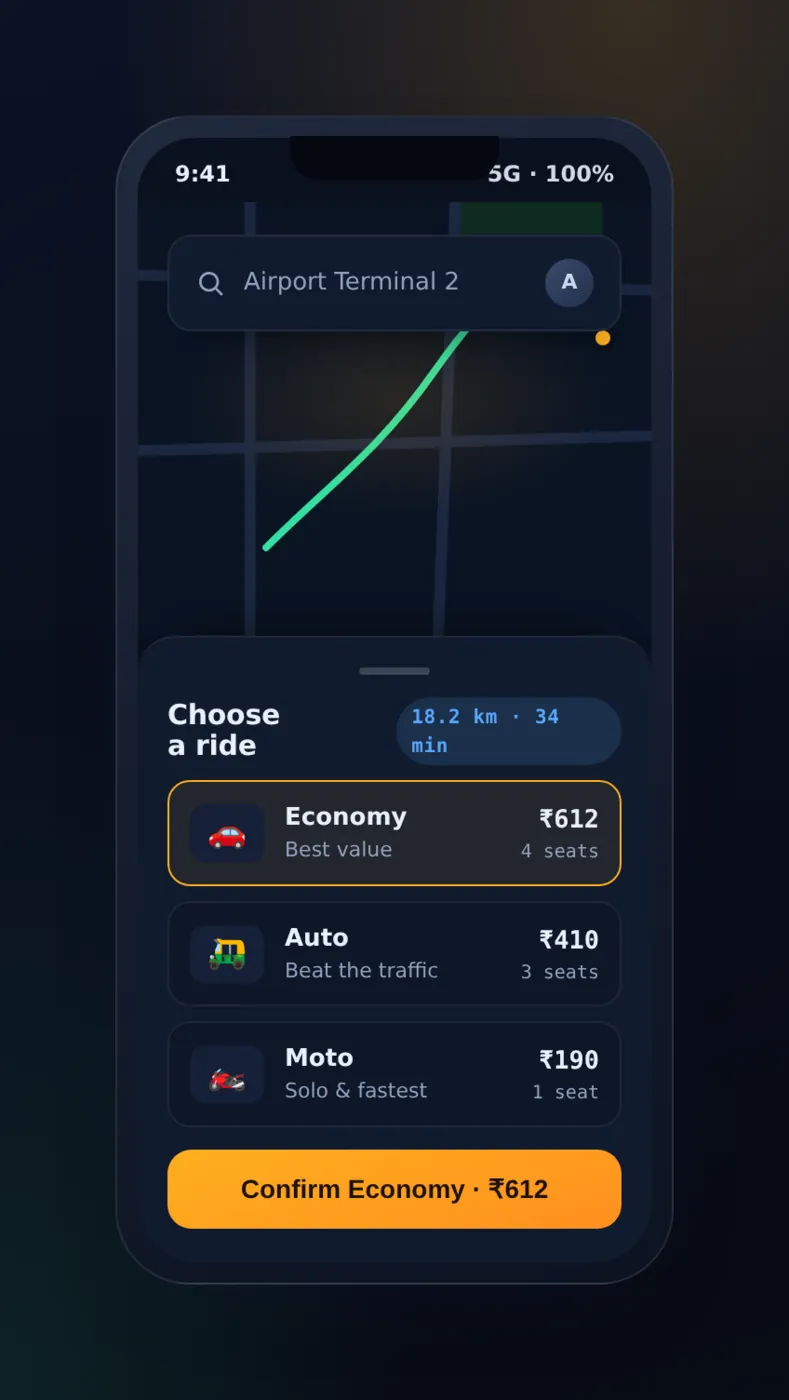
The booking screen riders see
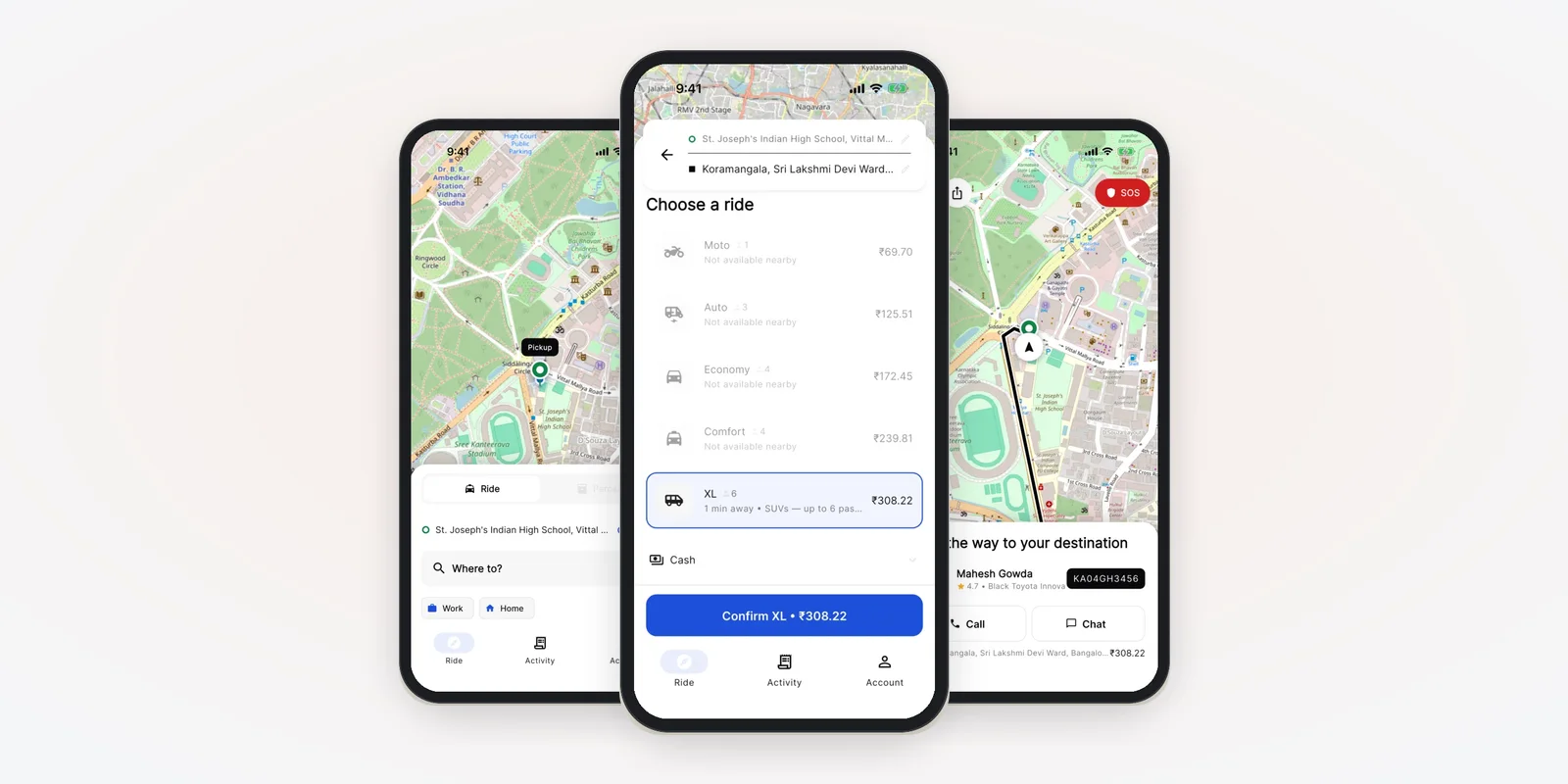
The rider types a drop point. The app shows the route, the ride types and the fare for each. One tap confirms the booking.
The fare is worked out from the rules you set in your office panel. So the rider sees the price before the ride, and nobody argues at the end.
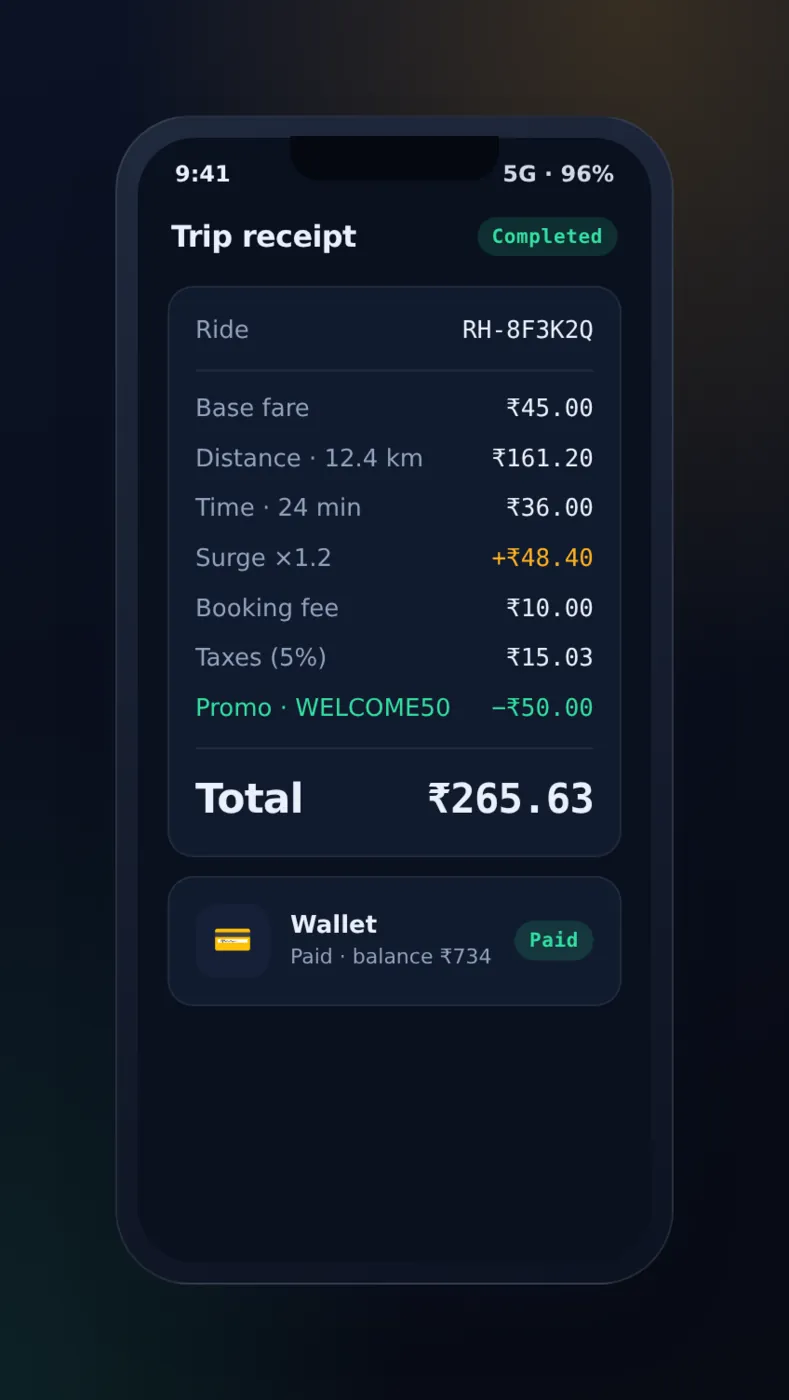
A receipt for every trip
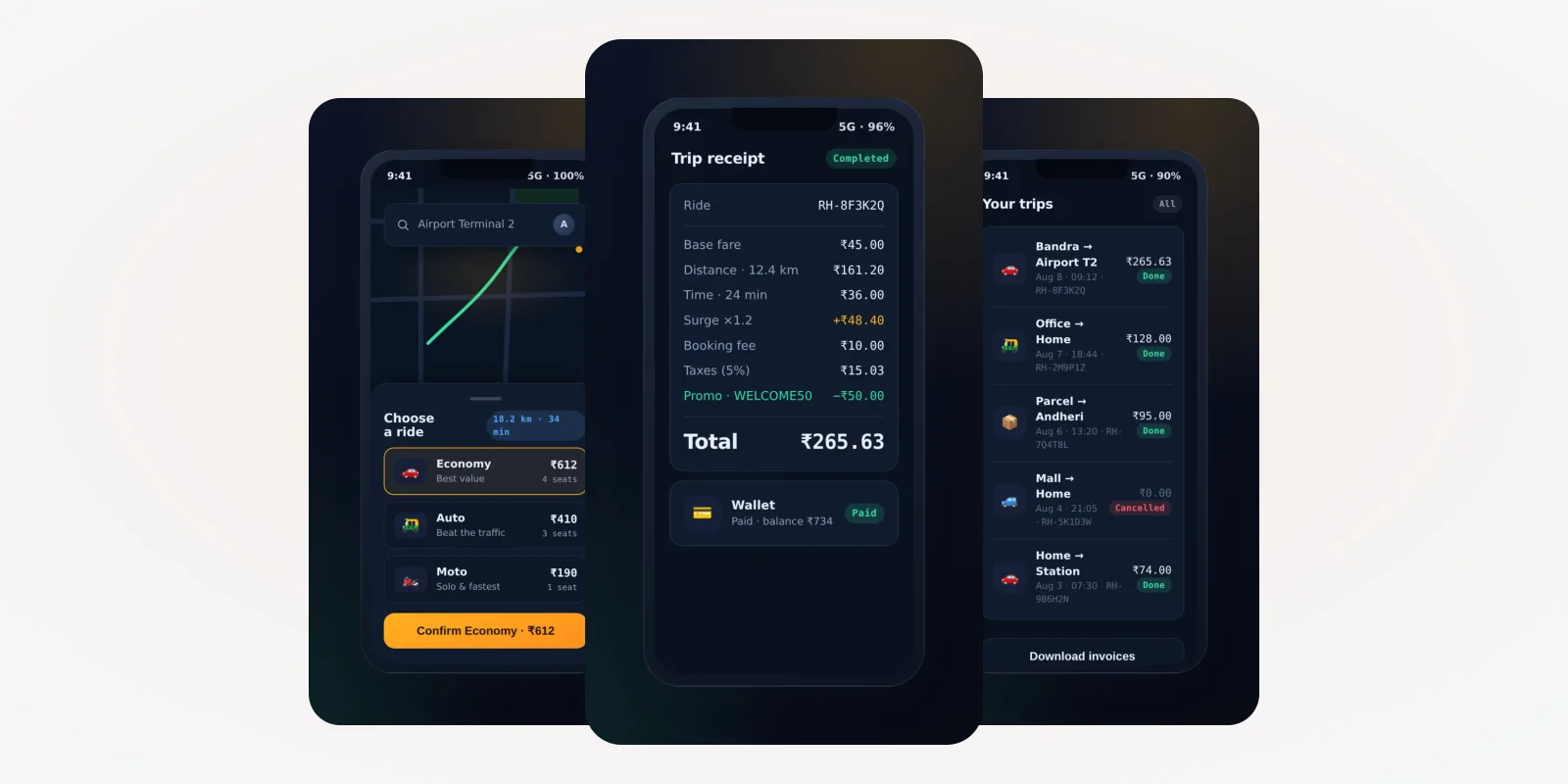
At the end of the ride, the app shows a receipt. It breaks the fare into base fare, distance, time, any busy-hour charge, booking fee, tax and discount. The same receipt is saved in the rider's trip list.
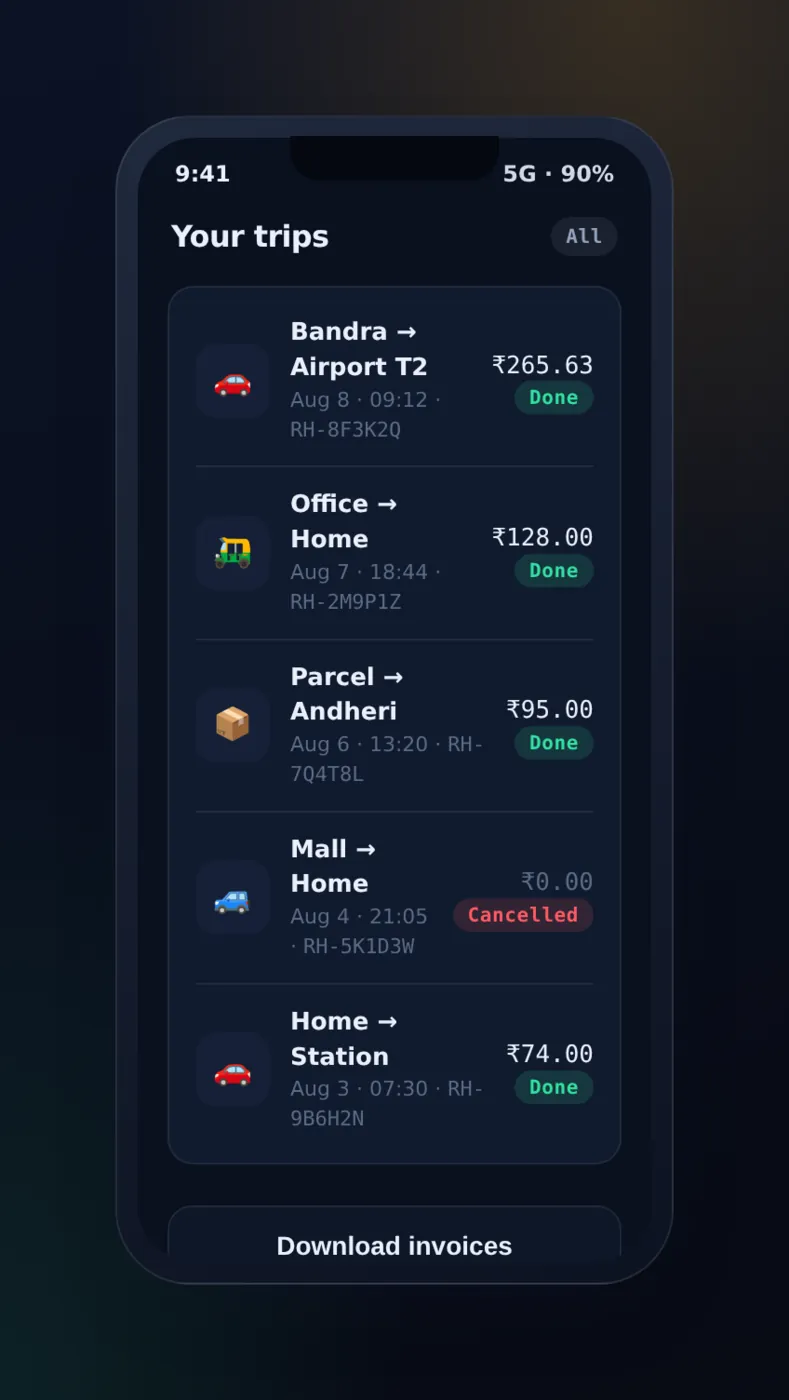
Trip history and invoices
Riders can see past trips and download invoices. Office travellers need these for their company claims.
Step five: plan the driver side
Riders come back when drivers are polite and on time. Drivers stay when they are paid on time and treated fairly. So the driver app matters as much as the rider app.
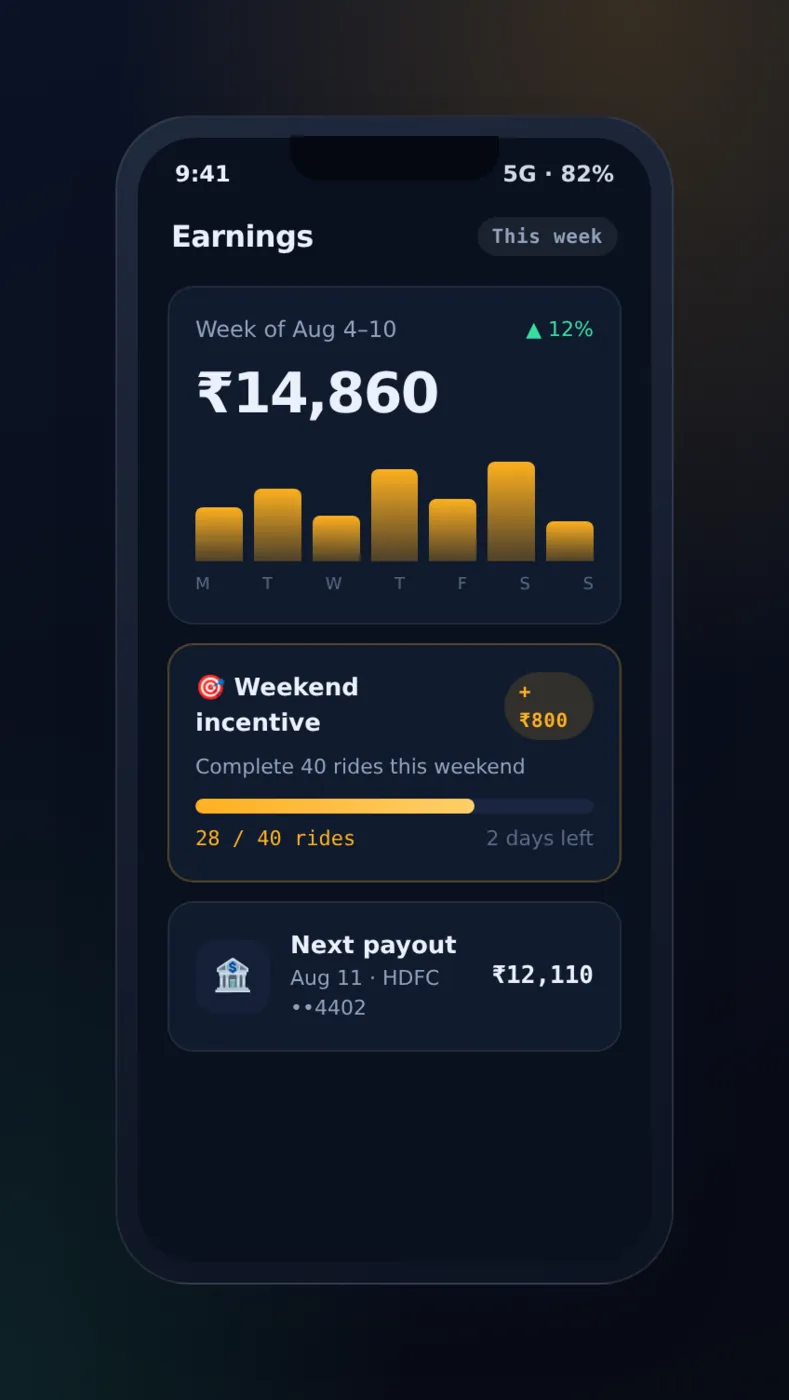
Earnings the driver can see
A daily chart, any target you run for the weekend, and the date of the next bank payout.
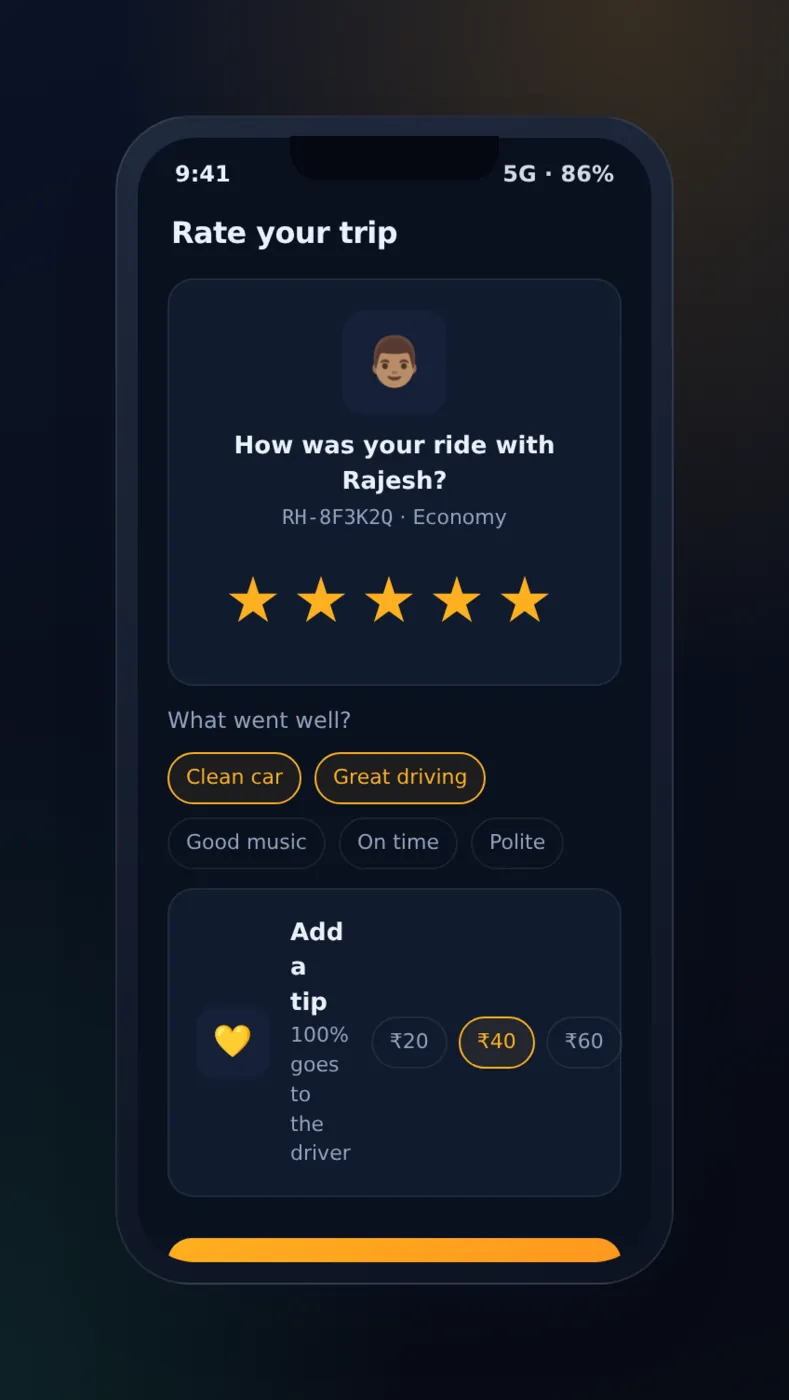
Ratings after each ride
Riders rate the trip and pick what went well. You see which drivers need a word.
In your office panel, every new driver goes through a check before the first ride. Your staff see each paper and approve or reject it with a note.
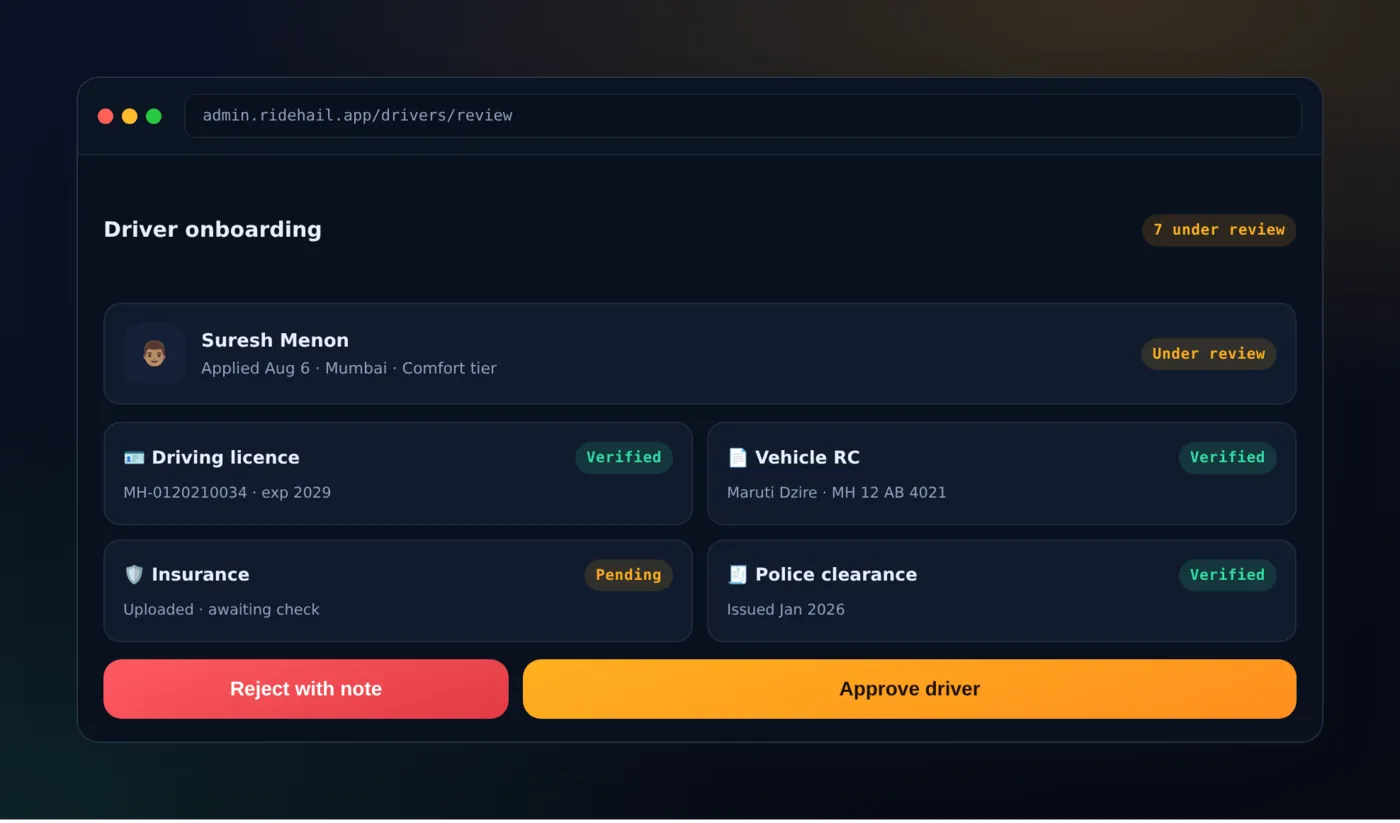
Step six: launch in one area
Launch with a few drivers you know well. You can see apps we have launched for other businesses in our case studies. Watch the live map from your office. See where riders book from and where cars wait. Move drivers to the places where bookings come in.
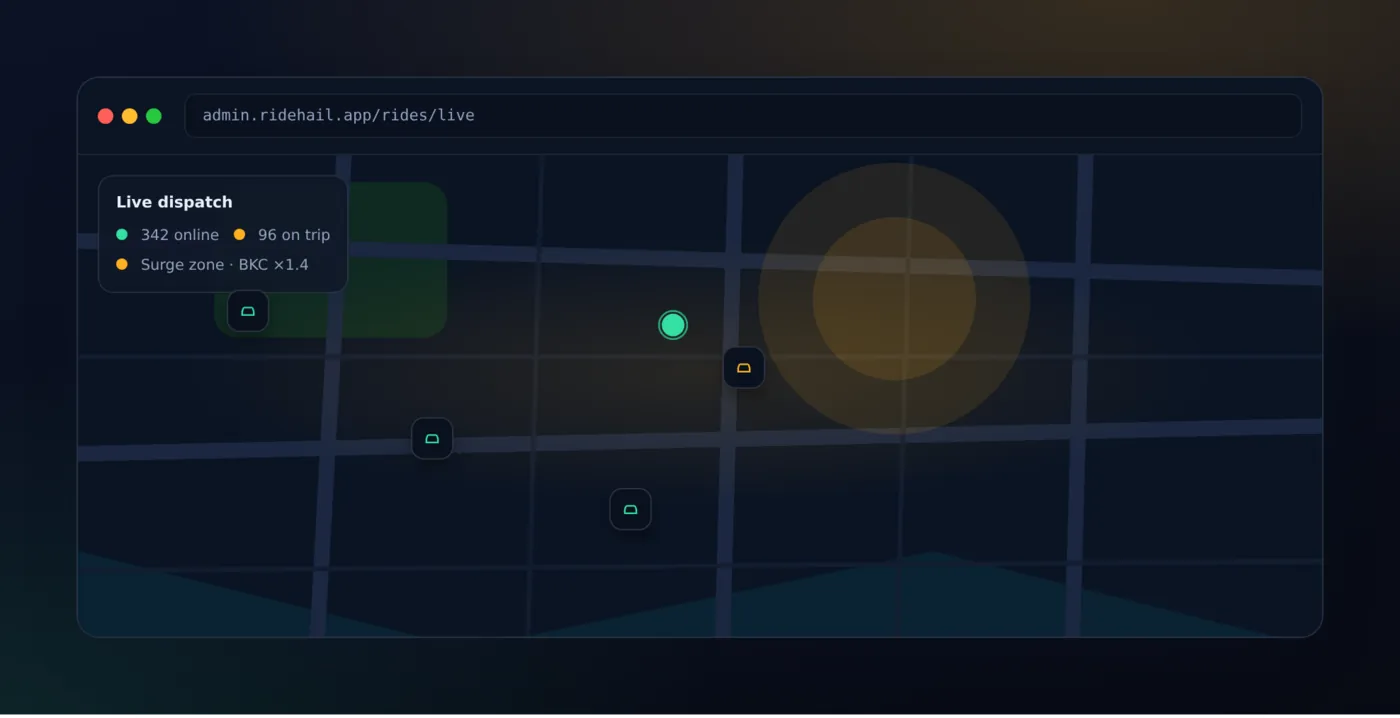
Share the app link with hotels, hospitals and offices near you. Print a QR code on a card in each car. Ask happy riders to share it. Our list of must-have taxi booking app features helps you decide what to add after launch.
Your own app vs joining a big ride app
| Question | Join a big ride app | Your own taxi app |
|---|---|---|
| Who owns the rider list? | The big app | You |
| Who sets the fare? | The big app | You |
| Share of each fare given away | Yes, on every ride | No |
| Your name on the app | No | Yes |
| Rides from day one | Yes, from their riders | You must bring riders in |
| Fixed fares for airport or hotel partners | No | Yes |
Some owners do both at first. They stay on a big app for steady work and move repeat riders to their own app. To see how the big apps work, read how to create an app like Ola.
Worked example: a station taxi owner goes digital
This is an example of how a small owner might use these steps.
- Where he starts. Ravi owns a few cars at a railway station. Bookings come by phone. Three car owners nearby want to attach their cars.
- Model. He picks the mixed model: his own cars, plus attached cars on a share of each fare.
- Papers. He registers his firm, gets GST advice from his accountant, and checks permits for every car with the RTO.
- Ride types. Station pickup, city ride and a fixed fare to the nearest airport.
- App. He gets his own rider app, driver app and office panel built, under his firm's name.
- Drivers. His staff upload each driver's papers and approve them in the panel.
- Launch. He puts a QR card in each car and at the station stand. Repeat riders now book from the app.
- Weekly payout. Attached owners see their trips and earnings in the driver app, so payout talks are short.
Our service
How we build your own taxi app
We build the app around the taxi business you are starting, not a fixed template.
- Learn your plan. We go through your model, area, ride types and driver rules with you.
- Design the screens. You see clickable screens with your name and colours before any code.
- Build the apps. Rider and driver apps built with Flutter for Android and iPhone, plus a web office panel.
- Set up the server. The ride server runs on a cloud account in your name, with backups.
- Test on real rides. Your first drivers and riders use the apps. We fix what they report.
- Launch and grow. We publish on your store accounts and add ride types as you grow.
Taxi app development cost: what decides it
We do not publish a fixed price for a taxi app. Each new business starts with a different plan. These are the things that decide the budget:
- Which apps you need at launch, and which can wait
- How many ride types and fare rules you start with
- Whether you run own cars, attached cars or both, which changes the payout rules
- Payment, SMS and map services you want to connect
- Extra panels, such as a desk for hotels and travel partners to book for guests
| Monthly taxi software plan | Your own app, built for you | |
|---|---|---|
| First payment | Low | A one-time build cost |
| As you grow | Bill grows with cars or rides | No charge per car or ride from us |
| Your own ride types | Within the plan's options | Built the way you work |
| Data and source code | With the seller | Yours |
Tell us your model and area. We send a written quote after one call.
Whoever builds your taxi app, make sure it can:
- Show the fare before the rider confirms
- Give every trip a receipt and a downloadable invoice
- Store each driver's papers and stop expired ones from taking rides
- Handle own cars and attached cars with different payout rules
- Show cars and bookings on a live map in your office
- Let riders rate the trip and raise a complaint
- Run on your own store accounts and your own server
FAQ
How do I start a taxi business in India?
Choose your model, own cars or attached cars. Register the business, sort GST, permits and insurance, and check driver licences. Then start in one area with a booking app under your own name.
Do I need my own app to start a taxi business?
No, you can start on phone calls. But an app shows fares upfront, keeps your rider list and tracks every car. That is hard to do on calls as you grow.
How long does it take to build my own taxi app?
It depends on the apps and ride types you need at launch. After one call, we share a plan with dates for each part, starting with screens you can click through.
Will I own my taxi app and its source code?
Yes. We build it under your brand and hand over the source code. The apps go on your own store accounts, and the data stays on your server.
Which phones will my taxi app work on?
Both phone apps run on Android and iPhone. Your office panel works in a web browser.
Is my riders' data safe in my own app?
It stays on a server in your name, and staff see only what their role allows. The Digital Personal Data Protection Act applies to rider data, so the app should record consent.
Which licence do I need to run a taxi app?
Cars need commercial permits, and apps may need a state aggregator licence. Rules differ by state. Check with a lawyer and your state transport department.
Can I add attached car owners to my app?
Yes. Attached owners join as drivers, upload their papers and get rides. The panel tracks each owner's trips and payouts.
Can PRS India build a taxi app for my new business?
Yes. We build your rider app, driver app and office panel under your name. Book a consultation to plan your taxi app with us.
Related guides
- ONDC Taxi App: How to Build and Launch Yours
- How to Start a Taxi Business in Nigeria With Your Own App
- Electric Cab Booking App: EV Taxi Business Guide
- Employee Transport Management Software: Office Cab App
- How Do Taxi Apps Make Money: Revenue Model Guide
- Ride Sharing App for Women: Safety Features to Build
- Taxi mobile app development
- Mobile app development
- How we work
Written by
Babita Kumari · Business Developer
Business Developer at PRS India. Talks with business owners about the app or software they want, and helps them work out the scope, cost and launch steps before any code is written.