Best Ecommerce Platform for Jewelry: Build Your Own Store
How to choose a platform for a jewellery store: gold-rate pricing, making charges, HUID per piece and price breakup, and when to build your own.

Written by Babita Kumari, Business Developer
Reviewed by the PRS India software & mobile app development team
11 min read
Written from production. Our articles draw on products we run live and the client work behind them, and are revised as the systems they describe evolve.
Selling jewellery online is not like selling shirts. The gold price changes every day, so your prices change too. Each piece has its own weight, purity and HUID. The making charge follows your rules, not a fixed price tag. Many ecommerce platforms were built for fixed prices, so jewellers end up with add-ons, manual edits and price errors.
Jewellers, gold shops and jewellery brands search for the best ecommerce platform for jewelry. But the real question is different. Which platform can handle a jeweller's product data and pricing? This guide gives you a way to compare any ecommerce platform for jewelry. It also shows when to build your own jewellery store under your brand with our ecommerce development services.
Key takeaways
- A jewellery platform must store metal, purity, weight, stones, making charge and HUID for each piece.
- Prices should update from one daily gold rate entry, with a clear price breakup for the buyer.
- Hosted builders, open-source stores and custom builds each suit a different kind of jeweller.
- Choose by testing your own products on the platform, not by reading feature lists.
What a jewellery store platform must handle
Start with the product record. A T-shirt needs a size, a colour and a price. A gold ring needs much more. Every platform you look at must hold these fields for each piece:
- Metal: yellow gold, white gold, rose gold, silver or platinum.
- Purity: 22K, 18K or 14K for gold, or 925 for silver.
- Gross and net weight: gross weight is the full piece. Net weight is the metal after stones are taken out.
- Stone details: type, carat, count and the certificate number for diamonds.
- Making charge: per gram or a flat amount, set by category.
- HUID number: the unique ID on each hallmarked piece.
- Ring or bangle size: with a size guide for the buyer.
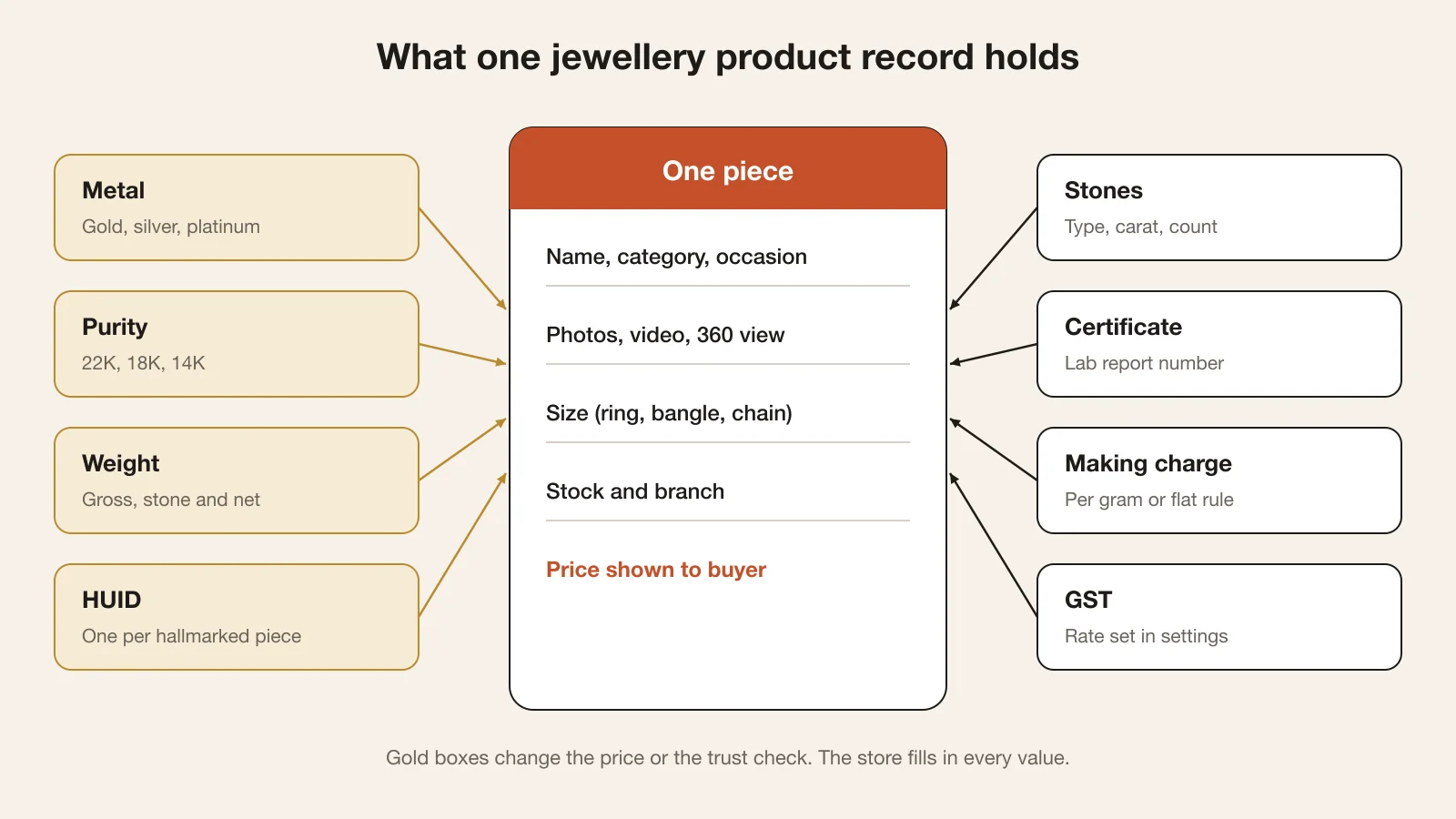
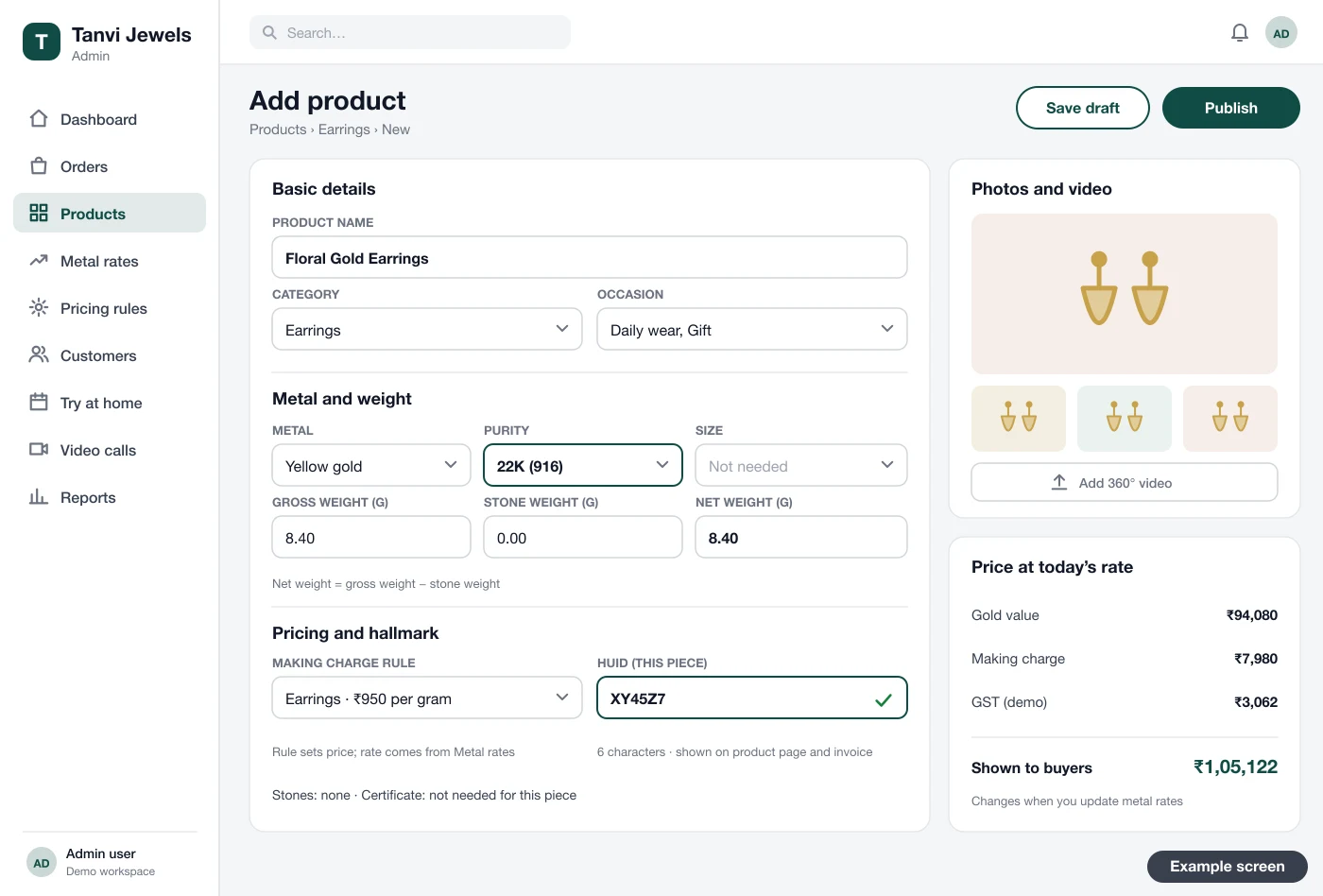
In a custom store, these are real fields with rules. Net weight is worked out from gross and stone weight. A missing HUID blocks publishing. Your staff fill one form, not ten notes.
Live gold price on every product: what the platform must do
Many jewellers set the day's rate each morning. Many check the rates published by the India Bullion and Jewellers Association first. Then the online store must follow. A platform for jewellery should do four things here:
- One entry per metal. Staff enter the rate for 22K, 18K and silver once. They do not edit each product.
- Show what will change. Before saving, the admin sees which products change and by how much.
- Update every channel. The website, the app and any rate screen show the same new price.
- Keep a log. The admin can see who changed the rate and when.
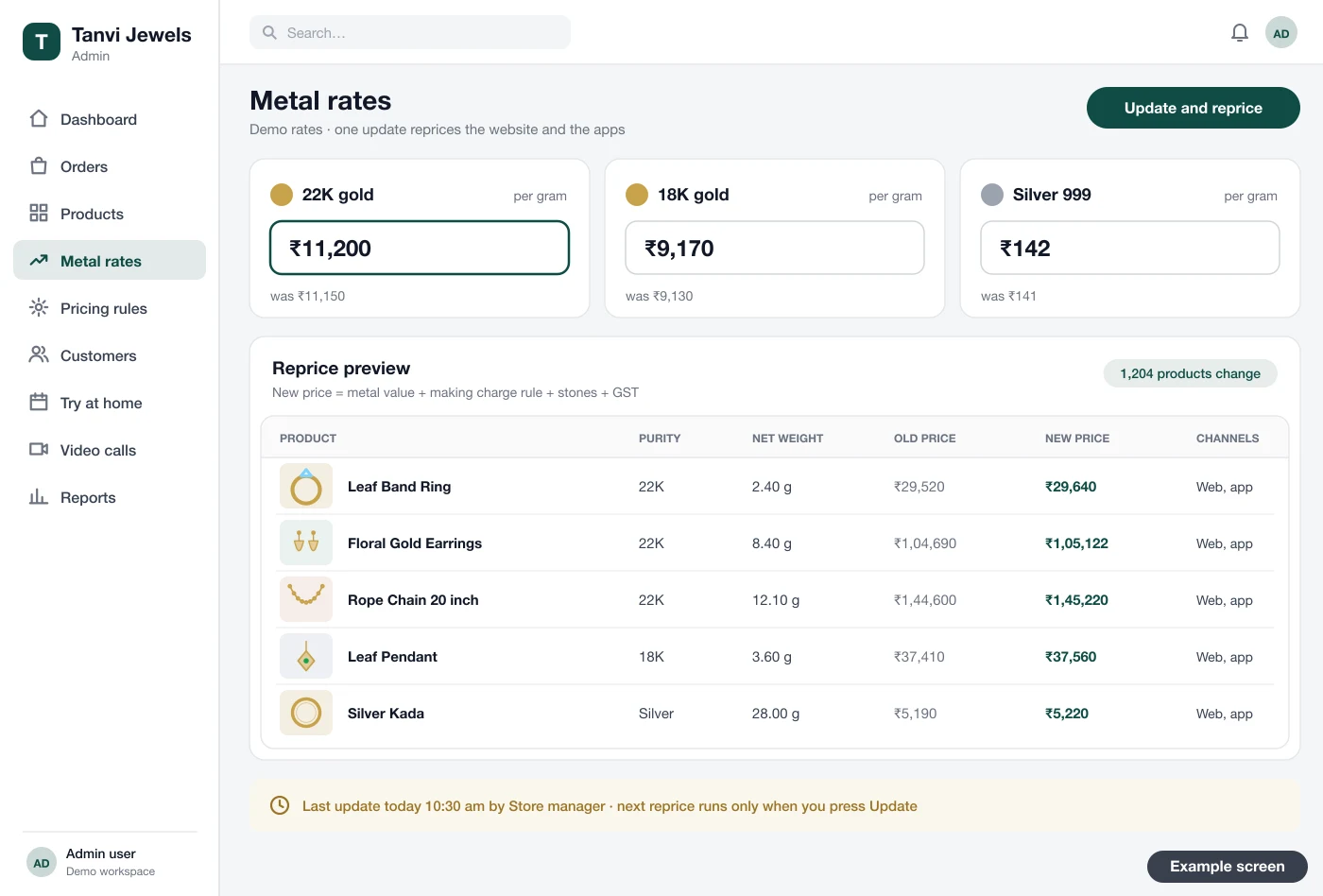
On hosted builders, this usually needs a paid app or a script. Check whether that app can handle your making-charge rules too. Want a rate app for walk-in buyers too? See our guide to gold rate app development for jewellers in India.
Price breakup: metal, making charge, stones and GST
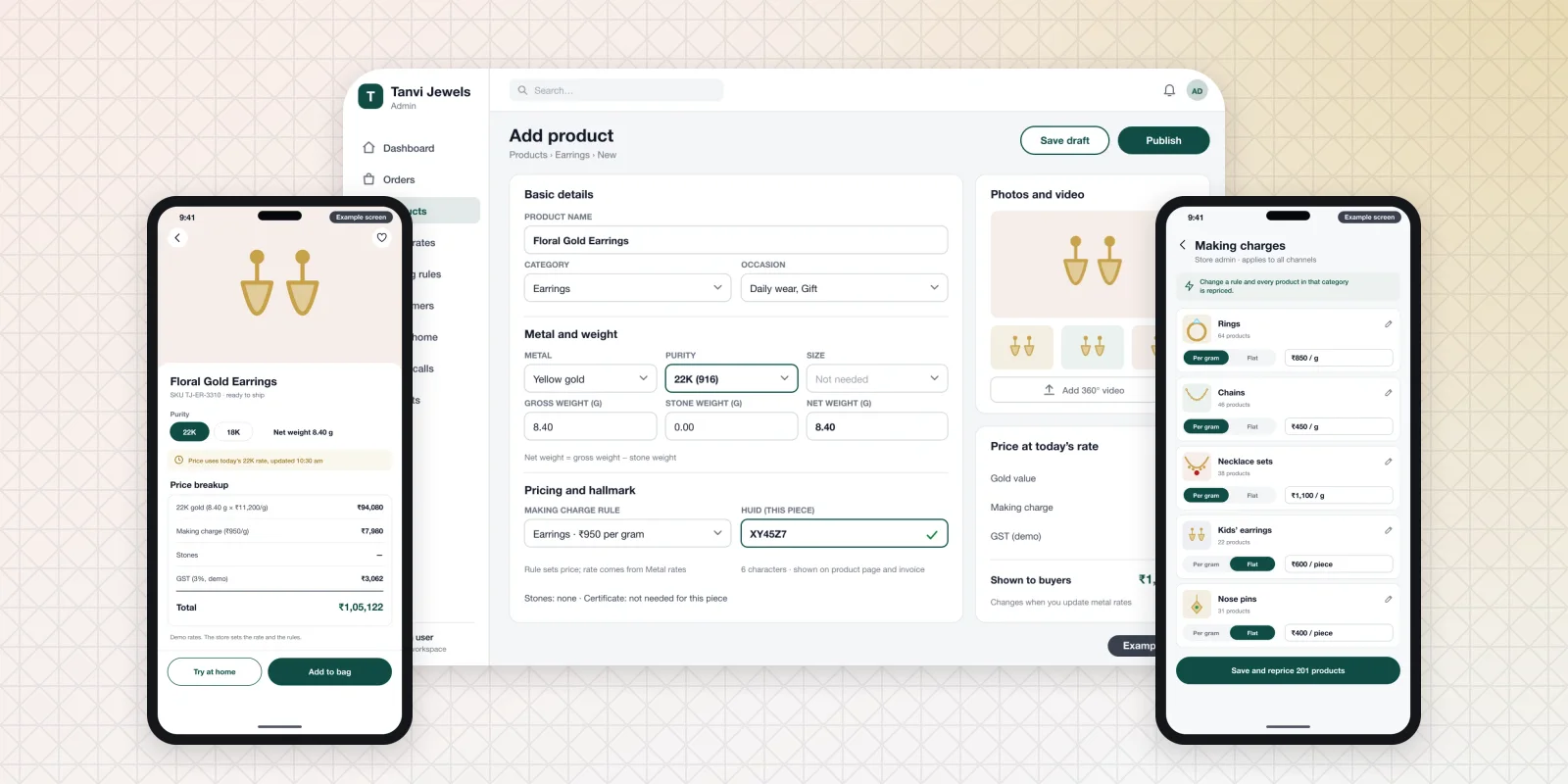
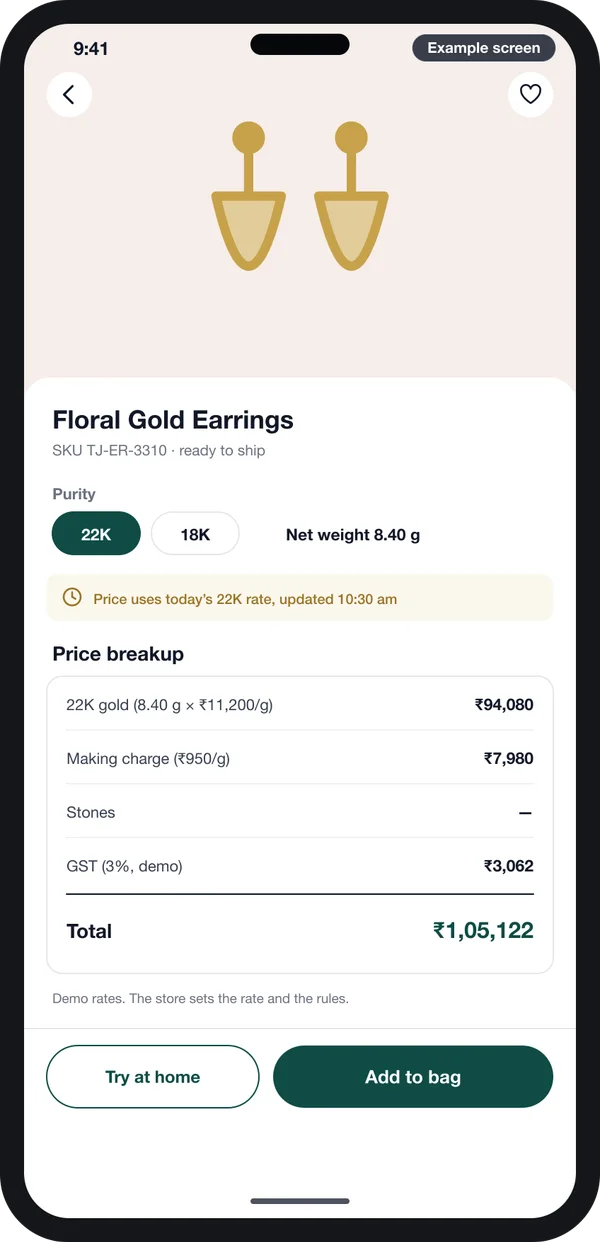
Buyers compare jewellers by the price breakup, not only the total. So the product page should show how the price is made:
- Metal value: net weight × today's rate for that purity.
- Making charge: from your rule for that category, per gram or flat.
- Stones: the stone value, shown on its own line.
- GST: at the rate your CA confirms for jewellery. The official rules are on the GST portal.
When the buyer switches from 22K to 18K, every line updates at once. The same breakup prints on the invoice.
Making charges need rules. Rings may be charged per gram. Nose pins or kids' pieces may carry a flat charge per piece. The admin sets one rule per category. Change a rule, and every product in that category is repriced.
A platform that only stores a final price cannot do this. Your staff would edit hundreds of prices by hand every day.
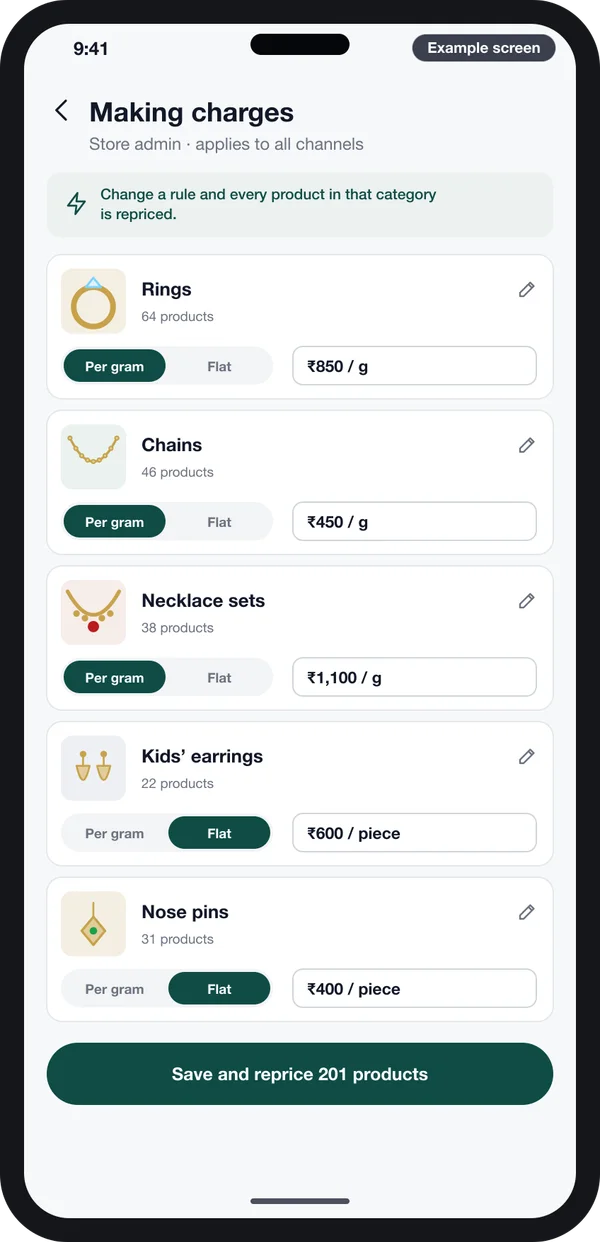
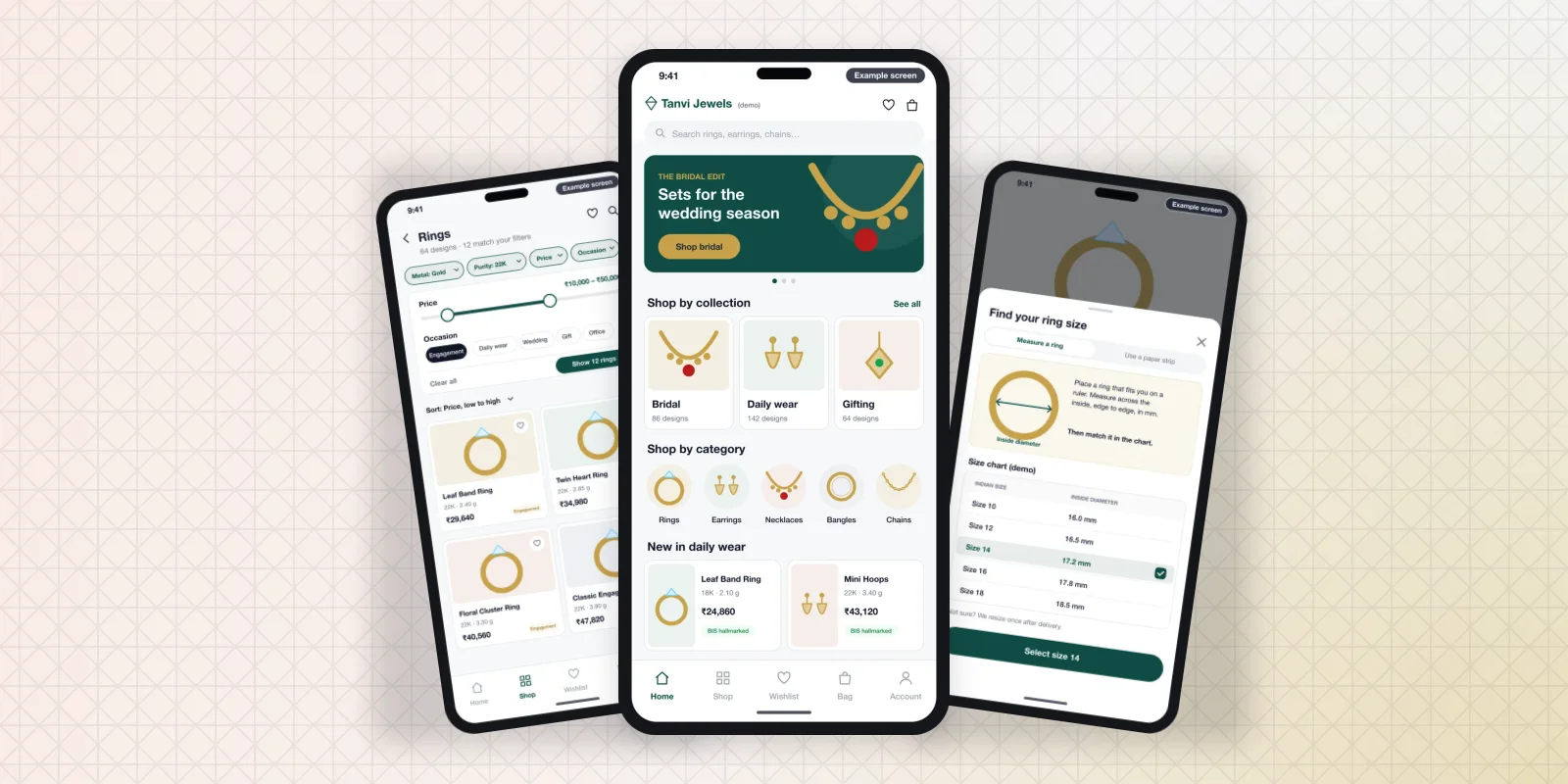
Example screens we designed, demo data.
Hosted builder vs open source vs custom build for jewellery
There are three main kinds of ecommerce platform. Each one can run a jewellery store. They suit different shops.
| What you need | Hosted builder (such as Shopify) | Open source (such as WooCommerce or Magento) | Custom build |
|---|---|---|---|
| Suits | Fast start, small range, fixed prices | Teams that want control and can run a server | Jewellers with rate-based pricing, many branches or their own app |
| Jewellery fields | Through metafields and apps | Through plugins or extensions | Built as real fields |
| Daily gold rate pricing | Through a third-party app | Through a plugin or custom code | Built in |
| Making-charge rules | Depends on the app | Depends on the plugin | Built to your rules |
| Hosting | Done by the platform | Your server or host | Your server, cloud or ours |
| Phone app | Through app builders | Separate project | Built on the same data |
| Source code | Theme and app code only | Open source, plus your changes | Yours |
We build on all three. See our Shopify development, WooCommerce development and Magento development pages. We also built a Shopify store with video-call shopping for a watch and eyewear brand. Read the case study of a watch and eyewear store we built.
For a wider list of systems, read our look at five ecommerce CMS options for 2026. If a hosted plan's monthly fees worry you, our guide to Shopify alternatives in India compares the options.
Hallmark and HUID: show it on every piece
Hallmarking is how buyers in India check gold purity. Each hallmarked piece carries a HUID, a unique ID for that piece. The Bureau of Indian Standards hallmarking page explains the current rules. Check which rules apply to your shop with BIS or your adviser.
For a platform, this has one big effect. Two pieces of the same design have two different HUIDs. So the store must track stock by piece, not only by design. When a buyer orders, the system picks one piece. Its HUID then goes on the order and the invoice.
Ask every platform to show this working. Can it hold one HUID per piece? Does the HUID print on the invoice? Can staff search an order by HUID? For diamond pieces, ask the same about certificate numbers. GIA's guide to the 4Cs lists the grades a certificate carries.
How to choose an ecommerce platform for jewellery: checklist
Feature lists all look alike. Instead, load ten of your own pieces into a trial and test these points.
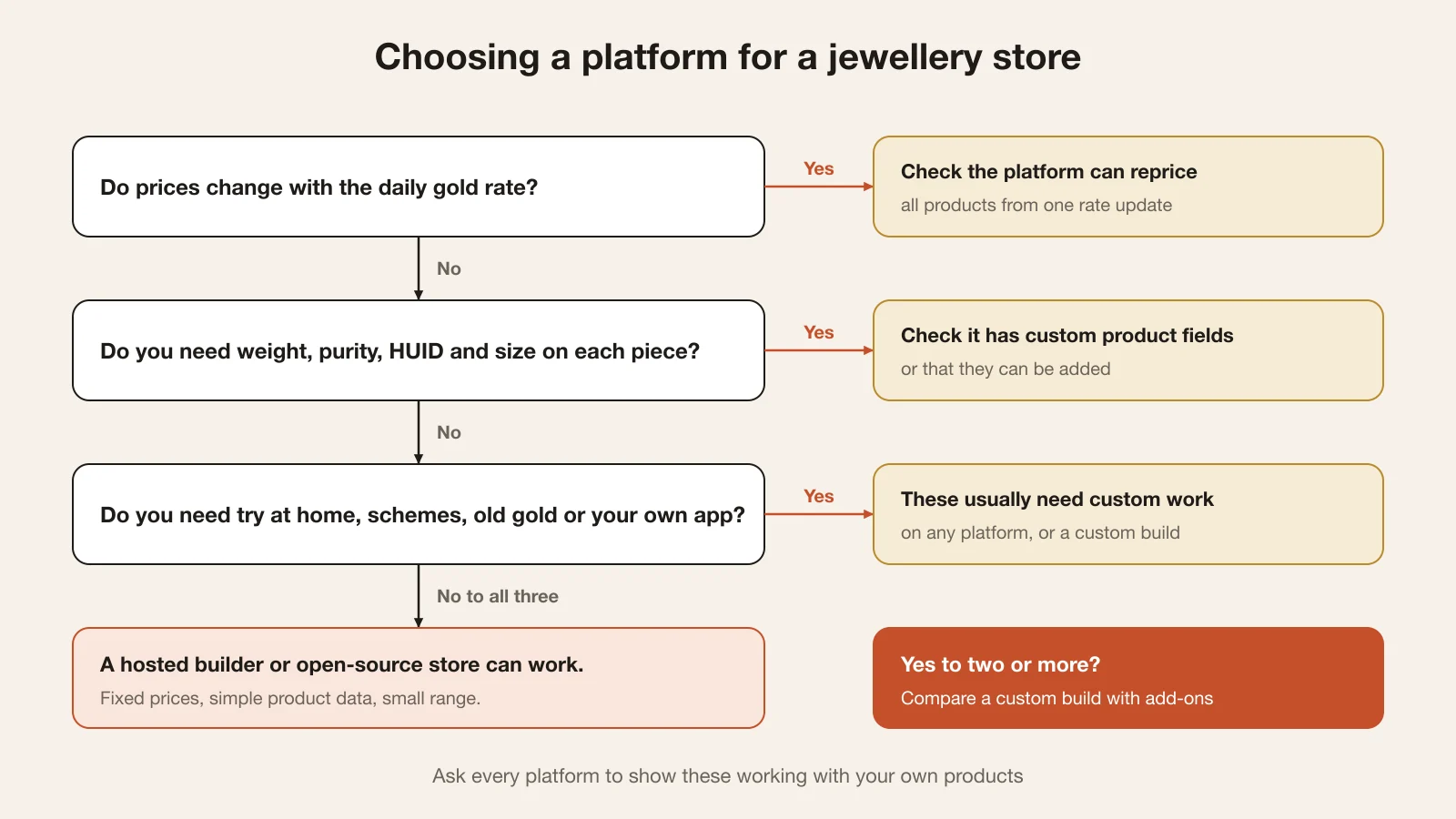
Before you pick a platform, check that it can:
- Store metal, purity, gross weight, net weight and stones per piece
- Reprice all products from one daily rate entry
- Apply making charges per gram or flat, by category
- Show a price breakup with GST on the product page and invoice
- Hold one HUID per piece and print it on the invoice
- Show diamond certificate details and the report link
- Offer ring and bangle sizes with a size guide
- Run a phone app on the same products and prices
- Let you export all products, orders and customers
When a custom build makes sense: a worked example
Here is how one jeweller might decide. The shop and its numbers are an example.
- The start. A family jeweller with two branches sells 22K gold and some diamond pieces. They try a hosted builder with a theme.
- The first problem. Staff edit prices by hand each morning. Some products show yesterday's price for hours.
- The second problem. They add a rate app. It handles the gold rate, but not their per-gram and flat making charges.
- The third problem. HUIDs sit in the description text. The invoice does not show them, so staff add them by hand.
- The check. They run the checklist above. The builder fails four points without more paid apps.
- The decision. They choose a custom build. Rates, rules, HUID per piece and an app all run on one system.
- The move. Products move over from the old store. The old links point to the new pages, so search traffic carries over.
A different jeweller with a small silver range and fixed prices would pass the checklist on a hosted builder. That is a fine choice too. The example screens below show two extra features that often lead jewellers to a custom build.
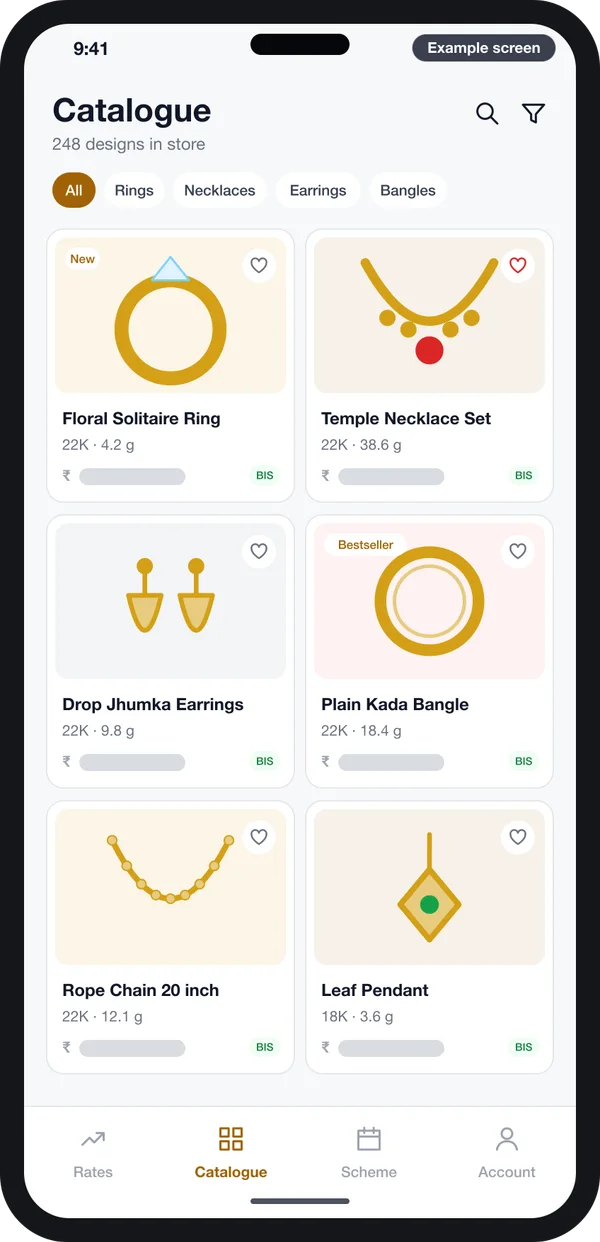
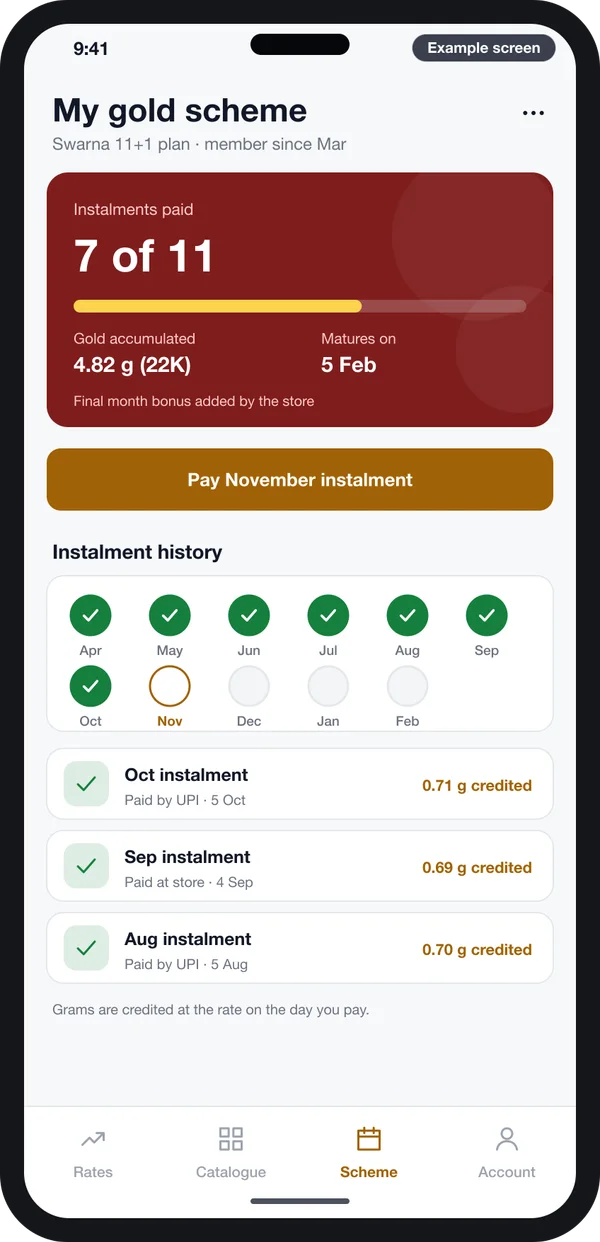
Our service
How we build your own jewellery store
We start from our ready-made online store and change it into your jewellery store. This is how we work.
- Understand your process. We list your metals, purities, making-charge rules, branches and how you set the daily rate.
- Design the screens. You click through example screens of the product page, price breakup and admin forms first.
- Build the store and apps. We build the web store, the admin panel and Android and iPhone apps on one set of data.
- Test with your team. Your staff update a rate, add pieces with HUIDs and place test orders. We fix what they find.
- Launch under your brand. The store goes live on your domain, on your server or ours.
- Support and grow. We add features as you grow, such as savings schemes or B2B wholesale pages.
Need a new front end on an existing system? We also do headless commerce development. You can see the products we have built on our store base. Want to run many jewellers on one system? Read about white-label ecommerce platform development.
Jewellery ecommerce development cost: what decides it
We do not publish a fixed price, because every jeweller's range and rules differ. These things decide the cost:
- How many products you have, and whether you track stock by piece.
- How many metals and purities you sell.
- How complex your making-charge and stone pricing rules are.
- Whether you need diamond certificates and 360 views.
- Whether you want Android and iPhone apps with the website.
- Extra features: savings schemes, try at home, old gold exchange, B2B pages.
- How much data we move from your old store or Excel.
- Where it is hosted: your server or ours.
| Monthly platform plan | Custom jewellery store (built for you) | |
|---|---|---|
| Start | Quick, low first payment | Takes a few weeks to build |
| Cost over years | Plan fee plus paid apps, every month | One build cost, then optional support |
| Gold rate and making-charge rules | Through apps, if they fit | Built in, the way you work |
| HUID per piece | Usually as text | A real field on stock and invoice |
| Data and source code | Stay with the platform | Yours |
Share your range and your pricing rules, and we will send a written quote after one call. You can get a quote here. Our retail and ecommerce software page shows our wider store work.
FAQ
How long does it take to build?
It depends on your products, your pricing rules and whether you need apps. We start from a ready-made store, so the base already works. We share a plan with dates after one call.
Do I own the source code, data and brand?
Yes. The store and apps carry your name and logo. We hand over the full source code, and your products, orders and customers stay yours.
Can you move my products from Shopify/WooCommerce or Excel?
Yes. We import products, photos, weights, purities, HUIDs and customers. We test a sample with you first, then move the rest.
Can it work on Android, iPhone and web?
Yes. The web store works on phones and laptops. The Android and iPhone apps use the same products, rates and orders.
How is customer and payment data kept safe?
Payments go through a licensed payment gateway, so card details are not stored on your server. We add secure connections, staff roles and daily backups.
Is there one best platform for jewellery?
No single platform fits every jeweller. A small range with fixed prices can run on a hosted builder. Rate-based pricing, HUID per piece and your own app often need a custom build.
Related guides
Written by
Babita Kumari · Business Developer
Business Developer at PRS India. Talks with business owners about the app or software they want, and helps them work out the scope, cost and launch steps before any code is written.