Jewellery Website Design and Ecommerce Development
We design and build your own jewellery store: weight, purity, HUID, price breakup and size guide on every piece. Web, Android and iPhone.

Written by Babita Kumari, Business Developer
Reviewed by the PRS India software & mobile app development team
12 min read
Written from production. Our articles draw on products we run live and the client work behind them, and are revised as the systems they describe evolve.
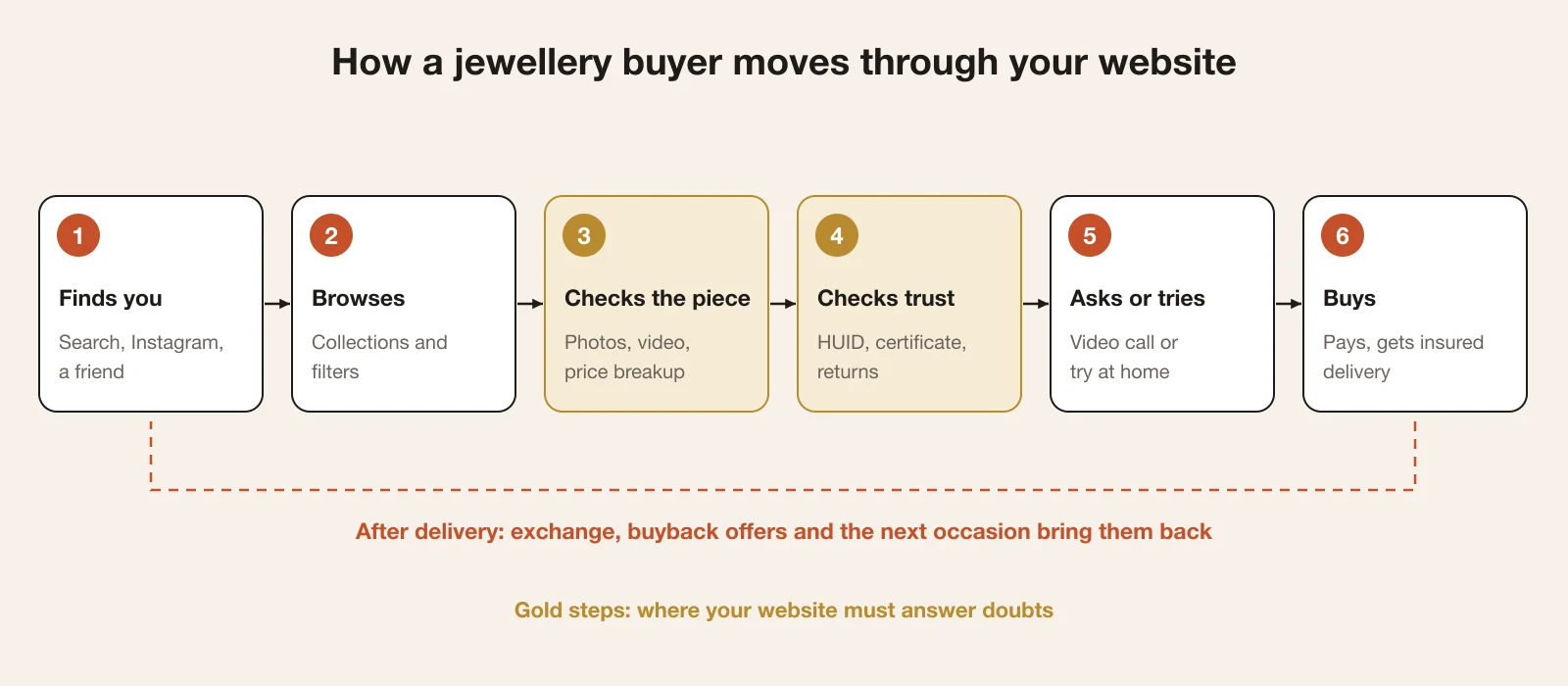
A jewellery buyer cannot touch the piece on a website. So the website has to answer every doubt a shop counter answers. Is it real gold? What is the purity? How much does it weigh? Why does it cost this much? Will the ring fit? Many template themes show a photo and a price, and nothing else. The buyer leaves, or calls the shop, or buys from a big brand they already know.
So many jewellers, gold shops and jewellery brands now build their own jewellery store under their brand. The website shows the weight, purity, HUID and price breakup on every piece. It comes with an app for Android and iPhone. This guide covers jewellery website design page by page. It also shows how our ecommerce development services build yours.
Key takeaways
- A jewellery website must show what a counter shows: metal, purity, weight, HUID, stones and how the price is made.
- Design starts with photos, filters and the phone screen, because many buyers browse jewellery on their phones.
- Trust pages and the certificate tab answer the buyer's doubts. A large banner does not.
- When the store is built for you, the brand, the data and the source code stay yours.
Pages every jewellery website needs
A jewellery website is more than a home page and a cart. Buyers move from a collection to a category, then to one piece, then to checkout. Each step needs its own page. The product page matters most. That is where the buyer checks the price, the proof and the size.
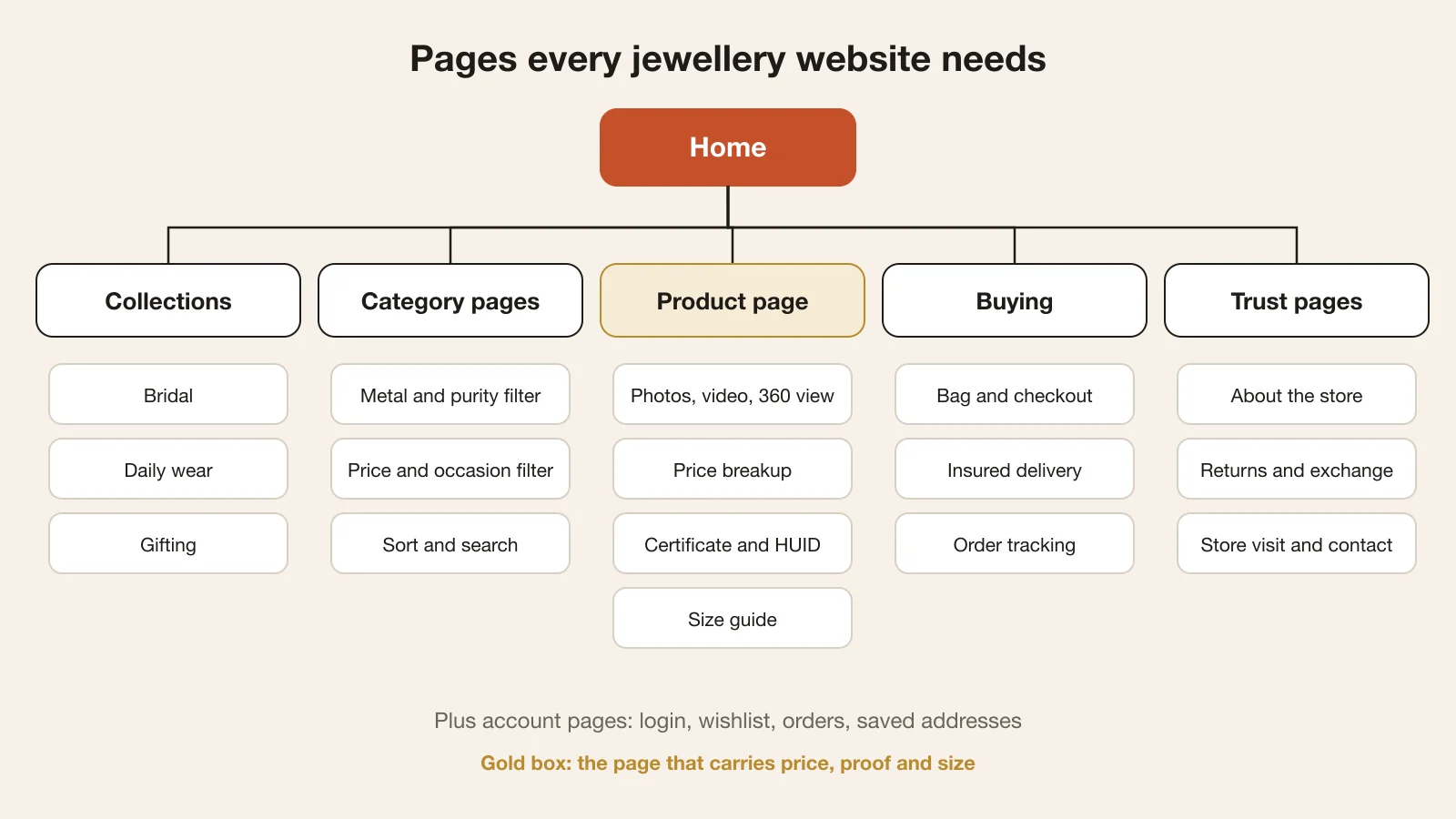
We plan this page map with you in the first week. A shop with bridal sets needs a strong collections page. A brand that sells daily wear needs fast filters and many small pieces on each screen. Our website development team builds each page to your range, not to a fixed theme.
Design rules for a jewellery website: photos, filters, mobile first
Good jewellery website design is mostly about what the buyer can see and find. Colours and fonts come later. We follow these rules on every jewellery store we design.
Photos first, text second
The piece should fill most of the product card. Use a plain, light background for every photo, so the gold colour stays true. Put the name, purity and weight under the photo in short lines. Keep the price large and clear.
Filters that match how jewellery is bought
People do not shop jewellery by brand. They shop by metal, purity, price, occasion and type. A ring buyer filters by "gold, 22K, under a set budget, engagement". The filters must also work together, so the count of matching pieces updates as the buyer taps.
Mobile first, then desktop
Design every screen for a phone first. Buttons must be large enough for a thumb. Filters open as a panel above the list, and the "Add to bag" button stays in view. Then the same layout widens for laptops. Our UI and UX design work starts with clickable phone screens that you test before any code is written.
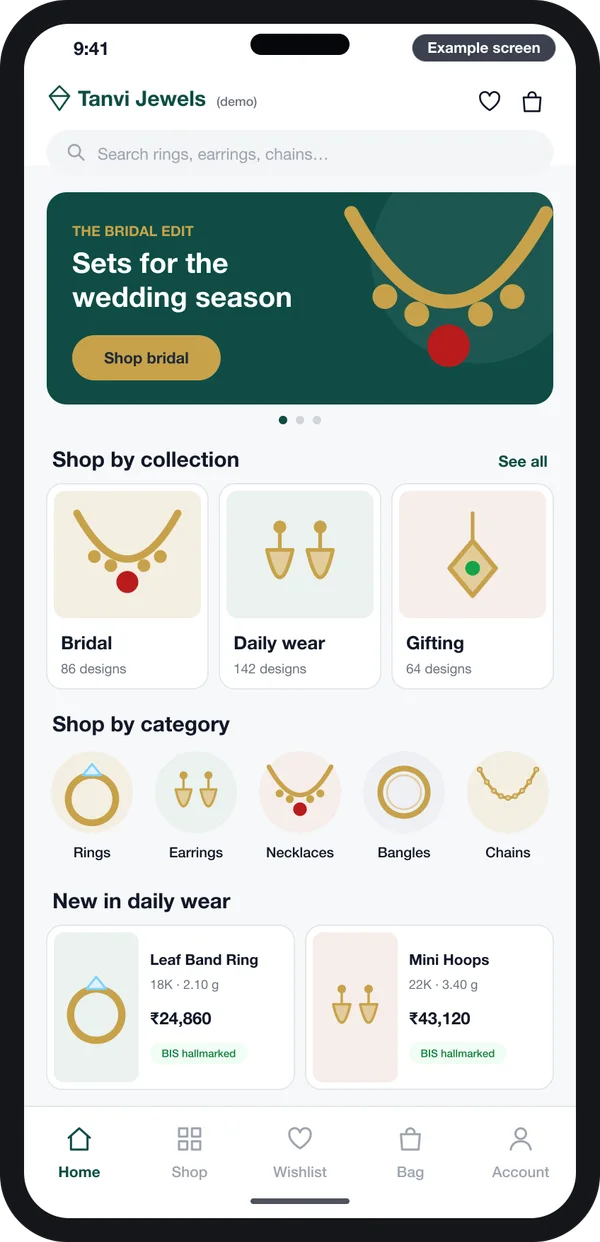
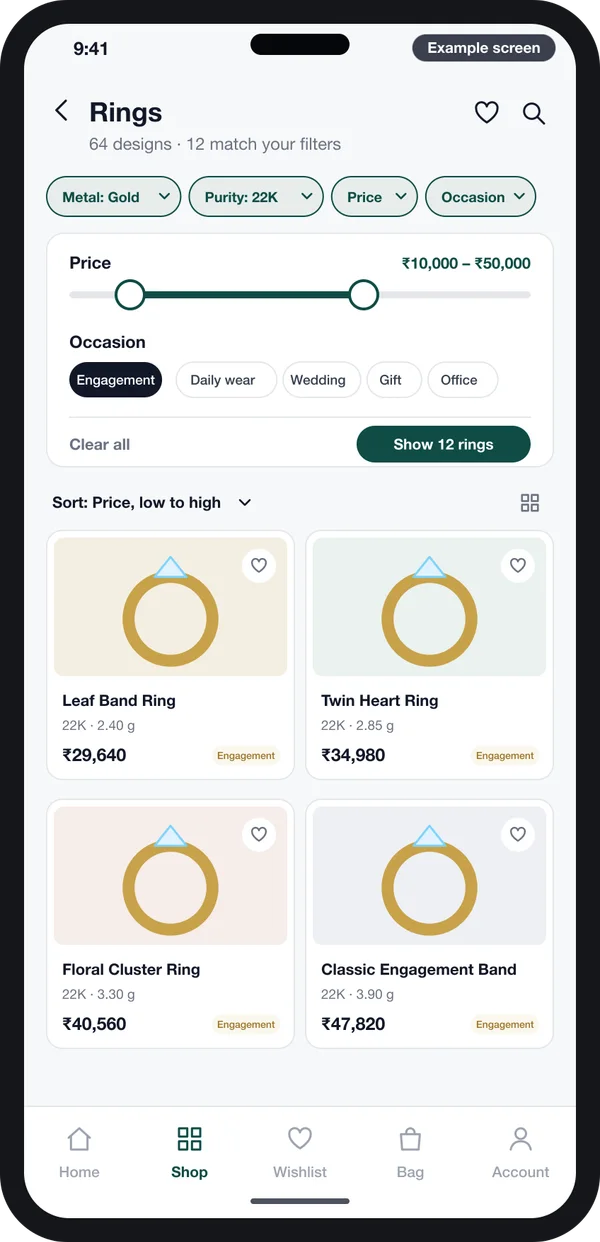
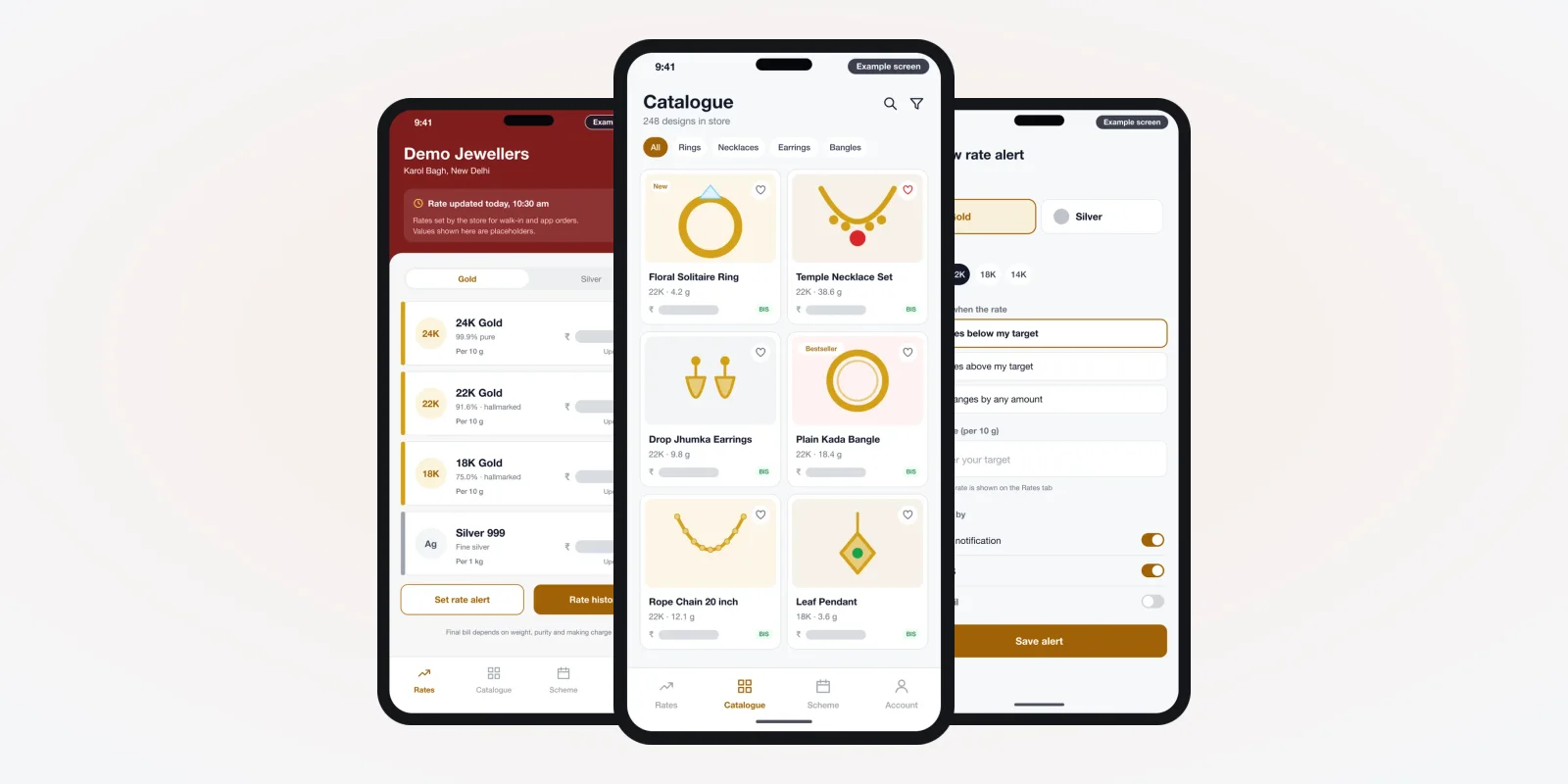
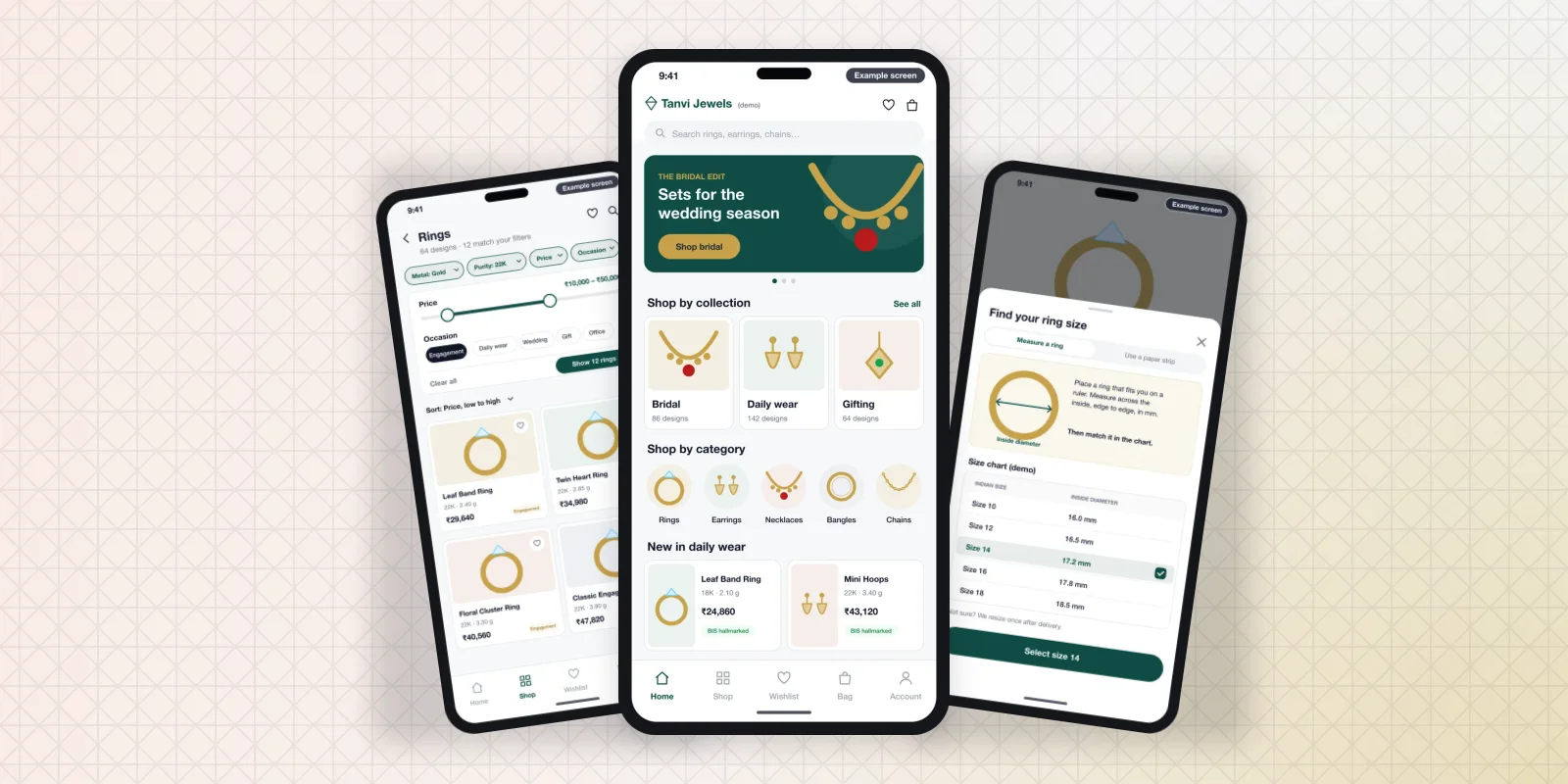
Example screens we designed, demo data.
Photos, videos and 360 views for jewellery
Jewellery photos must show size, shine and detail. One front photo is not enough. We plan for these media on every product page:
- Four to six photos. Front, side, back and a close-up of the stones or the clasp.
- A photo on a model or a hand. This shows the real size of an earring or a ring.
- A short video. A few seconds of the piece turning in light shows the shine better than a photo.
- A 360 view where it helps. For bridal sets and diamond rings, a turn-around view lets the buyer check every side.
- Zoom. The buyer can pinch to see the stone setting and the hallmark.
Heavy media can slow a page. So we resize every photo on upload and load videos only when the buyer opens them. Your staff upload from the admin panel. They do not need a designer for each new piece.
Features we build into jewellery websites
These are the features we add to the store base for a jewellery business. We set each one to your products and your way of selling. You can see the products we have built on the same base.
Ring size guide
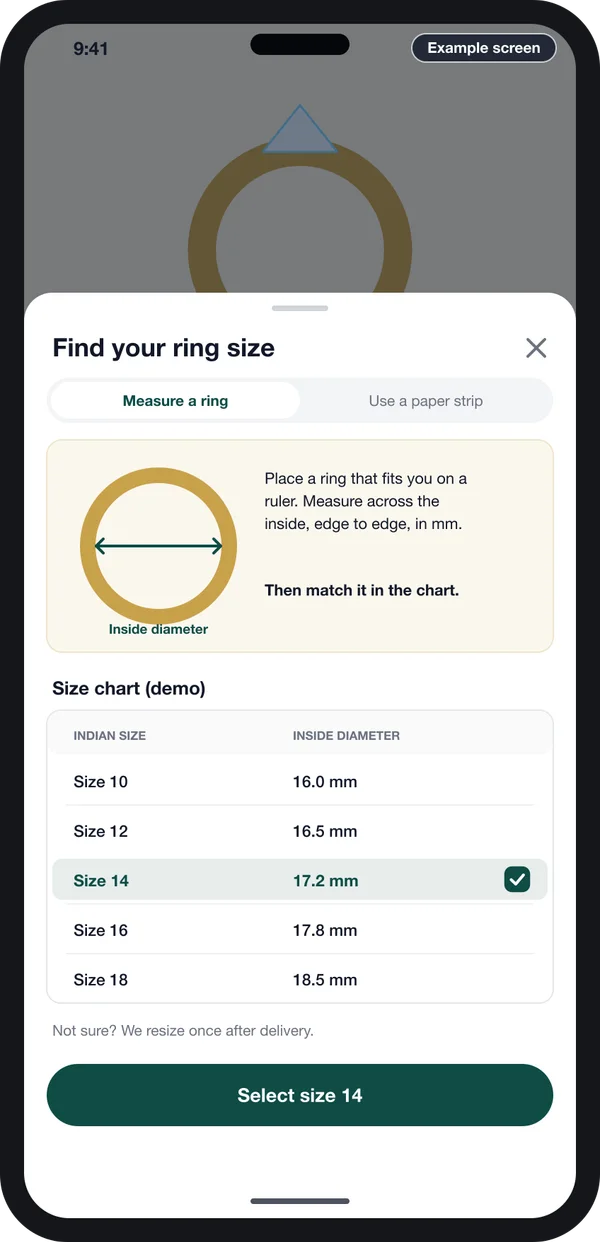
Wrong sizes are a common reason for returns. A size guide opens as a pop-up on ring and bangle pages. It shows how to measure a ring the buyer already owns, and a size chart. The buyer picks a size, and it goes into the order. You set the chart and your resize rule.
Price that follows the gold rate
Gold prices change every day. Your staff enter the day's rate once in the admin panel, and every product price updates. Each product page can show how the price is made: metal value, making charge, stones and GST. Many jewellers check the daily rates published by the India Bullion and Jewellers Association before they set their own. Want a rate app for walk-in buyers too? Read our guide to gold rate app development for jewellers in India.
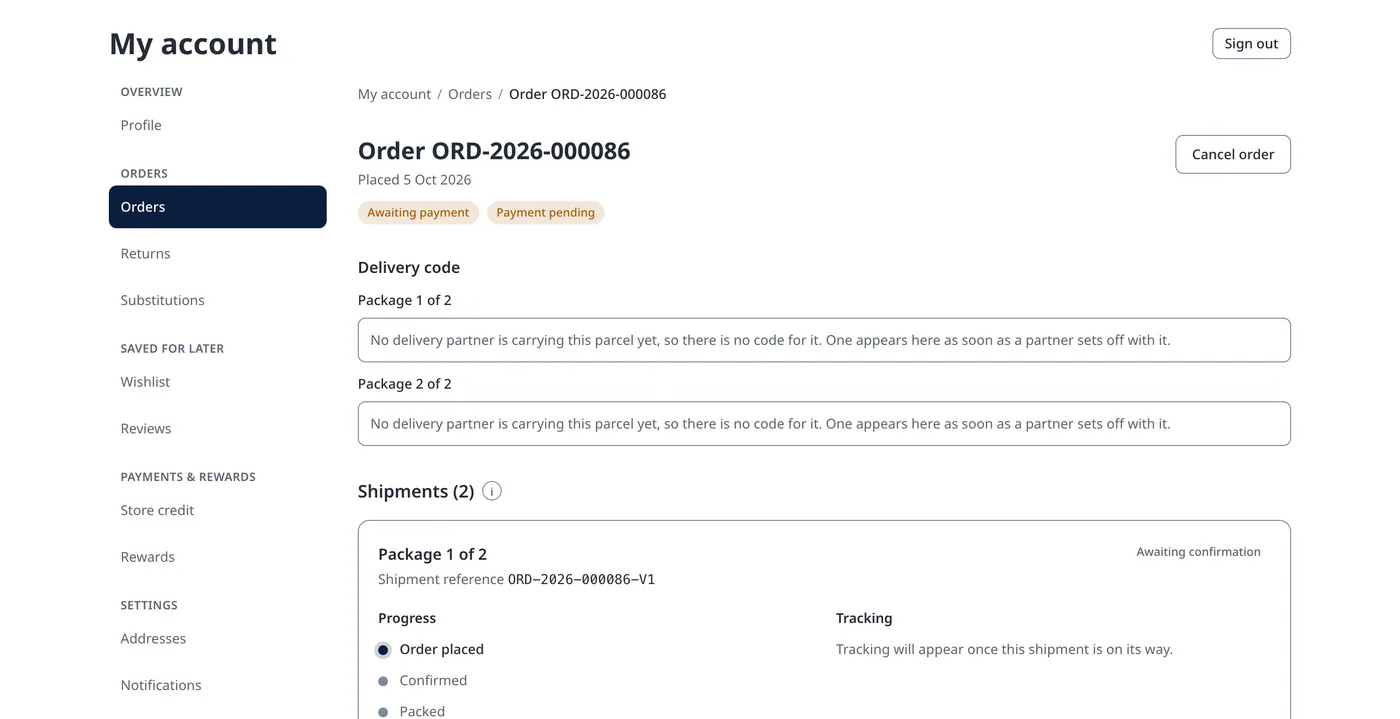
Order tracking with a delivery code
High-value parcels need a careful handover. The buyer sees each package, its progress and a delivery code that the courier asks for. This order page is from our ready-made store, and we restyle it for your jewellery brand.
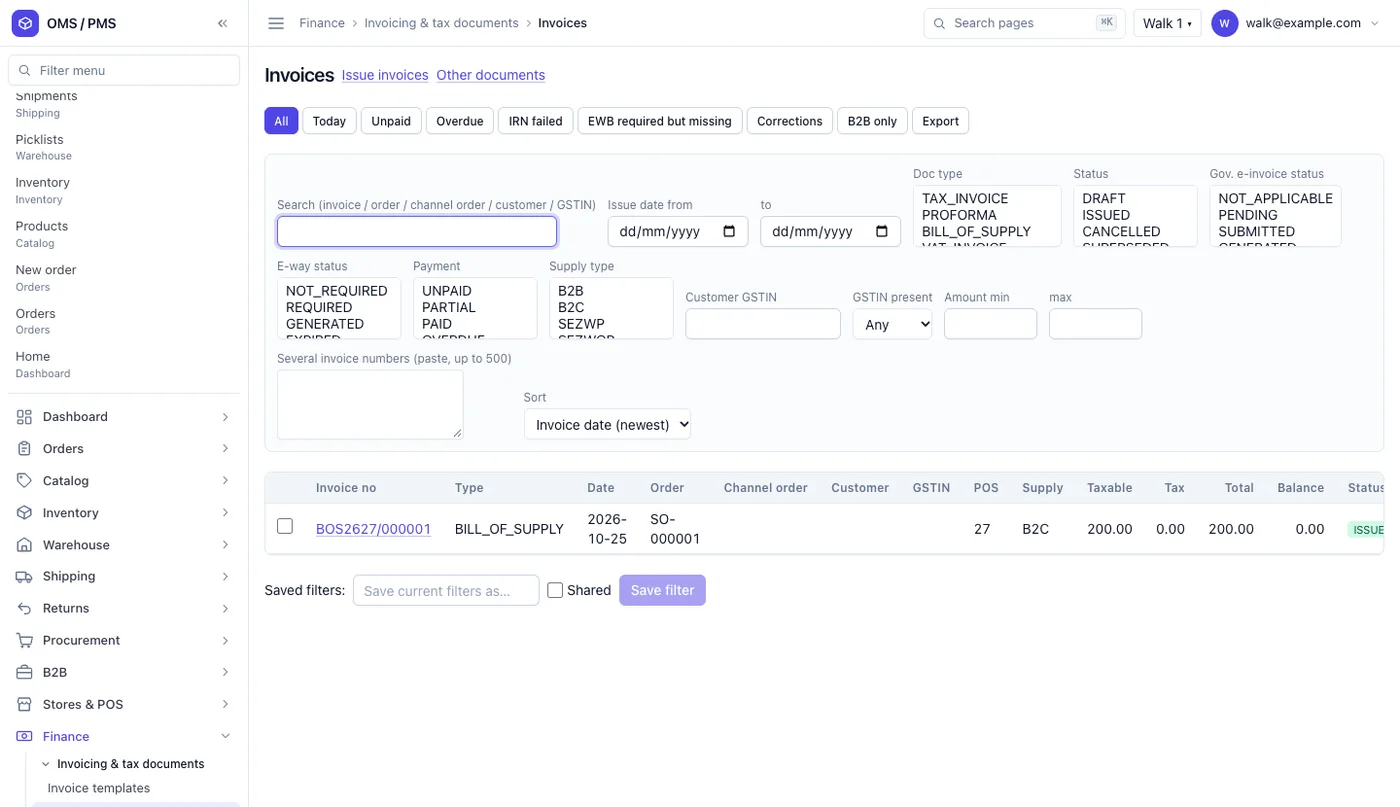
GST invoices from the admin panel
Every order needs a GST invoice. The admin can list invoices, filter them by status and export them. Where you need e-invoices, the panel tracks their status too. The official rules are on the GST portal. Your CA confirms the rates for your products.
Wishlist, enquiry and store visit
Many buyers save a piece and come back later. A wishlist keeps it for them. An enquiry button sends the piece to your staff on WhatsApp or email. A store visit form lets the buyer book a time to see the piece in your showroom.
Certificates (GIA/IGI) and HUID on the product page
Proof matters more in jewellery than in most other shops. We add a certificate tab to every product page that needs one.
Diamond certificates. For diamond pieces, the tab shows the lab and the report number. It also shows the four grades: carat, colour, clarity and cut. Labs such as GIA and IGI issue these reports. You can read how GIA explains the 4Cs of diamond quality. The buyer can open the report PDF from the page.
BIS hallmark and HUID. Each hallmarked gold piece in India carries a HUID, a unique ID for that piece. The Bureau of Indian Standards hallmarking page explains the rules. We add a HUID field for each piece in the admin. It shows on the product page and the invoice.
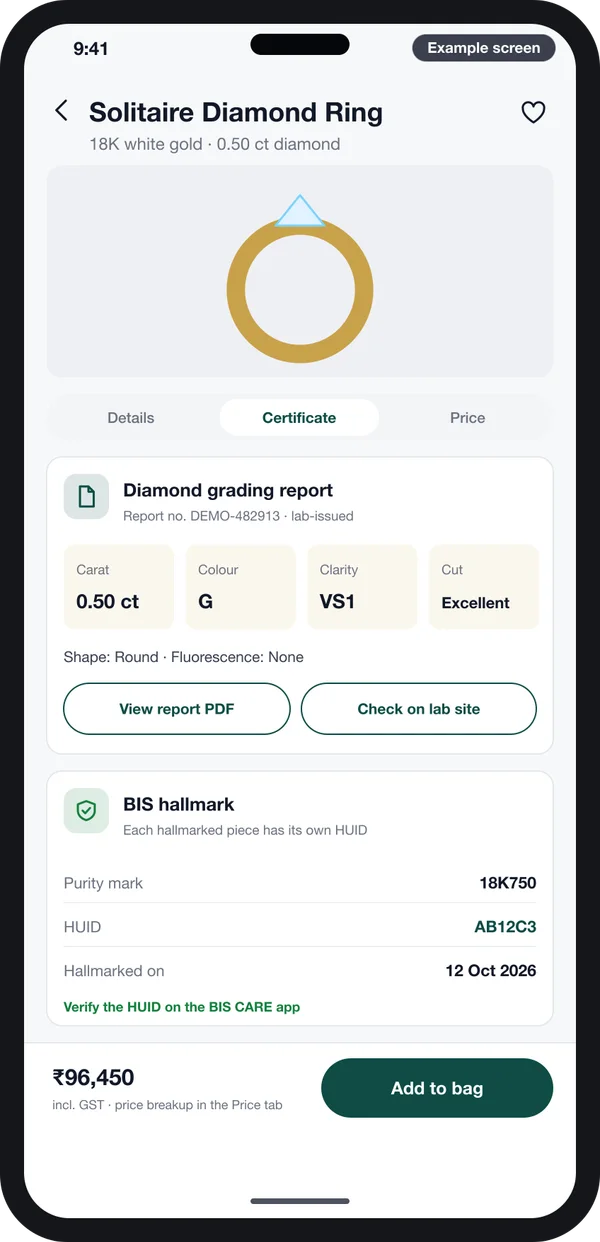
Two pieces of the same design have different HUIDs. So the store must track stock by piece, not only by design. We build it that way when you sell hallmarked gold online.
Selling to buyers in the US too? Their rules on describing jewellery are in the FTC Jewelry Guides. Check the rules for each country with your adviser before you ship there.
SEO basics for a jewellery store: product data, speed, structured data
A jewellery store needs search traffic, not only ads. Three things decide most of it.
- Product data. Each piece needs its own title, a written description and clean details: metal, purity, weight and stone. Photo names and alt text should say what the piece is, for example "22K gold jhumka earrings".
- Speed. Jewellery pages carry many photos. We compress them and load them as the buyer scrolls. We keep the code light, so pages open fast on a phone.
- Structured data. We add product data in the format search engines read: name, price, stock and photos. This can help your pieces show with price and stock in search results.
Category and collection pages also need their own short text. Then they can rank for searches like "gold earrings for daily wear". To pick a system for search, read how to choose a CMS for SEO and your website. We build the front of these stores with Next.js development. It renders pages on the server, so search engines can read them.
Template vs design agency vs development company
There are three common ways to get a jewellery website. Each one suits a different shop. Our wider retail and ecommerce software work covers the same choice for other shops.
| What you need | Ready template | Design agency | Development company |
|---|---|---|---|
| Suits | A small range with fixed prices | A new brand that needs a new look | A jeweller whose prices, stock and proof need their own logic |
| Look and brand | Theme colours and layout | Custom design | Custom design |
| Price from the daily gold rate | Usually needs an add-on | Depends on who builds it | Built in |
| Weight, purity, HUID per piece | Custom fields, if the theme allows | Depends on who builds it | Built in |
| Phone app | Separate | Rarely | Can be built with the store |
| Changes later | Within the theme's limits | Through the agency | Any change, on your code |
| Source code | Theme licence | Depends on the contract | Yours |
Shopify and other hosted builders suit many shops well. Want to own the code and avoid monthly apps? Read our guide to Shopify alternatives in India. We also built a Shopify store for a watch and eyewear brand, with video-call shopping and COD. You can read the case study of a watch and eyewear store we built.
Our service
Our jewellery website design and development process
We start from our ready-made online store, then change it into your jewellery store. This is how we work.
- Understand your shop. We list your categories, purities, making-charge rules, branches and how you sell today.
- Design the screens. You click through example screens of the home, category and product pages on a phone. You change them before we write code.
- Build the store and apps. We build the web store, the admin panel and the phone apps. The back end uses Laravel development, and the apps work on Android and iPhone.
- Load your products. We import your pieces from Excel, Shopify or WooCommerce, with weight, purity and photos.
- Test with your staff. Your team updates a rate, adds a piece and places test orders. We fix what they find.
- Launch under your brand. The store goes live on your domain, on your server or ours. Support continues after launch.
Jewellery website development cost: what decides it
Every jeweller sells differently, so we do not publish a fixed price. These things decide the cost of a jewellery website:
- How many products and categories you have, and how many photos each one needs.
- Whether prices follow the daily gold rate, and how complex your making-charge rules are.
- Whether you track stock by piece with HUID, or by design.
- Diamond certificates, 360 views and video.
- Payment, delivery and courier links you need.
- Whether you want phone apps with the website.
- How much data we must move from your old site or Excel.
- Languages, branches and B2B wholesale pages.
| Monthly store plan | Custom jewellery store (built for you) | |
|---|---|---|
| Start | Quick, low first payment | Takes a few weeks to build |
| Cost over years | Plan fee plus paid apps, every month | One build cost, then optional support |
| Gold rate, making charge, HUID | Through add-ons, if they exist | Built in, the way you work |
| Your own phone app | Usually a separate service | Can be built with the store |
| Data and source code | Stay with the platform | Yours |
Share your product range and how you price it, and we will send a written quote after one call. You can get a quote here.
Whoever builds your jewellery website, make sure it can:
- Show metal, purity, gross and net weight on every piece
- Update all prices from one daily gold rate entry
- Show a price breakup with making charge, stones and GST
- Store a HUID for each hallmarked piece and print it on the invoice
- Show diamond certificates with a link to the report
- Filter by metal, purity, price and occasion on a phone
- Offer a ring and bangle size guide
- Let you export your products, orders and customers at any time
FAQ
How long does it take to build?
It depends on your range, your pricing rules and the apps you need. We start from a ready-made store, which saves time. We share a plan with dates after one call.
Do I own the source code, data and brand?
Yes. The store carries your name and logo. We hand over the full source code. Your product, order and customer data is yours, and you can export it at any time.
Can you move my products from Shopify/WooCommerce or Excel?
Yes. We import products, photos, weights, purities and customers from Shopify, WooCommerce or an Excel sheet. We check a sample with you before the full import.
Can it work on Android, iPhone and web?
Yes. The web store works on every phone and laptop. We can also build Android and iPhone apps that use the same products, prices and orders.
How is customer and payment data kept safe?
Payments go through a licensed payment gateway, so card details never sit on your server. We use secure connections, role-based staff access and daily backups.
Can I edit products and banners myself?
Yes. Your staff add pieces, photos, banners and collections from the admin panel. They also update the gold rate and making-charge rules there, without a developer.
Related guides
Written by
Babita Kumari · Business Developer
Business Developer at PRS India. Talks with business owners about the app or software they want, and helps them work out the scope, cost and launch steps before any code is written.