Business of Software
White Label Carpool App Development in India
We build your own carpool app in India: rider and driver app plus web admin, per-km cost sharing, under your brand.

Written from production. Our articles draw on products we run live and the client work behind them, and are revised as the systems they describe evolve.
Many people in India drive to work or to another city with empty seats. Many others look for a ride on the same road. A carpool app in India connects these two groups. The driver is going anyway. The riders share the fuel and road cost for the kilometres they travel.
You can start such a service under your own name with a white label carpool app. That means we build the app on a tested base. Then we dress it in your brand, colours and rules. PRS India builds the rider and driver mobile apps and the web admin panel. You get your own app, your own data and the source code.
Key takeaways
- A carpool app is not a taxi app. The driver shares a trip they were taking anyway.
- The fare we build is per-km cost sharing. There is no commission cut from the driver's share.
- White label means your name, logo, colours, store listings and server. Nobody else's brand shows.
- For India, plan KYC checks, UPI payments, local languages and state transport rules from day one.
- You own the apps, the data and the source code when we hand over.
What white label means for a carpool app
White label is a short way to say "built once, branded for you". The working parts already exist: ride posting, seat booking, wallet, admin screens. We then change everything a user can see. Your app name goes on the home screen. Your logo goes on the splash screen. Your colours go on every button.
It also covers things users do not see. The app runs on your server or your cloud account. Messages and emails go out from your domain. The store listings are under your developer account, not ours. If you later switch developers, the app stays with you. Travel firms use the same idea for their own booking and travel software.
A white label build is different from a clone script. A script is a fixed package sold to many buyers, often with old code and no one to call. A white label build is set up for one client, tested with that client, and handed over with source code. We follow the same model for white label taxi booking apps. You can read more about that difference in our guide on clone scripts versus custom builds.
The three parts of a carpool app
Most carpool apps have one app for people and one panel for the office. The same person can be a driver on Monday and a rider on Friday. So we usually build one mobile app with two modes, not two separate apps.
- Driver mode. Post a trip with start point, end point, date, time and seats. Choose instant booking or approve each request.
- Rider mode. Search trips on a route and date. Book a seat, pay, see the driver's profile and track the car.
- Admin panel. Your team checks drivers, sets the per-km rules, watches bookings and handles complaints.
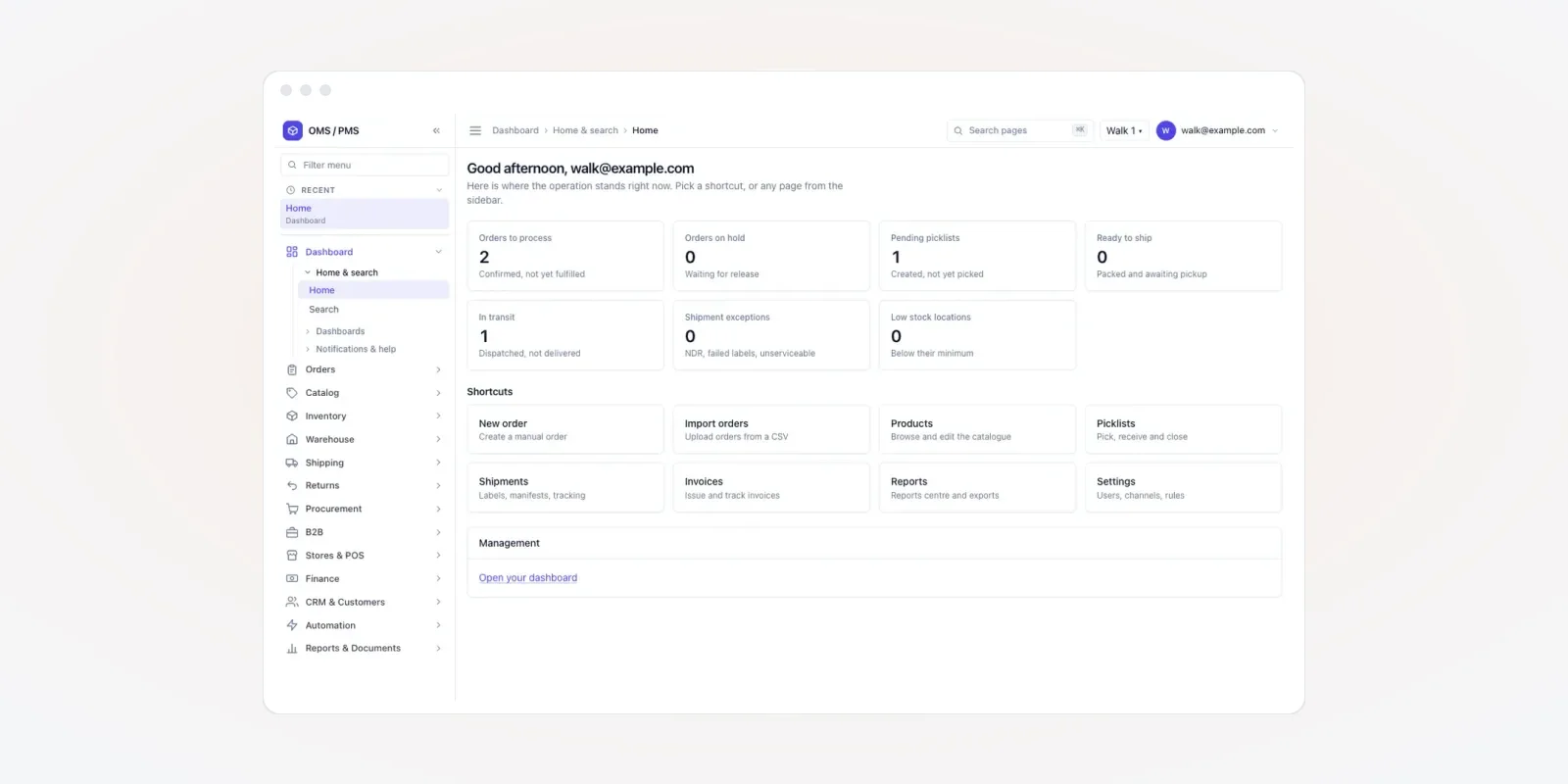
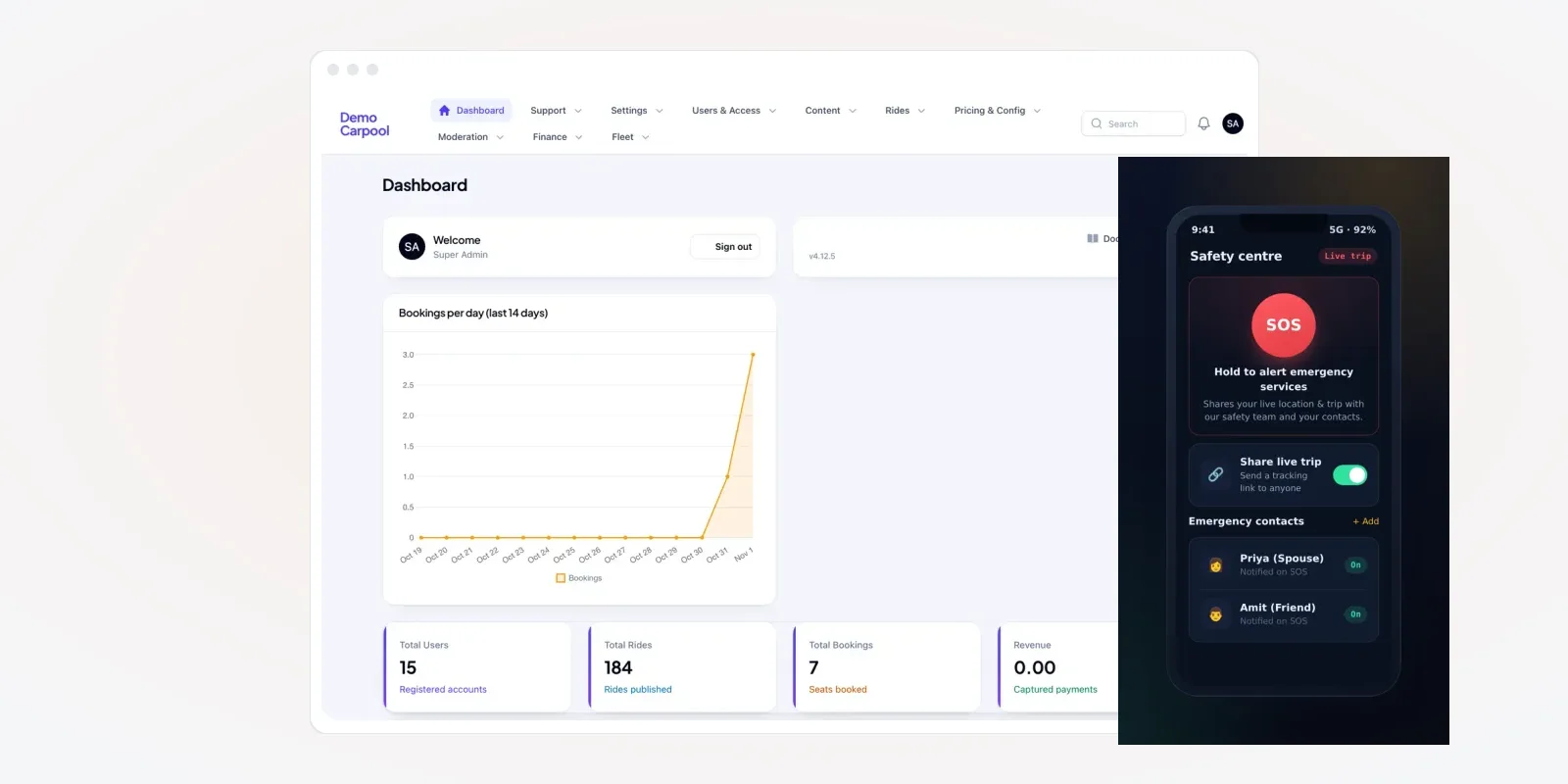
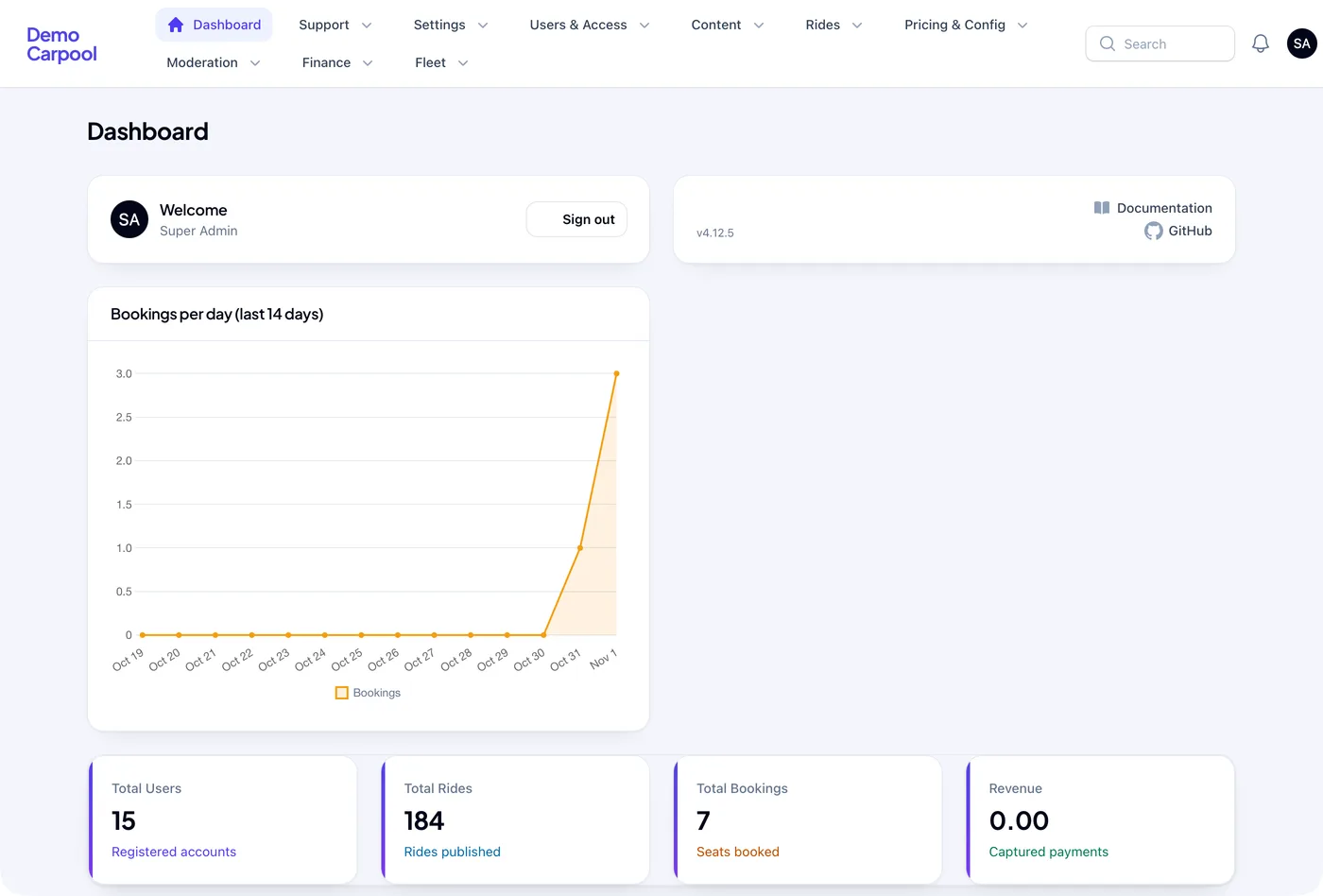
The admin panel is a web application your staff open in a browser. The screens below are from a carpool admin panel we built, filled with demo data.
The problem
Why carpool groups outgrow WhatsApp
Most carpool ideas start in a chat group. The same problems show up once the group grows.
- Seats get double booked. Two people say "I'll come" to the same last seat, and one is left at the gate.
- Nobody knows who the driver is. There is no check of licence, car papers or phone number.
- Money talk is awkward. Riders and drivers argue about how much to share for fuel and tolls.
- No record if something goes wrong. There is no trip log, no tracking link and no SOS.
- The group belongs to someone else. The chat app owns the platform. You cannot add features or keep the data.
Features we build into a white label carpool app
1. Trip posting and search
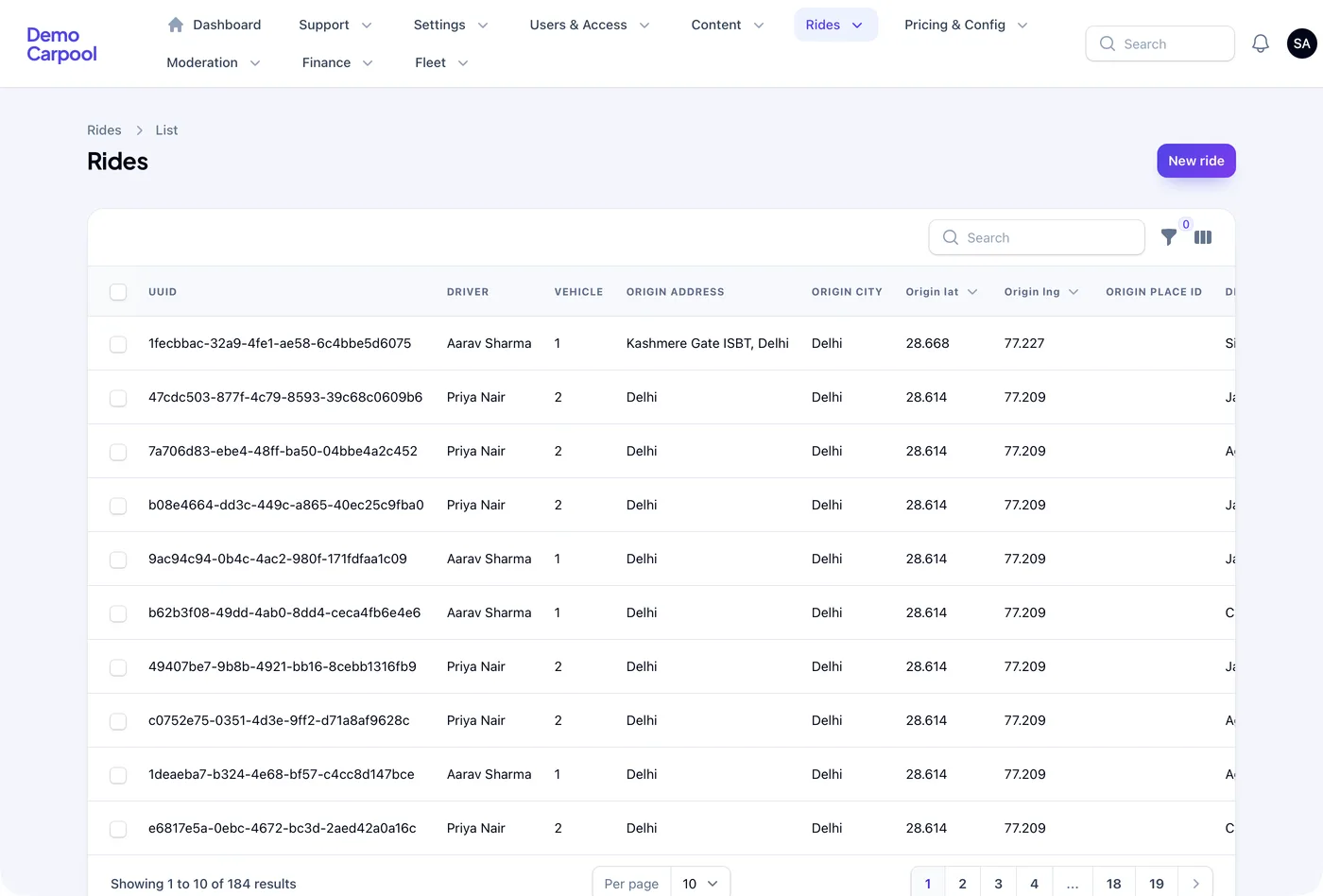
A driver posts a trip in a few taps. The app saves the start city, the exact pickup point on the map and the seats on offer. Riders search by route and date and see only trips with seats left.
The admin sees every posted trip in one list. Staff can search, filter by city and hide a trip that breaks your rules.
2. Seat booking with two modes
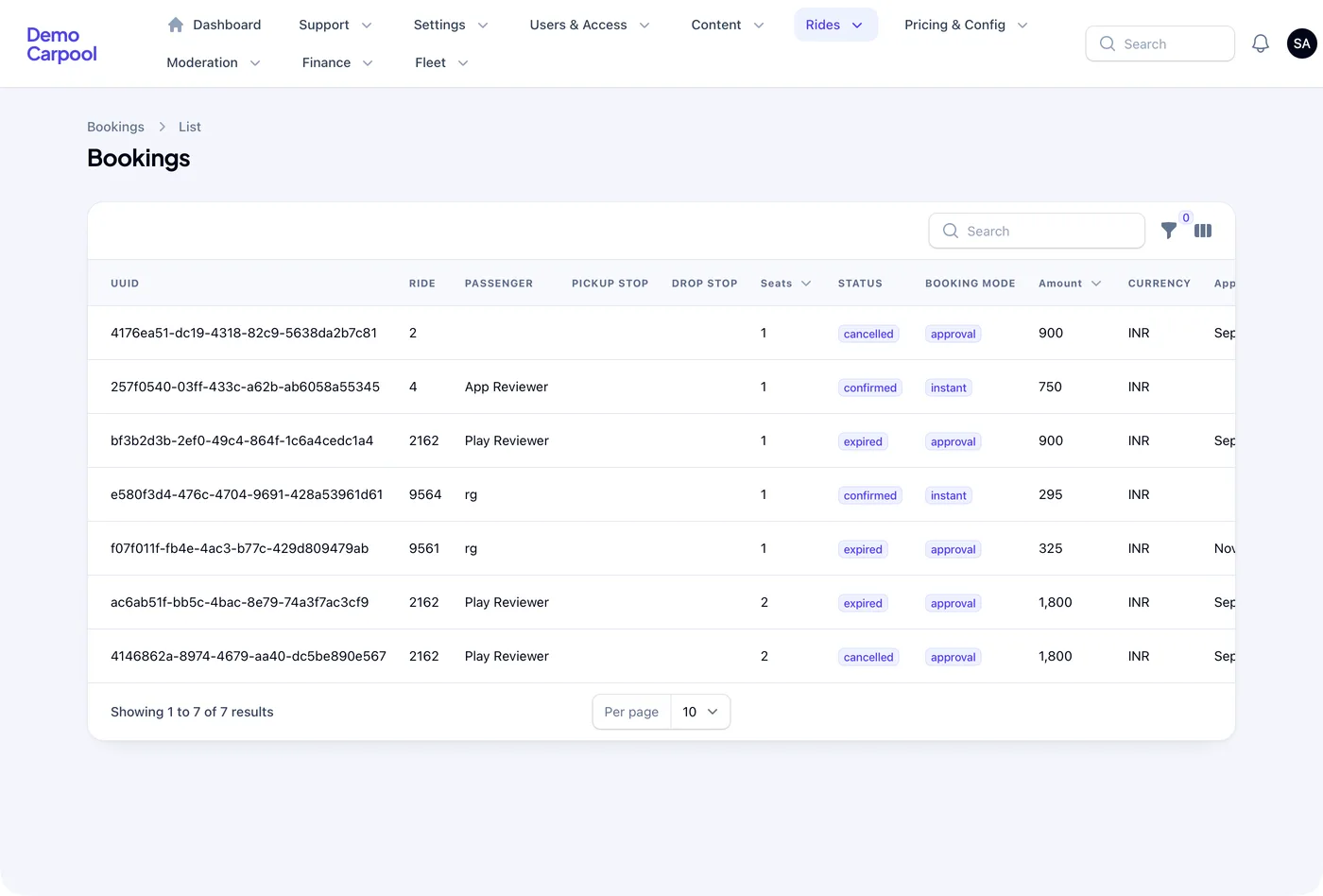
Some drivers are happy to take anyone. Others want to see who is coming first. So each trip can use instant booking or approval booking. The booking list shows the mode, the seats and the status: confirmed, cancelled or expired.
3. Fare by kilometre, not by surge
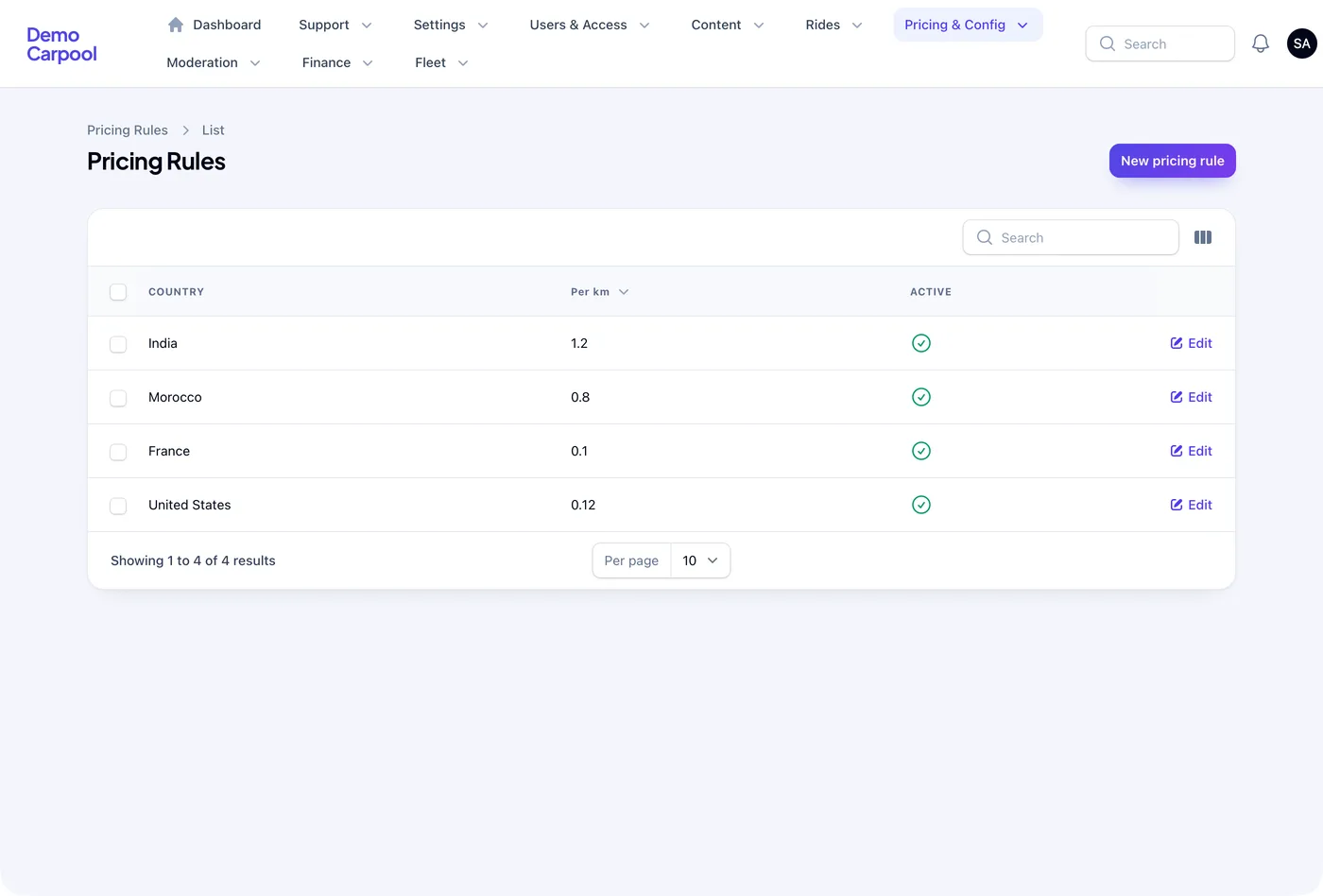
The fare comes from a per-km rule you set in the admin panel. A rider pays only for the part of the route they travel. There is no surge and no cut taken from the driver's share.
4. Driver checks before the first trip
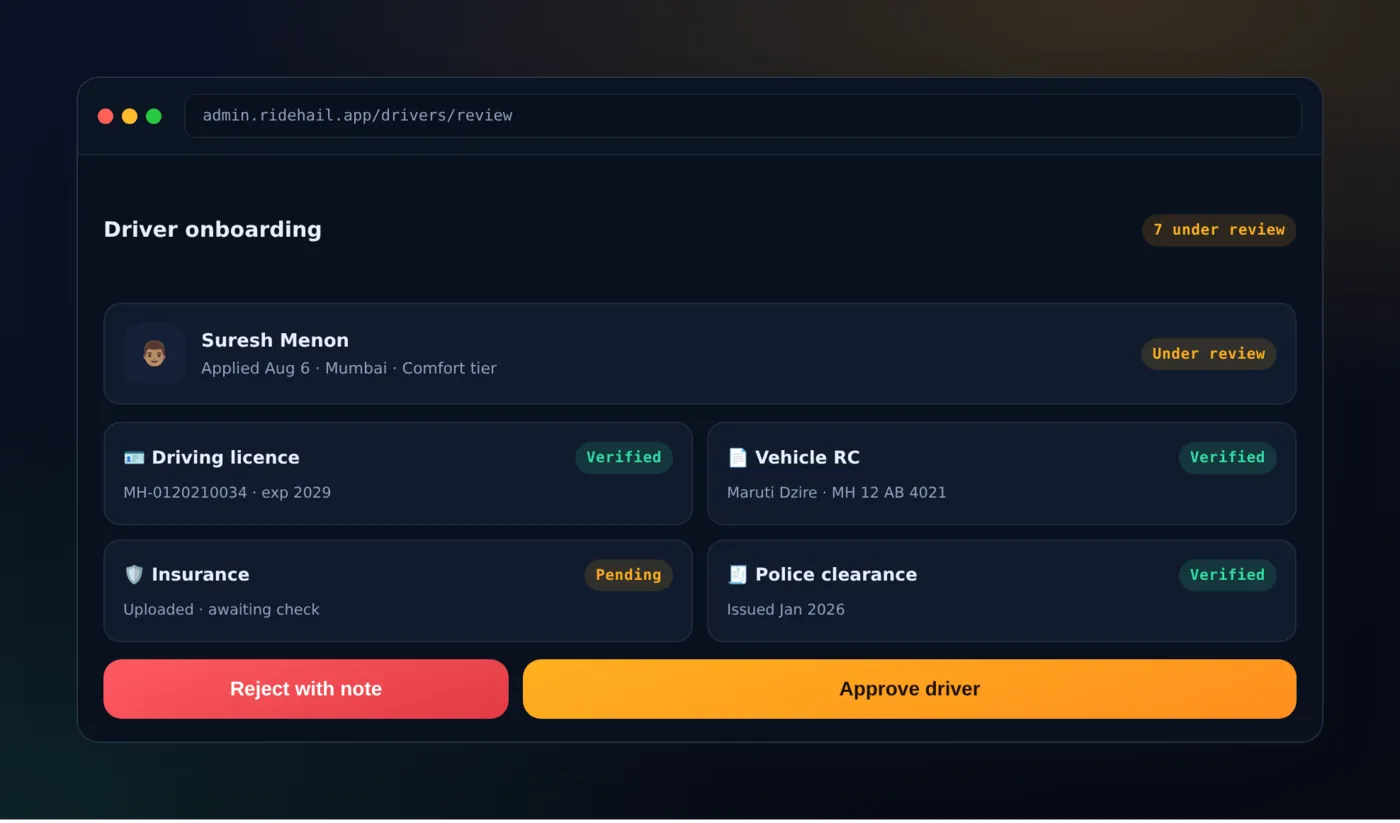
A driver uploads a driving licence, the car's registration paper and insurance. Your team checks each one and approves or rejects with a note. You can ask drivers to check their papers on the government's Vahan vehicle services portal too.
5. Wallet and refunds
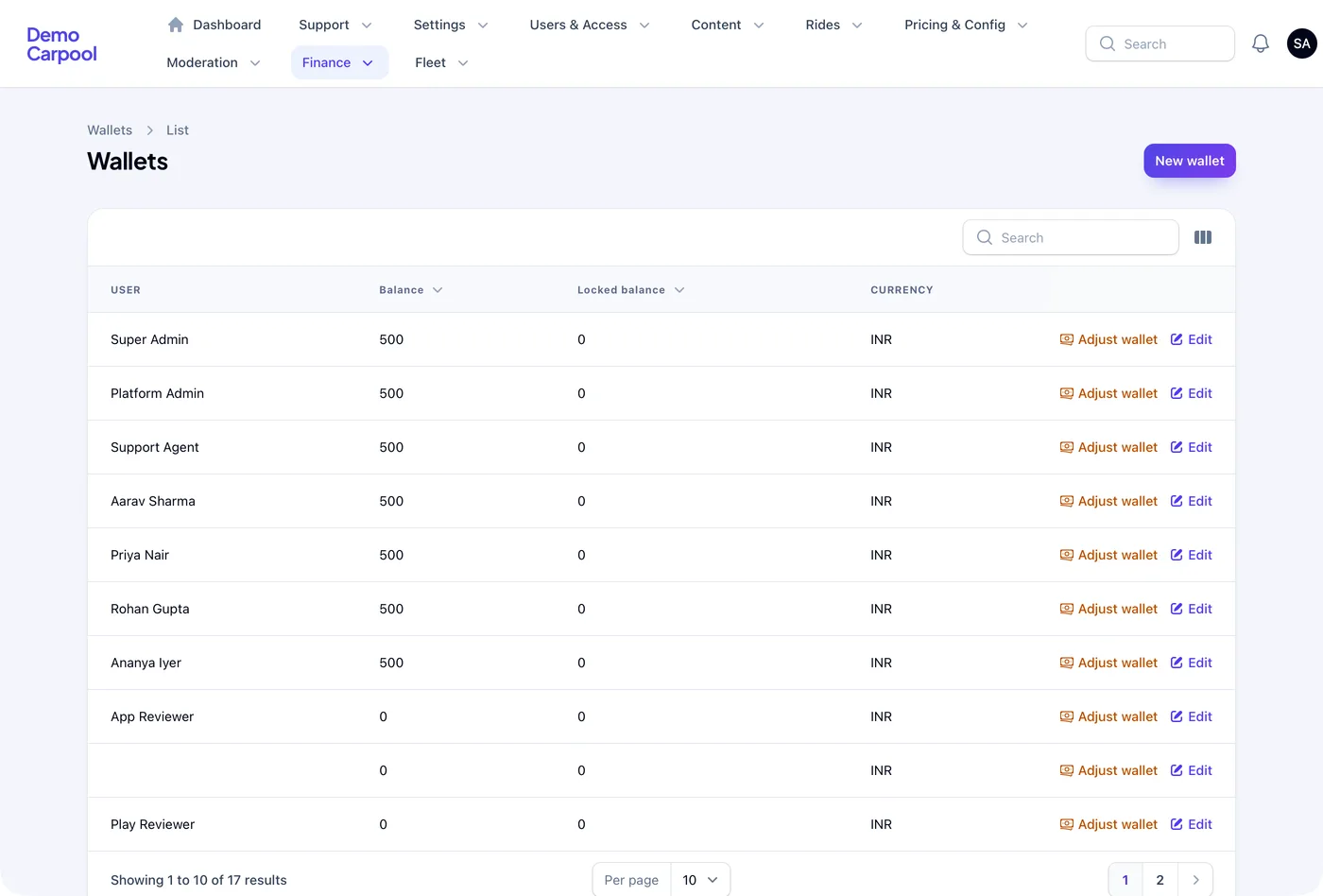
Riders can top up a wallet and pay from it. A seat amount stays locked until the trip ends, then goes to the driver.
6. Launch coupons
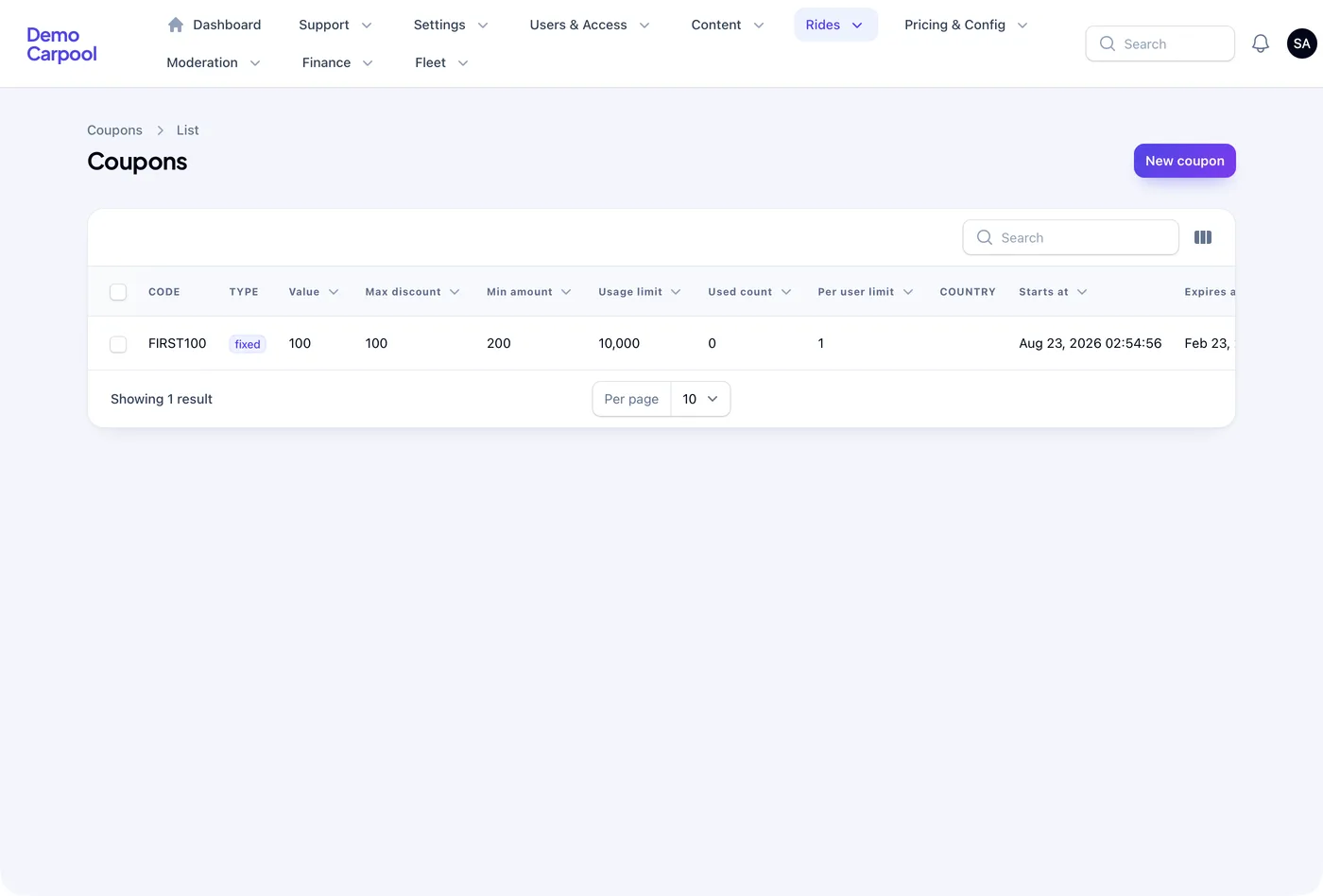
Run a welcome code for new riders. Set a usage limit, a per-user limit and start and end dates.
7. Safety tools in the app
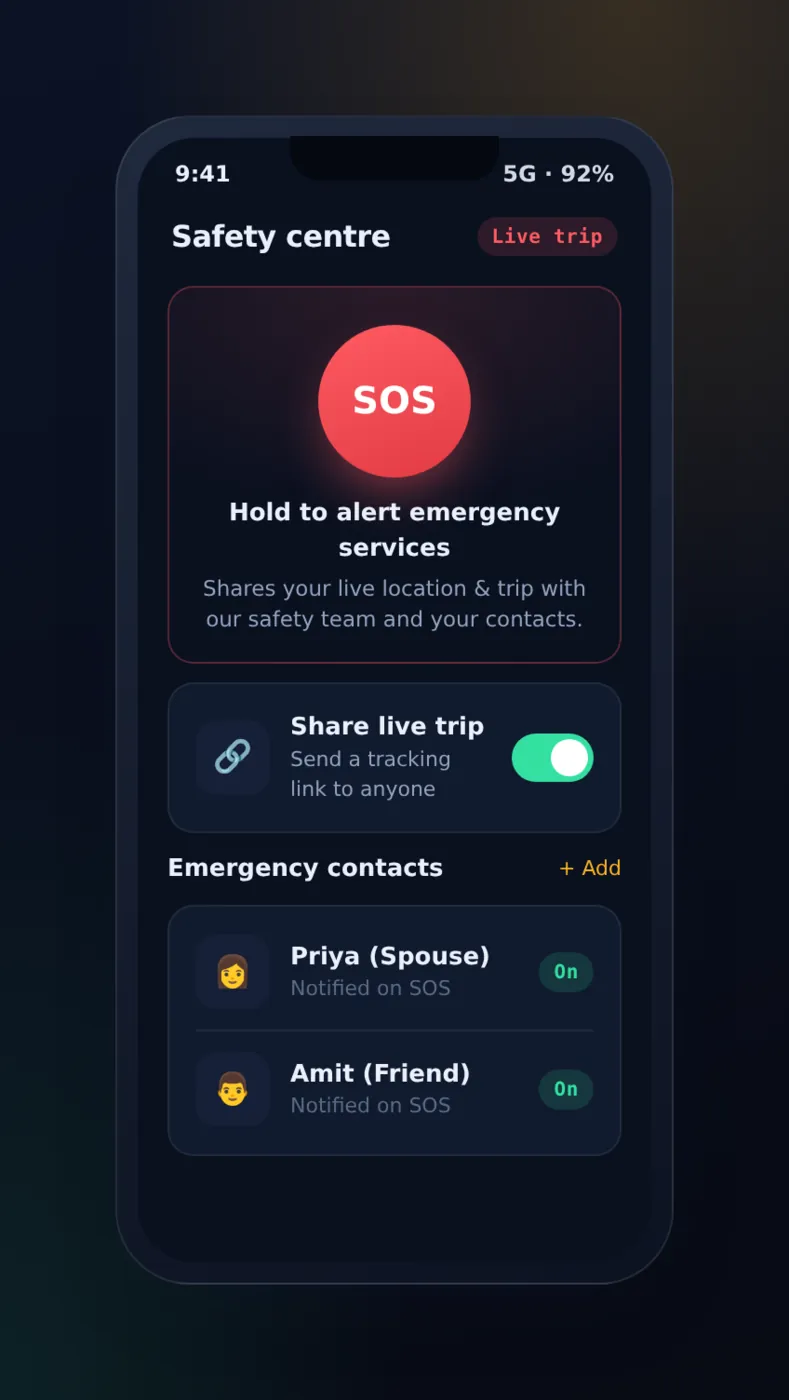
Riders and drivers can share a live trip link with family. An SOS button alerts your support team and the user's saved contacts. Ratings after each trip help your team spot problem users early.
What changes for a carpool app in India
A carpool app made for Europe will not fit Indian roads and users as it is. We have built ride apps for Indian cities before, so we know where it breaks. These are the parts we set up for India.
- Payments. Riders expect UPI, cards and a wallet. Some groups still want cash, so we can keep a cash option.
- Languages. Hindi and regional language screens help riders in smaller towns.
- Phone login. Most users sign in with a mobile number and an OTP, not an email.
- Transport rules. Rules on private cars that carry paying riders differ by state. The Ministry of Road Transport set out ride pooling in its Motor Vehicle Aggregator Guidelines 2020. Check your state's rules with the transport department and a lawyer before launch.
- Personal data. Phone numbers, ID papers and live location are personal data. The Digital Personal Data Protection Act, 2023 applies, so the app asks for consent and limits who sees what.
White label vs clone script vs built from scratch
| What you get | Clone script | White label build | From scratch |
|---|---|---|---|
| Time to first version | Short | Short to medium | Longest |
| Your brand on apps and stores | Partly | Yes | Yes |
| Per-km cost sharing fare | Often taxi fares only | Yes, set in admin | Yes |
| Changes to fit your rules | Hard | Yes | Yes |
| Source code handed over | Sometimes, often locked | Yes | Yes |
| Someone to fix bugs after launch | Rarely | Yes, with support | Yes, with support |
Worked example: an office park carpool
Here is how one white label launch could go. The company and places are examples.
- The need. A firm that runs an office park wants staff from nearby towns to share cars to work.
- Brand. We set the app name, logo and colours. The app only lets people with an office email sign up.
- Rules. The admin team sets the per-km rule and turns on approval booking for all trips.
- Drivers. Staff who drive upload their licence and car papers. The admin approves them one by one.
- First week. Drivers post morning and evening trips. Riders book seats and pay by UPI or wallet.
- Review. The office team checks the dashboard each Friday. They add a second pickup point after riders ask for it.
Our service
How we build your own white label carpool app
Your brand and your rules on a base that already works.
- Understand your model. We go through your routes, users and rules in one or two calls.
- Show the screens. You click through screens in your brand and ask for changes before we write code.
- Build the apps. One Flutter codebase for Android and iPhone, plus a Laravel admin panel and API.
- Test with real users. A small group of your drivers and riders use it on real trips. We fix what they find.
- Launch in your name. We publish to the stores under your account and set up hosting on your own server.
- Support and grow. We add cities, languages and features as your users ask for them.
White label carpool app development cost: what decides it
We do not publish a fixed price, because every carpool idea is different. These things decide the budget:
- How many platforms: Android only, or Android, iPhone and web.
- How many roles and rules: one city or many, open sign-up or closed groups. Selling the app to many groups needs a multi-tenant SaaS setup.
- Payments: wallet only, or UPI, cards and payouts to drivers.
- Safety and checks: document upload, manual review, SOS and live tracking.
- Languages and how many screens need translation.
| Monthly carpool software plan | Your own white label app | |
|---|---|---|
| Start | Quick, small first payment | A few weeks to set up and test |
| Cost over years | Pay every month, often per user or trip | One build cost, then optional support |
| Your rules and fare logic | Only what the vendor allows | Set the way you work |
| App in your name on the stores | Usually not | Yes |
| Data and source code | Stay with the vendor | Yours |
Share your routes, user groups and must-have features. We send a written quote after one call.
Whoever builds your carpool app, make sure it can:
- Work out the fare per kilometre from a rule you can edit
- Let drivers choose instant or approval booking
- Check driver licence, car papers and insurance before the first trip
- Share a live trip link and raise an SOS
- Hold the rider's money until the trip ends
- Show only your brand in the apps, emails and store listings
- Run on your own server, with the source code handed to you
FAQ
What is a white label carpool app?
It is a carpool app built on a tested base and set up under your brand. Your name, logo and colours appear everywhere. The apps run on your server and are listed under your store account.
How is a carpool app different from a taxi app?
In a taxi app, the driver goes where the rider wants and earns a fare. In a carpool app, the driver is already making the trip. Riders share the cost of the kilometres they ride.
How long does it take to build a white label carpool app?
It depends on platforms, payments and how much we change. After one call, we share a plan with dates for each stage, starting with clickable screens.
Will I own the app and its source code?
Yes. We hand over the source code, and the apps are published under your own store accounts. Your data stays on your server.
Which platforms do you build for?
We build the mobile app for Android and iPhone from one codebase. The admin panel runs in any web browser.
Is carpooling with a private car legal in India?
Rules on private cars carrying paying riders differ by state. Check with your state transport department and a lawyer before you launch. We can build the app to follow the rules they give you.
How do you keep rider and driver data safe?
We ask for consent and hide phone numbers between users. Staff see data by role, and ID papers stay on your server. These steps follow the Digital Personal Data Protection Act, 2023.
Can PRS India build a white label carpool app for my company?
Yes. We build the rider and driver app for Android and iPhone and a web admin panel, under your brand. Book a consultation and tell us your routes.
Related guides
Written by
Aditi
Building software at PRS India.