Business of Software
White Label Grocery Delivery App Development
Get a ready grocery delivery app set up under your brand: customer app, rider app, store app and web admin, on Android, iPhone and web.

Written from production. Our articles draw on products we run live and the client work behind them, and are revised as the systems they describe evolve.
A grocery shop owner who wants home delivery has three choices. List on someone else's app and give up the customer. Rent a monthly app that looks like every other shop. Or launch a grocery delivery app with your own name on it. The third choice used to mean starting from zero. A white label grocery delivery app changes that.
White label means a working app base is set up again under your brand. The screens, the order flow and the rider app already work. We change the name, logo, colours, catalogue and rules to match your shops. Then it goes live on the stores as your own app, as part of a full ecommerce development setup. This guide explains what you get and what you still arrange. It also shows how PRS India handles grocery app development for Android and iPhone under your brand.
Key takeaways
- A white label grocery app is a ready app base rebuilt under your name, logo and colours.
- It has four parts: a customer app, a rider app, a store app and a web admin.
- White label is faster than a fresh build. You still need your own FSSAI licence, payment account and store accounts.
- Ask for the source code and your data in writing. Many "white label" offers are only rentals.
- You can start with the white label base and add your own features later.
What is a white label grocery delivery app?
Think of a shop fit-out. The racks, counters and lights are standard, but the sign board is yours. A white label grocery app works the same way. The parts every grocery business needs are already built: catalogue, cart, checkout, order status and rider handover. Your brand goes over them, and your own rules are set inside.
This is not the same as being a seller on a big delivery app. There, the customer belongs to the platform. Here, the customer downloads your app, sees only your shops and pays your business. For a wider view, our guide on launching a 10-minute delivery app covers the quick commerce model.
The four parts you get
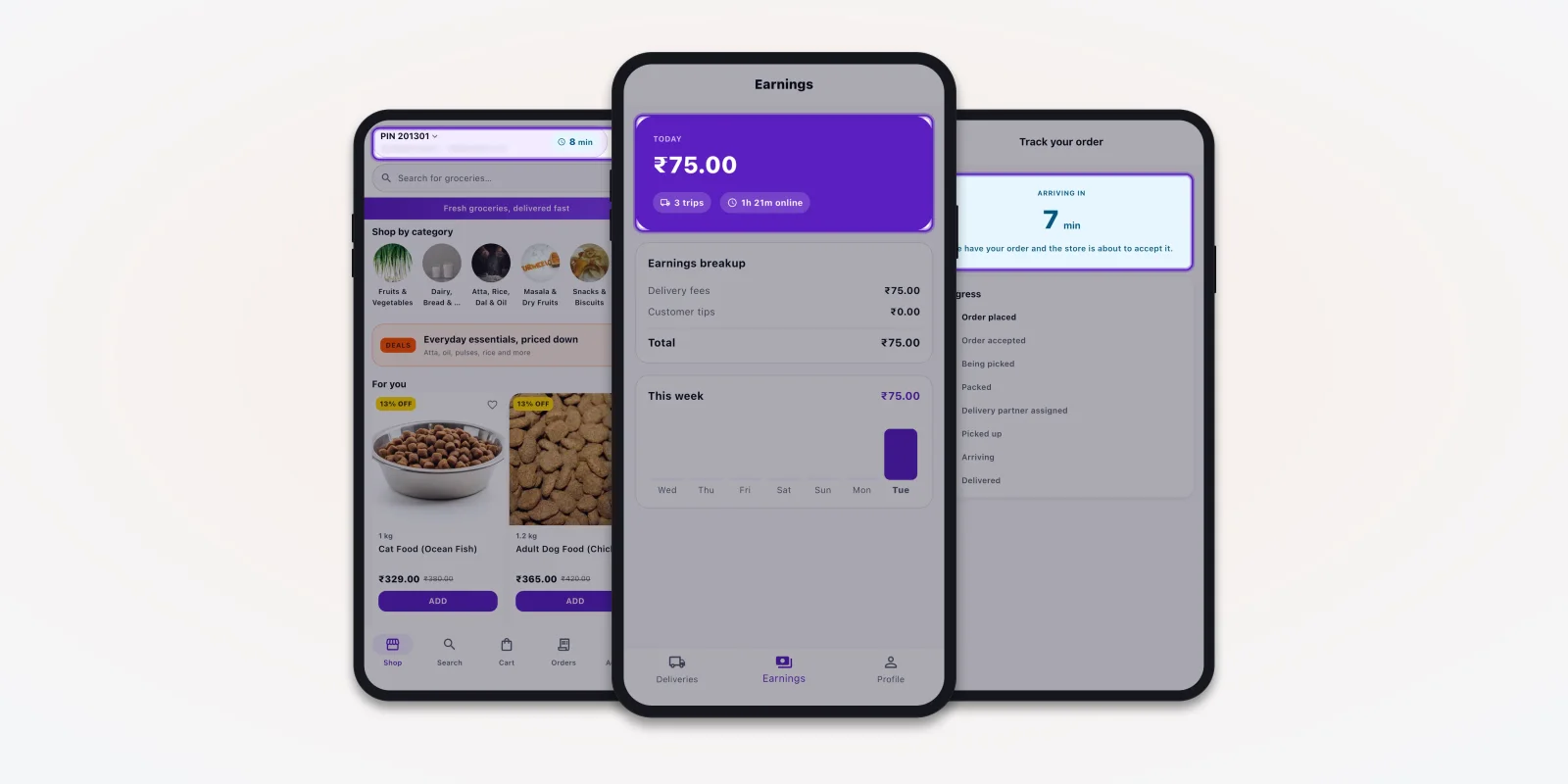
A grocery delivery business has four kinds of users. Each one needs its own screens. The phone screens below are from a grocery app we built, filled with demo data. You can see more of our work on our products page.
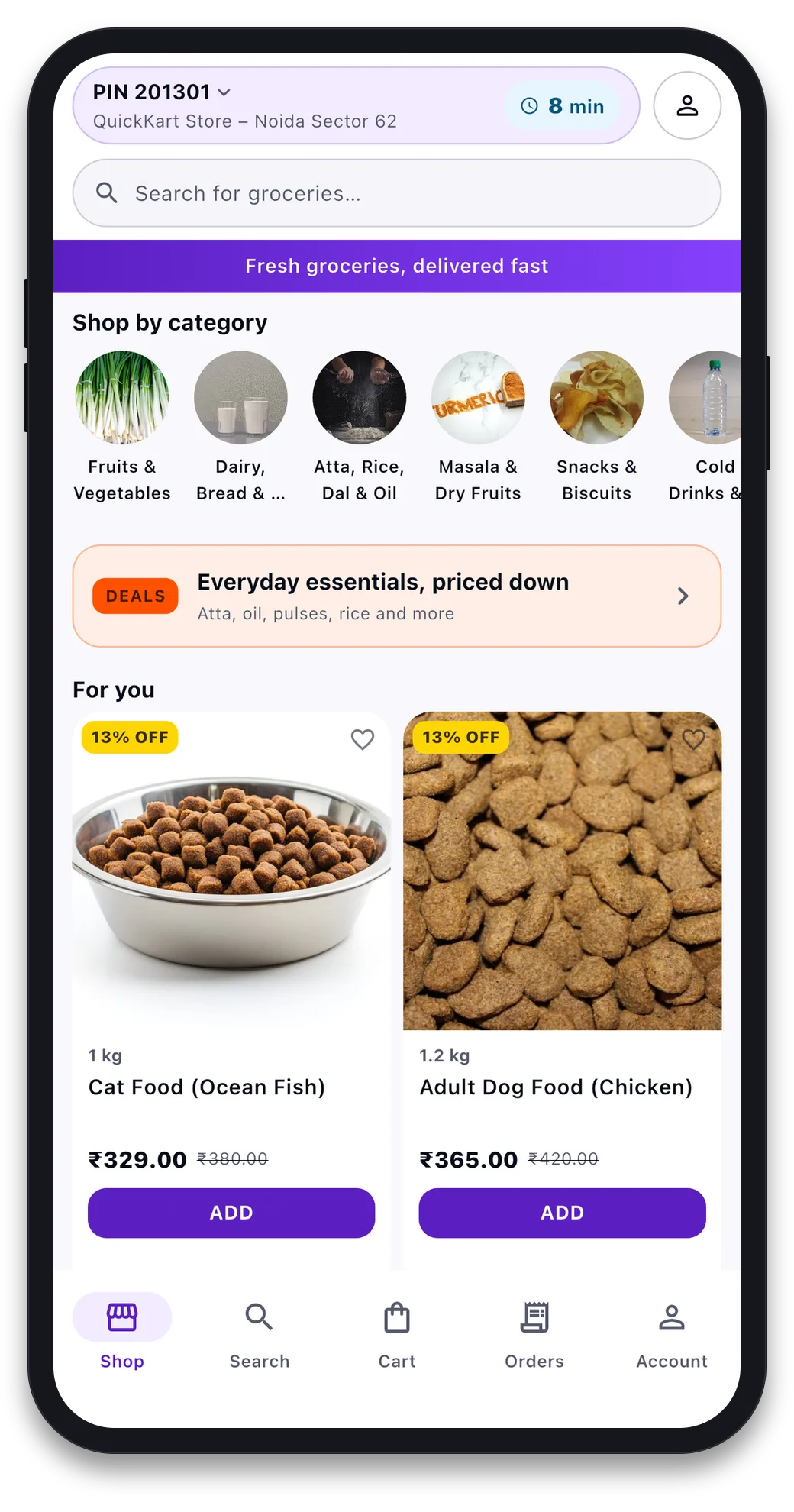
Customer app
Shoppers pick a pin code, browse categories, search and order.
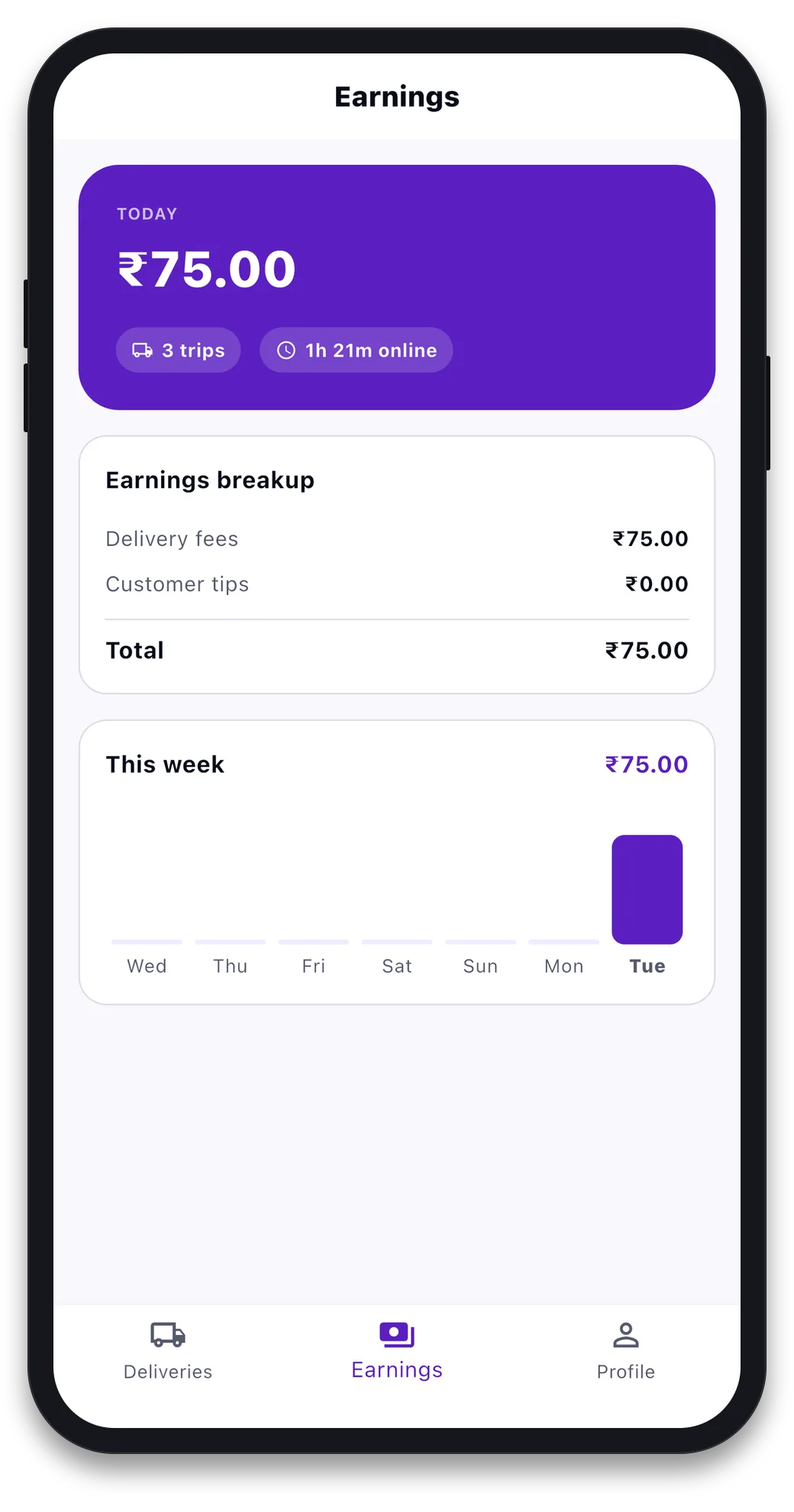
Rider app
Riders go online, take orders, deliver and see what they earned.
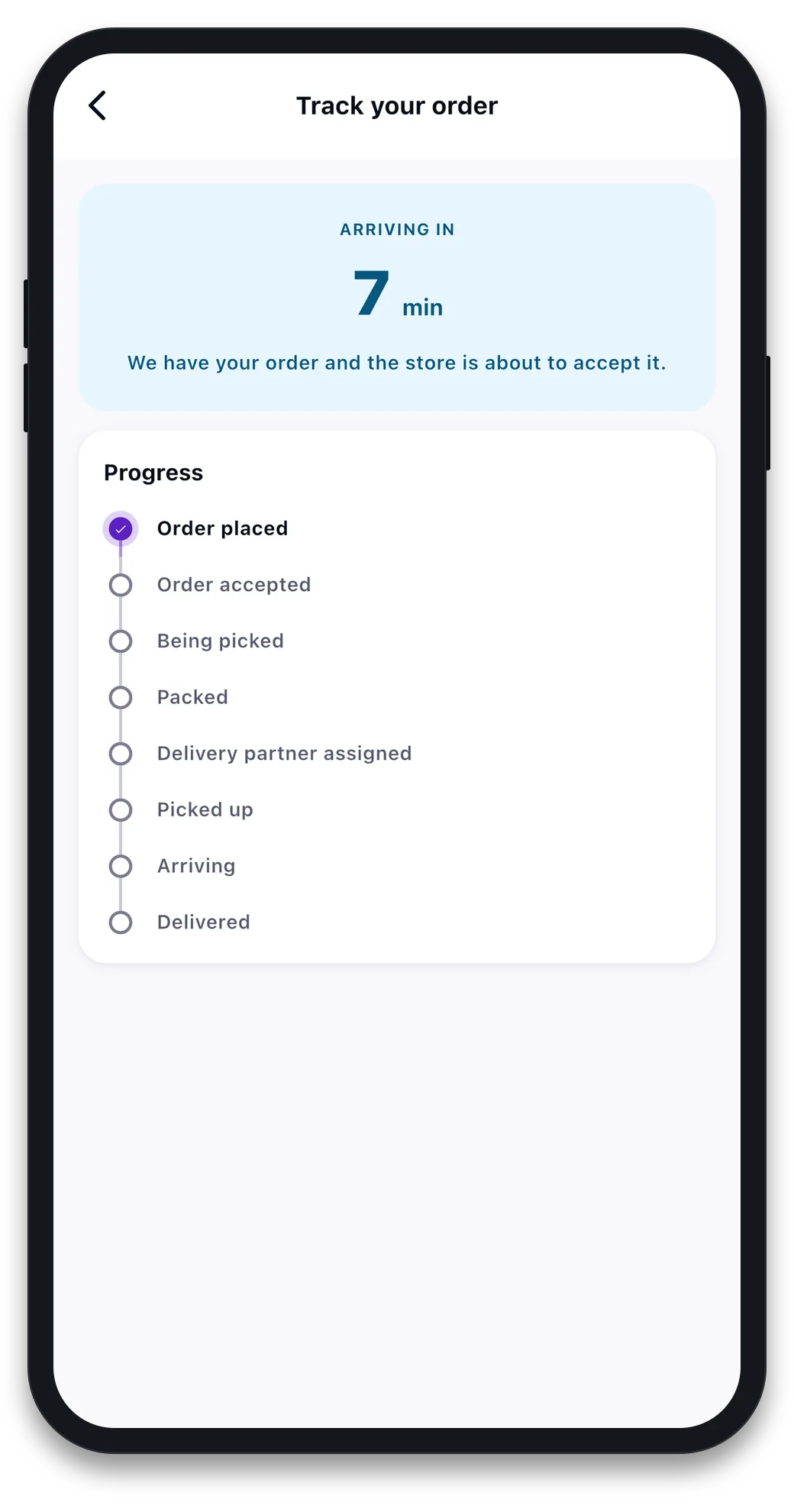
Order status
Every step from "placed" to "delivered" is shared between all apps.
The fourth part has no phone screen in this guide. It is the web admin, where your office manages shops, products, prices, offers, riders, refunds and reports. A store app, used at the counter or in the back room, shows new orders to pack. We build the admin as a web application that runs in any browser.
The problem
Why grocery owners look for white label
Most owners we speak to have tried one of these first.
- WhatsApp orders. Orders come as voice notes and photos of lists. Staff type them again. Items get missed.
- Big app listing. Sales come, but the customer's number and history stay with the platform.
- Shared app with many shops. Your shop sits next to the shop down the road. The customer compares and leaves.
- Monthly rented app. It carries the vendor's name in places, and fees grow with each user or order.
- Fresh build from zero. It takes longer, because every screen is designed and coded for the first time.
What we change to make it yours
White label is more than a new logo. These are the things we set up for each grocery client.
1. Brand and look
App name, icon, colours, splash screen and fonts. Your brand also goes on the store listing, the order messages and the invoices.
2. Catalogue and units
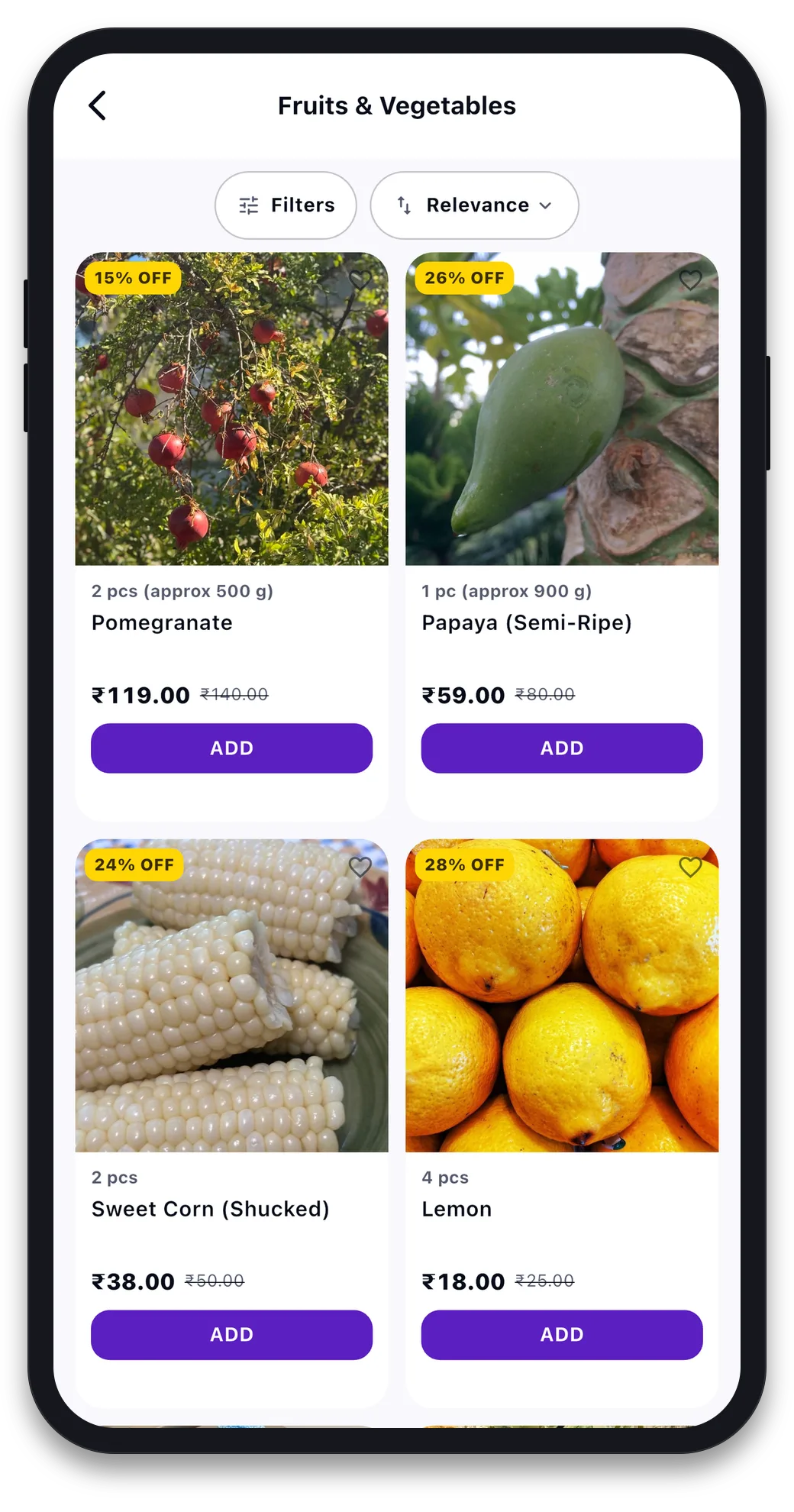
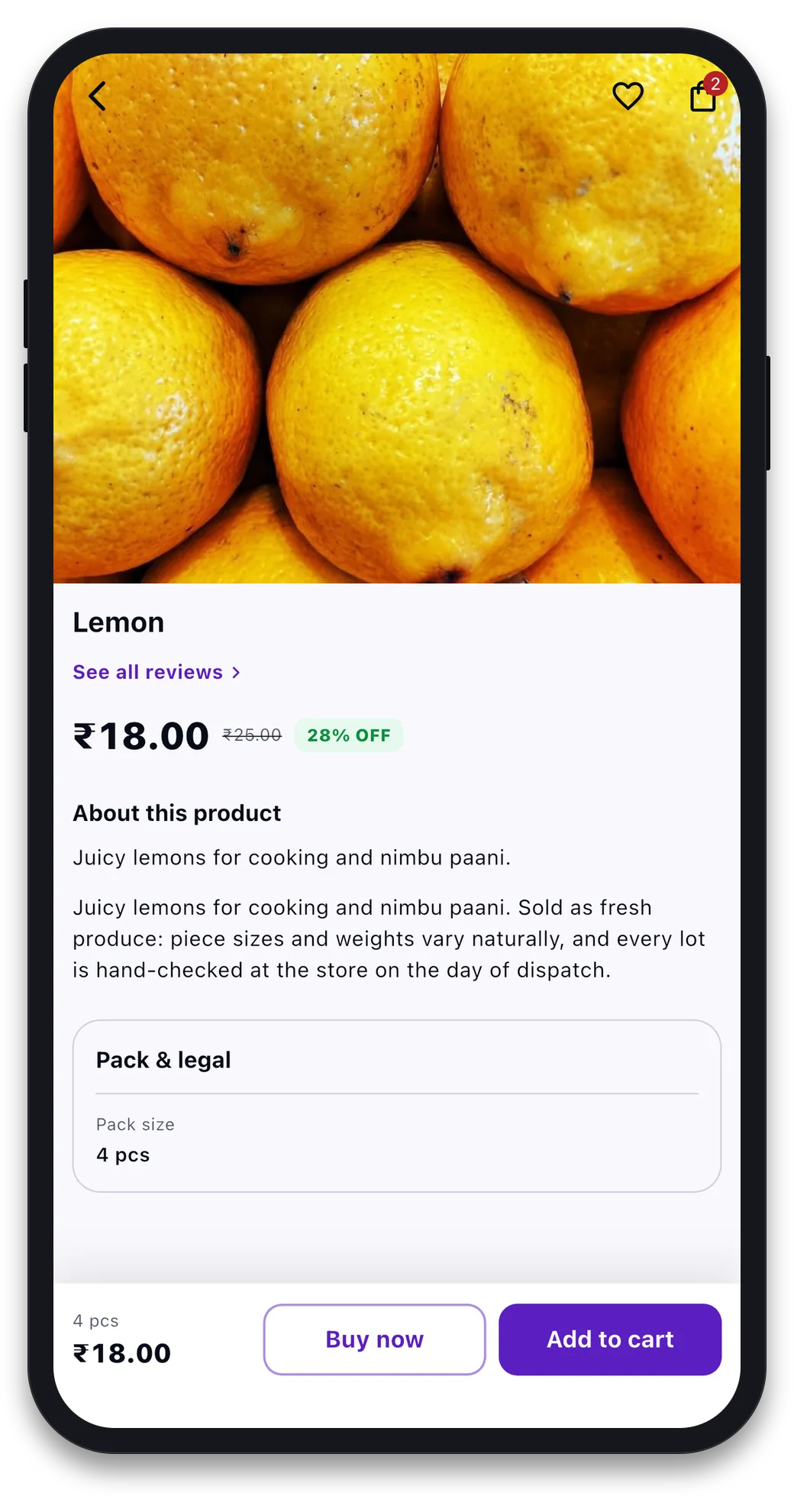
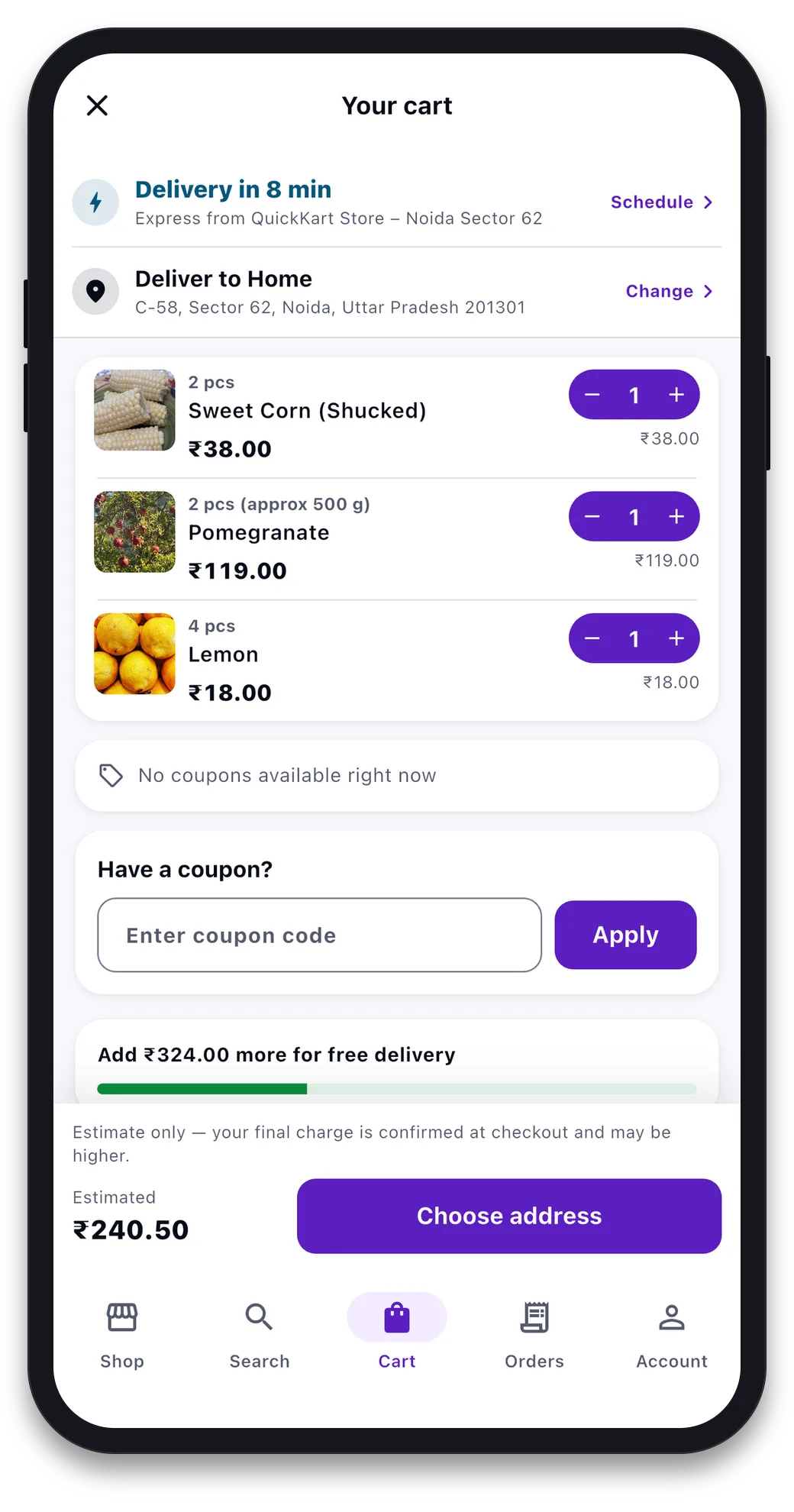
Groceries are sold in many ways. Some items come in fixed packs. Others, like fruit, are sold "about 500 g" and weighed at packing. We set up categories, pack sizes and loose-item rules to match your stock list.
3. Delivery area and charges
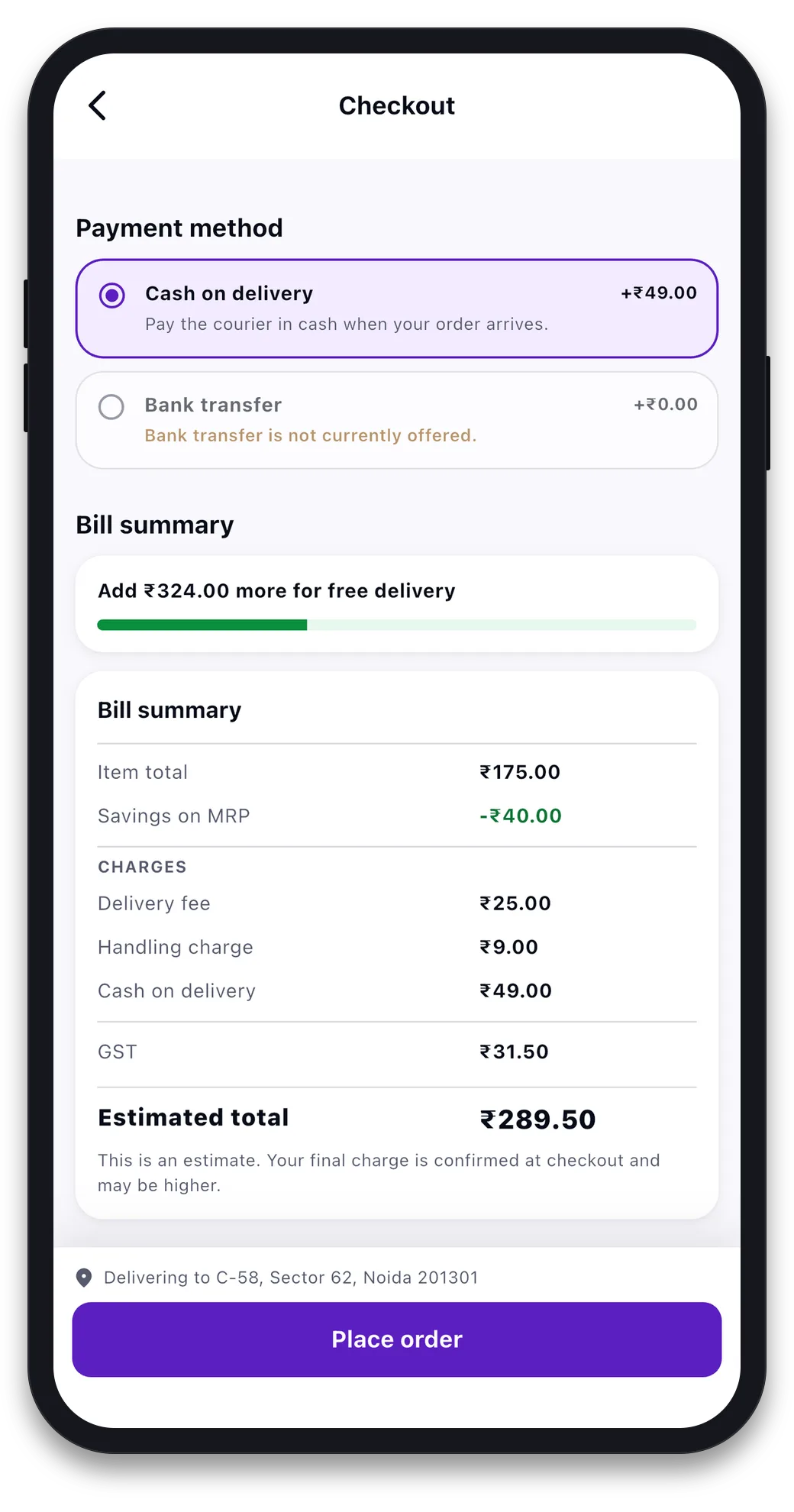
You decide which pin codes each shop serves. You also set the order minimum, delivery charge, handling charge and any extra charge for cash on delivery. The app shows all of these on the bill before the order is placed.
4. Payment modes
Cash on delivery, UPI and cards through a payment gateway account in your business name. The money goes to your bank, not to us.
5. Rules for your stores and riders
One shop or ten? Your own riders or a delivery partner? Instant delivery or time slots? These choices change the order flow. In a white label setup, they are settings and small changes, not a rebuild. If other shops also sell on your app, it becomes a multi-vendor marketplace. That needs seller accounts and payouts.
Papers you need, whoever builds the app. FSSAI's e-commerce rules say food businesses that sell online need an FSSAI licence or registration. The Consumer Protection (E-Commerce) Rules, 2020 ask online sellers to show return and refund terms and a grievance contact. Rules change, so check the latest text with a lawyer or the authority.
White label vs custom build vs monthly app
| What you need | Monthly rented app | White label, built for you | Custom build from zero |
|---|---|---|---|
| Time to go live | Days | Weeks | Months |
| Your own name on the store listing | Sometimes | Yes | Yes |
| Customer list and order data | Kept by the vendor | Yours | Yours |
| Source code | No | Yes, if written in the contract | Yes |
| Change the order flow | Rarely | Yes | Yes |
| Rider and store apps included | Varies | Yes | You plan them |
| Payments go straight to you | Varies | Yes | Yes |
A white label build sits between the other two. You get the speed of a ready base and the ownership of a custom app. It suits shops that want to start now and grow the app later. Our case studies show how other businesses grew their apps after launch.
Worked example: a supermarket with three branches
Here is how a white label launch can run for a retail business. The shop and the steps are an example.
- First call. The owner runs three supermarket branches in one city. Each branch serves different pin codes. Today, orders come by phone.
- Brand kit. The owner shares the logo, colours and shop names. We set up the app name and icon.
- Catalogue import. The stock list comes from the billing software as a sheet. We map it to categories, packs and loose items.
- Area rules. Each branch gets its own pin codes, delivery charge and order minimum.
- Rider setup. Six shop delivery boys get the rider app. Each one is linked to a branch.
- Test week. Staff and family place real orders. We fix what they find.
- Store launch. The app goes live on Google Play and the App Store under the supermarket's own account.
Our service
How we build your white label grocery app
Your shops, your rules, your brand on every screen.
- Understand your shops. We map your branches, stock, delivery area and team in one or two calls.
- Show the screens. You click through screens in your colours and ask for changes before launch.
- Set up the apps. Customer and rider apps built in Flutter for Android and iPhone. A Laravel back end runs the web admin.
- Test with your staff. Real orders, real riders, real pin codes. We fix what comes up.
- Launch under your name. Your server, your store accounts, your payment gateway.
- Support and add. Loyalty points, slots, new branches or new cities, when you need them.
White label grocery app development cost: what decides it
We do not publish a fixed price, because every grocery business is set up differently. The cost depends on your branches and pin codes, the products you import, and the apps you need. It also depends on extra features beyond the base, such as slots, wallet or loyalty points. If you plan to rent the app to other shops, a multi-tenant SaaS setup adds work.
| Monthly rented app | White label built for you | |
|---|---|---|
| First payment | Low | One build cost |
| Over the years | Pay every month, often per order or per shop | Hosting and optional support only |
| Your rules and changes | Limited to what the vendor offers | Changed for you |
| If you stop paying | The app goes offline | The app stays yours |
Share your branch count, product list and delivery plan. We send a written quote after one call.
Whoever builds your white label grocery app, make sure it can:
- Go live under your own Google Play and App Store accounts
- Sell both fixed packs and loose items by weight
- Set pin codes, charges and order minimums for each branch
- Send payments straight to your bank account
- Give riders their own app with cash collection and handover steps
- Let you export customers and orders at any time
- Hand over the source code when the project ends
FAQ
What is a white label grocery delivery app?
It is a ready grocery app base that is set up again under your brand. Your name, logo, colours, products and rules are added to it. It then goes live on the app stores as your own app.
How long does a white label grocery app take?
It is faster than a fresh build, because the order flow already works. The time depends on your product list, branches and extra features. After one call, we share a plan with dates for each part.
Will I own the app and the source code?
Yes, when you build with us. The app goes live under your store accounts. We hand over the source code, and your data stays on your server.
Which platforms does the app run on?
The customer and rider apps run on Android and iPhone. The admin runs in a web browser on any computer.
Is my customers' data safe?
It should be. The Digital Personal Data Protection Act, 2023 covers the names, numbers and addresses you collect. We build login roles, consent records and limited access to customer details.
Do I still need an FSSAI licence if I have my own app?
Yes. FSSAI rules say food businesses that sell online need a licence or registration. Check the right type for your shop with FSSAI or a consultant.
Can other shops sell on my white label app?
Yes, but then it becomes a marketplace. It needs seller logins, commission rules and payouts. If you collect payment for other sellers, GST rules for e-commerce operators may apply, so check with your CA.
Can PRS India build a white label grocery app for my shops?
Yes. We build the customer app, rider app, store app and web admin under your brand. Book a consultation and we will show you screens set up for your shops.
Related guides
Written by
Aditi
Building software at PRS India.