How to Start a Courier Business: Build Your Own App
The steps to start a courier business in India, and the rider app, office admin and tracking page we build for you from day one.

Written by Babita Kumari, Business Developer
Reviewed by the PRS India software & mobile app development team
11 min read
Written from production. Our articles draw on products we run live and the client work behind them, and are revised as the systems they describe evolve.
Online orders reach every town in India now. Someone has to pick them up, sort them and hand them over at the door. That is why many people ask how to start a courier business in India. The van and the riders are the visible part. The hard part is knowing where each parcel is, who has the cash, and why a parcel came back.
This guide walks through the steps to start a courier business. It then shows the app you need from the first day. PRS India does mobile app development for new courier firms. We build your own rider app, office software and tracking page, under your brand.
Key takeaways
- First choose your model: local same-day, last mile for online sellers, or city-to-city with hubs.
- Register the business and check GST and local rules before you sign your first sender.
- Start with a small area you can cover well, then add pincodes.
- From day one, every parcel needs a number, a scan at each step and proof at the door.
- Your own courier app keeps your brand on the tracking link, not a software vendor's.
Choose your courier business model
Before you rent a hub or buy a bike, decide what kind of parcels you will carry. Each model needs different staff, space and software.
| Model | What you do | What the software must handle |
|---|---|---|
| Local same-day | Pick up and drop within one city on the same day | Fast booking, rider assignment, live status |
| Last mile for online sellers | Collect from sellers or a big carrier's hub and deliver to buyers | Bulk parcel upload, delivery attempts, cash on delivery, returns |
| City to city | Move parcels between your own hubs | Bags, trips between hubs, hub stock |
| Franchise of a big brand | Run one area for a national courier | Usually their software, so less to build |
A franchise is quicker to start, but the brand and the senders belong to the main company. Your own brand takes more work. In return, you keep the senders and build your own name.
Some new firms carry only groceries or medicines in one city. If that is your plan, read our guide on how to start a 10-minute grocery delivery business.
How to start a courier business in India, step by step
- Pick your area. List the pincodes you can reach in one rider shift. Start with fewer pincodes and deliver every parcel on time.
- Register the business. Choose a business type with your CA. Many small firms also do Udyam registration as a small business.
- Check GST. Courier is a taxable service. Check whether you must register on the GST portal, and what to charge your senders.
- Get local licences. Most states need a shop and establishment licence for your office and hub. Ask your local labour office.
- Set up a hub. A small room with racks, a scale and a label printer is enough at first. Mark shelves by area.
- Hire riders. Each rider needs a valid driving licence. Licence services are on the Sarathi portal of the transport ministry.
- Sign your first senders. Local online sellers, pharmacies, labs, printers and shops send parcels every day.
- Set your rates. Rates usually depend on weight, distance or zone, and speed. Keep a rate card in your software, not in your head.
- Put software in place. Booking, labels, scans, rider tasks, proof of delivery and cash tracking. This is where most new firms cut corners.
Check the rules for your state. Registration, GST and labour rules change over time and differ by state. Confirm them with your CA or a lawyer before you start.
The problem
What goes wrong in a new courier business
New courier firms rarely fail for lack of parcels. They fail on these six points.
- Lost parcels. Nobody scanned the parcel at the hub, so nobody knows who had it last.
- Cash gaps. Riders collect cash on delivery but hand it over late or short.
- "Not delivered" disputes. A buyer says the parcel never came. You have no photo or code to show.
- Returns pile up. Failed parcels sit on the shelf. Sellers ask for them back and you cannot find them.
- WhatsApp tracking. Senders call or message you for every status. Your phone rings all day.
- No numbers. You cannot see which rider or which pincode loses money.
Courier app development: what to build first
You do not need every feature on day one. You need the parts that stop parcels and cash from going missing. Below are screens from courier software we built, with demo data. We use it as a base for logistics platform development for new firms. The base is our courier and hub management software.
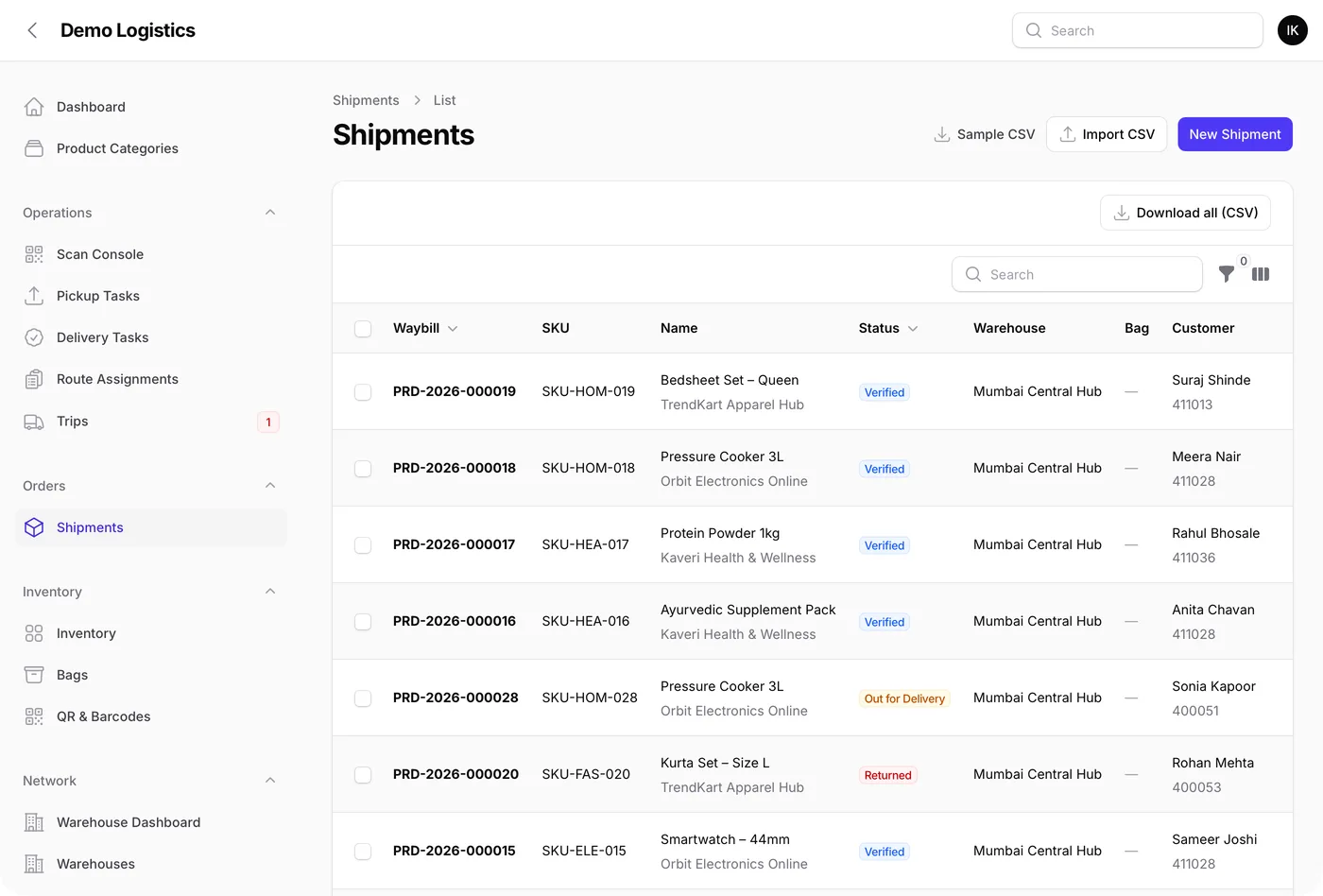
Parcels with a number from the start
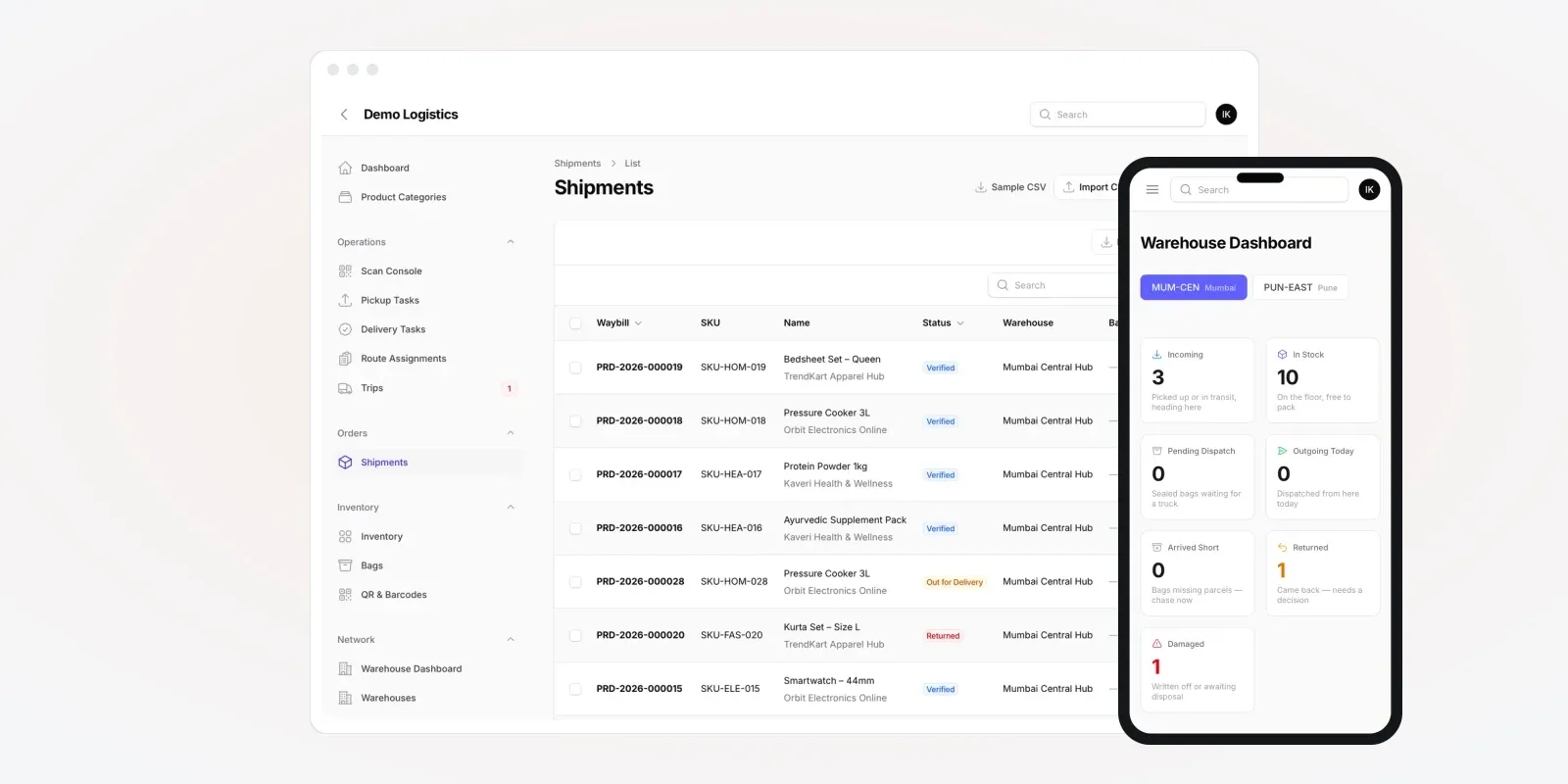
Every parcel gets a waybill number when it is booked. Sellers can upload a CSV of many parcels at once. The list shows each parcel's status, hub and buyer pincode.
A status such as "Returned" or "Out for delivery" comes from a scan, not from someone typing it.
Rider tasks for pickups and drops
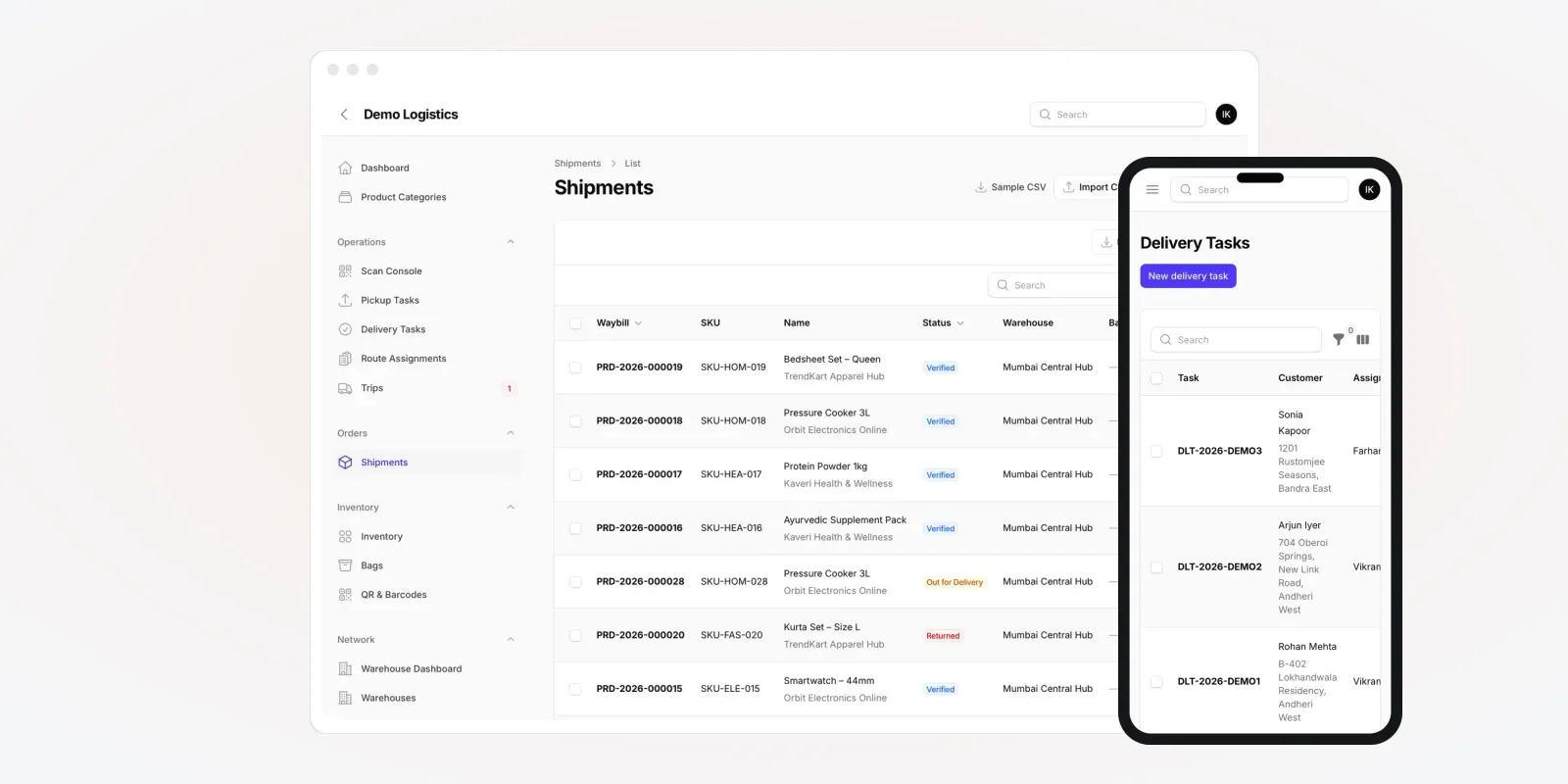
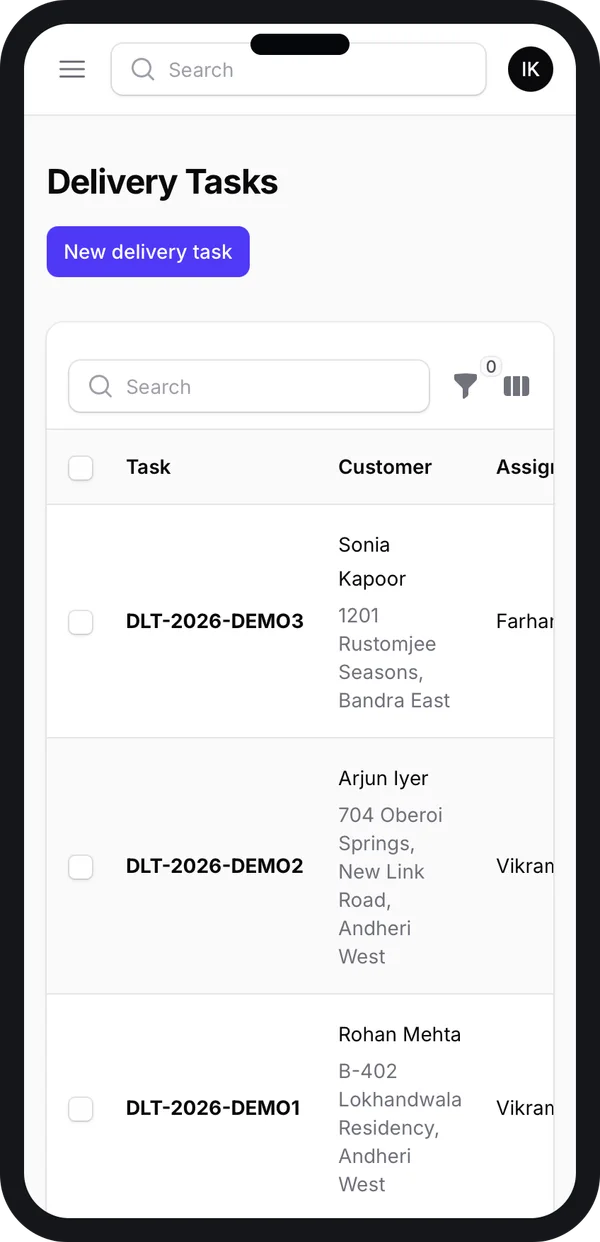
Each morning, the office gives every rider a list. Pickup tasks show the sender address and the number of parcels to collect. Delivery tasks show the buyer, the address and the attempt count.
The rider updates each task from the phone. The office sees it at once.
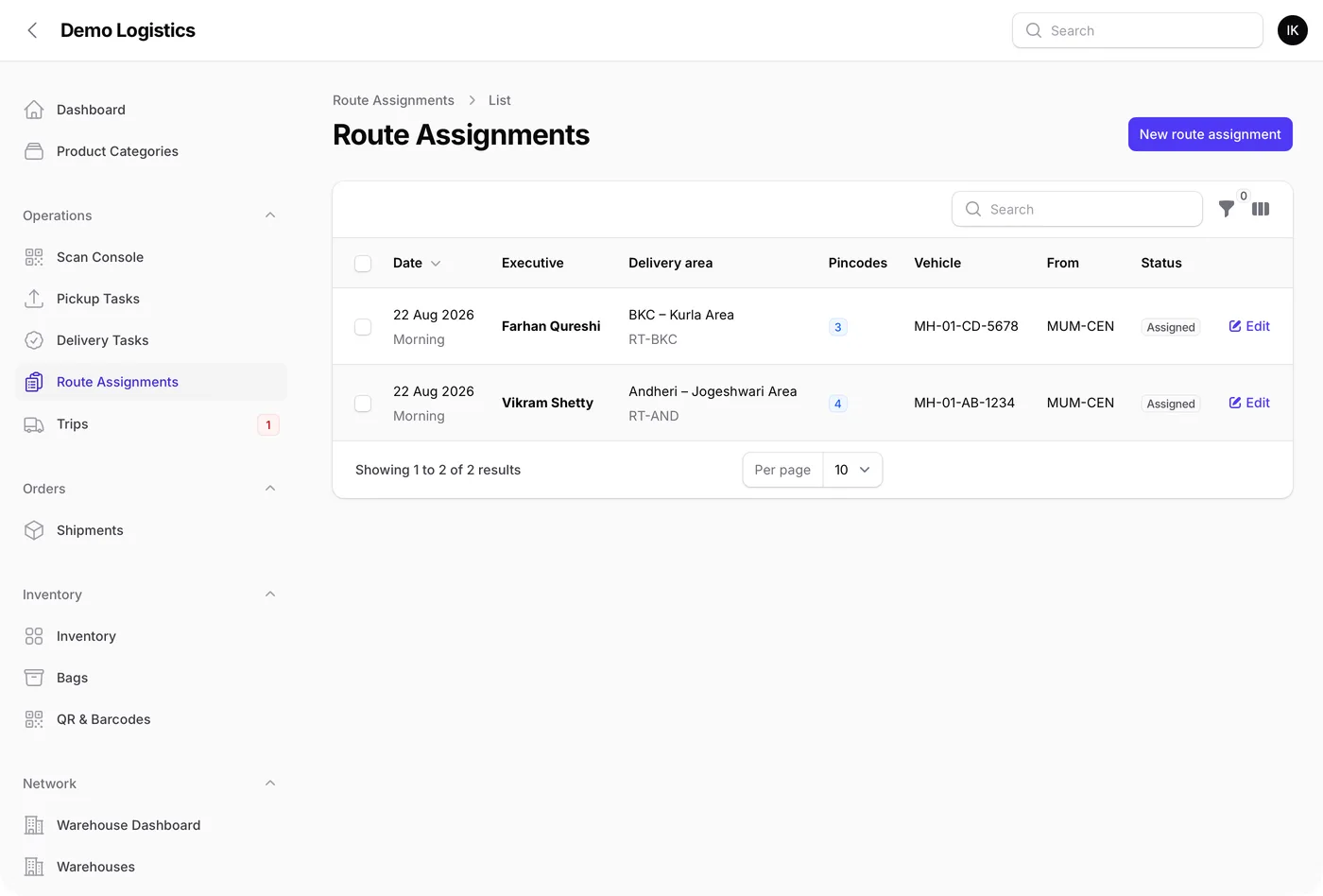
Routes by pincode
Group pincodes into delivery areas. Then assign each area to a rider and a vehicle for the day. When a rider is absent, you move the area to someone else in one step.
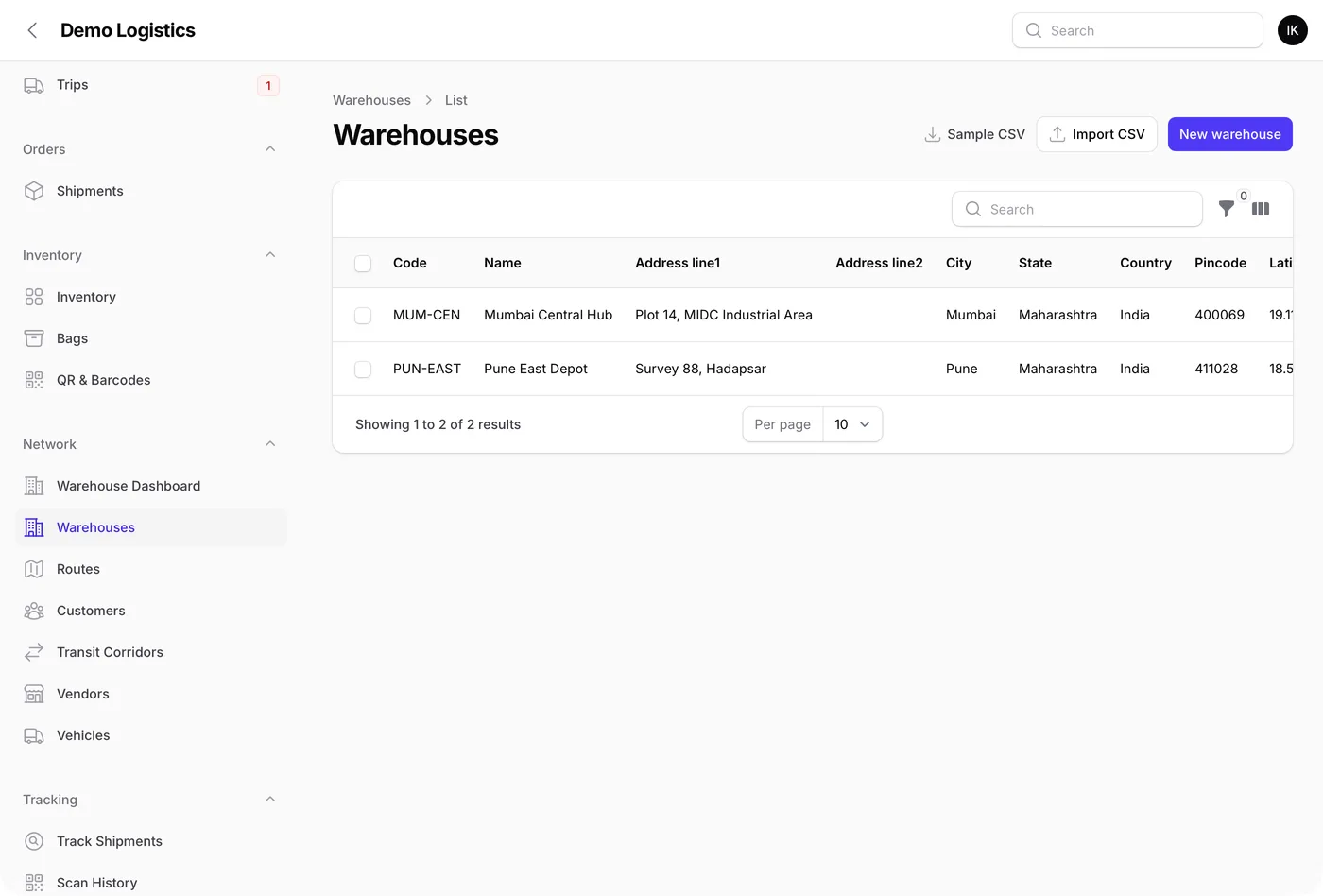
A hub view once you grow
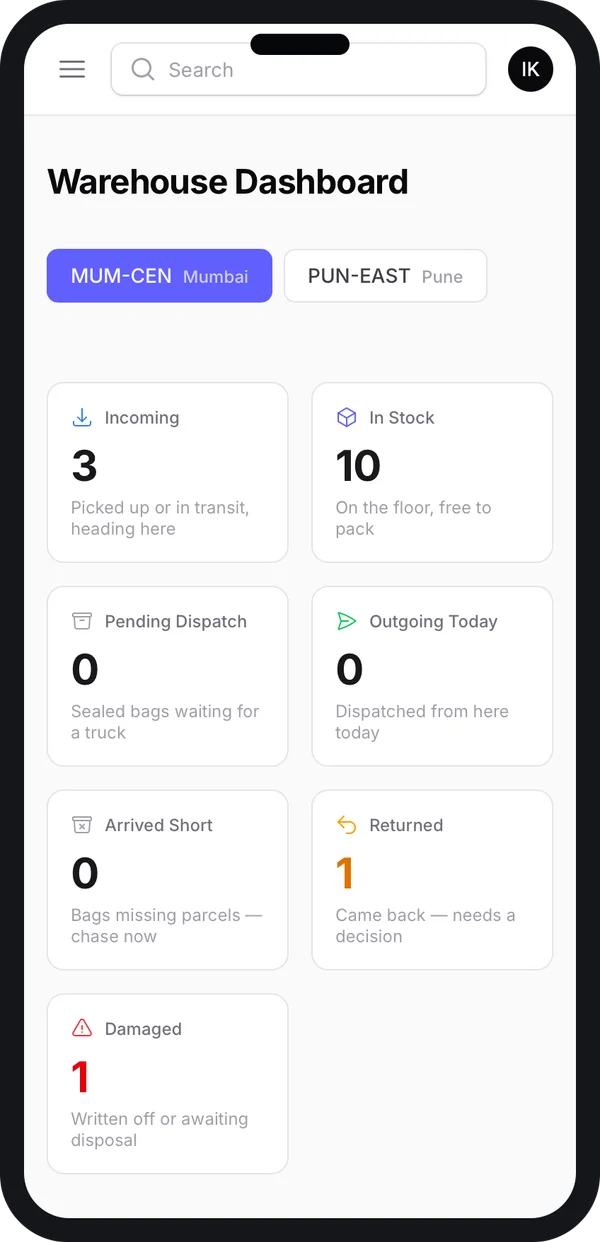
A second hub brings new questions. What is coming in? What is on the shelf? What came back? The hub dashboard also lists parcels that have not moved for three days or more.
Vehicles linked to routes
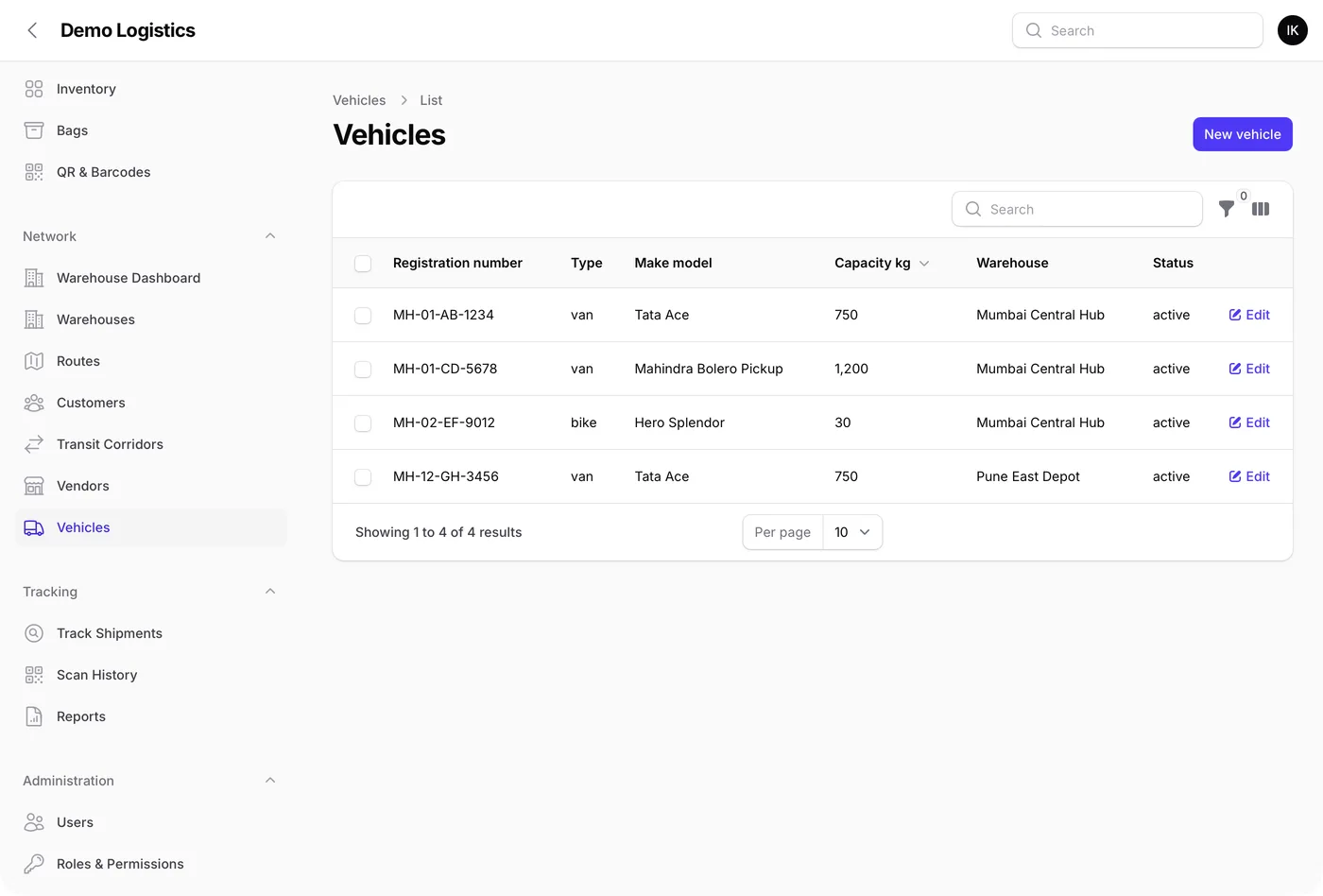
Add each bike or van with its number, type, load limit and home hub. Then the route list shows which vehicle went where on each day.
Build in phases, not all at once
| Phase | What you get | When you need it |
|---|---|---|
| Phase 1 | Parcel booking, labels, rider app, proof of delivery, cash on delivery list, tracking link | Before your first sender |
| Phase 2 | Second hub, bags, trips between hubs, return hold, reports | When you open a second hub |
| Phase 3 | Sender portal, rate card, invoices, partner logins | When senders want self-service |
This keeps your first spend small. Each phase is planned so the next one adds to it without a rebuild.
Worked example: the first three months
Here is how a two-person courier start-up might use its app. The details are examples.
- Week 1. The founders sign three local online sellers. Each seller uploads its parcel list as a CSV each morning.
- Week 2. Two riders cover twelve pincodes. Each parcel gets a photo and a one-time code at the door.
- Week 4. A seller says a parcel never arrived. The founder opens the task and shows the photo, the time and the receiver's name.
- Week 6. Cash on delivery grows. The day-end cash list shows one rider short. It is sorted the same evening.
- Week 9. Failed parcels go on a hold. Those not delivered within the hold go back to the seller with a return reason.
- Week 12. The founders open a second hub in the next town and add bags and trips to the app.
Our service
How we build your own courier app
Your process first, then screens, then code. You can see products we have built as proof.
- Understand your plan. We talk through your model, area, senders and team.
- Show clickable screens. You see the screens with your brand and change them before we write code.
- Build the apps. A rider app in Flutter for Android and iPhone, and a web admin for your office.
- Test with live parcels. Your riders use it for a few days. We fix what they find.
- Launch under your name. Your app name, your domain and your own server.
- Add the next phase. Hubs, partner logins and reports, when your parcels grow.
Courier app development cost: what decides it
We do not publish a price list. The cost depends on the phase you start with and the number of apps. It also depends on hubs, roles and the services you connect. Common ones are SMS, WhatsApp, payment links and a seller's online store. A sender portal and invoices add more screens.
| Monthly courier software plan | Your own courier app | |
|---|---|---|
| Start | Sign up and start | A few weeks to build phase 1 |
| As you grow | Fee often rises with parcels or users | No fee for each parcel |
| Brand on tracking link | Usually the vendor's | Yours |
| Your own rules | Fixed by the vendor | Built your way |
| Data and code | Stay with the vendor | Yours |
Tell us your model, area and senders, and we send a written quote after one call.
Whoever builds your courier app, make sure it can:
- Give every parcel a number and a label at booking
- Take bulk parcel lists from sellers as a CSV
- Show riders their pickups and drops on the phone
- Take a photo, signature or code at the door
- Show cash on delivery by rider, by day
- Hold failed parcels and then return them with a reason
- Give senders a tracking link with your brand
- Add hubs later without a rebuild
FAQ
How do I start a courier business in India?
Choose your model and area, then register the business. Check GST and local licences. Set up a small hub, hire riders and sign your first senders. Put parcel software in place before the first pickup.
Do I need a franchise to start a courier business?
No. A franchise is one way to start. You can also run your own brand. It takes more work, but you keep your senders and your name.
Do I need GST registration for a courier business?
It depends on your turnover and where you work. Check the GST portal and ask your CA before you send your first bill.
How long does it take to build a courier app?
It depends on the phase you start with. After one call, we share a plan with dates. Phase 1 is planned so you can start taking parcels soon.
Will I own the courier app and its source code?
Yes. It is built under your name, and you get the source code. Your parcel data sits on your own server.
Which platforms do you build for?
We build the rider app for Android and iPhone. We also build a web admin for the office and a tracking page for buyers.
Is buyer data safe in a courier app?
It should be. Names, phones and addresses are personal data under the Digital Personal Data Protection Act, 2023. We build role-based access and hide private details on the tracking page.
Can PRS India build an app for my new courier business?
Yes. We build courier apps around your model, area and team, starting with the parts you need first. Talk to our team and we will show you screens for your plan.
Related guides
Written by
Babita Kumari · Business Developer
Business Developer at PRS India. Talks with business owners about the app or software they want, and helps them work out the scope, cost and launch steps before any code is written.