Engineering
Top 5 B2B eCommerce Platforms in 2026
OroCommerce, Adobe Commerce, commercetools, Salesforce B2B Commerce and a custom build — what each is genuinely best at, and the trade-off you sign up for.

Written from production. Our articles draw on products we run live and the client work behind them, and are revised as the systems they describe evolve.
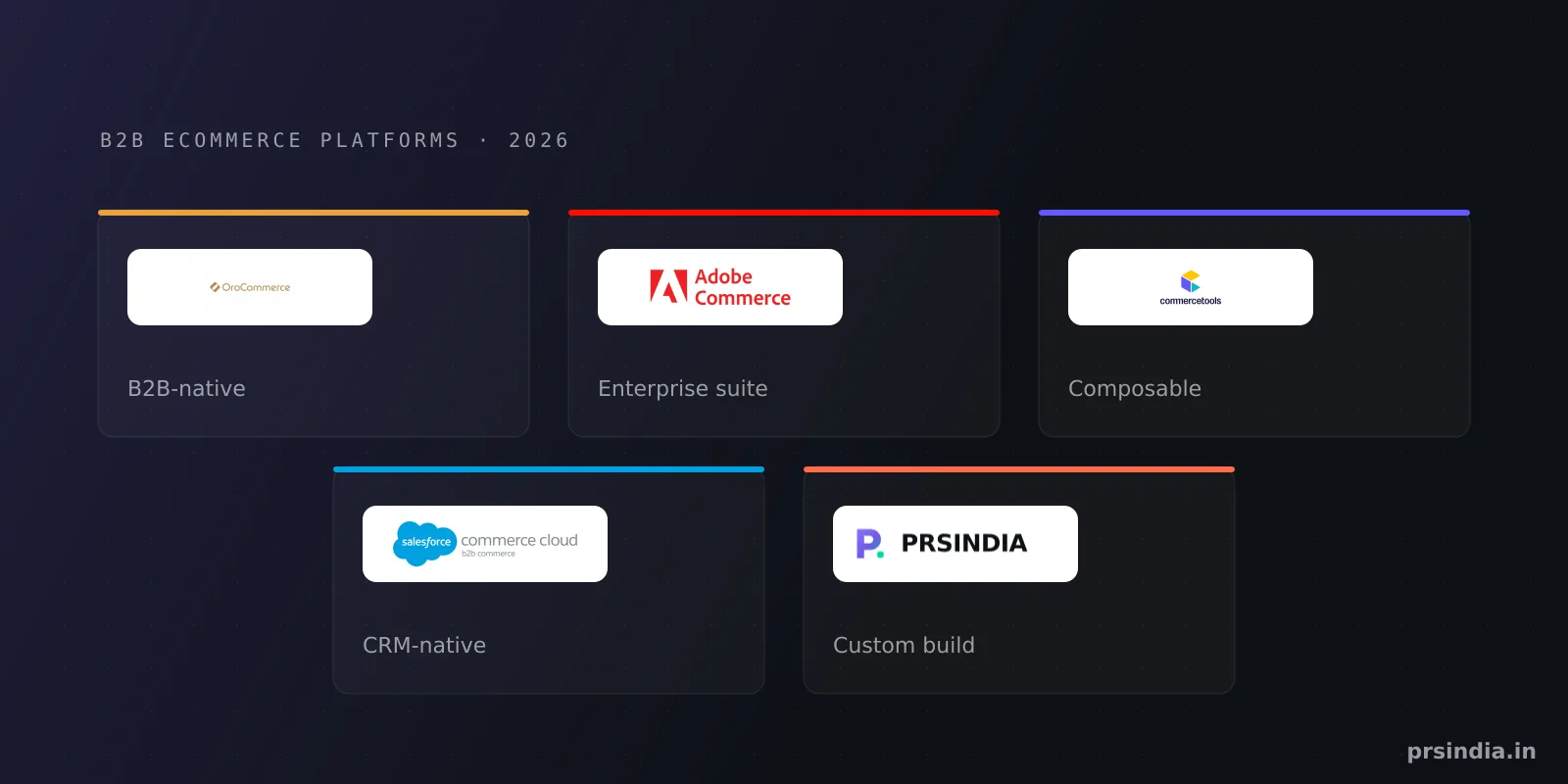
The best B2B eCommerce platform for 2026 is the one that fits your catalogue, your pricing rules and the systems you already run — and for most manufacturers, distributors and wholesalers that shortlist comes down to five: OroCommerce, Adobe Commerce, commercetools, Salesforce B2B Commerce, and a custom build.
This guide compares all five B2B eCommerce platforms on architecture, native B2B features and what really drives cost, so you can walk into a vendor call knowing which one you actually need.
A disclosure up front: PRS India publishes this guide and we are on the list — as the custom-build option, placed last, not ranked first.
We build commerce systems for a living, and we resell none of the four enterprise platforms above, so where one of them is the right answer and we are not, we say so plainly.
What this guide covers
- Why B2B commerce is not B2C commerce
- How we compared these B2B eCommerce platforms
- The comparison at a glance
- 1. OroCommerce · 2. Adobe Commerce · 3. commercetools · 4. Salesforce B2B Commerce · 5. PRS India B2B Commerce
- Which one should you choose?
- Implementation checklist before you sign
- Frequently asked questions
Why B2B commerce is not B2C commerce
A B2B storefront that behaves like a consumer shop fails on contact with a real buyer. Five differences drive everything else on this page.
- Pricing is per-customer, not per-product. The same SKU sells at a different price to every account, governed by contracts, volume tiers and negotiated rates. A price tag is an output of who is logged in, not a fixed field.
- The buyer is a committee, not a person. A purchaser builds the order, a manager approves it, finance pays on terms. The platform has to model organisations, roles and approval workflows, not just a single shopper with a card.
- Orders are large, repetitive and structured. Buyers reorder hundreds of lines, upload CSVs, work from requisition lists and often push a purchase order through punchout or EDI from their own procurement system.
- The back office is the hard part. Real-time stock across warehouses, credit limits, GST-correct invoicing and a clean handshake with the ERP matter more than the hero banner. The costly failures land after the order rather than at the "buy" button — a quantity the ERP does not agree with, or an invoice the buyer's finance team sends back.
- Self-service is now expected. Gartner found that 61% of B2B buyers prefer a rep-free buying experience (Gartner, 2025), and McKinsey reports that eCommerce is now the single largest B2B revenue channel, at roughly a third of sales (McKinsey B2B Pulse, 2024). The digital channel is no longer a catalogue — it is where the deal closes.
For an Indian or Gulf audience the prize is concrete: global B2B eCommerce is measured in the tens of trillions of dollars of transaction value, Asia Pacific holds the largest regional share, and India's B2B online marketplace opportunity is estimated at about US$200 billion by 2030 (IBEF, 2025).
How we compared these B2B eCommerce platforms
Eight criteria separate these five better than any feature checklist. We use the same eight in the table and in every section below.
- Architecture — monolith, composable/MACH, CRM-native, or bespoke.
- Storefront model — a built-in storefront, or headless where you build the front end.
- Native B2B depth — account hierarchies, quotes/RFQ, contract and tiered pricing, requisition lists and approval workflows, as first-class features rather than plugins.
- Punchout / EDI — native, or via a connector, for procurement-led buyers.
- ERP / CRM / PIM integration — native CRM, an iPaaS, a connector marketplace, or custom.
- Licensing and pricing model — open source, quote-based licence, or a percentage of GMV.
- Implementation effort — realistic timeline and the team skills required.
- Best-fit profile and TCO — company size, catalogue complexity and what drives total cost.
The comparison at a glance
| Criteria | OroCommerce | Adobe Commerce | commercetools | Salesforce B2B | PRS India |
|---|---|---|---|---|---|
| Architecture | Open-source modular monolith (Symfony/PHP), API-first | Monolithic core (Magento), API-first, headless options | Composable, API-first, headless (MACH) SaaS | Built on Salesforce CRM platform | Bespoke — headless Next.js over a Laravel core |
| Storefront | Built-in B2B store + headless option | Built-in + PWA / Edge Delivery headless | None out of the box — you build it | LWR / Experience Builder store | Custom-built per client |
| Native B2B depth | Deep — B2B-first by design | Deep — company accounts, quotes, shared catalogs | Deep — Business Units, Quotes, approval rules | Solid — buyer groups, price books, reorder | Built to spec — contract pricing native in a custom core |
| Punchout / EDI | Connector | Connector | Connector | Connector | Custom if required |
| ERP / CRM / PIM | Native OroCRM; ERP connectors; Akeneo PIM | Adobe Experience Cloud; App Builder | Connect marketplace; no built-in PIM | Native Salesforce CRM; MuleSoft for ERP | Direct API to your ERP / Tally / OMS |
| Pricing model | Community free; Enterprise quote-based | Open Source free; Adobe Commerce quote-based | Subscription, quote-based | 1% (Growth) / 2% (Advanced) of GMV / year | Fixed-scope project or retainer; you own the code |
| Implementation | ~6–12+ months; Symfony engineers | ~4–12+ months; certified developers | ~6–12+ months; strong dev team + front end | ~4–9 months; Salesforce devs + SI | ~6–8 wks (Shopify) to 14–20 wks (custom core) |
| Best fit | Mid-to-large distributors with tech resources | Mid-market to enterprise, B2B + B2C | Large / global, composable-ready | Firms already on Salesforce | Mid-market wanting a build they own |
Timeline and cost figures are indicative; only Salesforce publishes a pricing figure. See each section for sources and caveats.
1. OroCommerce

Overview. OroCommerce is an open-source, B2B-first platform built by Oro, Inc. for manufacturers, distributors and wholesalers.
It was designed for B2B from the ground up rather than adapted from a consumer cart, and it ships alongside a bundled CRM (OroCRM) and a separate marketplace product (OroMarketplace).
Standout B2B capabilities.
- Corporate account hierarchies with granular roles and permissions.
- Native RFQ and quote management, with quote-to-order in one step.
- Tiered and per-customer price lists, plus scheduled price changes.
- Shopping lists (the requisition-list equivalent) and multi-tier order approvals.
Architecture & integrations. A modular monolith on Symfony/PHP with a single database — API-first (JSON:API) with a headless/PWA option, but not microservices.
ERP connectors and guidance exist for the usual distribution stack (Epicor, SAP Business One, NetSuite, Dynamics), an official Akeneo PIM connector, and native OroCRM. Multi-warehouse inventory is an Enterprise-edition feature.
Pricing model. The Community Edition is free and open source. The Enterprise Edition is commercial and quote-based — you contact sales; Oro says licensing aligns to GMV bands, with no per-site, per-API or per-transaction fee. No dollar figures are published.
Best for. Mid-to-large distributors and manufacturers with genuinely complex, multi-entity B2B requirements and in-house or partner engineers to run a Symfony application.
Watch out for. It is developer-heavy — even small changes need Symfony skills, so it is overkill for simpler operations. Implementations run long, and the ERP integration is repeatedly the item that stretches the timeline and the total cost of ownership.
Official site: oroinc.com/b2b-ecommerce
2. Adobe Commerce

Overview. Adobe Commerce is the paid, supported edition of the Magento platform; Magento Open Source is the free, self-hosted core that shares the same engine.
Adobe renamed Magento Commerce to Adobe Commerce, so that is the correct current name. Adobe positions it as one platform for running B2B and B2C, multiple brands and multiple markets together.
Standout B2B capabilities.
- Company accounts with buyer roles and an org hierarchy.
- Negotiable quotes — buyers raise a request-for-quote from the cart.
- Shared catalogs with per-company pricing tiers.
- Requisition lists, purchase-order approval rules and multi-source (multi-warehouse) inventory.
Architecture & integrations. A monolithic Magento core, extensible via modules and Adobe App Builder, with a GraphQL layer for headless builds; front-end options are PWA Studio and the newer Edge Delivery Services storefront.
It sits inside Adobe Experience Cloud, and partner connectors link it to ERP (Dynamics, SAP), CRM and PIM.
Pricing model. Adobe Commerce is a paid licence, quote-based with no public price list, tiered on GMV and average order value. Magento Open Source is free. No dollar figures are published by Adobe.
Best for. Mid-market to enterprise merchants running B2B and B2C at scale, especially multi-brand or global operations that want deep catalogue and promotion flexibility.
Watch out for. Total cost of ownership is high — the licence is only part of it once you add hosting, integrations, certified developers and maintenance. Implementations are complex, and Adobe's shift toward Edge Delivery Services adds front-end churn for teams currently on PWA Studio.
Official site: business.adobe.com/products/magento
3. commercetools

Overview. commercetools (always lowercase) is an enterprise, API-first commerce engine delivered as SaaS and built on MACH — microservices, API-first, cloud-native, headless. It is a founding member of the MACH Alliance (2020).
In practice it gives you catalogue, cart, order, pricing and inventory APIs, and you compose the front end and the rest of the stack yourself.
Standout B2B capabilities.
- Business Units to model account hierarchies (companies and divisions) with role-based permissions.
- A native Quotes flow (request → staged quote → binding quote) with an audit trail.
- Tiered, volume-based and business-unit-specific pricing.
- Approval rules and multi-warehouse inventory by supply channel.
Architecture & integrations. Fully headless and composable. Integrations run through commercetools Connect and its connector marketplace; there is no built-in PIM, so you integrate a best-of-breed one (Akeneo, Contentserv). It reports 600+ enterprise customers across 60+ countries.
Pricing model. Subscription, quote-based, scaled to your revenue and usage. No public price list, and no figure is stated here.
Best for. Large or global enterprises with complex catalogues, high order volumes and the engineering maturity to run a composable stack across multiple markets.
Watch out for. There is no storefront out of the box — you build the front end from the APIs, which is real, ongoing development effort.
It needs an experienced team, and without architecture governance the flexibility "can turn into fragmentation and higher delivery costs." Licensing is revenue-scaled and not cheap.
Official site: commercetools.com
4. Salesforce B2B Commerce

Overview. Salesforce B2B Commerce is CRM-native commerce: a storefront that runs on the same Salesforce platform and data model as Sales and Service Cloud, so accounts, contacts, orders and price books are shared with your CRM.
The current product is B2B Commerce on Core (Lightning); the older CloudCraze/Classic package is being retired.
Standout B2B capabilities.
- Account hierarchies via native Accounts plus commerce Buyer Groups.
- Request-for-quote in the store (full configure-price-quote is the separate Salesforce CPQ product).
- Standard, custom and buyer-group price books with tiered pricing and entitlements.
- Fast reordering and multiple inventory locations.
Architecture & integrations. Built on the Salesforce Lightning Platform, with LWR storefront templates and a headless option via the Commerce API.
Its defining strength is that no CRM sync is needed — commerce and CRM are one system. ERP, PIM and OMS integration is done through MuleSoft; Data Cloud is bundled for unified data.
Pricing model. The one platform here that publishes a figure: 1% of GMV per year for B2B Commerce Growth and 2% of GMV for Advanced, on an annual contract, with dollar amounts quoted per deal. Implementation and add-ons are extra.
Best for. Manufacturers and distributors already invested in the Salesforce estate, where sharing the CRM data model is the whole point.
Watch out for. The percentage-of-GMV model is effectively a success tax — as revenue grows, so does the bill, on top of six-figure implementation and a success plan, which makes long-term TCO hard to forecast.
It is complex, needs scarce Salesforce specialists, and ties you tightly to the Salesforce ecosystem.
Official site: salesforce.com/commerce/b2b
5. PRS India B2B Commerce

Overview. This is our own offering, and here is the honest version. PRS India is a senior software development company in New Delhi; we do not sell a productised B2B platform.
We build bespoke commerce systems — typically a headless Next.js storefront over a Laravel commerce core, or Shopify Plus where that genuinely fits — for mid-market manufacturers, distributors and wholesalers who want a system shaped around their own pricing and operations, and owned outright.
We are the custom-build alternative to the four platforms above — the option to weigh when none of them fits your pricing model, not a substitute for one that does.
Standout B2B capabilities.
- Contract-based and tiered B2B pricing built natively into a custom core — no plugin gymnastics.
- One stock pool across marketplace, D2C and POS with reservation logic, so you do not oversell.
- GST-correct invoicing: HSN, place of supply, e-invoice IRN and e-way bills, credit notes matched for GSTR-1.
- Subscription, rental and made-to-order models, and ONDC participation, when the model needs them.
Architecture & integrations. Bespoke per client — Laravel, Next.js, and Medusa where composable makes sense. We integrate directly with whatever you already run: your ERP, an OMS such as Unicommerce, Tally or Zoho Books, and Indian payment rails (Razorpay, PhonePe, Cashfree) with server-verified webhooks.
If you specifically need Adobe Commerce or commercetools, we will tell you and point you to specialists — we do not resell them.
Pricing model. A fixed-scope project or a support retainer, not a licence. You own the repository, the cloud account and the code, with no fee on your GMV. The Shopify-to-custom crossover usually arrives somewhere around ₹15–25 crore of annual GMV.
Best for. Budget-conscious Indian and Gulf mid-market businesses whose pricing logic "will never fit into somebody else's data model," and who want to own what they build.
Watch out for. A bespoke build is not a productised platform — there is no vendor roadmap, app marketplace or analyst coverage, and you depend on your engineering partner or in-house team for the feature set and its upkeep.
And we are a software development company, not a global enterprise vendor with 24/7 tiered support SLAs.
Our commerce engineering: prsindia.in/services/ecommerce-development
Which B2B eCommerce platform should you choose?
Match the platform to your situation rather than to a leaderboard.
- Large SKU catalogue with complex, contract-based pricing, and a team that can run it: OroCommerce is the B2B-native default, especially for distributors who want a bundled CRM and don't mind a Symfony stack.
- A heavy Adobe or Salesforce estate already in the building: lean toward Adobe Commerce or Salesforce B2B Commerce respectively — the value is the integration you already own, provided you can carry the licence and implementation cost.
- API-first, multi-market, with real engineering maturity: commercetools, if you have (or will hire) the team to build and govern a composable front end and stack.
- Budget-constrained mid-market that wants a system tailored to its pricing and owned outright: a custom build — the option we build at PRS India — and Shopify Plus if your catalogue and pricing are straightforward and speed matters most.
Those two inputs — the systems you already own and the pricing you actually run — clash more often than a simple decision tree admits. When they do, choose before you draw up the shortlist. Either bend your pricing to fit the platform you already pay for. Or run your store beside those systems and connect it back to them. No vendor on this page will make that choice for you. Yet it decides how much of the budget goes on integration instead of features.
Implementation checklist before you sign
- Map your pricing rules first. Write down every contract, tier and exception before a demo — this is what separates the shortlist.
- Pin down the ERP integration. Name the system, the sync direction and the fields; it is the usual source of overruns. See our ERP integration work.
- Get pricing in writing, including growth. Ask what the bill looks like at 2× and 5× GMV, and what every add-on costs.
- Confirm punchout / EDI up front if procurement-led buyers need it — none of the five has it built in. The four platforms need a connector, and a custom build has to write it. Scope it in either way.
- Insist on a realistic timeline with something demonstrable every few weeks, not a single launch date months away.
- Check who owns the code and data, and how you would exit — licence, hosting and lock-in included.
- Name who runs it after launch. Every option on this page assumes somebody maintains it — an in-house engineer, your implementation partner, or an SI on retainer. Decide which, and cost it, before you sign: it is the line a licence quote never shows.
- Plan the SEO-safe migration: URL mapping and 301s shipped with launch, not as a follow-up ticket.
Frequently asked questions
What is a B2B eCommerce platform?
Software that lets a business sell to other businesses online, with the features B2B buying needs: account hierarchies, negotiated and tiered pricing, quotes, requisition lists, approval workflows and integration with the seller's ERP.
It differs from a B2C store, where price is fixed and the buyer is a single consumer.
Which is the best B2B eCommerce platform in India?
There is no single best B2B eCommerce platform — it depends on catalogue size, pricing complexity, your existing systems and budget.
Indian distributors with complex pricing often shortlist OroCommerce or a custom build with GST-correct invoicing and ONDC support; those already on Salesforce or Adobe usually extend what they own.
OroCommerce vs Adobe Commerce — which is better for B2B?
OroCommerce is B2B-native and open source, so more B2B features are on by default and the Community Edition is free.
Adobe Commerce is broader — strong at combined B2B and B2C, multi-brand and multi-market — but the licence and implementation cost more. Choose Oro for pure B2B distribution; choose Adobe when you also run a large B2C business.
How much does a B2B eCommerce platform cost?
Only Salesforce publishes a figure — 1% of GMV per year (Growth) or 2% (Advanced). OroCommerce Enterprise, Adobe Commerce and commercetools are all quote-based ("contact sales"). Across all of them the licence is a minority of total cost; implementation, integration, hosting and maintenance usually dominate.
What is composable (MACH) B2B commerce?
A composable, or MACH, approach (microservices, API-first, cloud-native, headless) assembles commerce from independent, API-connected services rather than one monolith — so you can swap the front end, search or payments independently. commercetools is the example here. It offers maximum flexibility in exchange for needing a strong engineering team.
Should I buy a platform or build a custom B2B eCommerce site?
Buy when your requirements match a platform's out-of-the-box B2B features and you want a vendor roadmap and support.
Build when your pricing or operating model won't fit someone else's data model, you want to avoid per-GMV fees, or you need to own the code — the trade-off is that you rely on your engineering team for the feature set and its upkeep.
Talk to a team with no stake in which one you pick
We take no commission from any vendor on this list, and we are the fifth option on it. If you are replatforming, we will help you shortlist honestly, or build the custom alternative if that is the right call. See our commerce work or talk to our engineers.
Written by
PRS Admin
Building software at PRS India.