Product
Top 5 Best Open-Source Influencer Platforms (2026)
Most influencer platforms are SaaS you rent forever. Here are the 5 best open-source ones you can self-host, rebrand and own — plus how to build your own.

Written from production. Our articles draw on products we run live and the client work behind them, and are revised as the systems they describe evolve.
"Influencer platform" means two very different things. To a brand, it is a SaaS influencer marketing tool — Upfluence, GRIN, Aspire — that you rent by the month to find and manage creators.
To a founder, it is something else entirely: the app creators actually live on, a social platform you own and operate, your own TikTok, Instagram Reels or YouTube for a niche, a region or a community.
This guide is about the second kind — and specifically about the open-source influencer platforms you can self-host, rebrand and launch as your own. Why open source? Because the alternative is renting forever: a bill that never stops, a codebase you can never touch, and your community living on someone else’s servers.
Below are the five best options in 2026, a look at how they compare to the SaaS incumbents, and a guide to building your own.
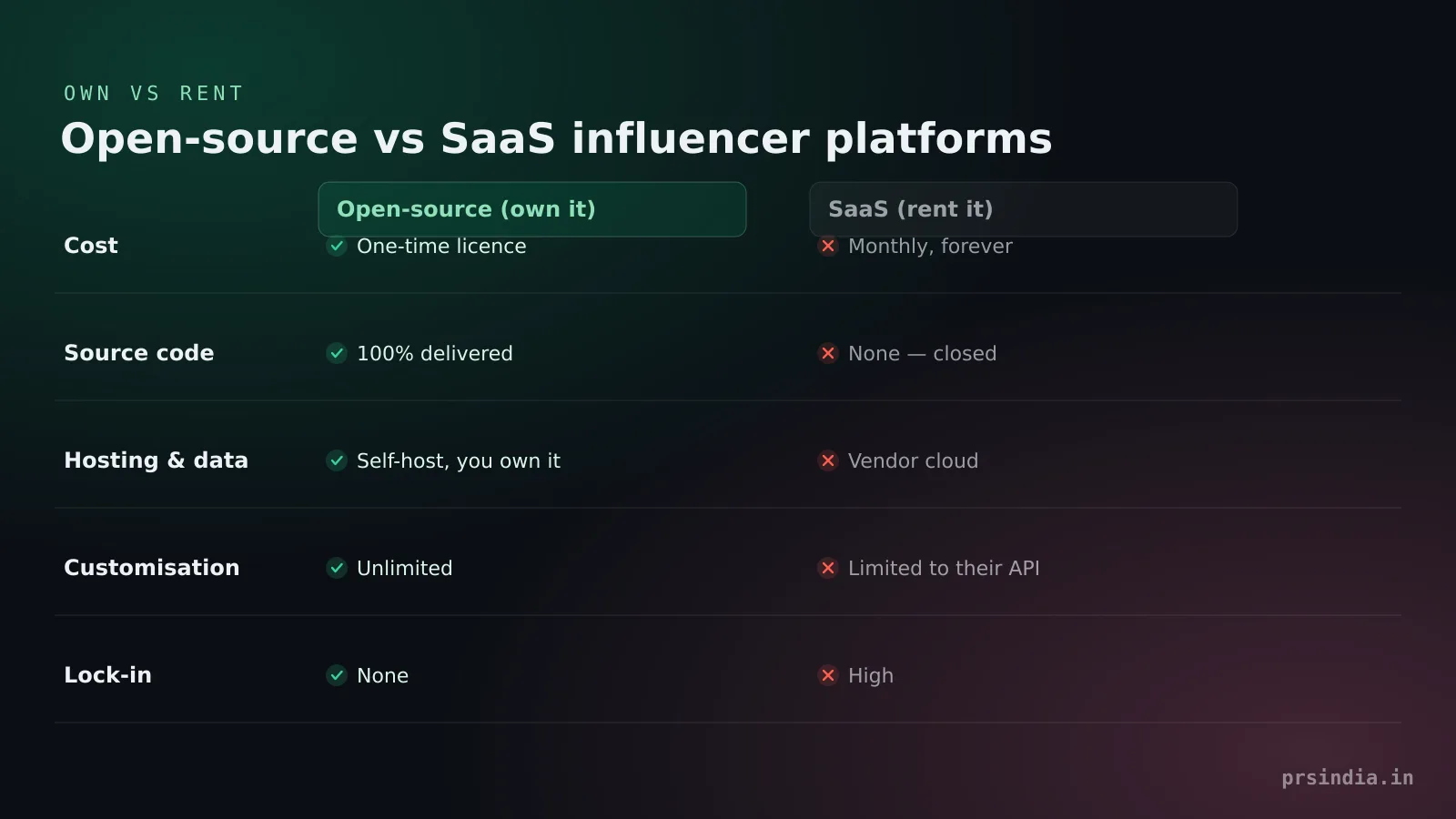 Own vs rent: what actually changes when you self-host an open-source platform instead of renting SaaS.
Open-source vs SaaS: why owning beats renting
The SaaS influencer platforms are genuinely good at what they do — creator discovery, outreach, campaign tracking, payments to influencers. But they are tools a brand uses, not a platform a business owns.
You pay every month, you get none of the code, your data sits in their cloud, and you can only customise as far as their API allows. The day you stop paying, it all disappears.
An open-source platform inverts that trade:
Cost. One-time instead of recurring.
Source code. Delivered in full, so any feature you can imagine is on the table.
Data and audience. You self-host, so the data — and the audience — is yours.
Vendor lock-in. There is none, because there is no vendor.
For anyone building a creator business rather than running a single campaign, that ownership is the entire point.
The 5 best open-source influencer platforms in 2026
These are the strongest open-source and self-hostable platforms for building a creator or influencer community today, ranked by how close they get you to a real, launch-ready product.
That is the only test used. The order shows how much finished product you get on day one. It does not rank code quality, popularity or age. Several entries below cover one layer of a creator platform, not the whole thing. So ask which layer your product is really about.
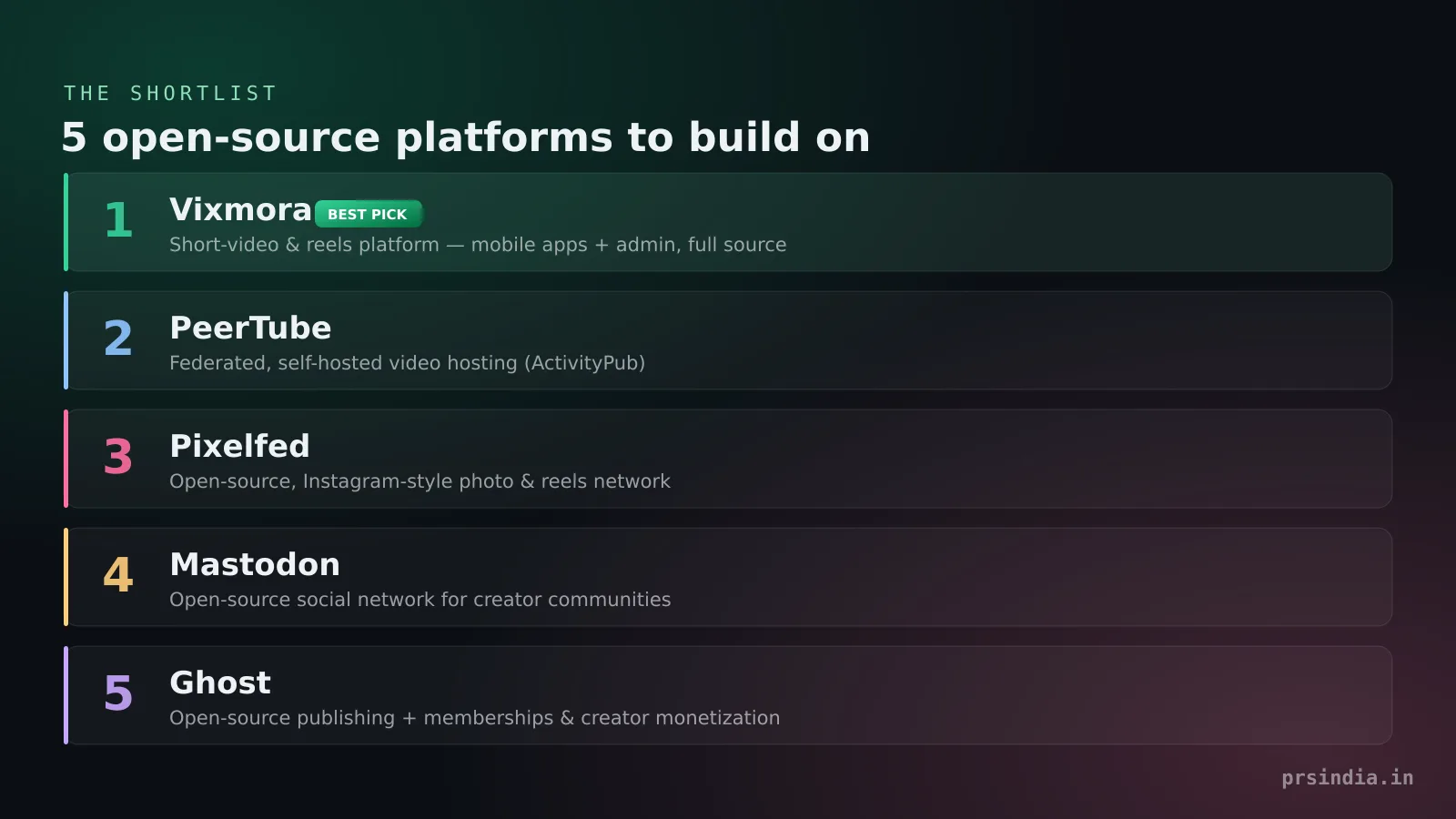 The shortlist — five open-source platforms you can build a creator business on.
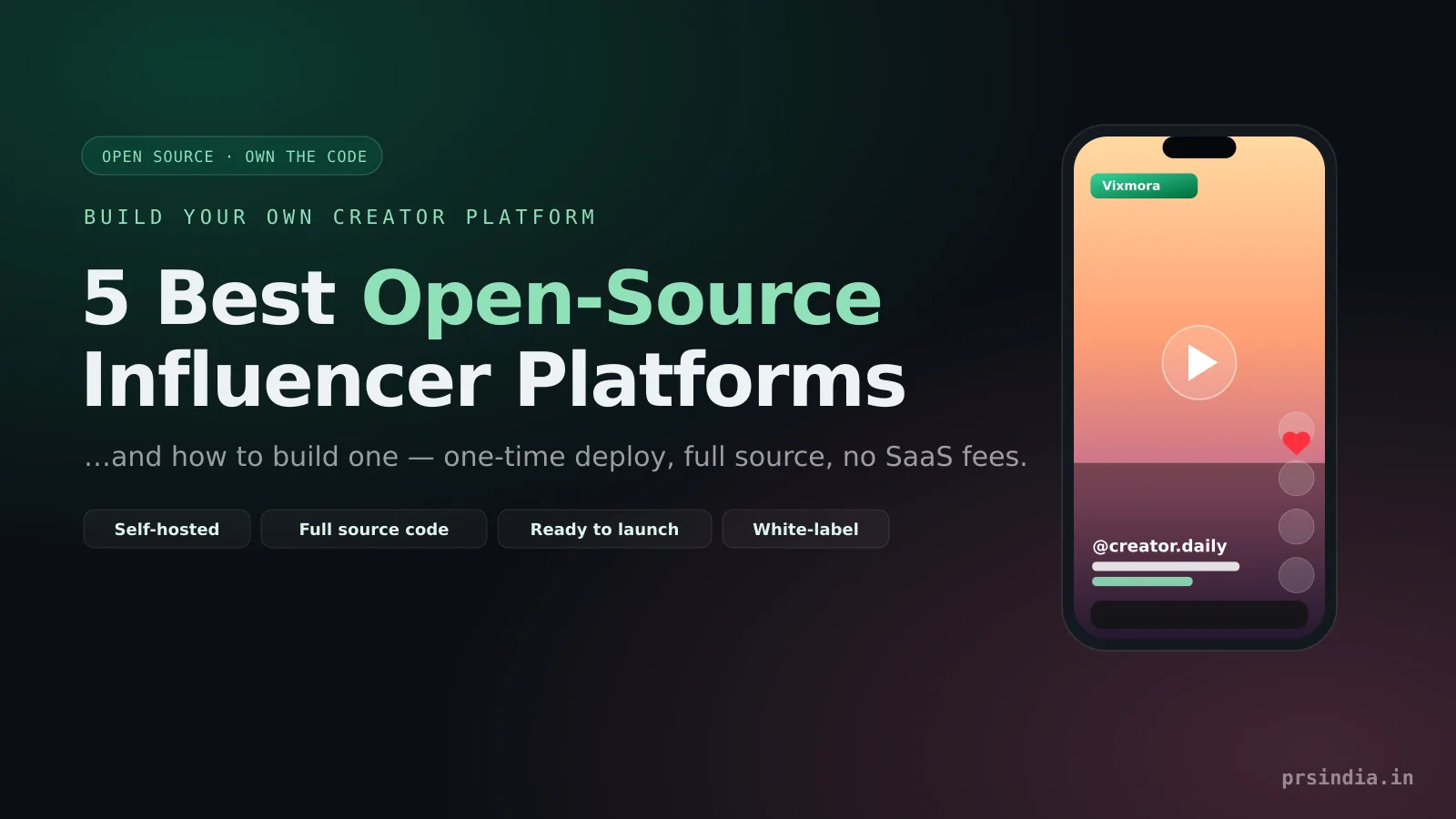
1. Vixmora — best for launching your own short-video & reels app
Vixmora is the most complete option if your goal is to launch a real short-video and reels platform — your own TikTok alternative — rather than assemble one.
It ships as full source code: the iOS and Android client apps for creators and viewers, a web admin panel and a self-hosted video pipeline, to build and deploy yourself.
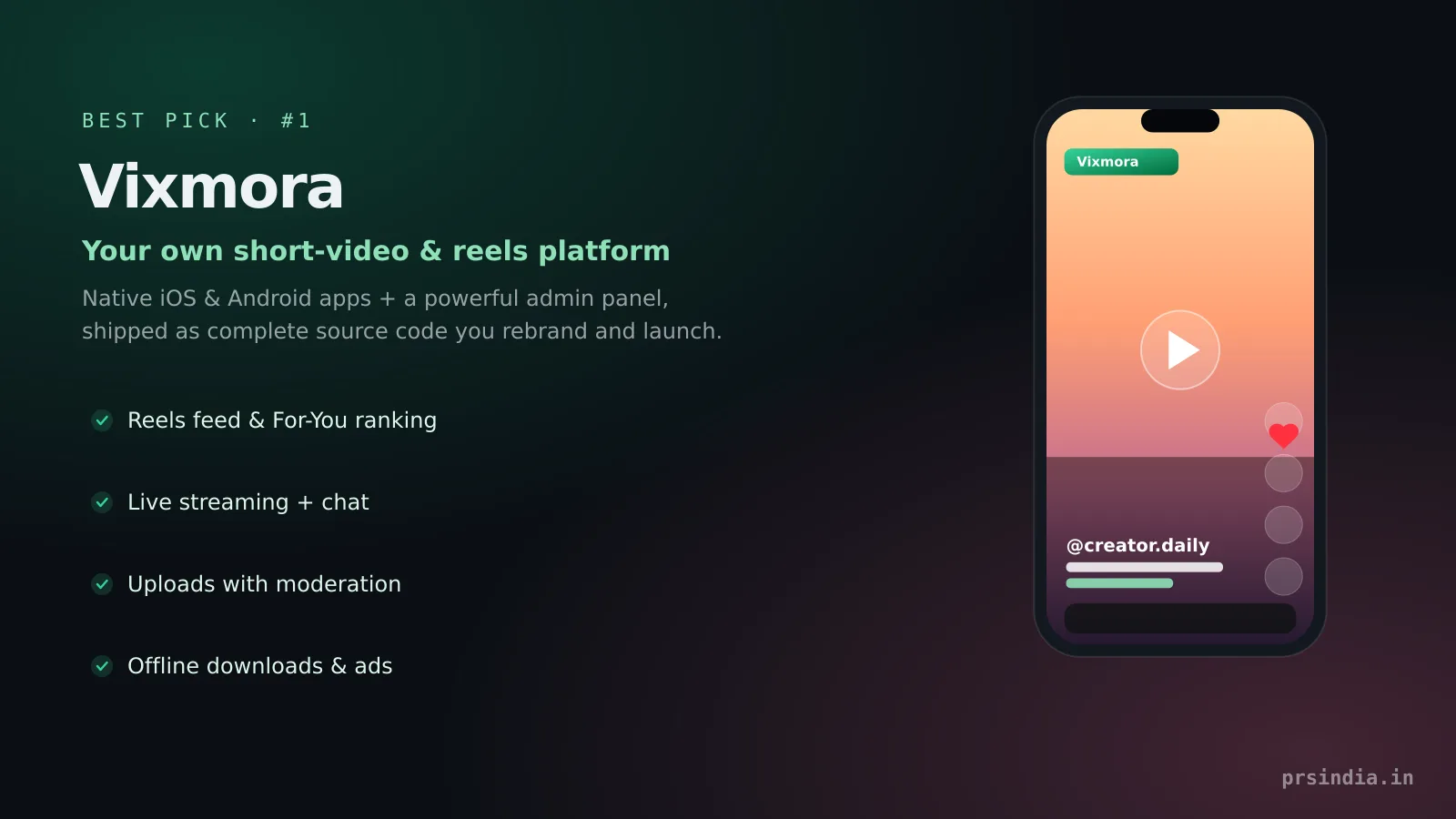 Vixmora — a reels platform delivered as complete, rebrandable source code.
The features creators expect are part of the codebase:
Reels feed. A vertical feed with a For-You ranking model.
Live streaming. Real-time chat and reactions.
Uploads. Three-step uploads with a moderation review queue.
Profiles & discovery. Creator profiles, discovery and hashtags.
Offline downloads.
Ad system. A built-in three-format ad system.
Because you get the whole codebase, it is white-label by design — change the name, colours and logo and deploy it as your own.
It is built to demo stage: the apps exist as demo builds, neither is published to an app store, and the infrastructure it runs on is yours to stand up. See the full Vixmora platform breakdown.
Best for: launching a branded TikTok/Reels-style app with mobile + admin.
Stack: React Native (Expo), NestJS API, Next.js admin, self-hosted HLS video pipeline.
Model: one-time source licence — no monthly fees, no per-view costs.
2. PeerTube — federated, self-hosted video
PeerTube is a free, open-source, decentralised video platform built on ActivityPub, the same protocol behind the Fediverse.
You run your own instance, own your library, and can federate with other instances so videos and audiences flow between them, with peer-to-peer streaming to keep bandwidth costs down. It is the natural open-source answer to "a self-hosted YouTube."
Best for: a web-first, creator-owned video community without a central gatekeeper.
Trade-off: web platform, not a native mobile app product — you build the audience experience around it.
3. Pixelfed — the open-source Instagram
Pixelfed is a free, open-source photo- and reel-sharing network — an ethical, ad-free Instagram alternative that also federates over ActivityPub. It brings the familiar grid, stories and short-video formats to a platform you can self-host and moderate on your own terms.
Best for: an image- and short-video-led creator community with a familiar, Instagram-like feel.
Trade-off: photo-first heritage; heavier video and monetization features need extending.
4. Mastodon — the open-source social network
Mastodon is the best-known open-source social network — self-hosted, federated microblogging where creators build a following on servers they (or you) control. It is less a video platform and more the connective tissue of a creator community: conversation, following and reach, without an algorithm optimising against you.
Best for: the community and conversation layer around your creators.
Trade-off: text/microblog-first; not a short-video product on its own.
5. Ghost — creator publishing & memberships
Ghost is a fast, open-source publishing platform with native memberships and subscriptions — so creators can publish and get paid directly, no platform taking a cut. If your influencer platform is built around long-form content, newsletters and paid memberships rather than short video, Ghost is a strong open-source foundation for creator monetization.
Best for: creator monetization via memberships, newsletters and paid content.
Trade-off: publishing-first; not a social feed or video app.
What about the SaaS influencer platforms?
For completeness, here are the SaaS platforms most brands compare — the "rent it" side of the market. They are excellent at influencer discovery and campaign management, but none of them give you the software, and every one of them bills monthly.
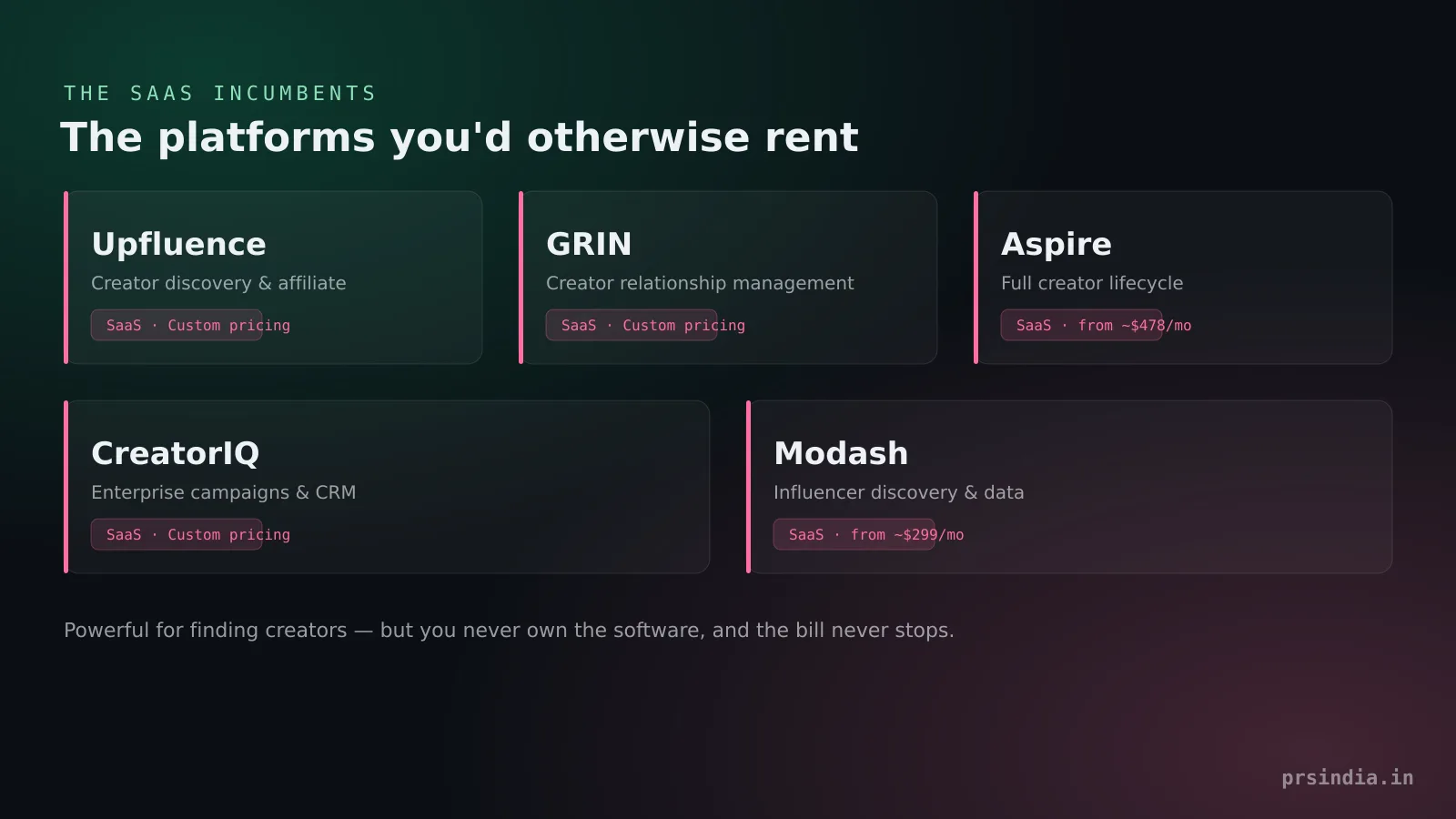 The SaaS incumbents — powerful for finding creators, but you never own the software.
Upfluence — creator discovery and affiliate marketing for e-commerce; custom pricing.
GRIN — creator relationship management for DTC brands; custom pricing.
Aspire — the full creator lifecycle from discovery to long-term partnerships; from roughly $478/month.
CreatorIQ — enterprise campaign management and CRM for large teams; custom pricing.
Modash — influencer discovery and analytics across Instagram, TikTok and YouTube; from roughly $299/month.
These are the right tool if your job is to run campaigns with influencers. They are the wrong tool if your goal is to be the platform influencers post on — that is what the open-source options above are for.
A business that owns its platform may still rent a discovery tool to find the creators it wants posting there in the first place. What it should not do is mistake a campaign tool for the product.
The real cost: SaaS fees vs owning it
The headline difference is money over time. A SaaS platform at a few hundred to a few thousand dollars a month is a line item that grows with you and never ends.
A one-time open-source licence is a fixed, upfront cost you never pay again — after which nobody takes a cut of what your platform earns.
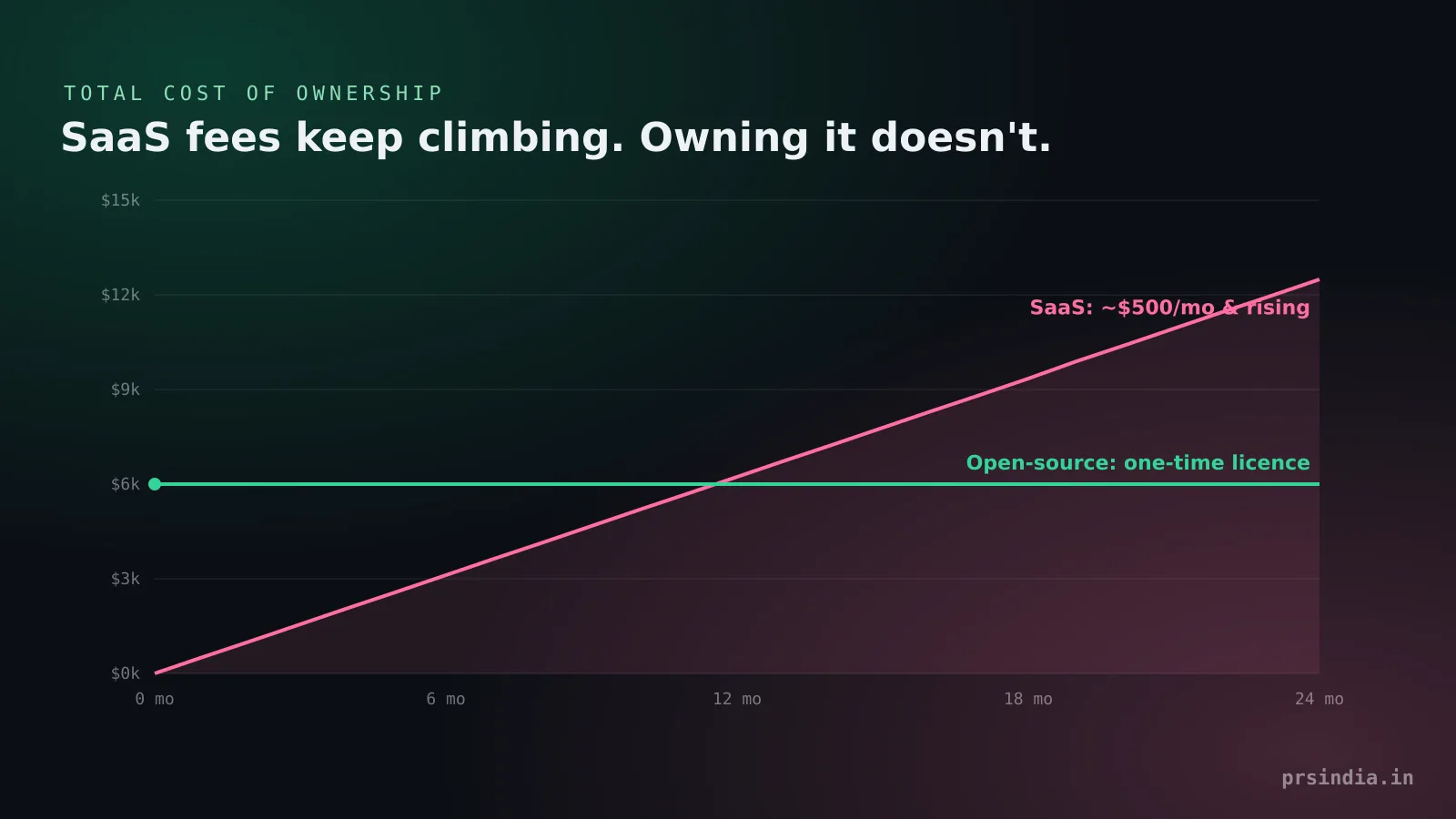 Total cost of ownership: recurring SaaS fees overtake a one-time licence within a year or two.
Within a year or two, the recurring SaaS spend quietly overtakes what a complete, owned codebase would have cost you once — and unlike the subscription, the code is an asset you keep.
Owning it does not make the running costs vanish, though — it moves them. The servers, the storage and the bandwidth a video platform eats are yours now, as is the time someone spends on upgrades, moderation and the call that comes when the feed stops loading. The comparison is only honest if you count those in. It still lands in favour of owning, but for a better reason than the headline number: these are costs you can size, optimise and actually control, rather than a price set on someone else's terms.
How to build your own influencer platform
If none of the off-the-shelf options fit exactly, building your own is more approachable than it looks — provided you respect the architecture. Every creator platform, from TikTok down, is the same handful of moving parts:
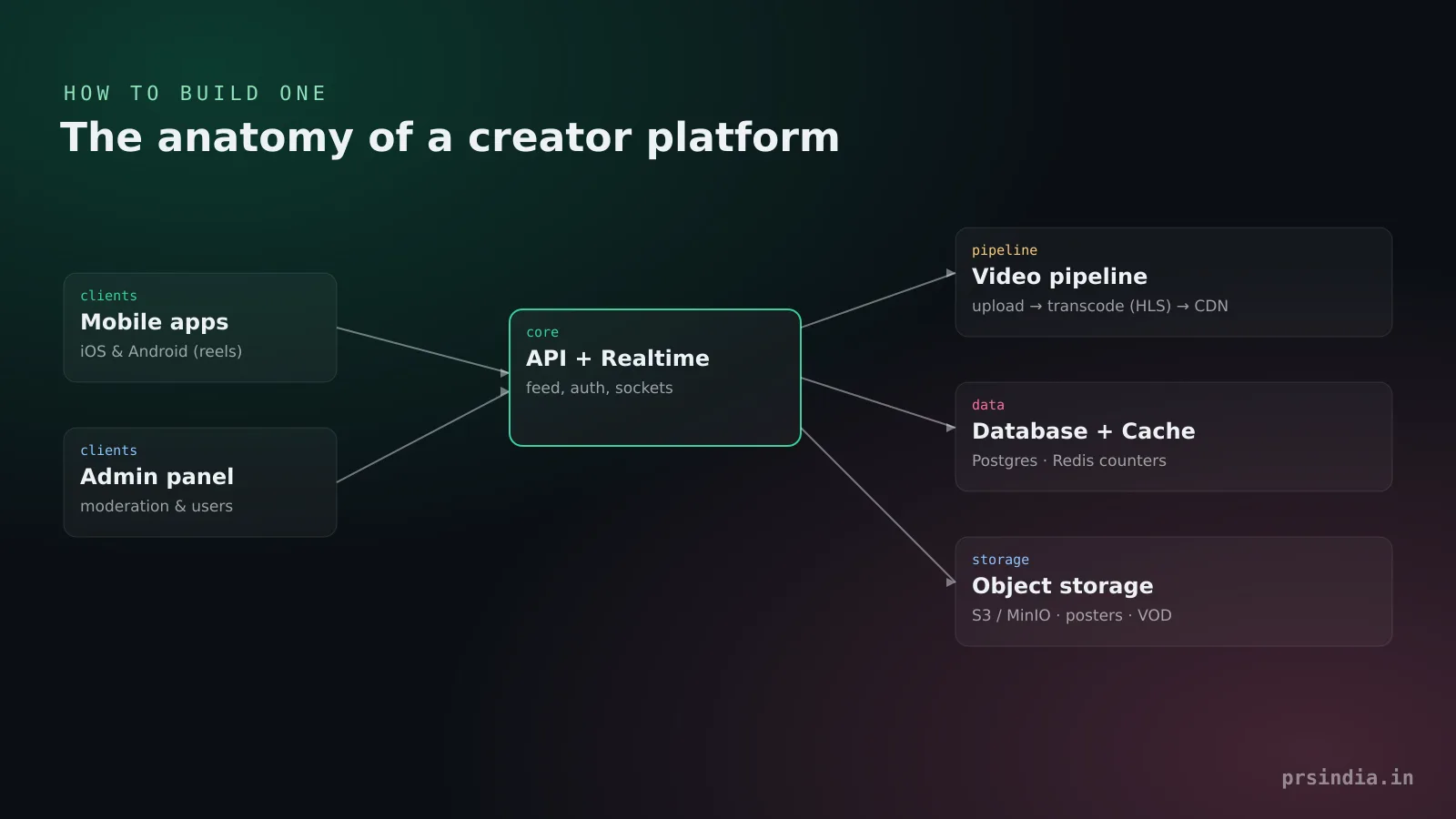 The anatomy of a creator platform — the pieces every influencer app needs.
Client apps. Native iOS and Android apps for the reels feed, plus a web admin panel for moderation and operations.
API & realtime layer. Auth, the feed and ranking, and WebSockets for live chat, notifications and viewer counts.
Video pipeline. Direct-to-storage uploads, transcoding to an adaptive HLS ladder, and edge/CDN delivery — the part most teams underestimate.
Data & cache. A relational database as the source of truth, with a fast cache for feeds, counters and live state so a viral video never stalls the site.
Object storage. S3 or MinIO for raw uploads, transcoded renditions, posters and recordings.
Moderation & monetization. Automated pre-publish checks, a report/review queue, and an ad or subscription system — the things that make it a business, not a demo.
Get those six right and you have a real platform. Get any one wrong — especially the video pipeline or the caching layer — and it falls over the moment it succeeds.
The shortcut: start from Vixmora
Building all six layers from scratch is nine to twelve months of engineering before your first creator uploads a video. Starting from an open-source platform that already has them is the difference between launching this quarter and launching next year.
Vixmora gives you the entire stack above — mobile apps, admin panel, API and self-hosted video pipeline — as complete, rebrandable source code with a one-time licence.
If you want a short-video or reels platform launched under your own brand, that is exactly the kind of build we do. Explore the Vixmora platform, or talk to our engineers about launching your own influencer platform.
Frequently asked questions
What is an open-source influencer platform?
It is a social or creator platform — a short-video app, a video host, a community network — whose source code is open and self-hostable, so you can run it on your own servers, customise it freely and rebrand it as your own, instead of renting a closed SaaS product.
Is an open-source platform cheaper than a SaaS influencer platform?
Over a long enough period, usually yes. SaaS platforms charge every month indefinitely, while an open-source platform is a one-time cost plus your own hosting. The recurring fees typically overtake a one-time licence within the first year or two, after which owning it costs less.
Can I build my own TikTok or Instagram alternative?
Yes. A creator platform is a well-understood architecture — client apps, an API and realtime layer, a video pipeline, a database with a cache, and object storage. The fastest route is to start from a complete open-source platform like Vixmora rather than building all of it from scratch.
Which open-source influencer platform is best for short video?
For a native short-video and reels experience with mobile apps and an admin panel, Vixmora is the most complete of these for that use case. PeerTube is the strongest choice for a web-first, federated video community.
Written by
Aditi
Building software at PRS India.