Mobile-App
B2B Marketplace Development Cost: Readymade Script vs Custom Build
Cheap script, six-figure custom build, or owned white-label source — this breaks down real upfront costs, time to launch and 2-year total cost of ownership (TCO) for a B2B marketplace.

Written from production. Our articles draw on products we run live and the client work behind them, and are revised as the systems they describe evolve.
Launch a B2B marketplace and you hit the same fork within the first planning meeting: buy a cheap script, pay for a custom build, or get a licence for white-label source code you really own.
Each path solves the same problem (vendors, buyers, orders, invoicing). But the price and the time are very different. The label on the box rarely matches what is inside.
This is a cost comparison. The figures below are rough ranges for planning, not quotes. That includes the figures for PRS India’s own platform, Souqley.
What "Readymade B2B Marketplace Script" Usually Means
"Readymade script" is not one product. It is a label put on everything, from a $99 template storefront to a fully tested multi-vendor platform with tax and credit rules built in.
At the cheap end, most scripts are B2C storefronts with a vendor login bolted on. They were never made for how businesses really buy from each other.
No credit terms: every order is prepaid. This kills deals with buyers who expect net-30 or net-60 invoicing.
No GST/VAT engine: tax is either missing or fixed for one country. So GSTIN capture and invoice-ready tax details need custom work.
No tiered pricing: bulk buyers see the same price as a one-off retail customer, which is a non-starter in B2B.
No commission logic: vendor payouts and marketplace commission splits are often done by hand or missing completely.
At the other end are real white-label platforms. They are ready for live use, tested with many users, with real B2B rules already built in. Souqley sits in this category. "Readymade" tells you nothing until you look inside.
Two requests tell the two ends of that label apart cheaply. Neither needs a technical review. In a live demo, ask to place an order on net invoice terms against a credit limit. Then ask for the tax invoice that order made. Either they exist or they do not, and no feature list will tell you which. A seller who answers with a future plan instead of a screen has already answered.
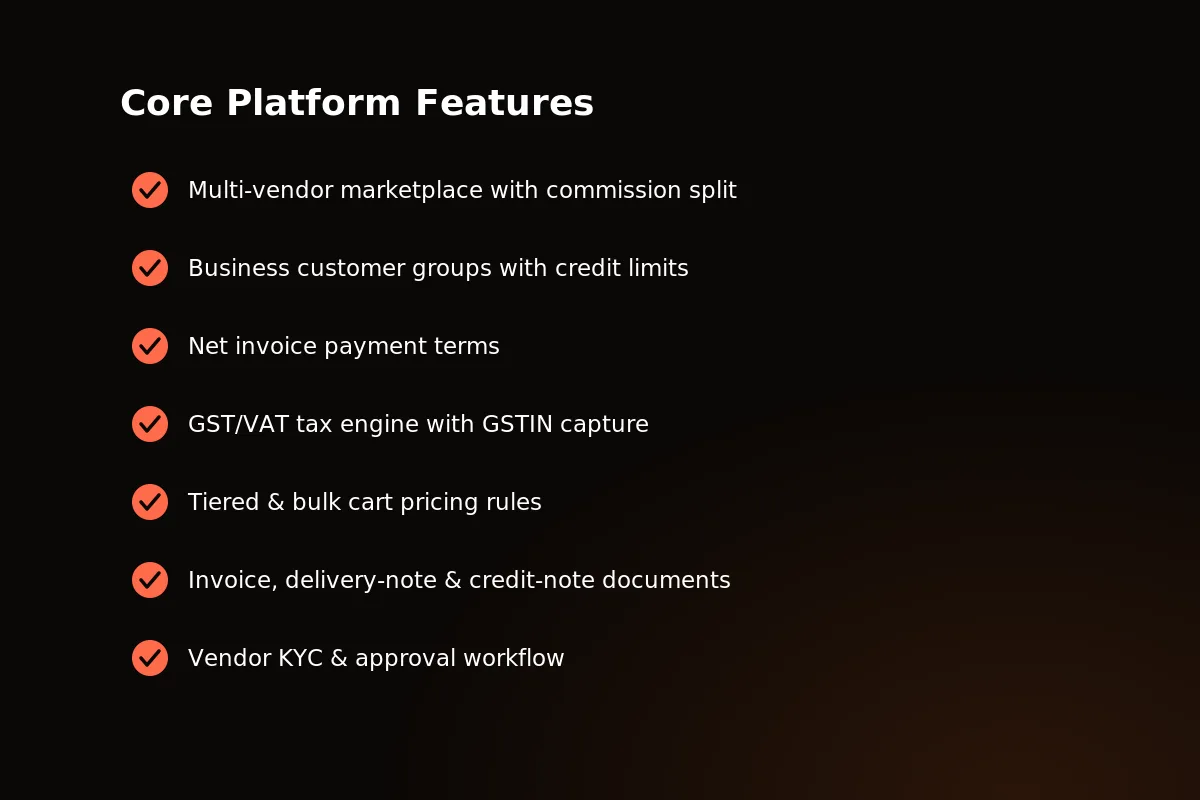 Features vary a lot across products all marketed as a "readymade B2B marketplace script."
What Custom Development Actually Costs
Custom development means hiring a team to build every part from a blank start. That includes vendor sign-up, commission, tax, invoicing and everything else.
For a real multi-vendor B2B platform with credit terms and GST compliance, the team usually looks like this:
2-3 backend developers for the marketplace core, payments, tax and commission.
1-2 frontend developers for the buyer storefront, vendor dashboard and admin panel.
1 project manager to manage scope, sprints and talks with vendors.
1 QA engineer to test many users at once, odd payment cases and tax sums.
1 UI/UX designer for buyer-facing and vendor-facing screens.
This scope usually takes 8-14 months from start to a stable live launch. It takes longer if credit limits or multi-currency support are added mid-build.
An example cost for that team over that time is between $60,000 and $150,000+, depending on location and seniority. This is a planning range, not a quote — get one from a real dev company before you plan your budget on it.
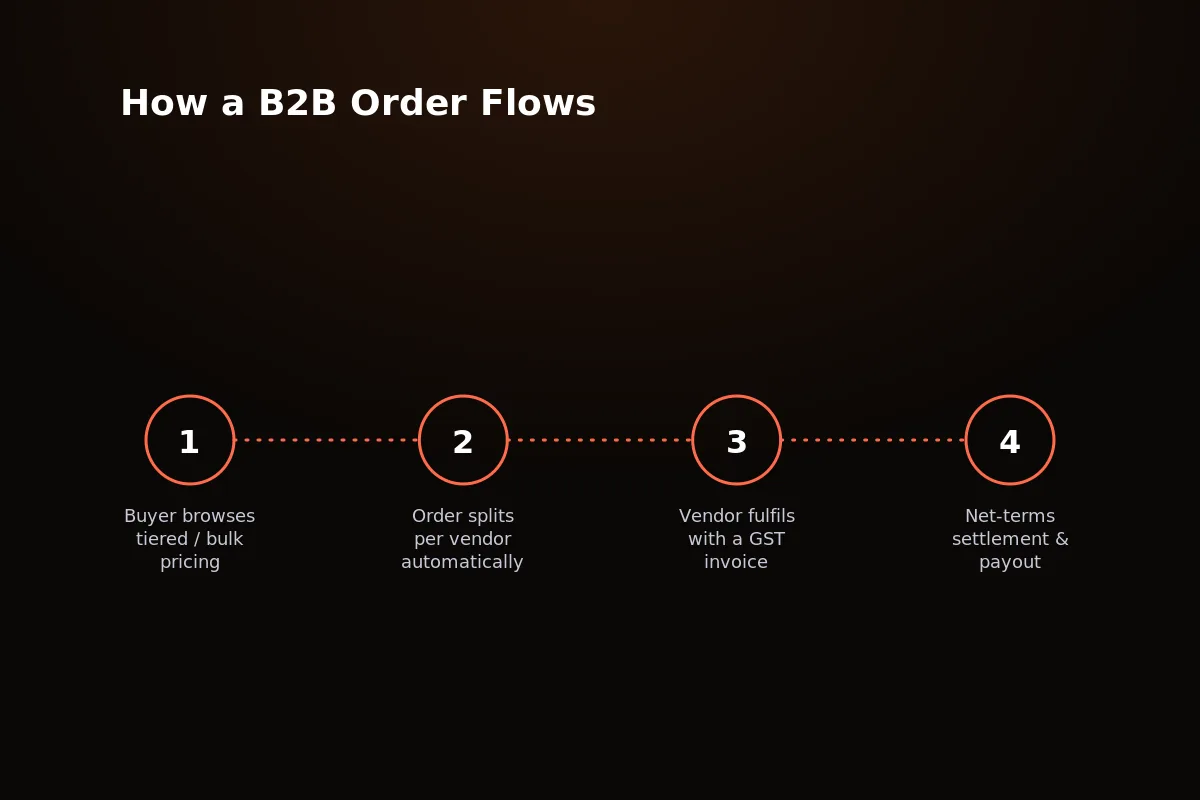 A custom multi-vendor B2B build usually goes through discovery, core build, tax/commission and QA before it is ready to go live.
Upfront Cost, Time and Ownership Compared
Here is how the three paths compare on the numbers that matter before you commit budget. The figures are example ranges based on typical projects we see.
| Path | Upfront Cost | Time to Launch | Source Ownership | Customization | Ongoing Fees | Best For |
|---|---|---|---|---|---|---|
| Readymade script | $500 – $3,000+ | 2-4 weeks | Varies, often none | Limited, vendor-dependent | License/hosting fees common | Simple catalogs, quick validation |
| Custom development | $60,000 – $150,000+ | 8-14 months | Full ownership | Unlimited, built to spec | 15-20%/yr maintenance typical | Genuinely unique workflows, large budgets |
| White-label source (Souqley) | $999 – $2,500 one-time | 1-2 weeks | Full ownership, source included | Unlimited, you control the code | Hosting only, no license fee | Founders who want B2B logic live now |
What Drives B2B Marketplace Development Cost
The gap between those rows is not random. B2B commerce is more complex than a single-seller store. Five factors explain most of the gap between a cheap quote and a real one.
Multi-vendor architecture. Commission, vendor payouts and a storefront for each seller add moving parts that a single-seller e-commerce build never has to handle.
Business account logic. Credit limits and net payment terms don’t exist in generic e-commerce platforms — Shopify or WooCommerce weren’t built for buyers who pay on invoice.
GST/tax compliance. A must for any marketplace in India, and rarely built correctly the first time.
Tiered and bulk pricing rules. Quantity-based discounts in the cart and in the catalogue are real engineering work, not a tick box in a page builder.
RFQ and negotiation flows, if needed. Quote requests started by the buyer add a lot of scope on top of a standard catalogue-and-checkout flow. Budget for this separately. Do not assume it is included.
None of these five factors are optional extras for a serious B2B launch. They are the product. A quote that skips two or three of them is not a discount. It is a different, smaller product with the same name.
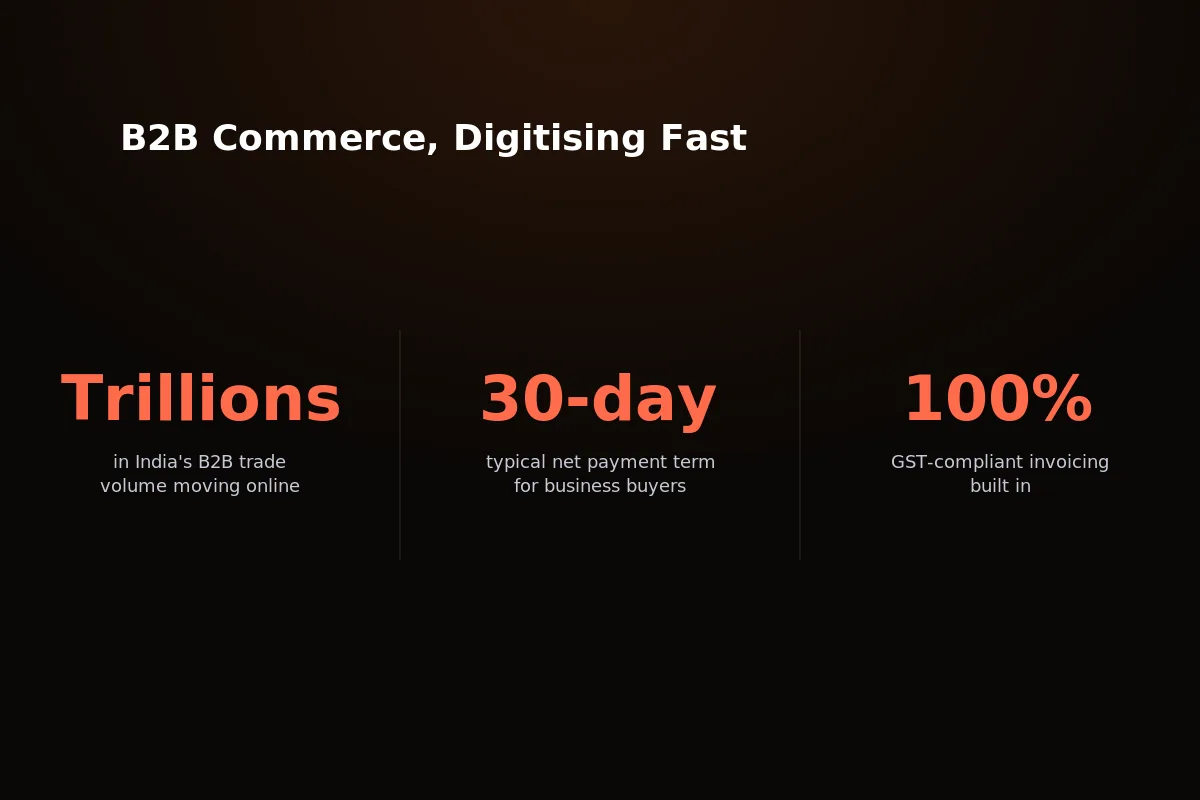 India’s B2B e-commerce market — led by platforms like IndiaMART and Udaan — keeps pulling more sellers to run their own marketplace instead of only listing on one.
Feature-by-Feature Cost Breakdown
Here is where the engineering work, and the budget, really goes, feature by feature.
The weights below are relative, not fixed prices. They show where a build's hours are used most, which is exactly where a cheap quote tends to cut corners.
Multi-vendor storefront + commission engine — highest weight. Vendor sign-up, split payments and payout timing touch nearly every other part.
Business customer groups + credit limits — high. Custom account states, tracking of credit given, and approval steps for net-terms buyers.
GST/VAT tax engine + GSTIN capture — high. HSN/SAC mapping, place-of-supply rules, and invoice layout that holds up in an audit.
Tiered/bulk pricing rules — medium. Quantity price breaks applied the same way in both cart and catalogue views.
Invoice, delivery-note, and credit-note generation — medium. Numbers in order, PDF making, and document layout that businesses accept.
Vendor KYC/approval workflow — medium. Document upload, check status, and an admin review list before a vendor can sell.
Admin GMV/reporting dashboard — low-to-medium. Views of orders, revenue and results for the whole platform and for each vendor.
RFQ/quote-request flow — optional, adds scope. Not part of most base platforms. Treat it as a clear add-on, not a default.
In most B2B marketplace builds, the top three items above take roughly 60-70% of total engineering work, as an example.
That is also the exact set of features a $1,000-2,000 clone script almost never comes with.
Souqley’s core module set: multi-vendor commerce, business credit accounts, GST-compliant invoicing, and tiered pricing — the features a real cost estimate must include.The Hidden Costs Nobody Budgets For
With a Cheap Readymade Script
The price on the tag is never the real price. What breaks after launch usually costs more than what you saved upfront.
Missing credit-terms and GST logic: the first real B2B buyer asks for net-30 invoicing, and now you pay for rework you thought you avoided.
No source ownership on some models: you are renting a hosted account, not owning the code. The vendor can change terms or shut down.
Support disappears: many script sellers stop replying once the sale is made, and bugs stay unfixed.
The first of those is rarely a quick screen fix. Net terms mean an order is accepted before it is paid. That touches order states, payment records and every document an order makes. A tax engine means every line needs a tax class, and the buyer's location must be worked out at checkout. One rate fixed for one country will not do. Adding either to a checkout built for prepaid orders and one fixed price per SKU is closer to rebuilding the order model than fixing it. That is why this work costs more late than it would have cost up front.
With Custom Development
Custom is not just costly upfront. It is also costly in ways that only show up mid-project.
Scope creep: real B2B complexity, such as multi-vendor commission splits and odd GST cases, shows up mid-build and adds to both time and budget.
Opportunity cost: every month you are not live is a month competitors spend winning the buyers you are still building for.
Post-launch maintenance budget: 15-20% of build cost per year is a common rule of thumb, and it is rarely planned upfront.
Key-person risk: the one developer who understands the tax part leaves, and the knowledge leaves with them.
Illustrative 2-Year Total Cost of Ownership
Take an example multi-vendor B2B marketplace launching this year. The numbers below are examples, but the pattern holds across most builds we have seen.
Cheap script path: $2,000-5,000 in license and hosting fees, plus $15,000-30,000 in urgent rework once real buyers ask for credit terms and GST. Total: roughly $17,000-35,000, with months lost to fixes.
Custom development path: $60,000-150,000 to build, plus $10,000-30,000 a year in maintenance. Total: roughly $80,000-210,000 over two years, plus 8-14 months not trading at all.
White-label source path (Souqley): $999-2,500 one-time, plus hosting around $50-150 a month. This counts licence and hosting only, not upkeep. When you own the source, fixes and upgrades are your job. Total: roughly $2,200-6,100 over two years — live within 1-2 weeks, not months.
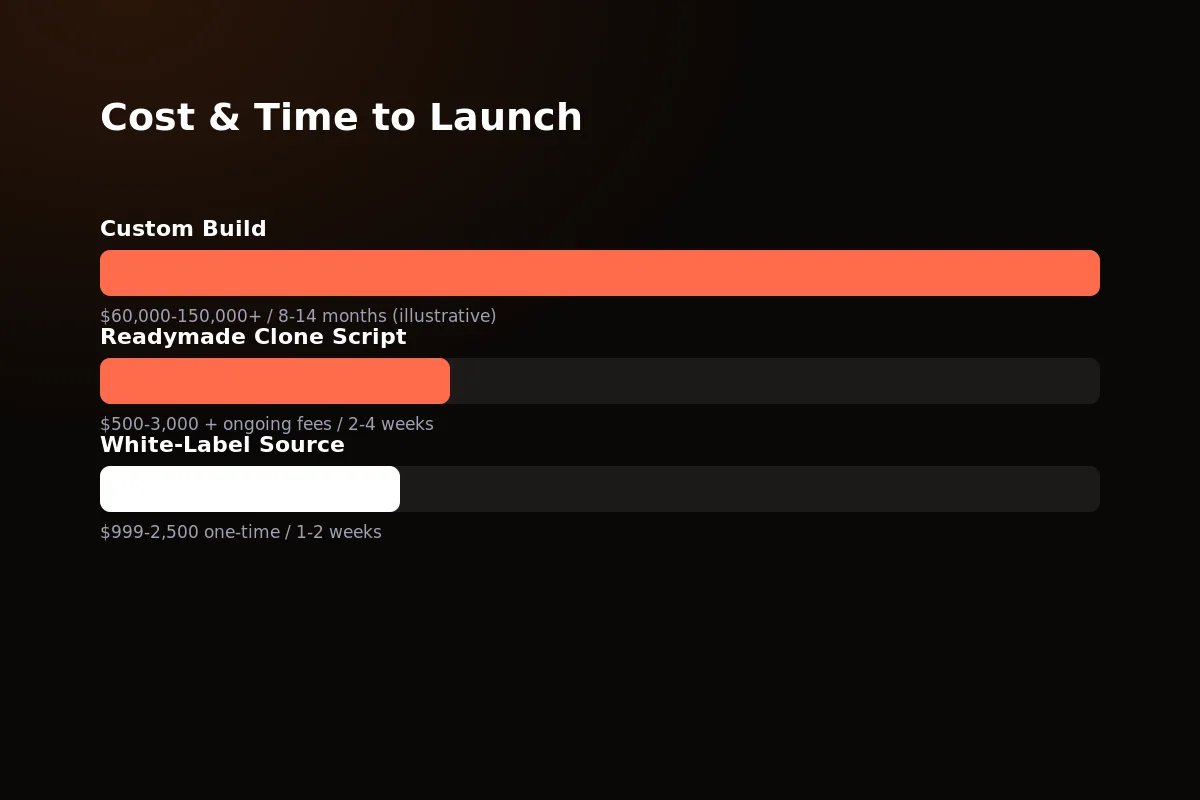 Example 2-year TCO across the three paths. Real figures vary by scope, region and vendor.
Where Souqley Fits
Souqley is PRS India’s white-label B2B marketplace platform — Next.js 15 on the frontend, NestJS and PostgreSQL/Prisma on the backend.
It comes with the B2B features that most readymade scripts skip completely:
Multi-vendor marketplace with automated commission splits per vendor.
Business customer groups with credit limits and net invoice payment terms you can set.
GST/VAT tax engine with GSTIN capture built into checkout and invoicing.
Tiered and bulk pricing rules applied across both cart and catalog.
Invoice, delivery-note and credit-note document generation, ready for accounting.
Vendor KYC and approval workflow before anyone can list a product.
Stock-reservation concurrency safety, so two buyers cannot buy the same last unit.
Multi-store and multi-currency support for growing into new regions.
If you are a manufacturer looking to sell direct to retailers, this is exactly the kind of buyer-seller relationship Souqley is built for.
RFQ and MOQ steps are not built in. Because you own the source fully, adding them is work you can schedule, not a support ticket you wait weeks for. But it is a custom job with its own quote, not a setting somebody switches on for you. Our complete guide to building a B2B marketplace shows how those features are usually added.
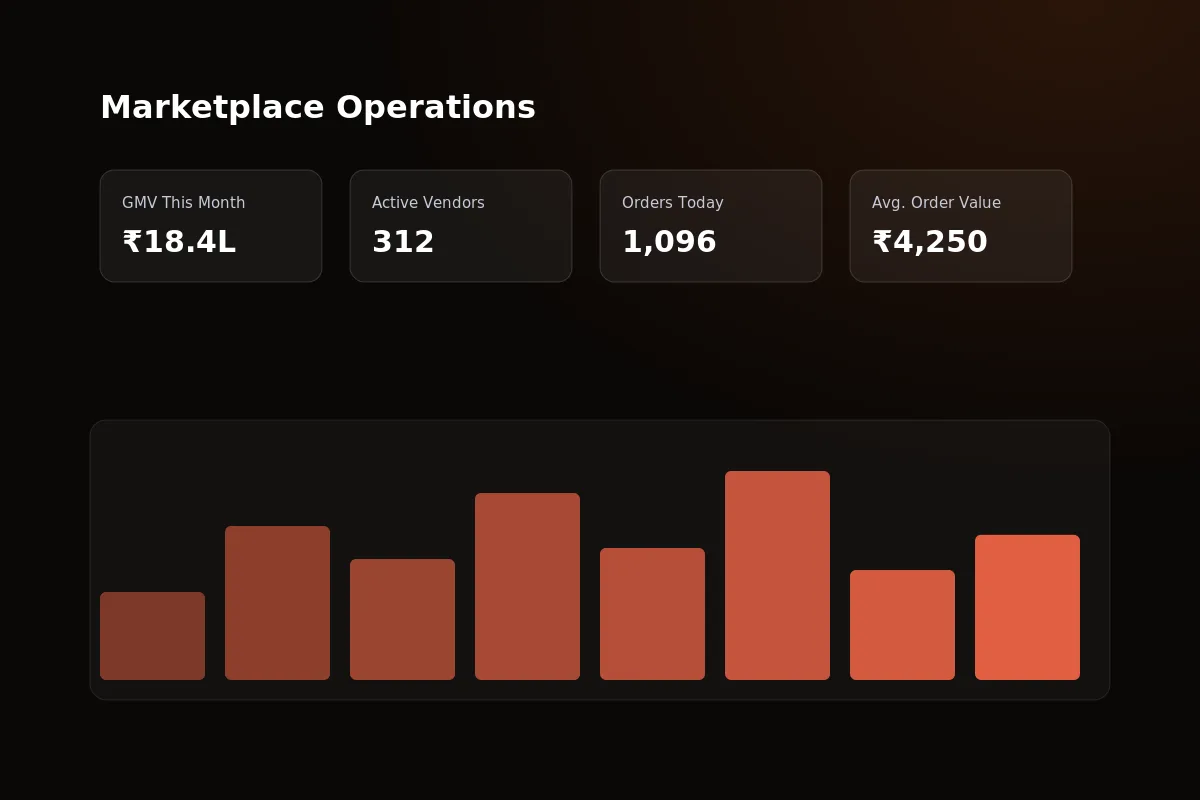 The Souqley admin dashboard — commission tracking, credit limits and GST invoicing in one panel.
Talk to our team for a tour of the platform before you commit budget either way.
Decision Framework: Which Path Should You Choose?
Choose a cheap script if you are testing a simple B2C-style catalogue with no real credit terms, tax needs or commission needs, and your budget is under $3,000.
Choose full custom development if your B2B process is truly unique, something no existing platform supports, and you have $80,000+ and a year to build it from scratch.
Choose a white-label source-code platform if you want multi-vendor, credit terms, GST invoicing and tiered pricing working on day one, want to own the code fully, and need to be live in weeks, not months.
For many founders launching a real B2B marketplace this year, that third option is a sensible default. The features that cost six figures to build custom are already tested and working.
 Source code you own, tested B2B features, and a launch in weeks instead of months.
Frequently Asked Questions
Is a readymade B2B marketplace script safe to use commercially?
It depends entirely on the license and what is actually inside it. Check for GST/tax compliance readiness, clear data ownership terms, and whether you get full source access rather than just a hosted account.
How much does real custom B2B marketplace development cost?
Illustratively, $60,000-150,000+ for a genuine multi-vendor build with credit terms, GST compliance and commission logic, spread over 8-14 months. Actual figures vary by team location, seniority and scope.
What’s the difference between renting a SaaS platform and owning white-label source code?
A SaaS platform charges an ongoing fee, gives no source access, and the vendor controls the roadmap and pricing. White-label source is a one-time cost with full codebase ownership — you control hosting, customization and long-term fees.
How fast can you launch with white-label source?
Typically 1-2 weeks for setup, branding and deployment on infrastructure you control, compared to 8-14 months for a custom build started from a blank repository.
Written by
Aditi
Building software at PRS India.