Business of Software
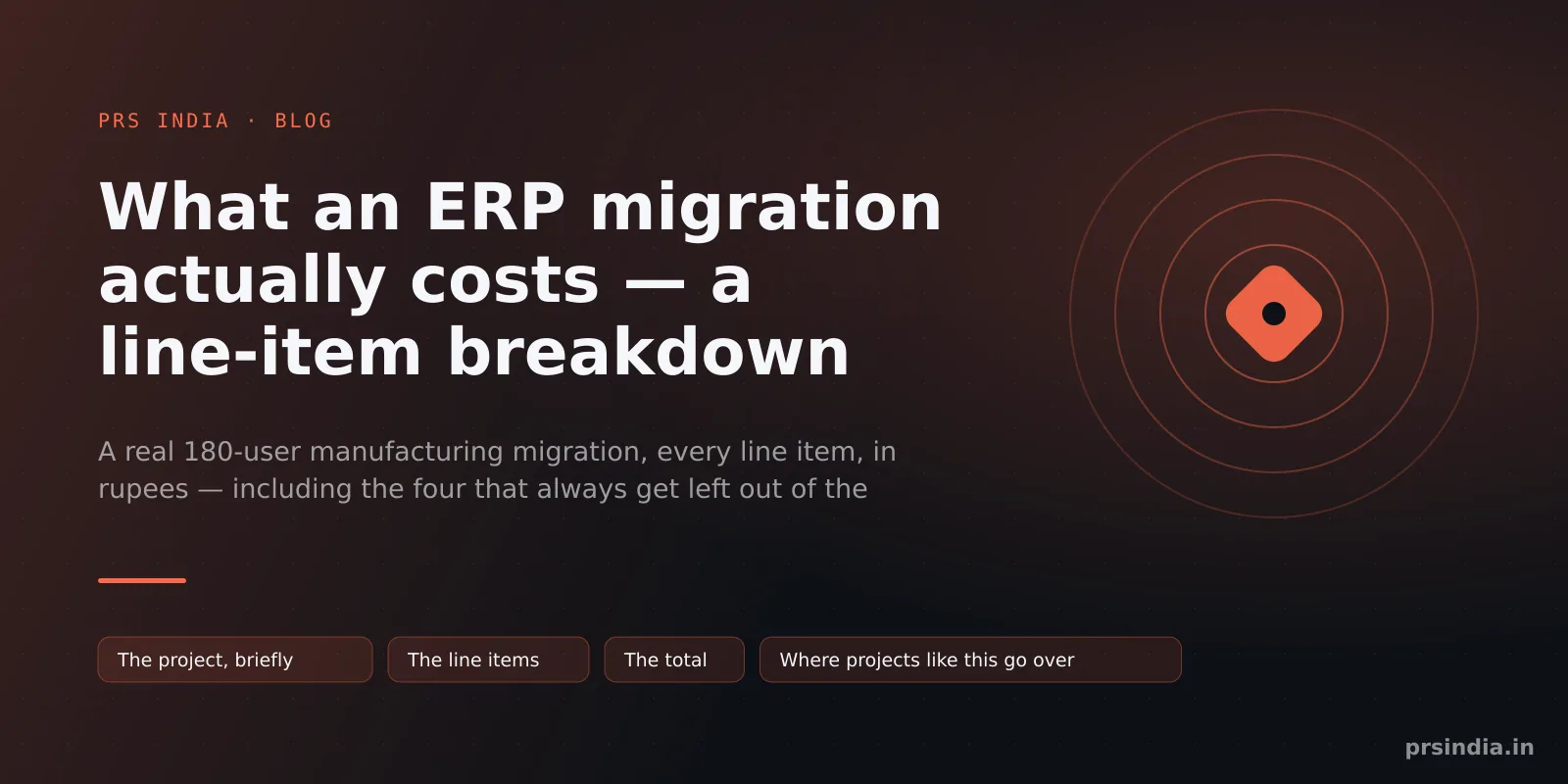
What an ERP migration actually costs — a line-item breakdown
A real 180-user manufacturing migration, every line item, in rupees — including the four that always get left out of the quote.

Written from production. Our articles draw on products we run live and the client work behind them, and are revised as the systems they describe evolve.
Every ERP conversation starts at the licence fee, because that is the number the vendor puts on the first slide. On the project below — a mid-size auto-components manufacturer in the NCR belt, 180 named users, three plants, eleven years of history in a legacy system — the licence fee was about 19% of the true first-year cost.

Here is the whole thing, line by line, with the numbers rounded but not flattered. If you are about to sign an ERP quote, this is the shape of the bill you are actually signing up for.
The project, briefly
- 180 named users; ~70 concurrent at peak (month-end)
- 3 plants + 1 head office + 2 depots
- Modules: finance, inventory, production planning, purchase, sales & dispatch, quality, plant maintenance
- 11 years of transactional history in the outgoing system, ~4.2 million transaction rows
- Timeline: 11 months from kickoff to the end of hypercare (the original plan said 7)
The line items
1. Discovery and process mapping — ₹9,00,000
Six weeks. Two business analysts, on site, walking every process from purchase requisition to e-way bill. The output is not a document nobody reads; it is a decision log — 140-odd decisions of the form "today the store keeper does X because the old system cannot do Y; in the new system we will do Z."
Clients push back on this line more than any other. Every hour skipped here reappears as a change request at four times the rate.
2. Licences — ₹21,00,000 (year one)
Named-user licensing, mixed tiers (full users vs. limited/self-service). The negotiation here is worth doing, but it is not where the money is. Do check whether the licence is perpetual with an AMC or a subscription, because the five-year total differs by roughly 2x between the two and the first-year quote hides it.
The tier split deserves the same scrutiny, because you commit to it before discovery has told you who actually touches what. Ask what it costs to promote a limited user to a full one mid-term, and whether the block is sized against month-end peak or against the average — that distinction only surfaces after you have signed.
3. Data migration — ₹18,00,000
The single most underestimated line in every ERP project, without exception. It breaks into three unequal parts:
- Master data cleanup (₹11,00,000). The client had 31,400 item codes. After de-duplication — the same bearing under four codes across three plants, spelling variants, trailing-space keys, "MISC" as a category with 900 items in it — the real number was 19,700. Somebody has to look at 11,700 rows and decide. That somebody has to be the client's storekeeper and purchase head, and their time is a real project cost even if it never appears on our invoice. This work cannot be automated away, and any vendor telling you it can is selling you a future data disaster.
- ETL build and reconciliation (₹5,00,000). Writing the extract/transform scripts is the easy half. Proving the migration is correct is the other half: trial-balance-to-the-paisa reconciliation, stock quantity and value tie-out per plant per SKU, open PO/SO reconciliation. We ran seven full trial loads before the numbers matched.
- History decision (₹2,00,000). You will not migrate 11 years of transactions into the new system, and you should not want to. We migrated opening balances plus two financial years, and kept the legacy system alive read-only for the rest. This is cheaper, faster and — for statutory purposes — perfectly adequate. Budget for the read-only archive; it is a real thing you have to host and secure for as long as the retention rules say — its hosting sits in line 10, not in this ₹2,00,000.
4. Integrations — ₹14,00,000
Nothing in an Indian ERP lives alone:
- GST e-invoicing (IRP) and e-way bill generation — mandatory, and the API has real edge cases around cancellation windows and amendment flows
- Bank statement import and payment file export (two banks, two formats)
- Barcode/handheld terminals on the shop floor and in stores
- The customer's EDI portal (one large OEM customer, one bespoke format)
- Tally, for the auditor, who was not going to change (be realistic about this)
Rule of thumb we now quote: ₹2.5–4 lakh per non-trivial integration, and treat "the vendor says there is a standard connector" as unverified until you have seen it move a document end-to-end in a sandbox.
These slip because you only own half of each one. The bank's file format, the OEM's portal, the IRP's amendment rules and the auditor's Tally each belong to someone whose release calendar is not yours, and a sandbox proves the format, not their calendar. Start them early, get a named person on the other side, and accept that the counterparty sets the date.
5. Customisation — ₹16,00,000
Roughly 22 developer-weeks. The critical governance move here is to force every customisation request through a single question: is this a legal/statutory requirement, a genuine competitive differentiator, or a habit? We started with 61 requests. Legal: 9. Differentiator: 12. Habit: 40. We built 21. The 40 habits were resolved with training and, in six cases, a mild process change.
Every customisation you build is a line item you also pay for at every future upgrade. That is the real price, and it is not on this invoice.
6. Reports — ₹7,50,000
The silent killer. The legacy system had 240 reports. We pulled the access logs: 61 had been opened in the previous 12 months, and 18 accounted for 80% of all views. We rebuilt those 18 properly, another 25 adequately, and put the rest behind a "raise a request if you actually need this" policy. Eleven months later, four had been requested.
If you rebuild all 240, you will spend ₹25 lakh reproducing reports for people who retired in 2019.
One caveat on the access-log method, because it is easy to over-apply. A log tells you how often a report was opened, not how much rests on it: the one somebody opens once a year may be the one that feeds a statutory filing, and "nobody uses this" is a different finding from "one person uses it when it matters". Check the last reader before you retire anything.
7. UAT and parallel run — ₹6,00,000
Two month-end cycles run in both systems simultaneously. This means double data entry for the finance and stores teams for two months, and it is exhausting and unpopular and you must do it anyway. It is the only test that finds the discrepancies that matter — the ones where both systems are internally consistent but disagree with each other.
Our line covers the engineering and analyst time. The client's cost — their team's overtime — was, by their own estimate, another ₹4 lakh in equivalent hours.
8. Training and change management — ₹5,00,000
Role-based, not module-based. A storekeeper does not need a four-hour tour of the ERP; they need forty minutes on the six screens they will touch daily, in Hindi, with a one-page laminated card at the terminal. We recorded the sessions, which turned out to be the highest-leverage ₹40,000 in the project, because attrition on the shop floor meant a third of the trained users had changed by month six.
9. Cutover and hypercare — ₹4,50,000
The go-live weekend (a long one, and it will slip into Monday), plus six weeks of embedded support afterwards at declining intensity. Everyone budgets the weekend. Almost nobody budgets the six weeks, and the six weeks is where the project is actually won or lost — it is when the ERP either becomes the system of record or becomes the thing people work around with an Excel file.
10. Infrastructure and year-one run — ₹8,00,000
Hosting (we ran it in ap-south-1 with a warm DR in a second AZ), backups with tested restores, monitoring, the read-only legacy archive, and an AMC/support retainer from month three.
The total
- Discovery — ₹9,00,000
- Licences (yr 1) — ₹21,00,000
- Data migration — ₹18,00,000
- Integrations — ₹14,00,000
- Customisation — ₹16,00,000
- Reports — ₹7,50,000
- UAT / parallel run — ₹6,00,000
- Training — ₹5,00,000
- Cutover + hypercare — ₹4,50,000
- Infra + year-one run — ₹8,00,000
- Total year one — ₹1,09,00,000
The licence — the number that took up 80% of the negotiation — is ₹21 lakh of a ₹1.09 crore first year. 19%. Data, integration and customisation together are ₹48 lakh: nearly half the project, and the three lines most likely to be under-quoted by a vendor who wants to win on headline price.

Where projects like this go over
- Master data was worse than anyone admitted. Always. Do a data quality audit before you sign, not after. It costs a lakh and it will change your number.
- No single decision-maker. If three people can veto a process decision and none can make one, your timeline is a function of their calendars, and it will double.
- Scope creep through "small" report requests. Each is two days. Forty of them is a quarter.
- Treating go-live as the finish line. It is the halfway point of adoption.
- Nobody costs the client's own hours. The cleanup decisions, the parallel run and the training consume the time of people who also have a day job, and none of it lands on a vendor's plan or invoice. Time that is in nobody's plan does not get protected.
If a vendor quotes you an ERP migration without having looked at your item master, they are quoting a different project from the one you are about to run.

Written by
Aditi
Building software at PRS India.