Turant Logistics
EduDock
A search-first study-resource hub for EduDock
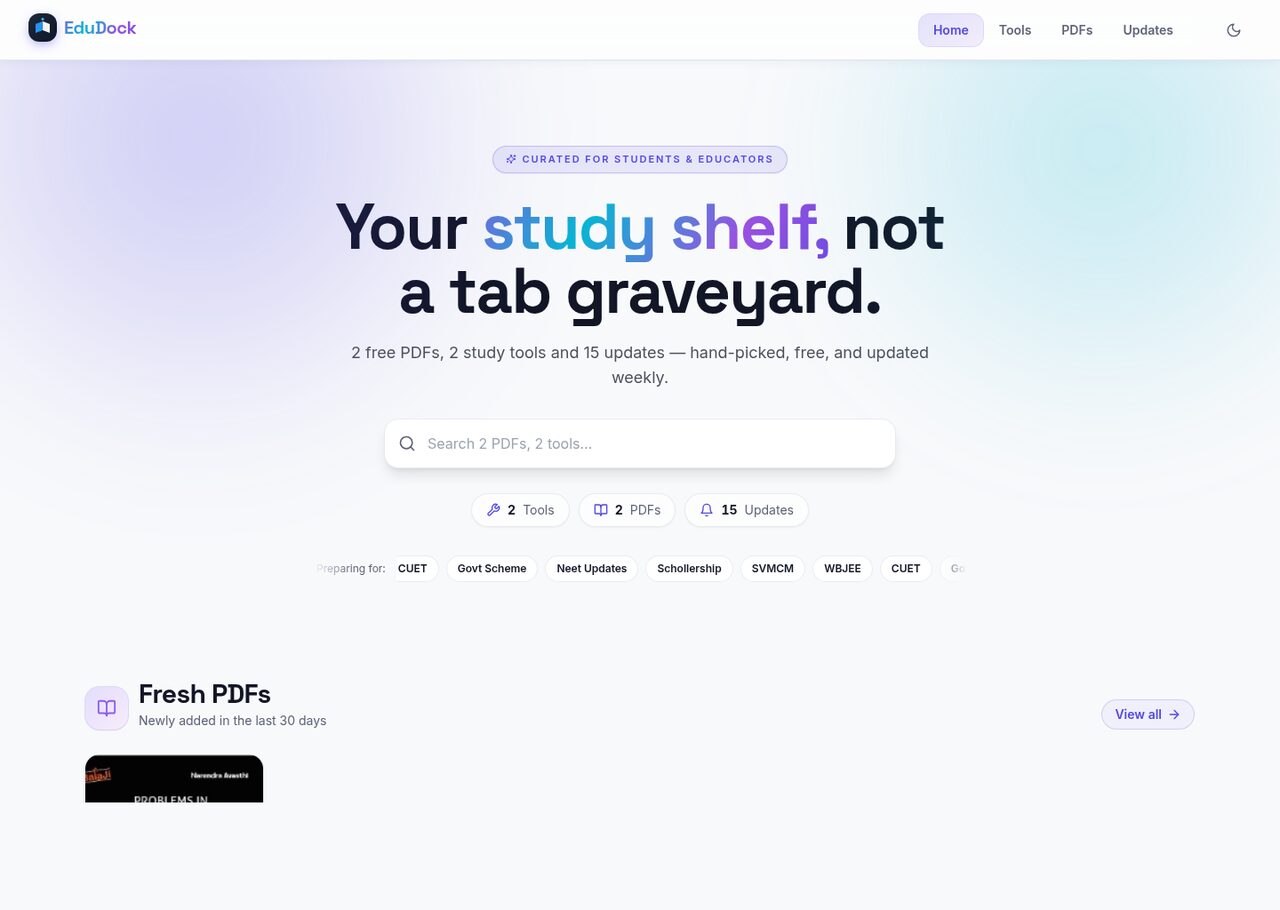
A fast, server-rendered educational resource hub — a growing, searchable library of study materials, PDFs and tools for students and educators, built on Next.js to be fast and easy to find.
- Client
- EduDock
- Industry
- Education / EdTech
- Location
- India
- Duration
- 9 weeks
- Published
- Aug 2021
- Updated
- Oct 2026
Next.js
Platform
SSR/SSG
Rendering
PDFs & tools
Library
Mobile-first
Experience
01
The challenge
A study-resource hub depends on people being able to find it. EduDock's value is a growing, curated library of PDFs, study materials and tools that students reach mostly through search, not by typing the domain. A usual browser-built app would have hidden that library behind JavaScript — thin, slow-to-load, hard-to-index pages on exactly the mid-range Android phones and patchy connections most Indian students browse on.
The real problem
The catalogue grows every week, so each new PDF or tool needed its own fast, easy-to-share page that shows up in search — without a developer touching code for every addition. And a hub only grows if people come back, which meant capturing subscribers for a weekly digest without the pushy popups that slow pages down.
02
What we built
We built EduDock on Next.js and React, rendering each resource and category page on the server so the full content ships in the HTML — fast to show, light on data, and fully ready for search engines.
Content that scales
Every PDF, study material and tool is a structured content record that generates its own clean, canonical, shareable page with the right metadata and structured data, so new items rank on their own. Categories plus a fast search let students narrow the library in a tap.
Built for Bharat's devices
We treated a four-year-old Android on 4G as the primary target: small JavaScript files, content that loads only when needed, smaller images, and Core Web Vitals checked before every release, not as an afterthought.
A retention loop
A light sign-up form on the page feeds the weekly digest, captured without the nagging modals that hurt speed — so growing the audience never slows the site.
03
The outcome
EduDock ships as a fast, server-rendered resource hub where the whole library is visible to search engines and quick on modest devices — a content platform the team can grow on their own.
- Every resource and category is its own indexable, shareable page with correct metadata and structured data.
- New PDFs and tools go live as structured content — no code change per item.
- Mobile-first performance held to Core Web Vitals targets on mid-range Android.
- A simple sign-up form builds the weekly-digest audience without slowing pages down.
The more the library grows, the more discoverable it becomes — a content engine that gets stronger over time, not a static site.
Under the hood
How it's built.
Technology
- Next.js
- React
- TypeScript
- Tailwind CSS
- Node.js
- Vercel
Services used
- Next.js Development
- Web Development
- SEO
- Performance
- UI/UX Design
- Content Platform